
Free resources
Free German grammar charts for your next class
Explore free German grammar charts for noun gender, cases, pronouns, verbs and more. Switch between image and table views.
Read as Markdown
Keep a small set of German grammar charts beside your class notes: one for articles, one for personal pronouns, and the appropriate adjective-ending table. This free collection contains reference charts with matching lessons, original examples and explained practice answers. View each chart as an image or switch to a selectable text table. No account is needed.
Choose the chart for your question
| Your question | Start here | Suggested level |
|---|---|---|
| How do I record a noun’s plural and use it after mit? | Plural shapes, umlauts and dative forms | A1–A2 |
| Can a noun ending help me choose der, die or das? | Noun gender patterns and limits | A1–A2 |
| Is it der, den, dem or des? | Definite articles and cases | A1–B1 |
| Is it ein, eine, einen or einem? | Indefinite articles | A1–B1 |
| Do I need ich, mich or mir? | Personal pronouns | A1–A2 |
| Why does das neue differ from ein neues? | Three adjective-ending charts | A2–B1 |
| Is it ich kann or ich können? | Modal verbs and sentence patterns | A1–A2 |
These levels are approximate teaching suggestions. Follow your teacher’s sequence: a complete reference sheet can include forms your class has not yet practised.
Browse the grammar charts
Choose Image or Table for each chart. Table mode lets you select and copy individual forms.
German definite articles
Four cases · der, die, das and plural die. Suggested level: A1–B1.
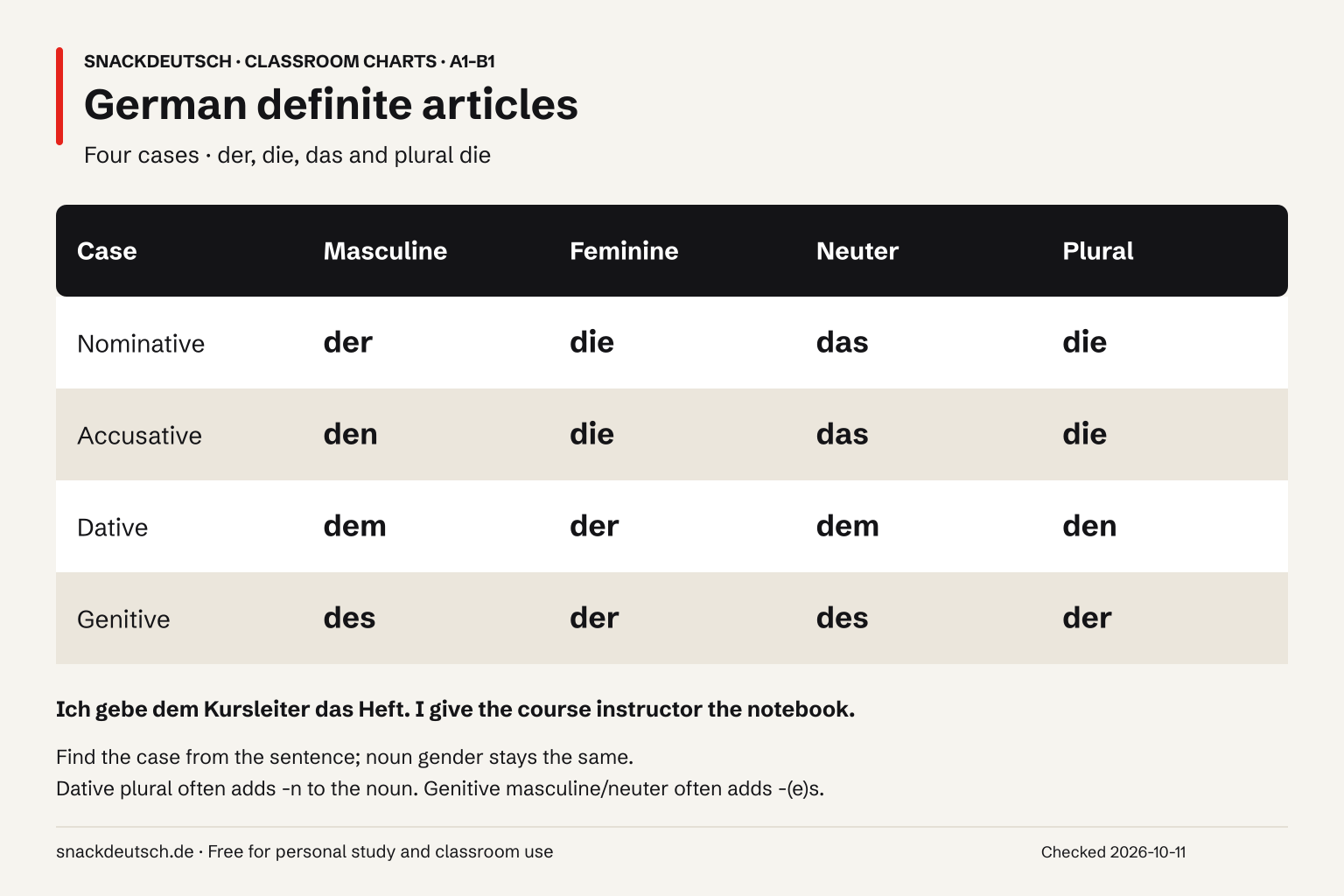
| Case | Masculine | Feminine | Neuter | Plural |
|---|---|---|---|---|
| Nominative | der | die | das | die |
| Accusative | den | die | das | die |
| Dative | dem | der | dem | den |
| Genitive | des | der | des | der |
Ich gebe dem Kursleiter das Heft. I give the course instructor the notebook.
- Find the case from the sentence; noun gender stays the same.
- Dative plural often adds -n to the noun. Genitive masculine/neuter often adds -(e)s.
German indefinite articles
Singular forms · ein, eine and einen. Suggested level: A1–B1.
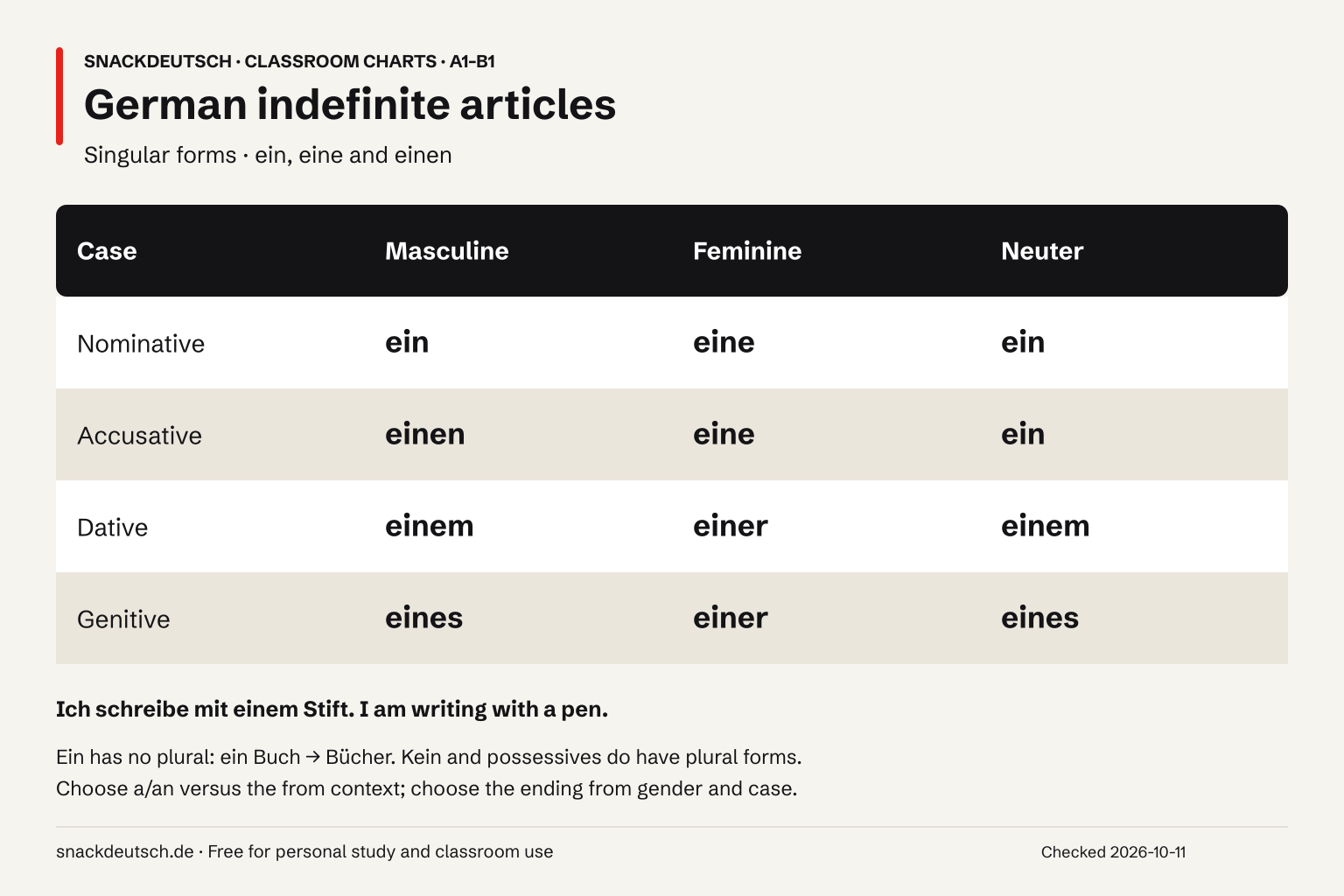
| Case | Masculine | Feminine | Neuter |
|---|---|---|---|
| Nominative | ein | eine | ein |
| Accusative | einen | eine | ein |
| Dative | einem | einer | einem |
| Genitive | eines | einer | eines |
Ich schreibe mit einem Stift. I am writing with a pen.
- Ein has no plural: ein Buch → Bücher. Kein and possessives do have plural forms.
- Choose a/an versus the from context; choose the ending from gender and case.
German personal pronouns
Subject and object forms · ich, mich, mir. Suggested level: A1–A2.
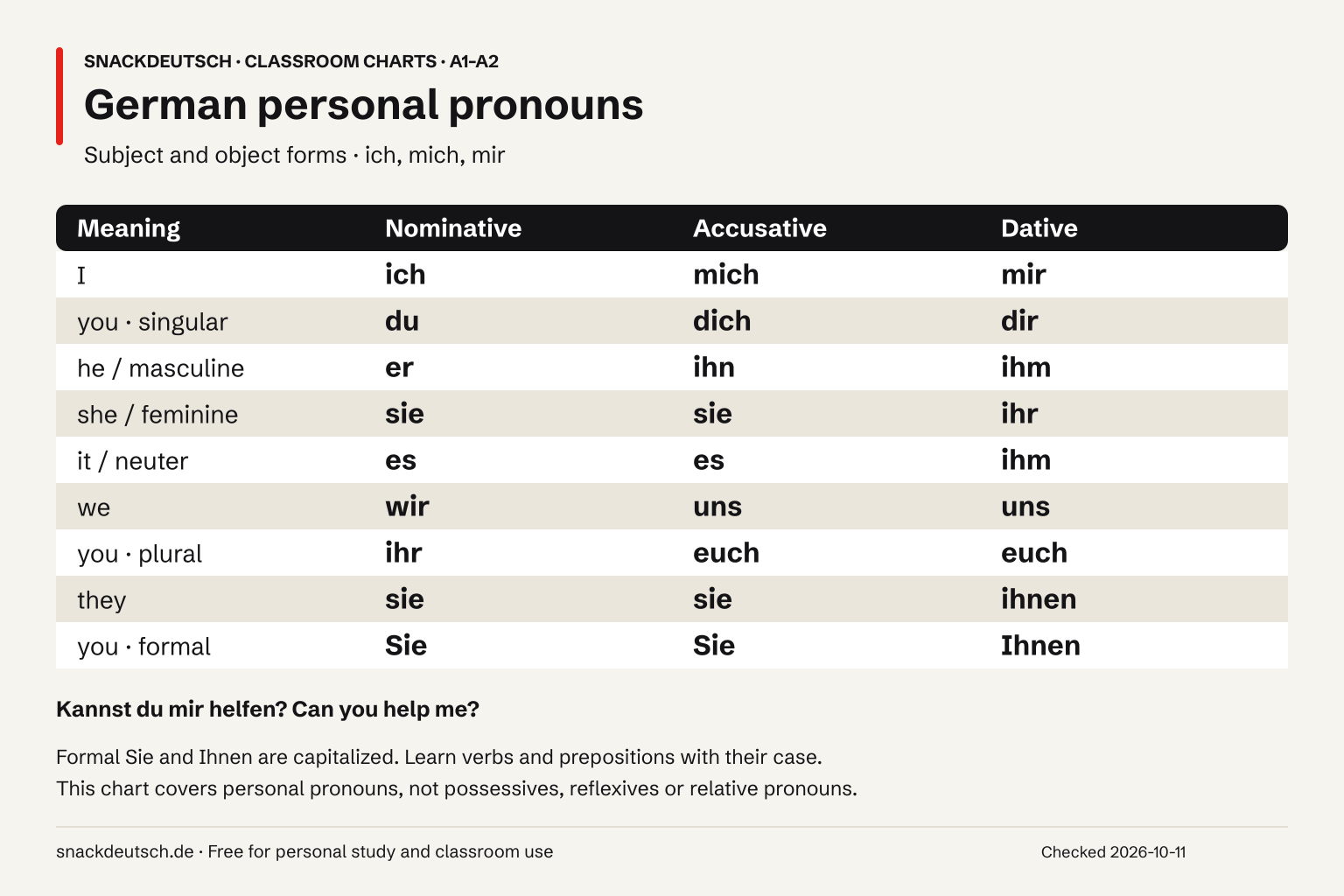
| Meaning | Nominative | Accusative | Dative |
|---|---|---|---|
| I | ich | mich | mir |
| you · singular | du | dich | dir |
| he / masculine | er | ihn | ihm |
| she / feminine | sie | sie | ihr |
| it / neuter | es | es | ihm |
| we | wir | uns | uns |
| you · plural | ihr | euch | euch |
| they | sie | sie | ihnen |
| you · formal | Sie | Sie | Ihnen |
Kannst du mir helfen? Can you help me?
- Formal Sie and Ihnen are capitalized. Learn verbs and prepositions with their case.
- This chart covers personal pronouns, not possessives, reflexives or relative pronouns.
Adjectives after der, die, das
Weak endings · after a definite article. Suggested level: A2–B1.
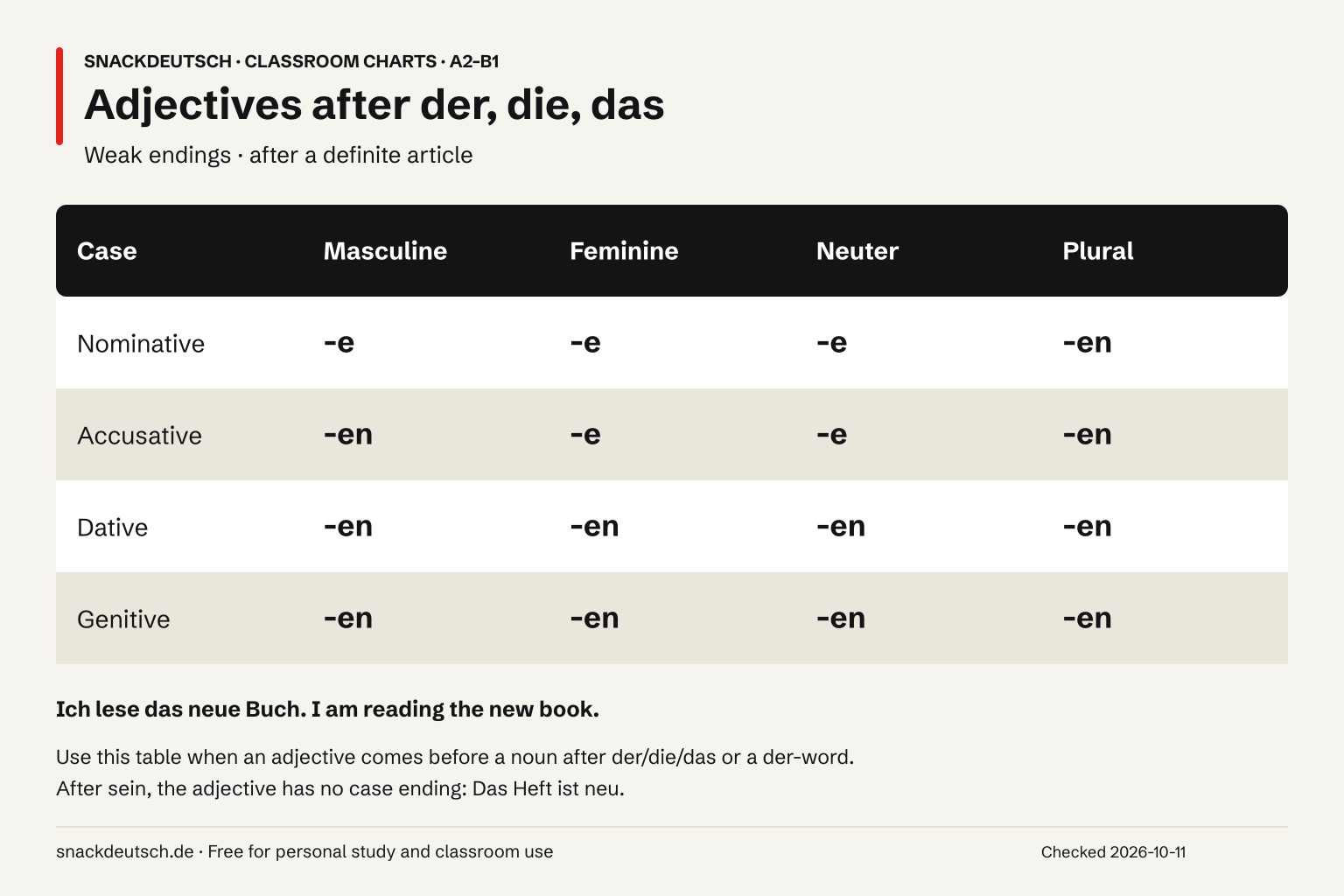
| Case | Masculine | Feminine | Neuter | Plural |
|---|---|---|---|---|
| Nominative | -e | -e | -e | -en |
| Accusative | -en | -e | -e | -en |
| Dative | -en | -en | -en | -en |
| Genitive | -en | -en | -en | -en |
Ich lese das neue Buch. I am reading the new book.
- Use this table when an adjective comes before a noun after der/die/das or a der-word.
- After sein, the adjective has no case ending: Das Heft ist neu.
Adjectives after ein and kein
Mixed endings · also after possessives such as mein. Suggested level: A2–B1.
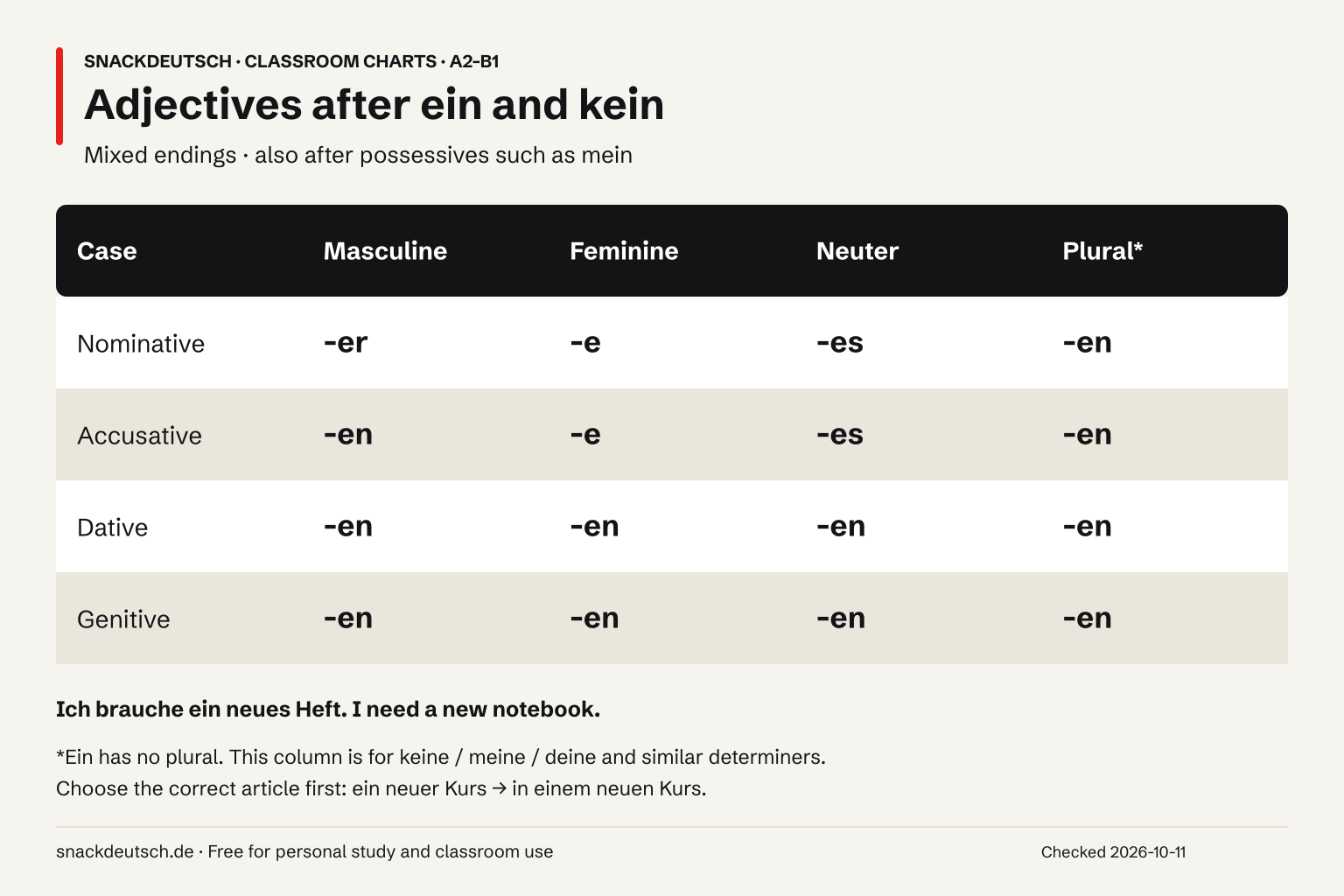
| Case | Masculine | Feminine | Neuter | Plural* |
|---|---|---|---|---|
| Nominative | -er | -e | -es | -en |
| Accusative | -en | -e | -es | -en |
| Dative | -en | -en | -en | -en |
| Genitive | -en | -en | -en | -en |
Ich brauche ein neues Heft. I need a new notebook.
- *Ein has no plural. This column is for keine / meine / deine and similar determiners.
- Choose the correct article first: ein neuer Kurs → in einem neuen Kurs.
Adjectives without an article
Strong endings · with no preceding determiner. Suggested level: A2–B1.
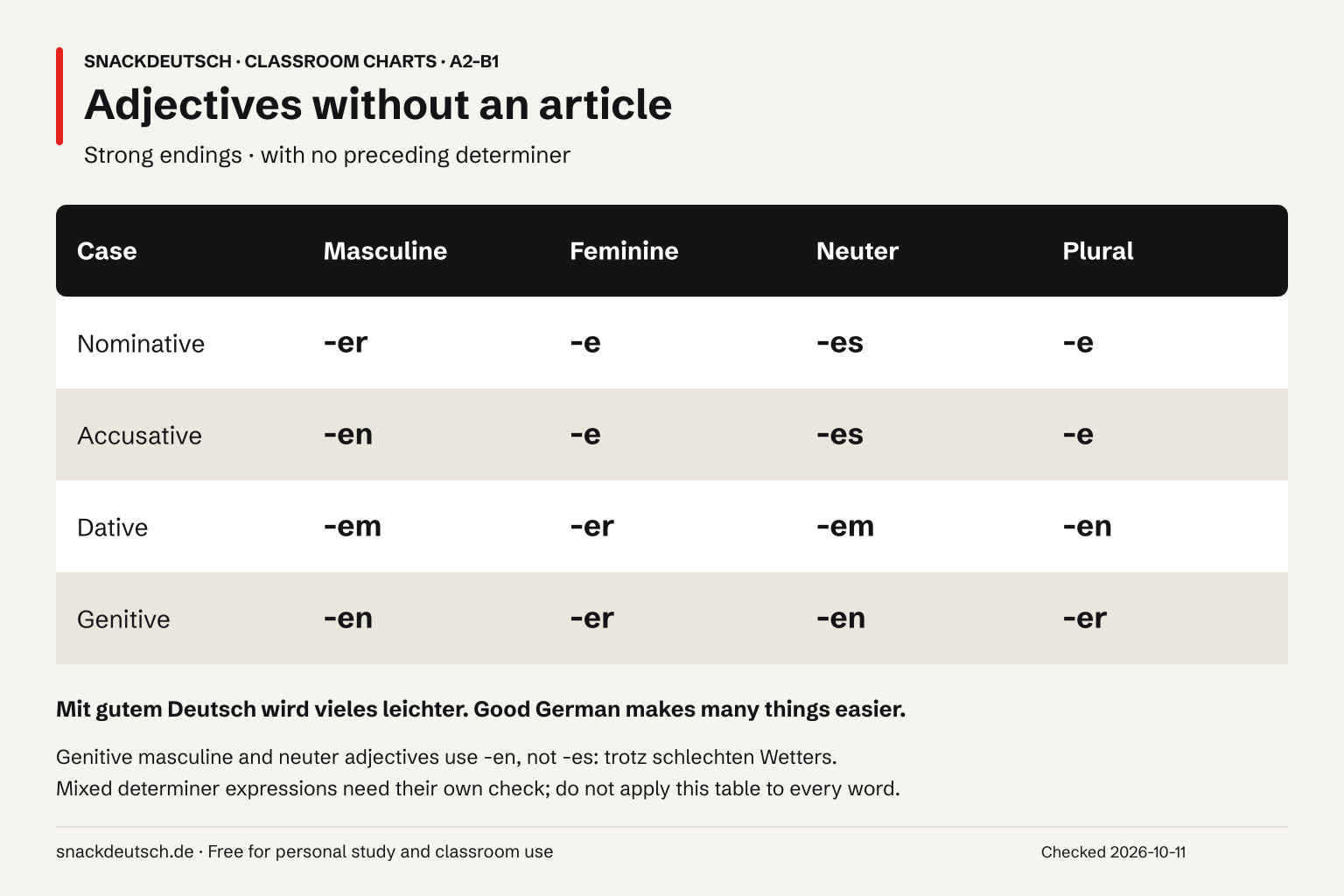
| Case | Masculine | Feminine | Neuter | Plural |
|---|---|---|---|---|
| Nominative | -er | -e | -es | -e |
| Accusative | -en | -e | -es | -e |
| Dative | -em | -er | -em | -en |
| Genitive | -en | -er | -en | -er |
Mit gutem Deutsch wird vieles leichter. Good German makes many things easier.
- Genitive masculine and neuter adjectives use -en, not -es: trotz schlechten Wetters.
- Mixed determiner expressions need their own check; do not apply this table to every word.
German modal verbs
Present tense · permission, ability, liking, necessity, instruction and intention. Suggested level: A1–A2.
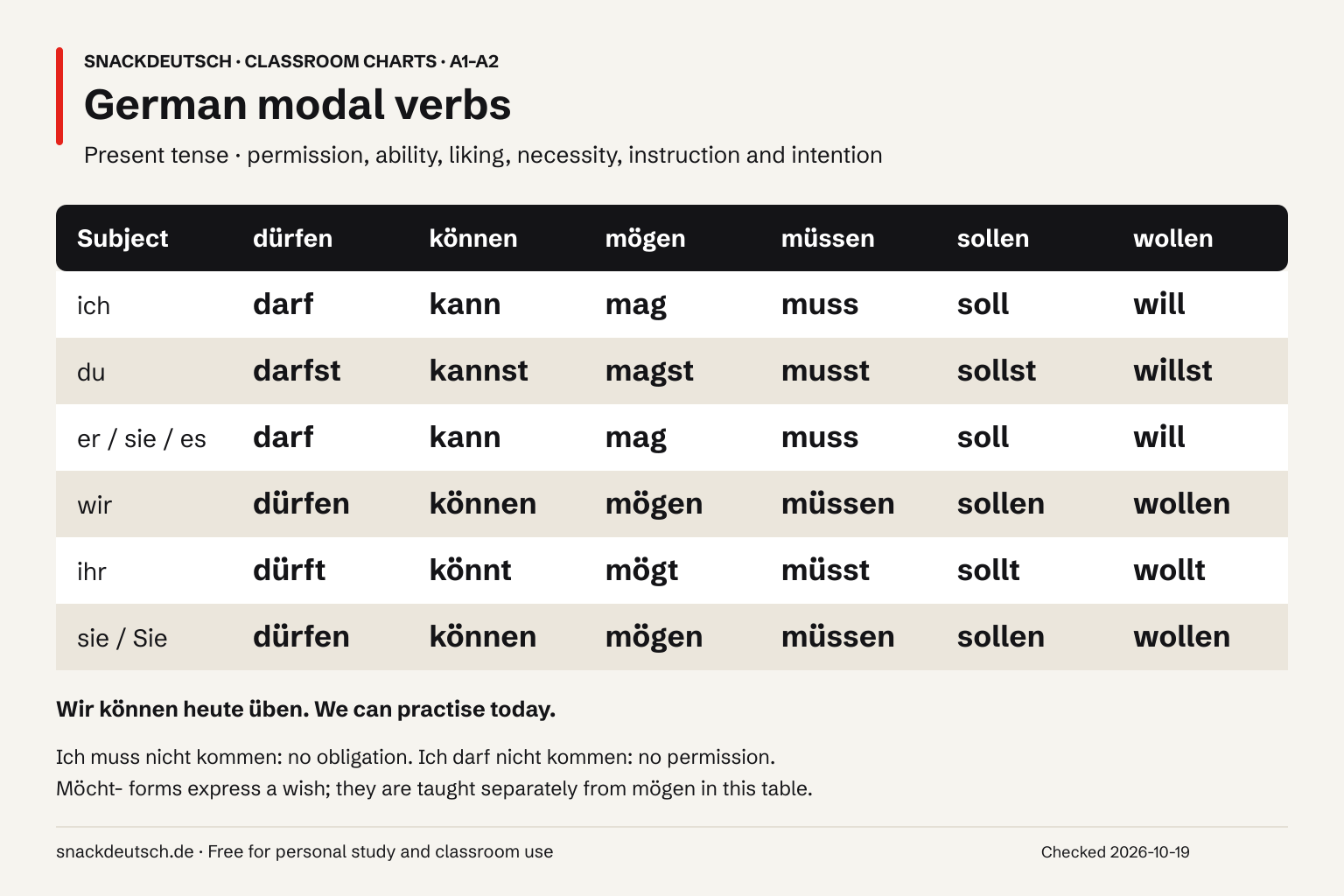
| Subject | dürfen | können | mögen | müssen | sollen | wollen |
|---|---|---|---|---|---|---|
| ich | darf | kann | mag | muss | soll | will |
| du | darfst | kannst | magst | musst | sollst | willst |
| er / sie / es | darf | kann | mag | muss | soll | will |
| wir | dürfen | können | mögen | müssen | sollen | wollen |
| ihr | dürft | könnt | mögt | müsst | sollt | wollt |
| sie / Sie | dürfen | können | mögen | müssen | sollen | wollen |
Wir können heute üben. We can practise today.
- Ich muss nicht kommen: no obligation. Ich darf nicht kommen: no permission.
- Möcht- forms express a wish; they are taught separately from mögen in this table.
Useful German dative verbs
Eight sentence patterns · learn the person in the dative. Suggested level: A2.
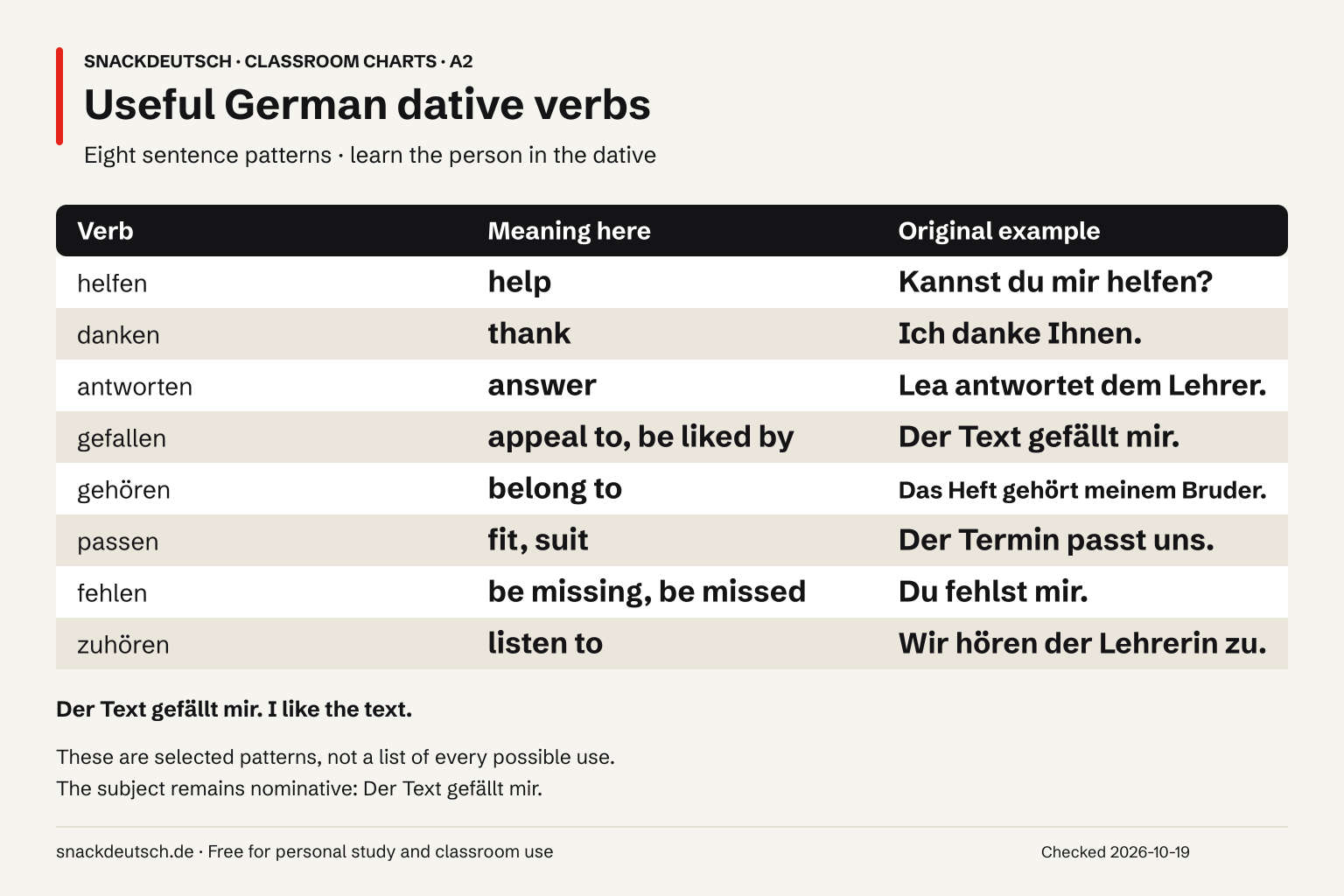
| Verb | Meaning here | Original example |
|---|---|---|
| helfen | help | Kannst du mir helfen? |
| danken | thank | Ich danke Ihnen. |
| antworten | answer | Lea antwortet dem Lehrer. |
| gefallen | appeal to, be liked by | Der Text gefällt mir. |
| gehören | belong to | Das Heft gehört meinem Bruder. |
| passen | fit, suit | Der Termin passt uns. |
| fehlen | be missing, be missed | Du fehlst mir. |
| zuhören | listen to | Wir hören der Lehrerin zu. |
Der Text gefällt mir. I like the text.
- These are selected patterns, not a list of every possible use.
- The subject remains nominative: Der Text gefällt mir.
Fixed-case prepositions
Selected common accusative and dative uses. Suggested level: A2.
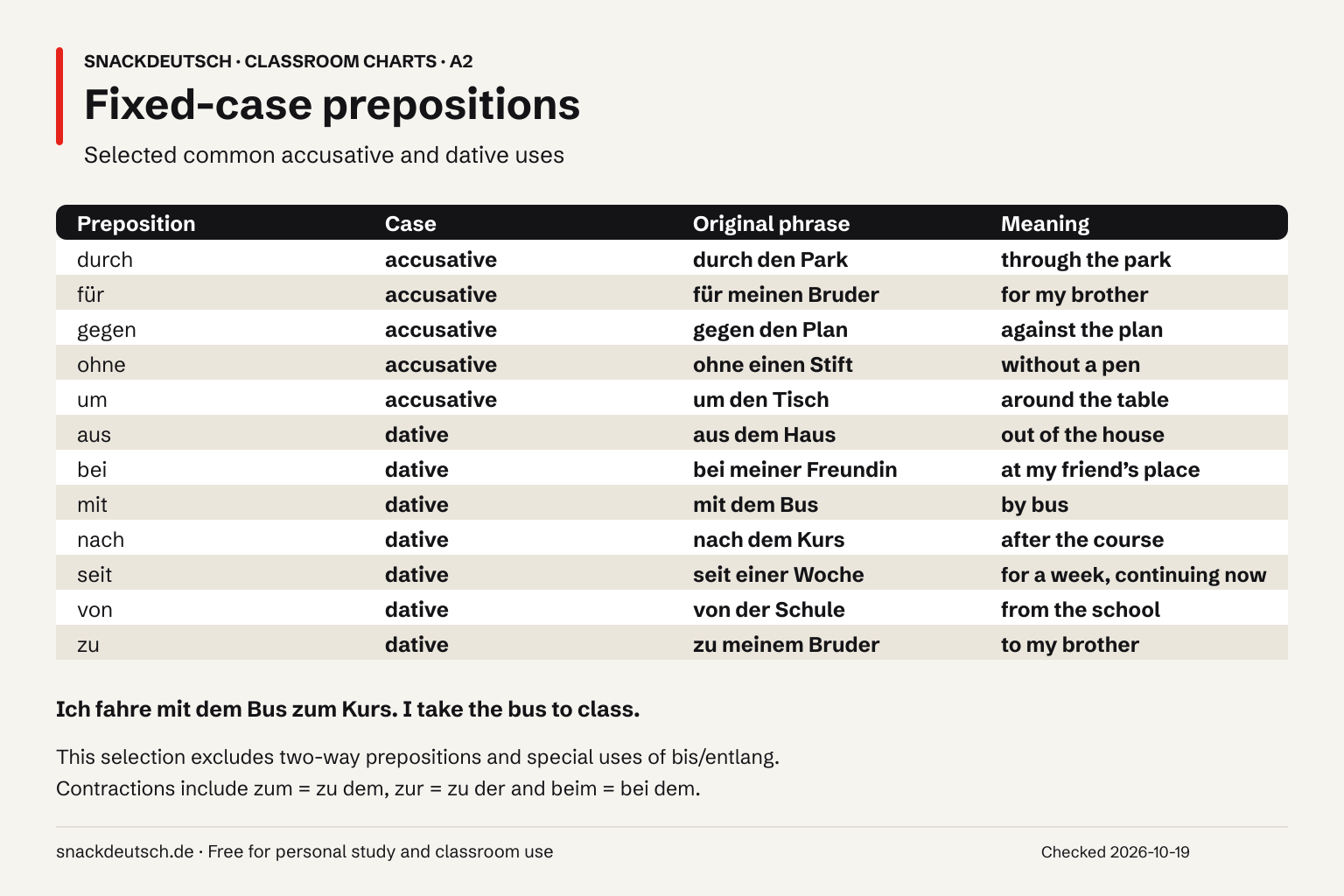
| Preposition | Case | Original phrase | Meaning |
|---|---|---|---|
| durch | accusative | durch den Park | through the park |
| für | accusative | für meinen Bruder | for my brother |
| gegen | accusative | gegen den Plan | against the plan |
| ohne | accusative | ohne einen Stift | without a pen |
| um | accusative | um den Tisch | around the table |
| aus | dative | aus dem Haus | out of the house |
| bei | dative | bei meiner Freundin | at my friend’s place |
| mit | dative | mit dem Bus | by bus |
| nach | dative | nach dem Kurs | after the course |
| seit | dative | seit einer Woche | for a week, continuing now |
| von | dative | von der Schule | from the school |
| zu | dative | zu meinem Bruder | to my brother |
Ich fahre mit dem Bus zum Kurs. I take the bus to class.
- This selection excludes two-way prepositions and special uses of bis/entlang.
- Contractions include zum = zu dem, zur = zu der and beim = bei dem.
Comparative and superlative
Useful adjective and adverb forms · predicative patterns. Suggested level: A2.
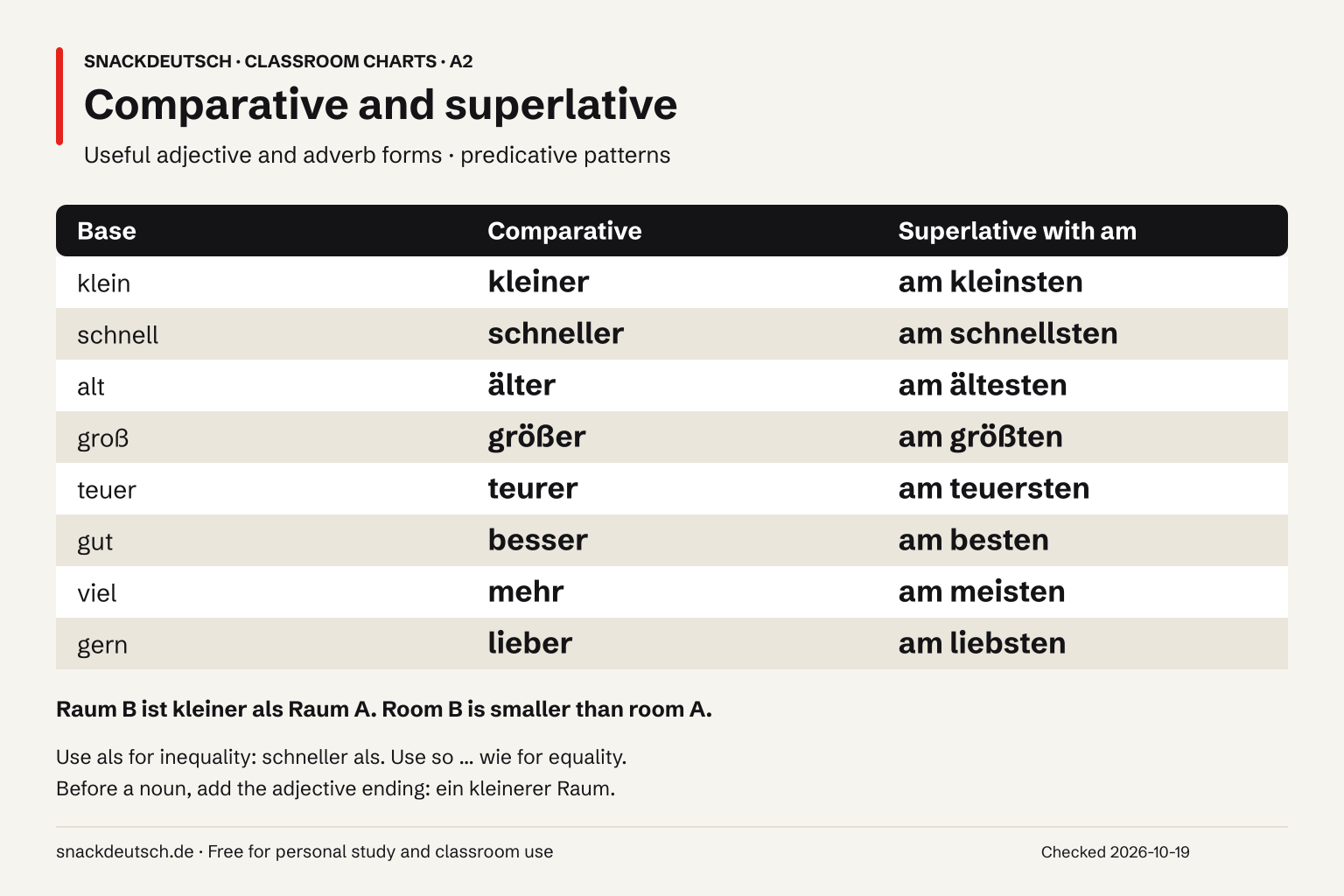
| Base | Comparative | Superlative with am |
|---|---|---|
| klein | kleiner | am kleinsten |
| schnell | schneller | am schnellsten |
| alt | älter | am ältesten |
| groß | größer | am größten |
| teuer | teurer | am teuersten |
| gut | besser | am besten |
| viel | mehr | am meisten |
| gern | lieber | am liebsten |
Raum B ist kleiner als Raum A. Room B is smaller than room A.
- Use als for inequality: schneller als. Use so … wie for equality.
- Before a noun, add the adjective ending: ein kleinerer Raum.
German reflexive pronouns
Accusative and dative · choose from the sentence pattern. Suggested level: A2.
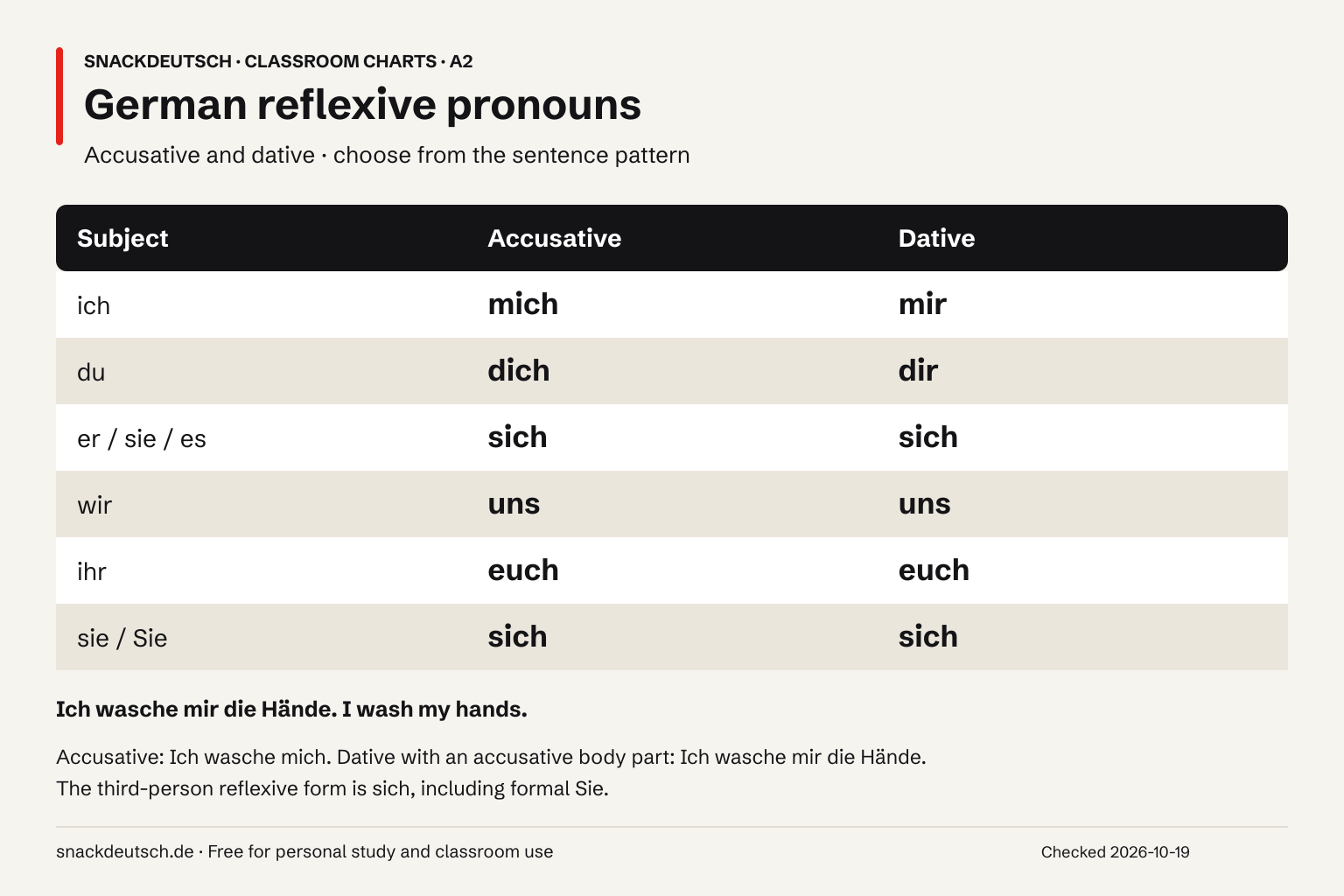
| Subject | Accusative | Dative |
|---|---|---|
| ich | mich | mir |
| du | dich | dir |
| er / sie / es | sich | sich |
| wir | uns | uns |
| ihr | euch | euch |
| sie / Sie | sich | sich |
Ich wasche mir die Hände. I wash my hands.
- Accusative: Ich wasche mich. Dative with an accusative body part: Ich wasche mir die Hände.
- The third-person reflexive form is sich, including formal Sie.
Polite classroom requests
Könnte, würde and hätte gern · selected useful frames. Suggested level: A2.
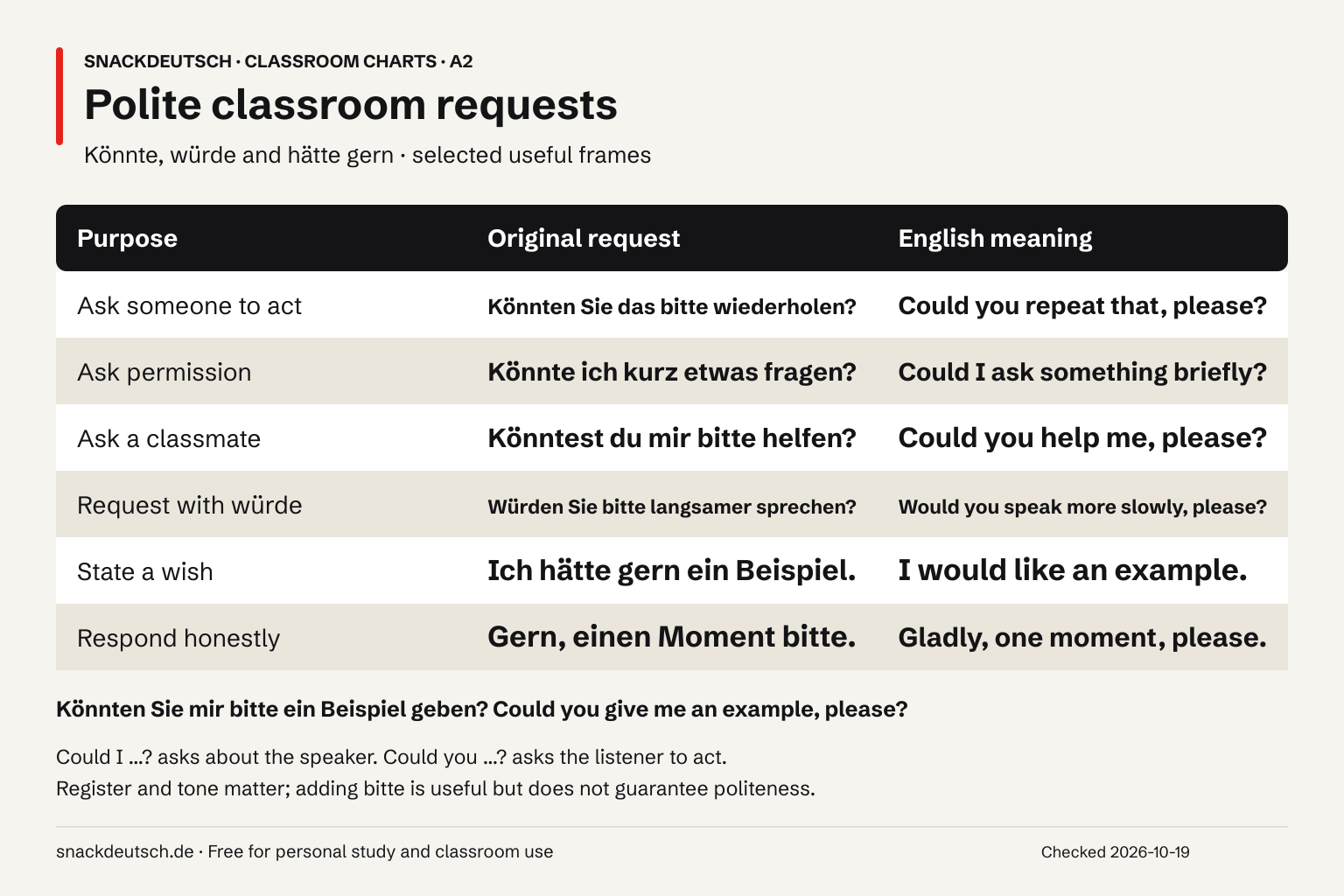
| Purpose | Original request | English meaning |
|---|---|---|
| Ask someone to act | Könnten Sie das bitte wiederholen? | Could you repeat that, please? |
| Ask permission | Könnte ich kurz etwas fragen? | Could I ask something briefly? |
| Ask a classmate | Könntest du mir bitte helfen? | Could you help me, please? |
| Request with würde | Würden Sie bitte langsamer sprechen? | Would you speak more slowly, please? |
| State a wish | Ich hätte gern ein Beispiel. | I would like an example. |
| Respond honestly | Gern, einen Moment bitte. | Gladly, one moment, please. |
Könnten Sie mir bitte ein Beispiel geben? Could you give me an example, please?
- Could I …? asks about the speaker. Could you …? asks the listener to act.
- Register and tone matter; adding bitte is useful but does not guarantee politeness.
Irregular verb families 1
er/sie/es forms · present, Präteritum and Perfekt. Suggested level: A2.
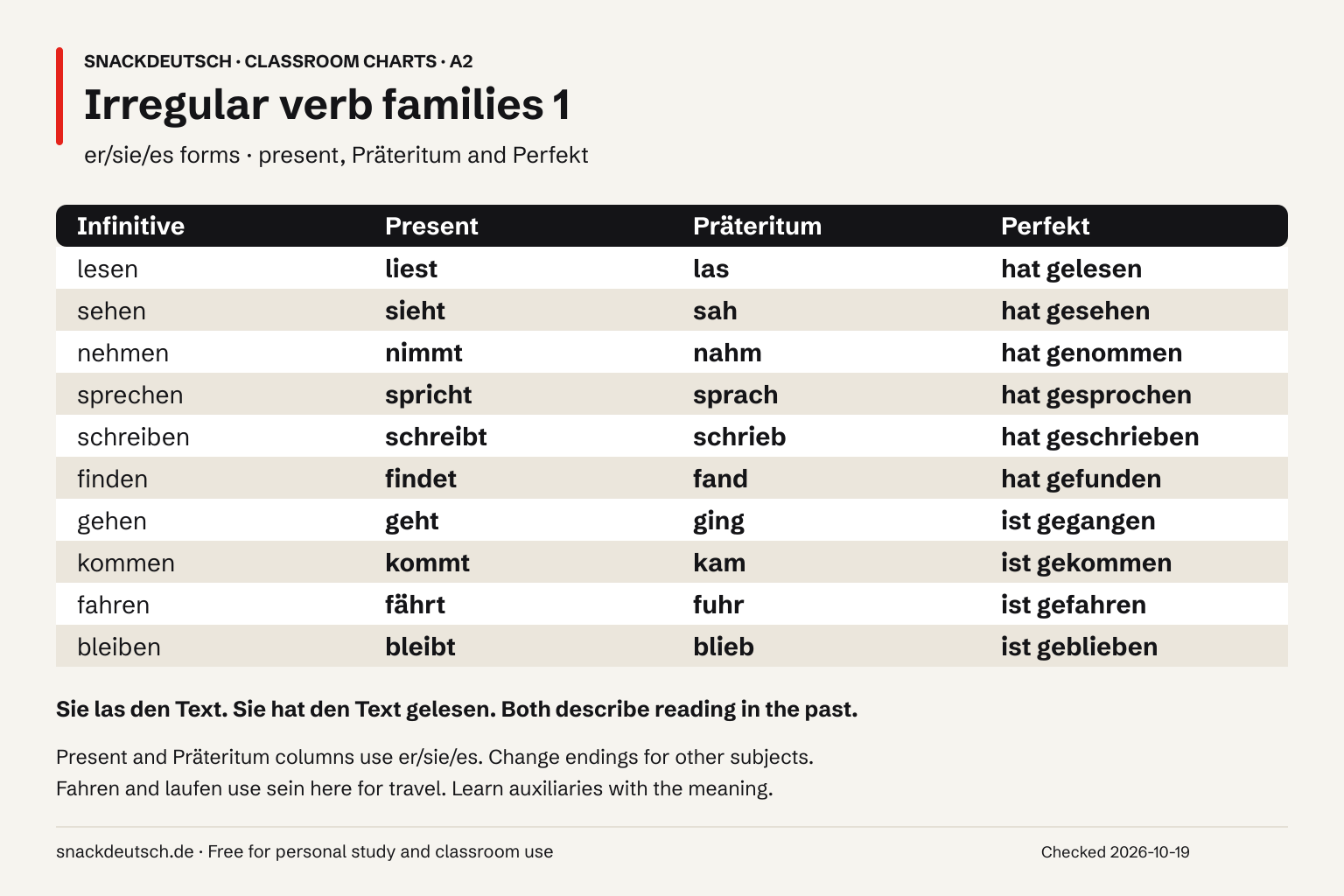
| Infinitive | Present | Präteritum | Perfekt |
|---|---|---|---|
| lesen | liest | las | hat gelesen |
| sehen | sieht | sah | hat gesehen |
| nehmen | nimmt | nahm | hat genommen |
| sprechen | spricht | sprach | hat gesprochen |
| schreiben | schreibt | schrieb | hat geschrieben |
| finden | findet | fand | hat gefunden |
| gehen | geht | ging | ist gegangen |
| kommen | kommt | kam | ist gekommen |
| fahren | fährt | fuhr | ist gefahren |
| bleiben | bleibt | blieb | ist geblieben |
Sie las den Text. Sie hat den Text gelesen. Both describe reading in the past.
- Present and Präteritum columns use er/sie/es. Change endings for other subjects.
- Fahren and laufen use sein here for travel. Learn auxiliaries with the meaning.
Irregular verb families 2
er/sie/es forms · present, Präteritum and Perfekt. Suggested level: A2.
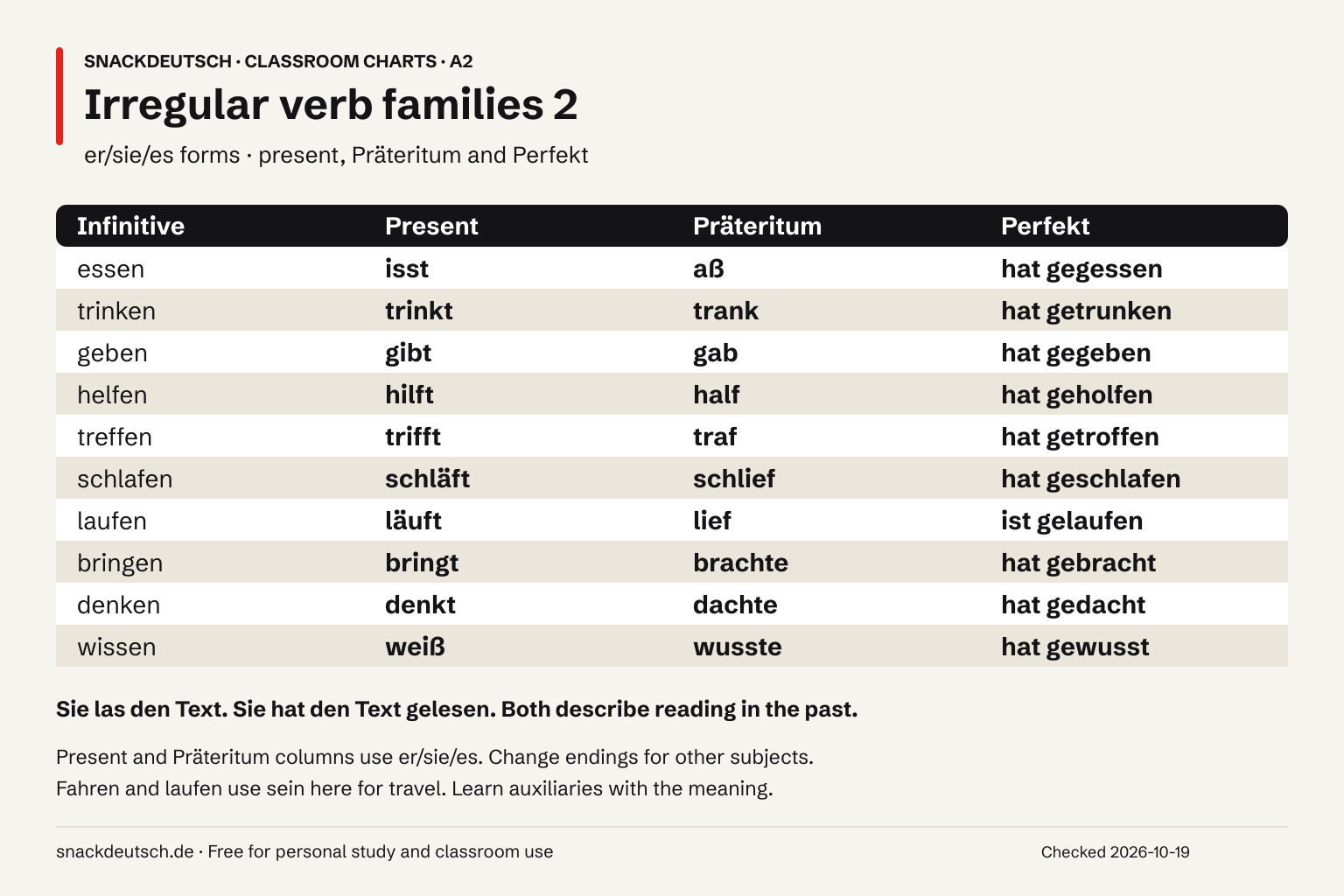
| Infinitive | Present | Präteritum | Perfekt |
|---|---|---|---|
| essen | isst | aß | hat gegessen |
| trinken | trinkt | trank | hat getrunken |
| geben | gibt | gab | hat gegeben |
| helfen | hilft | half | hat geholfen |
| treffen | trifft | traf | hat getroffen |
| schlafen | schläft | schlief | hat geschlafen |
| laufen | läuft | lief | ist gelaufen |
| bringen | bringt | brachte | hat gebracht |
| denken | denkt | dachte | hat gedacht |
| wissen | weiß | wusste | hat gewusst |
Sie las den Text. Sie hat den Text gelesen. Both describe reading in the past.
- Present and Präteritum columns use er/sie/es. Change endings for other subjects.
- Fahren and laufen use sein here for travel. Learn auxiliaries with the meaning.
Sein and haben
Present tense · being and having. Suggested level: A1.
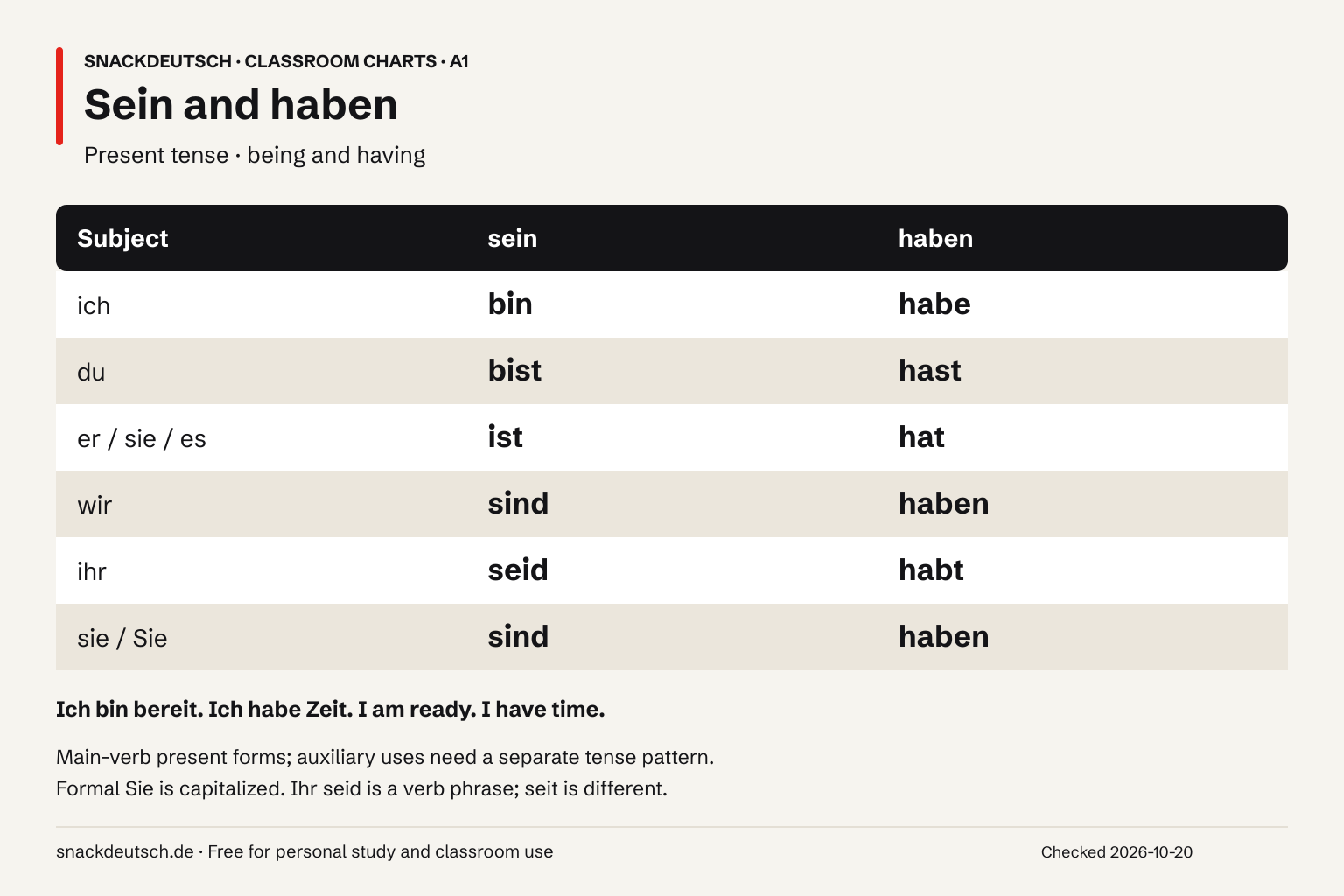
| Subject | sein | haben |
|---|---|---|
| ich | bin | habe |
| du | bist | hast |
| er / sie / es | ist | hat |
| wir | sind | haben |
| ihr | seid | habt |
| sie / Sie | sind | haben |
Ich bin bereit. Ich habe Zeit. I am ready. I have time.
- Main-verb present forms; auxiliary uses need a separate tense pattern.
- Formal Sie is capitalized. Ihr seid is a verb phrase; seit is different.
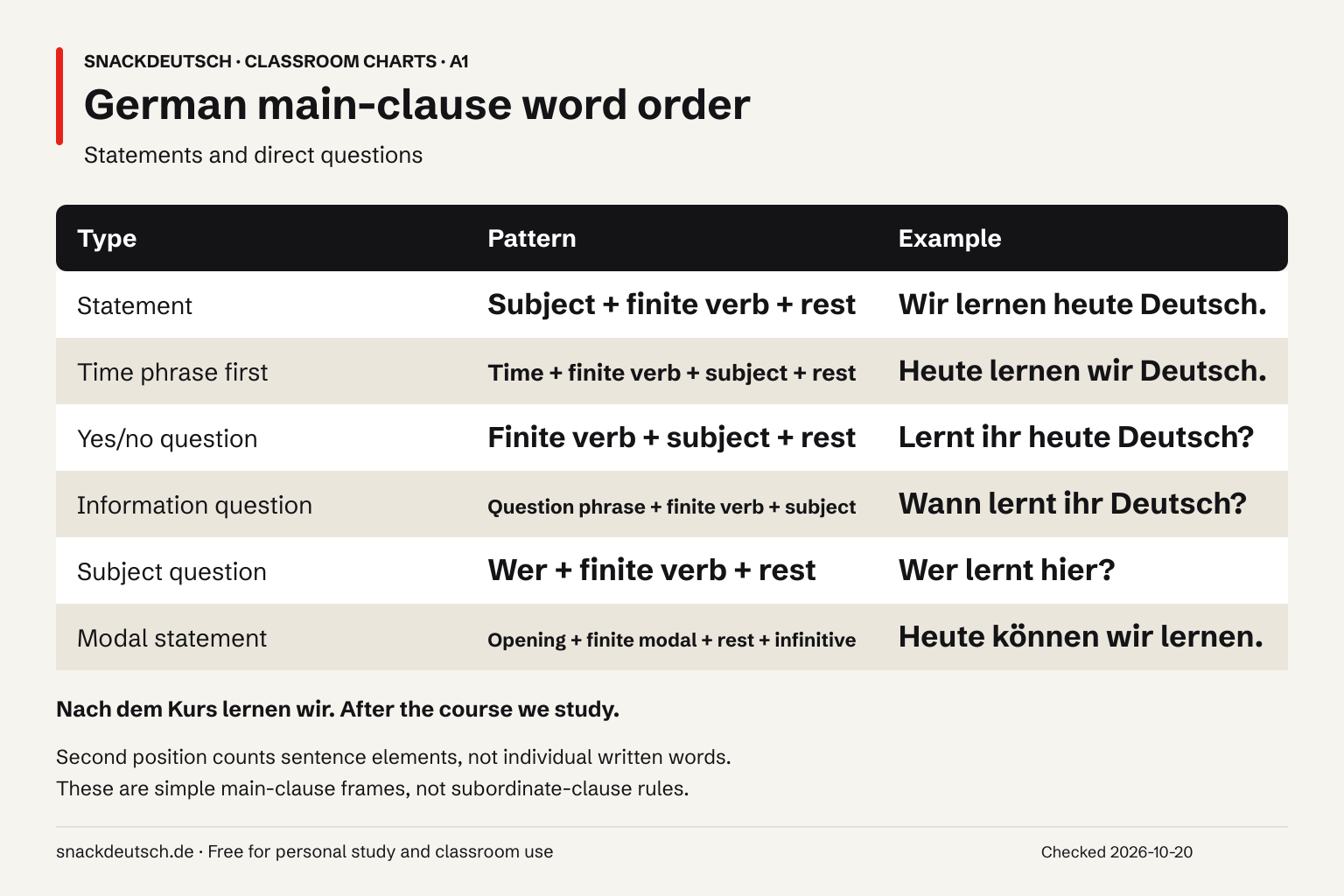
German main-clause word order
Statements and direct questions. Suggested level: A1.
| Type | Pattern | Example |
|---|---|---|
| Statement | Subject + finite verb + rest | Wir lernen heute Deutsch. |
| Time phrase first | Time + finite verb + subject + rest | Heute lernen wir Deutsch. |
| Yes/no question | Finite verb + subject + rest | Lernt ihr heute Deutsch? |
| Information question | Question phrase + finite verb + subject | Wann lernt ihr Deutsch? |
| Subject question | Wer + finite verb + rest | Wer lernt hier? |
| Modal statement | Opening + finite modal + rest + infinitive | Heute können wir lernen. |
Nach dem Kurs lernen wir. After the course we study.
- Second position counts sentence elements, not individual written words.
- These are simple main-clause frames, not subordinate-clause rules.
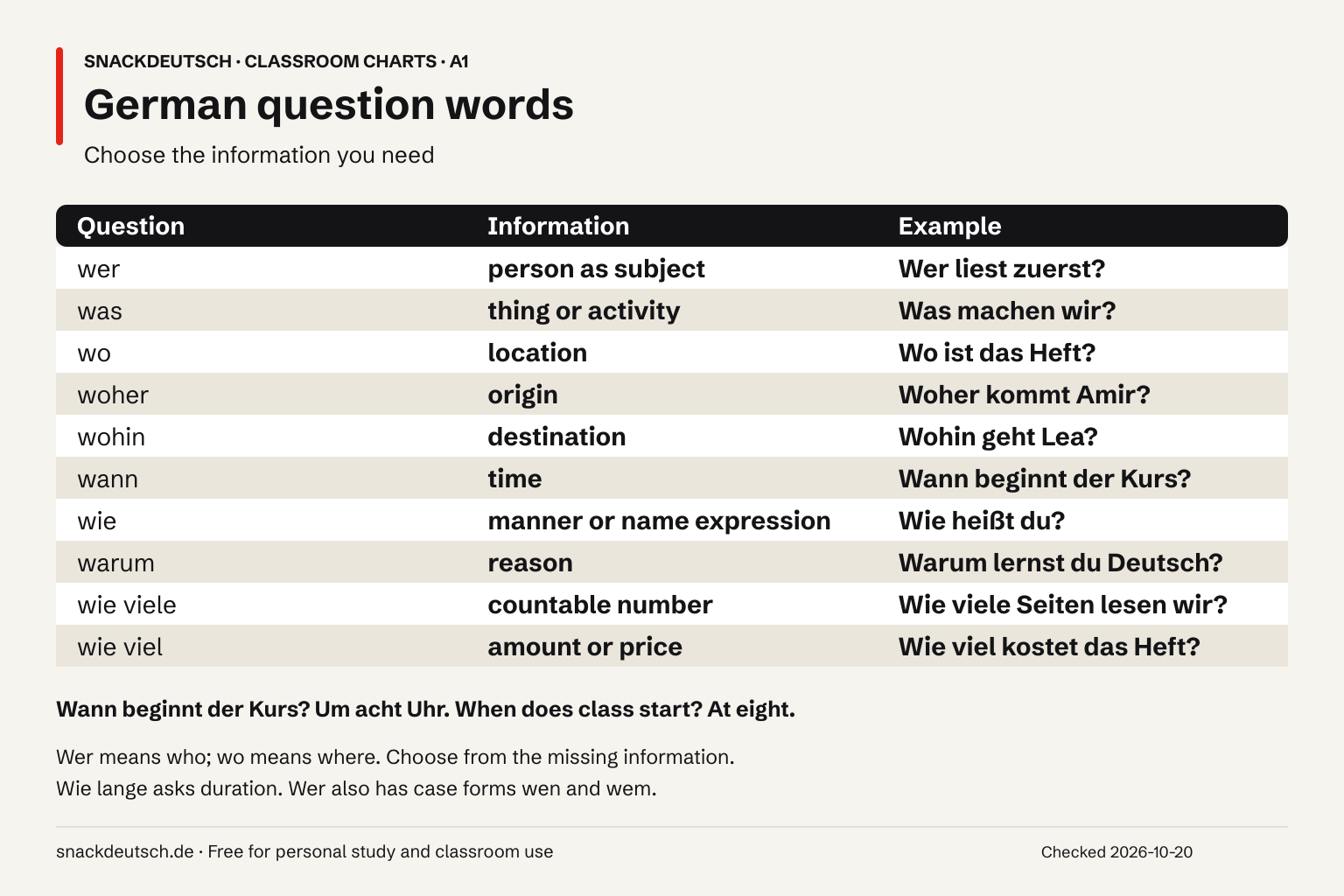
German question words
Choose the information you need. Suggested level: A1.
| Question | Information | Example |
|---|---|---|
| wer | person as subject | Wer liest zuerst? |
| was | thing or activity | Was machen wir? |
| wo | location | Wo ist das Heft? |
| woher | origin | Woher kommt Amir? |
| wohin | destination | Wohin geht Lea? |
| wann | time | Wann beginnt der Kurs? |
| wie | manner or name expression | Wie heißt du? |
| warum | reason | Warum lernst du Deutsch? |
| wie viele | countable number | Wie viele Seiten lesen wir? |
| wie viel | amount or price | Wie viel kostet das Heft? |
Wann beginnt der Kurs? Um acht Uhr. When does class start? At eight.
- Wer means who; wo means where. Choose from the missing information.
- Wie lange asks duration. Wer also has case forms wen and wem.
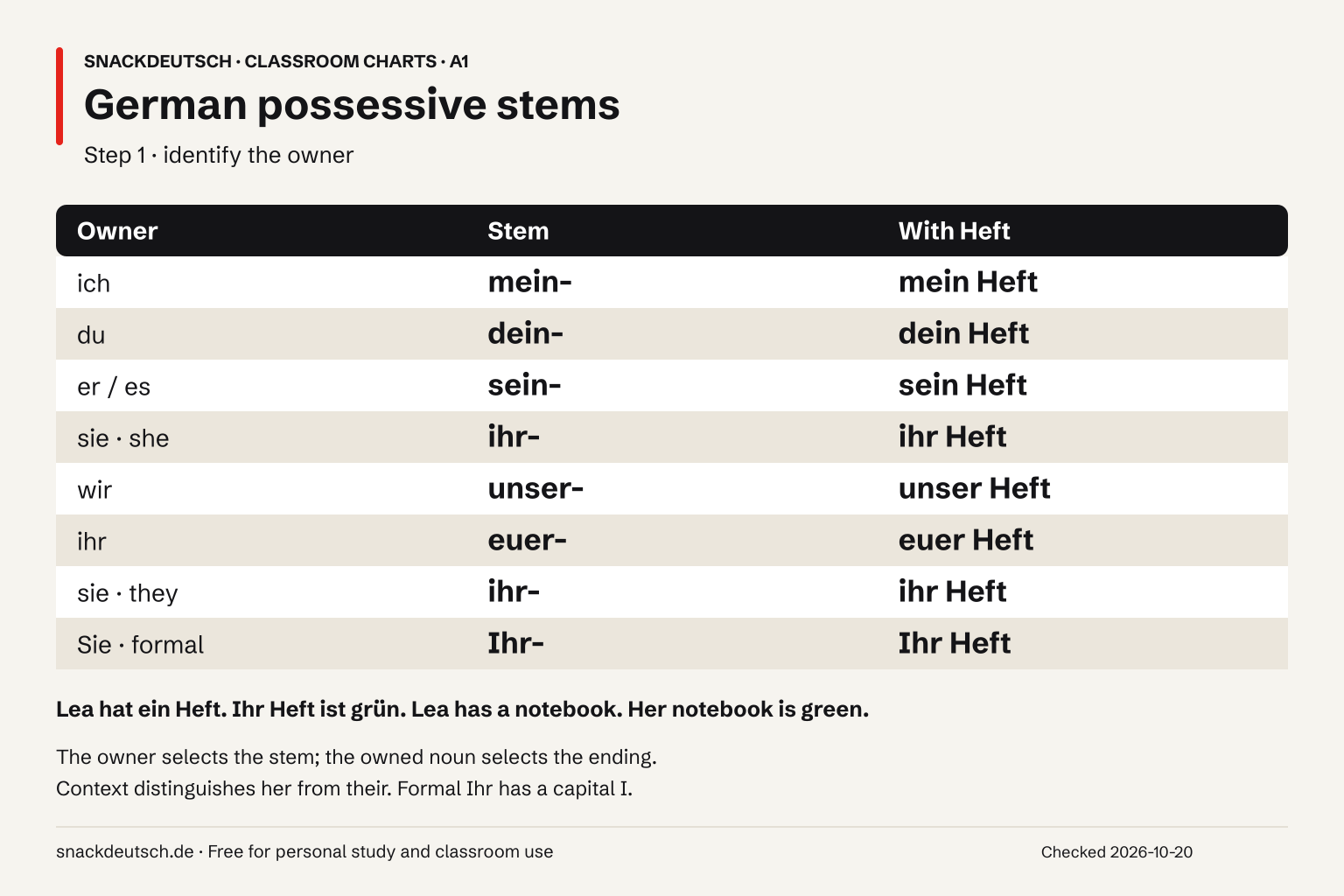
German possessive stems
Step 1 · identify the owner. Suggested level: A1.
| Owner | Stem | With Heft |
|---|---|---|
| ich | mein- | mein Heft |
| du | dein- | dein Heft |
| er / es | sein- | sein Heft |
| sie · she | ihr- | ihr Heft |
| wir | unser- | unser Heft |
| ihr | euer- | euer Heft |
| sie · they | ihr- | ihr Heft |
| Sie · formal | Ihr- | Ihr Heft |
Lea hat ein Heft. Ihr Heft ist grün. Lea has a notebook. Her notebook is green.
- The owner selects the stem; the owned noun selects the ending.
- Context distinguishes her from their. Formal Ihr has a capital I.
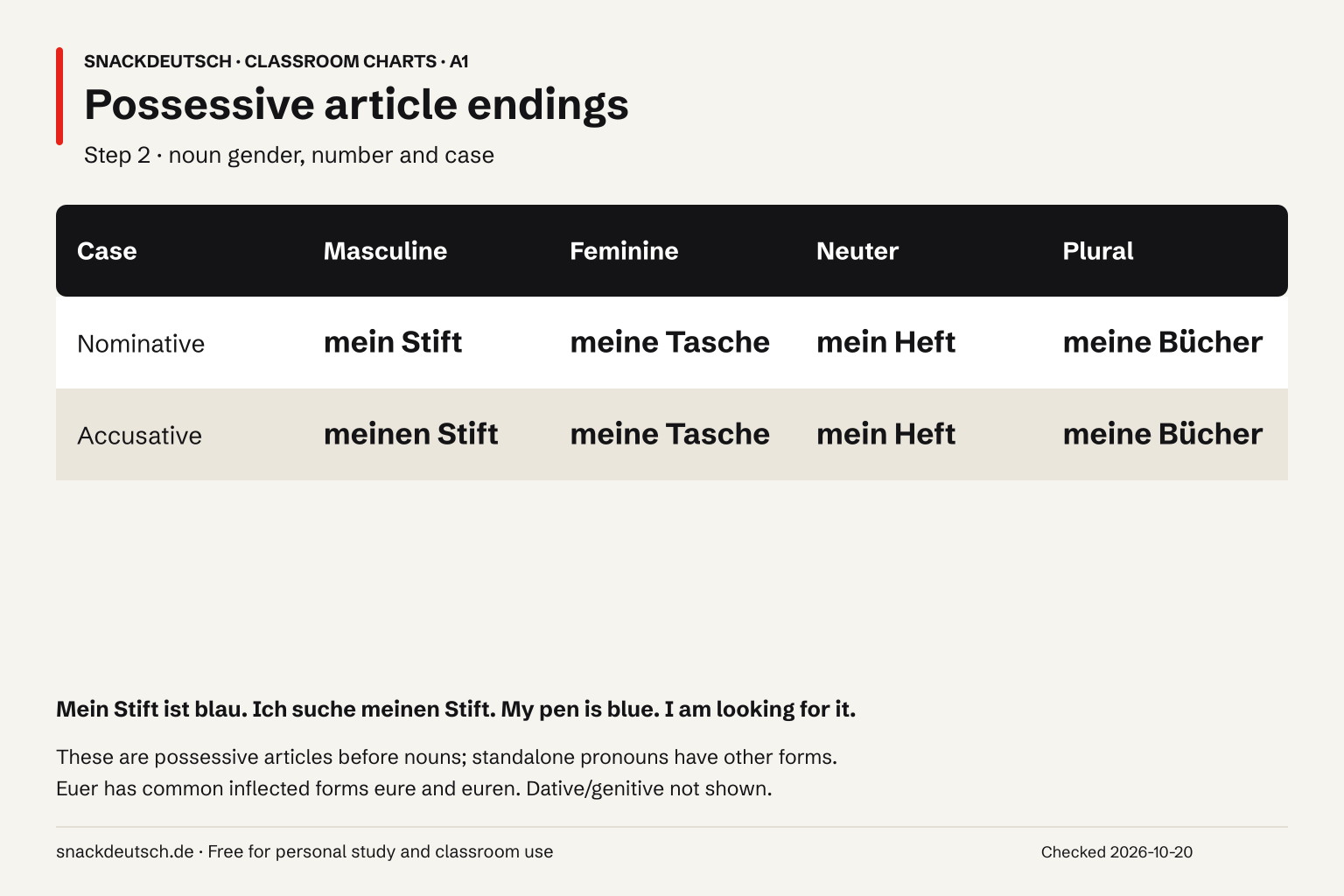
Possessive article endings
Step 2 · noun gender, number and case. Suggested level: A1.
| Case | Masculine | Feminine | Neuter | Plural |
|---|---|---|---|---|
| Nominative | mein Stift | meine Tasche | mein Heft | meine Bücher |
| Accusative | meinen Stift | meine Tasche | mein Heft | meine Bücher |
Mein Stift ist blau. Ich suche meinen Stift. My pen is blue. I am looking for it.
- These are possessive articles before nouns; standalone pronouns have other forms.
- Euer has common inflected forms eure and euren. Dative/genitive not shown.
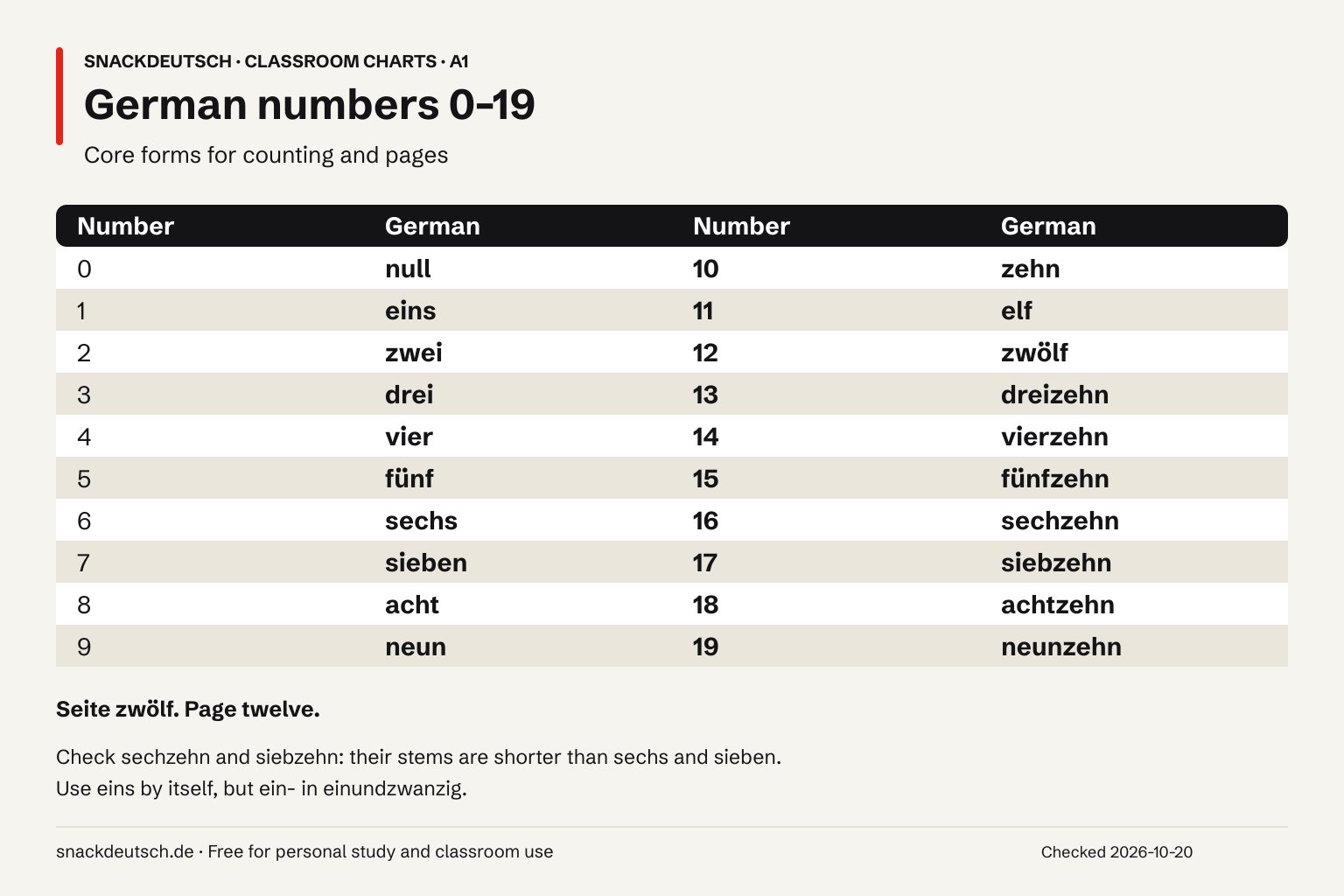
German numbers 0–19
Core forms for counting and pages. Suggested level: A1.
| Number | German | Number | German |
|---|---|---|---|
| 0 | null | 10 | zehn |
| 1 | eins | 11 | elf |
| 2 | zwei | 12 | zwölf |
| 3 | drei | 13 | dreizehn |
| 4 | vier | 14 | vierzehn |
| 5 | fünf | 15 | fünfzehn |
| 6 | sechs | 16 | sechzehn |
| 7 | sieben | 17 | siebzehn |
| 8 | acht | 18 | achtzehn |
| 9 | neun | 19 | neunzehn |
Seite zwölf. Page twelve.
- Check sechzehn and siebzehn: their stems are shorter than sechs and sieben.
- Use eins by itself, but ein- in einundzwanzig.
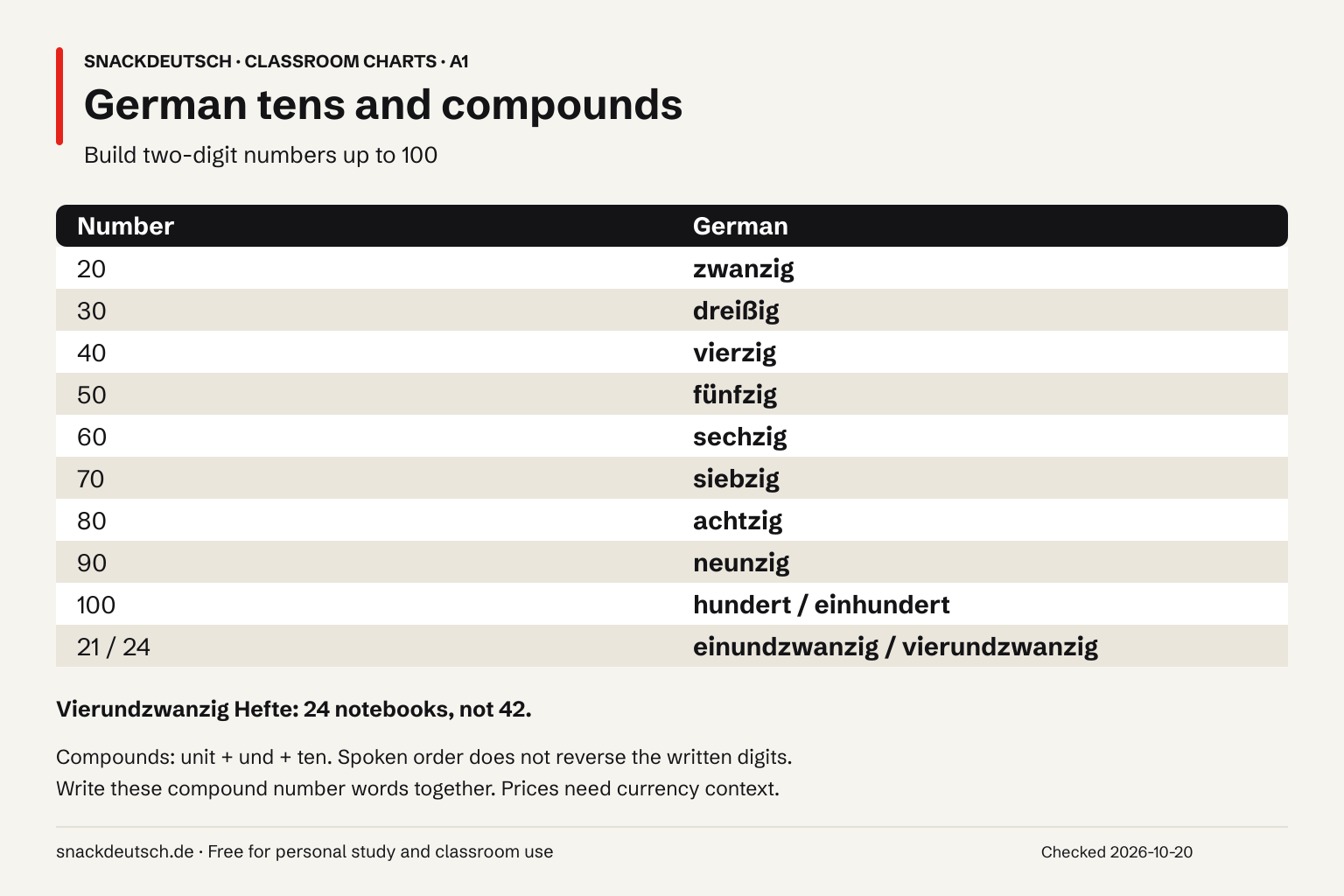
German tens and compounds
Build two-digit numbers up to 100. Suggested level: A1.
| Number | German |
|---|---|
| 20 | zwanzig |
| 30 | dreißig |
| 40 | vierzig |
| 50 | fünfzig |
| 60 | sechzig |
| 70 | siebzig |
| 80 | achtzig |
| 90 | neunzig |
| 100 | hundert / einhundert |
| 21 / 24 | einundzwanzig / vierundzwanzig |
Vierundzwanzig Hefte: 24 notebooks, not 42.
- Compounds: unit + und + ten. Spoken order does not reverse the written digits.
- Write these compound number words together. Prices need currency context.
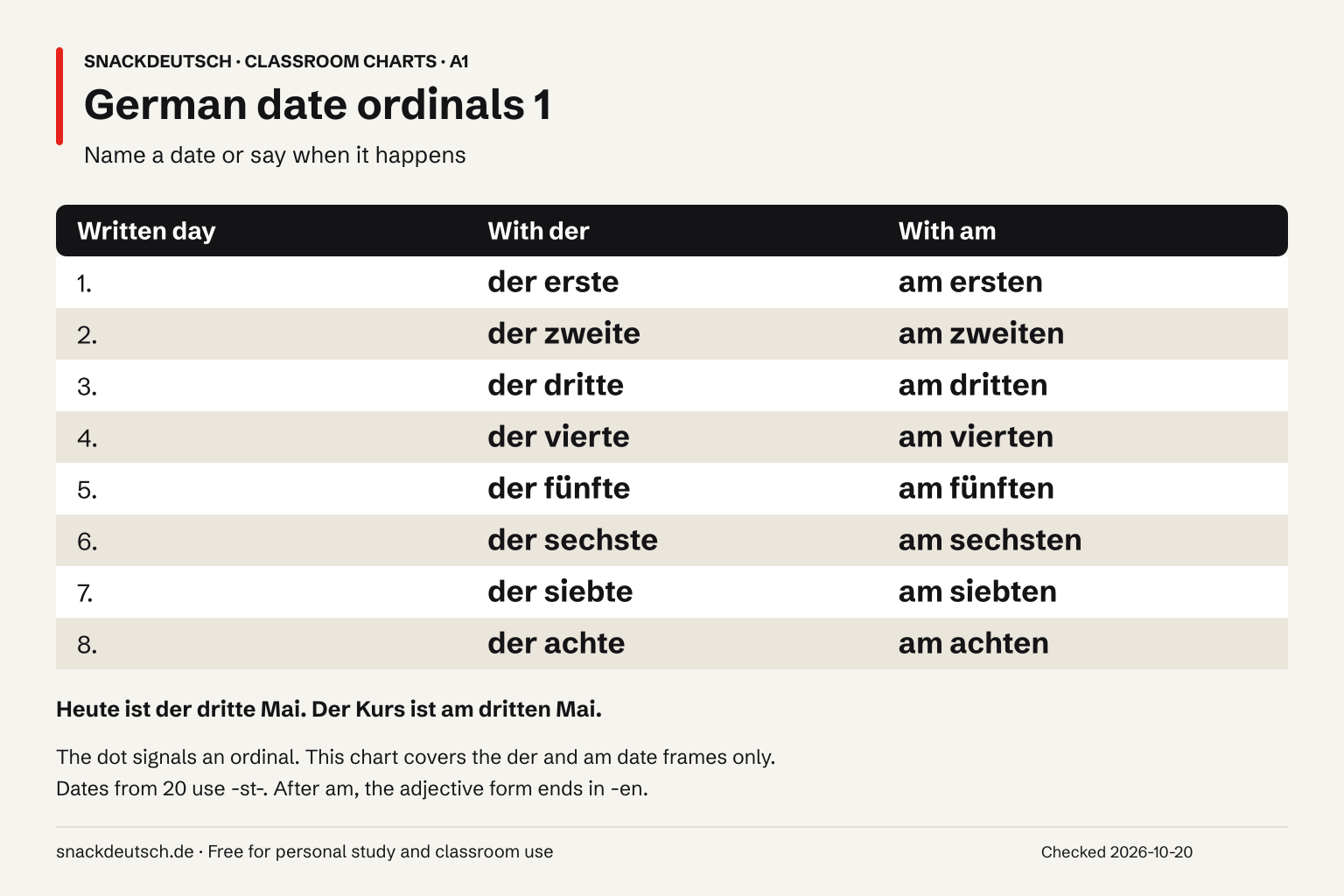
German date ordinals 1
Name a date or say when it happens. Suggested level: A1.
| Written day | With der | With am |
|---|---|---|
| 1. | der erste | am ersten |
| 2. | der zweite | am zweiten |
| 3. | der dritte | am dritten |
| 4. | der vierte | am vierten |
| 5. | der fünfte | am fünften |
| 6. | der sechste | am sechsten |
| 7. | der siebte | am siebten |
| 8. | der achte | am achten |
Heute ist der dritte Mai. Der Kurs ist am dritten Mai.
- The dot signals an ordinal. This chart covers the der and am date frames only.
- Dates from 20 use -st-. After am, the adjective form ends in -en.
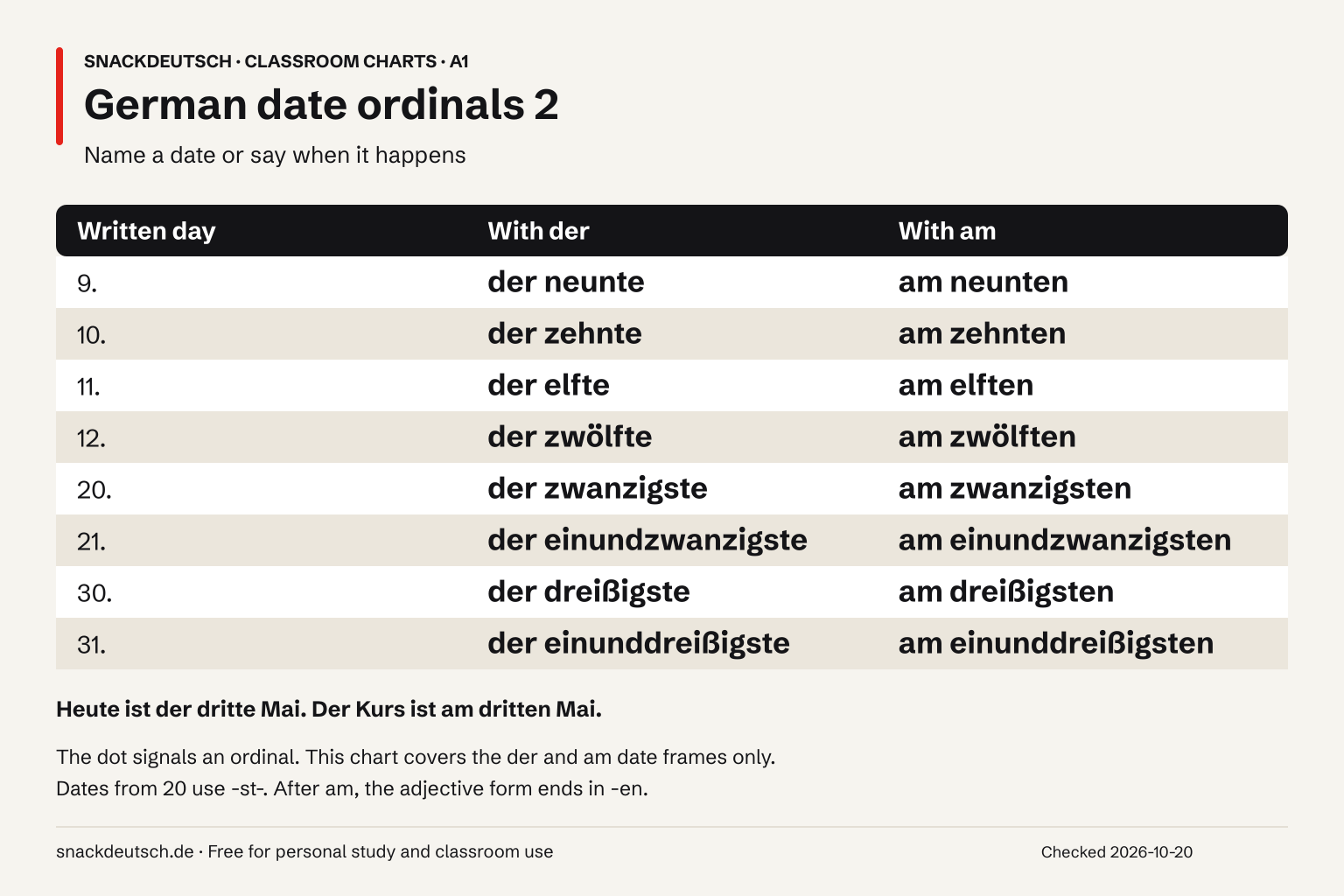
German date ordinals 2
Name a date or say when it happens. Suggested level: A1.
| Written day | With der | With am |
|---|---|---|
| 9. | der neunte | am neunten |
| 10. | der zehnte | am zehnten |
| 11. | der elfte | am elften |
| 12. | der zwölfte | am zwölften |
| 20. | der zwanzigste | am zwanzigsten |
| 21. | der einundzwanzigste | am einundzwanzigsten |
| 30. | der dreißigste | am dreißigsten |
| 31. | der einunddreißigste | am einunddreißigsten |
Heute ist der dritte Mai. Der Kurs ist am dritten Mai.
- The dot signals an ordinal. This chart covers the der and am date frames only.
- Dates from 20 use -st-. After am, the adjective form ends in -en.
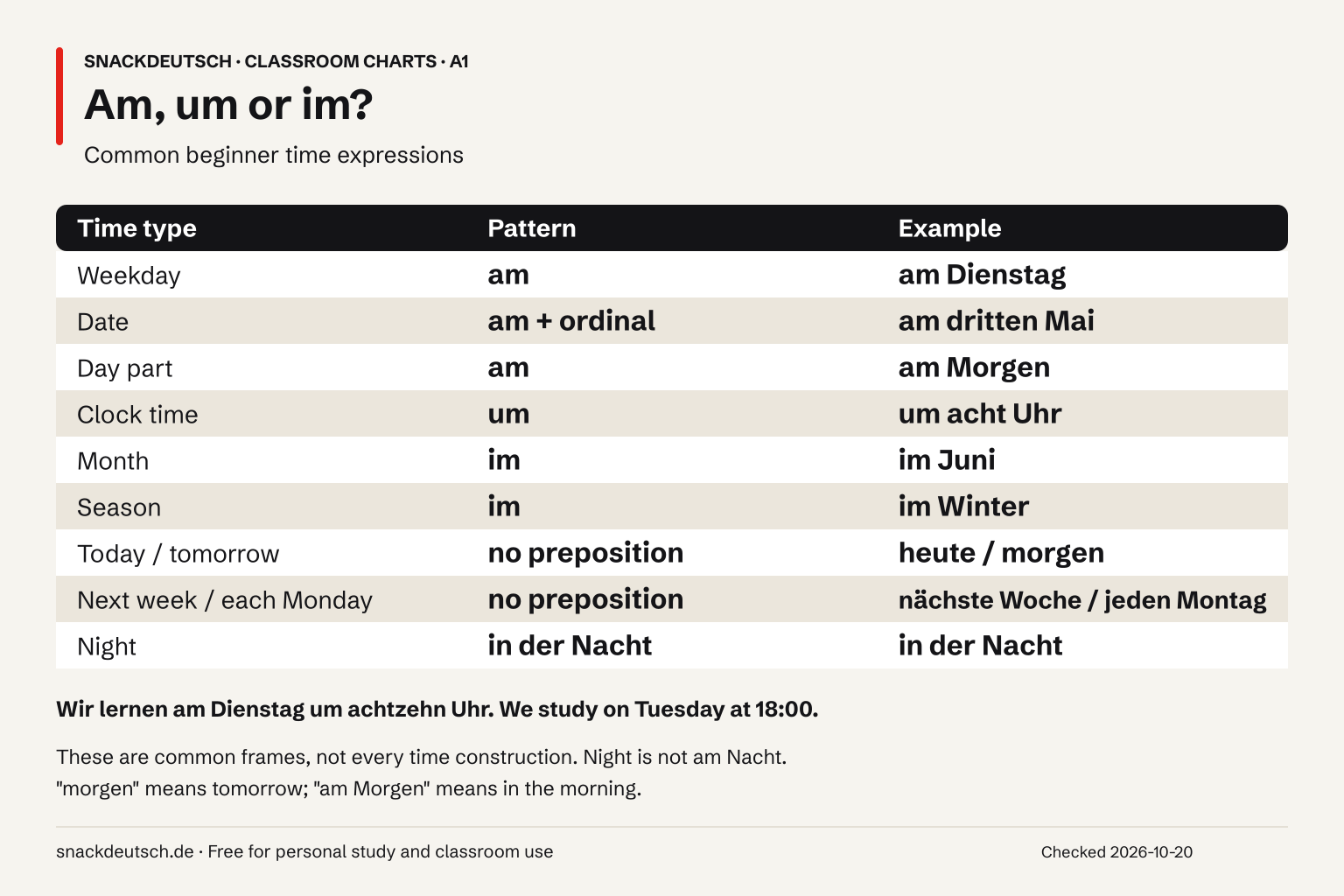
Am, um or im?
Common beginner time expressions. Suggested level: A1.
| Time type | Pattern | Example |
|---|---|---|
| Weekday | am | am Dienstag |
| Date | am + ordinal | am dritten Mai |
| Day part | am | am Morgen |
| Clock time | um | um acht Uhr |
| Month | im | im Juni |
| Season | im | im Winter |
| Today / tomorrow | no preposition | heute / morgen |
| Next week / each Monday | no preposition | nächste Woche / jeden Montag |
| Night | in der Nacht | in der Nacht |
Wir lernen am Dienstag um achtzehn Uhr. We study on Tuesday at 18:00.
- These are common frames, not every time construction. Night is not am Nacht.
- “morgen” means tomorrow; “am Morgen” means in the morning.
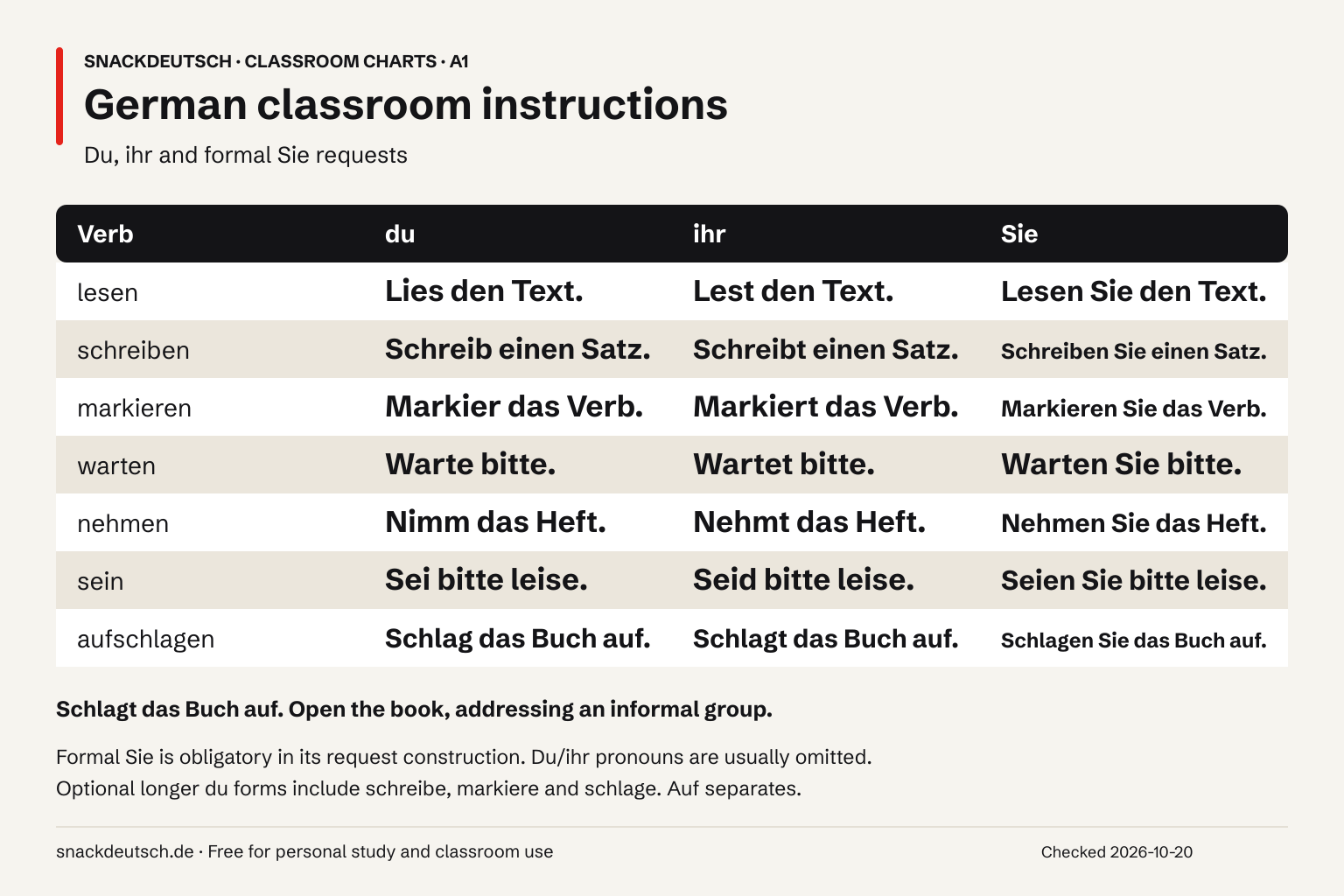
German classroom instructions
Du, ihr and formal Sie requests. Suggested level: A1.
| Verb | du | ihr | Sie |
|---|---|---|---|
| lesen | Lies den Text. | Lest den Text. | Lesen Sie den Text. |
| schreiben | Schreib einen Satz. | Schreibt einen Satz. | Schreiben Sie einen Satz. |
| markieren | Markier das Verb. | Markiert das Verb. | Markieren Sie das Verb. |
| warten | Warte bitte. | Wartet bitte. | Warten Sie bitte. |
| nehmen | Nimm das Heft. | Nehmt das Heft. | Nehmen Sie das Heft. |
| sein | Sei bitte leise. | Seid bitte leise. | Seien Sie bitte leise. |
| aufschlagen | Schlag das Buch auf. | Schlagt das Buch auf. | Schlagen Sie das Buch auf. |
Schlagt das Buch auf. Open the book, addressing an informal group.
- Formal Sie is obligatory in its request construction. Du/ihr pronouns are usually omitted.
- Optional longer du forms include schreibe, markiere and schlage. Auf separates.
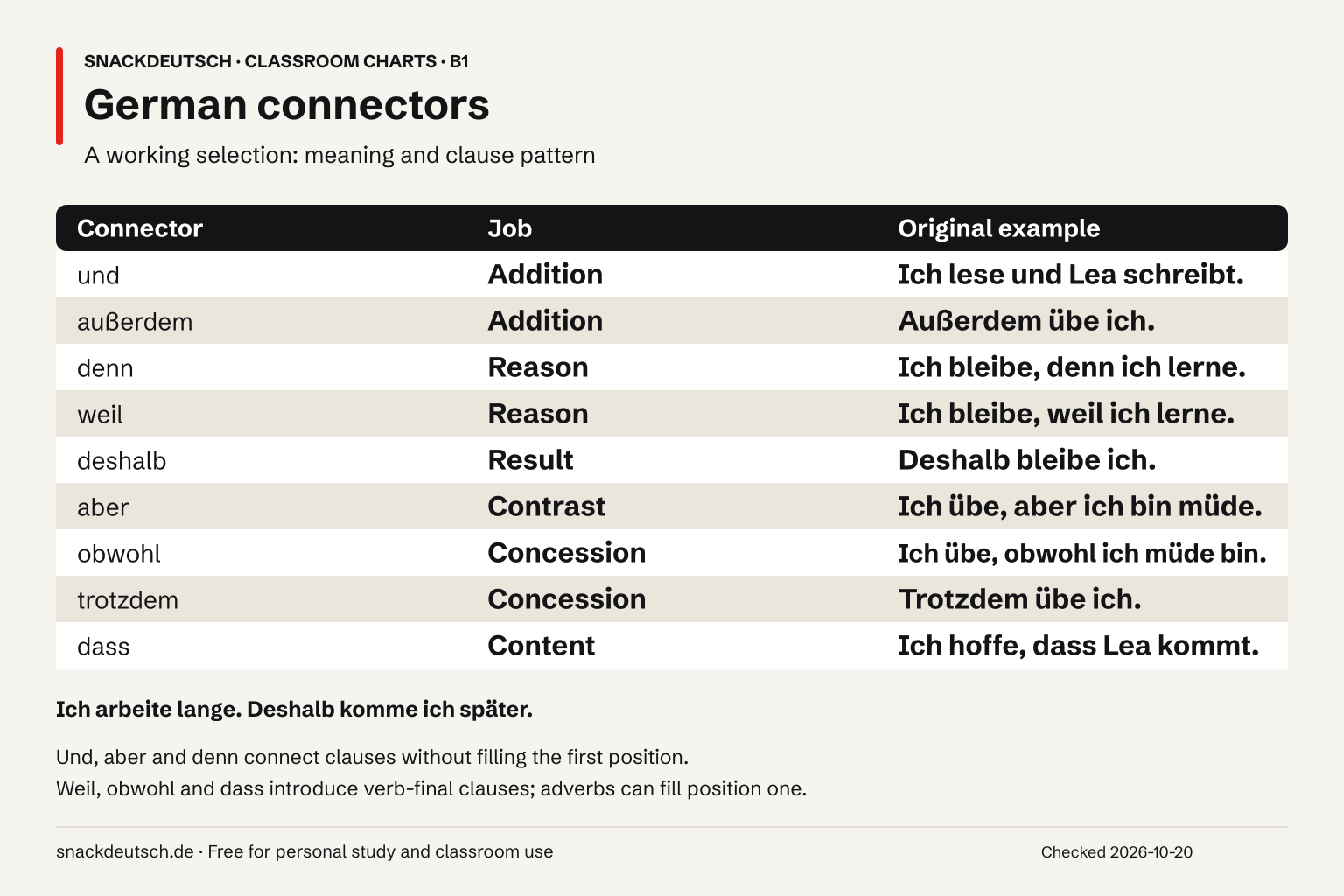
German connectors
A working selection: meaning and clause pattern. Suggested level: B1.
| Connector | Job | Original example |
|---|---|---|
| und | Addition | Ich lese und Lea schreibt. |
| außerdem | Addition | Außerdem übe ich. |
| denn | Reason | Ich bleibe, denn ich lerne. |
| weil | Reason | Ich bleibe, weil ich lerne. |
| deshalb | Result | Deshalb bleibe ich. |
| aber | Contrast | Ich übe, aber ich bin müde. |
| obwohl | Concession | Ich übe, obwohl ich müde bin. |
| trotzdem | Concession | Trotzdem übe ich. |
| dass | Content | Ich hoffe, dass Lea kommt. |
Ich arbeite lange. Deshalb komme ich später.
- Und, aber and denn connect clauses without filling the first position.
- Weil, obwohl and dass introduce verb-final clauses; adverbs can fill position one.
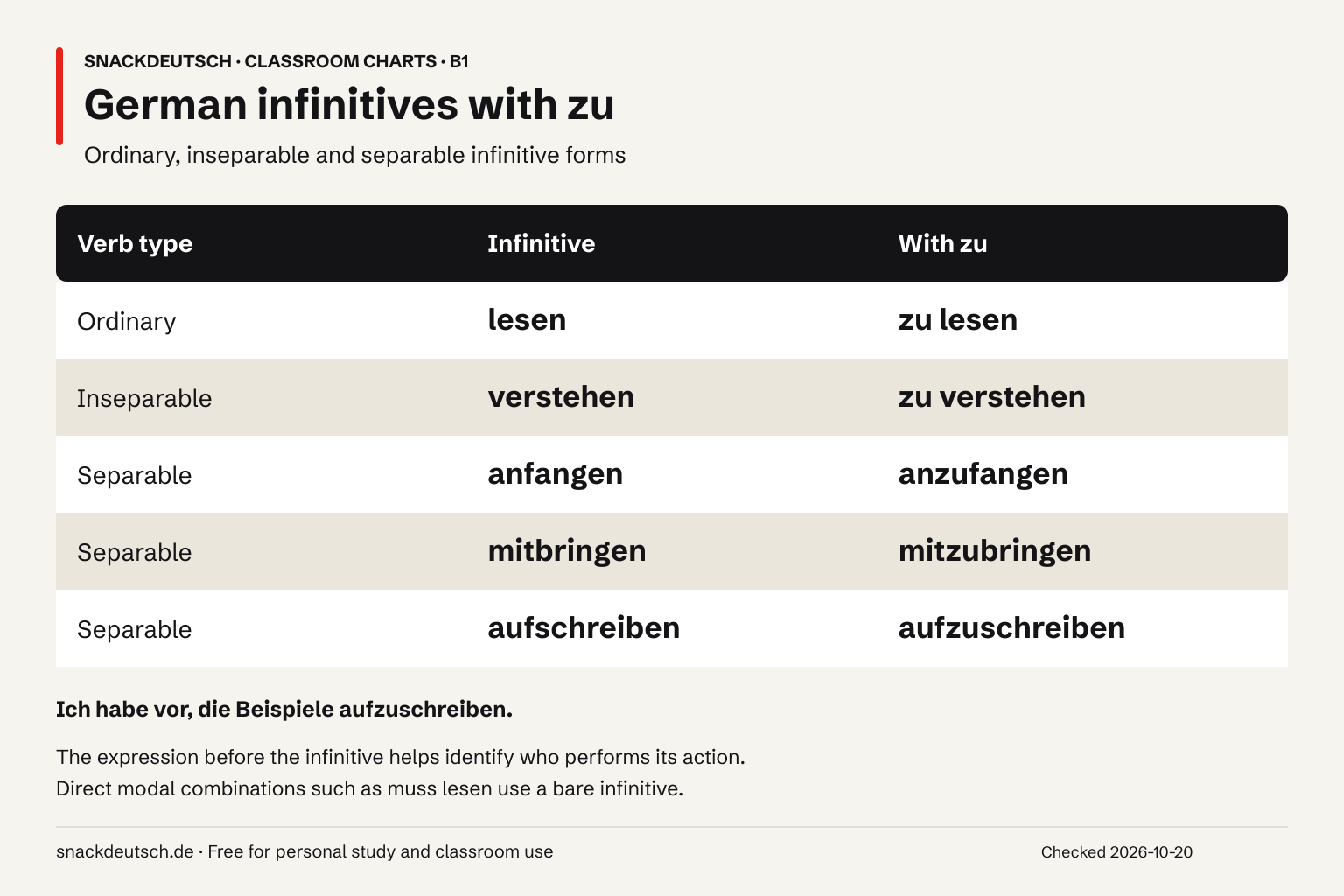
German infinitives with zu
Ordinary, inseparable and separable infinitive forms. Suggested level: B1.
| Verb type | Infinitive | With zu |
|---|---|---|
| Ordinary | lesen | zu lesen |
| Inseparable | verstehen | zu verstehen |
| Separable | anfangen | anzufangen |
| Separable | mitbringen | mitzubringen |
| Separable | aufschreiben | aufzuschreiben |
Ich habe vor, die Beispiele aufzuschreiben.
- The expression before the infinitive helps identify who performs its action.
- Direct modal combinations such as muss lesen use a bare infinitive.
German relative pronouns
Common der/die/das series. Suggested level: B1.
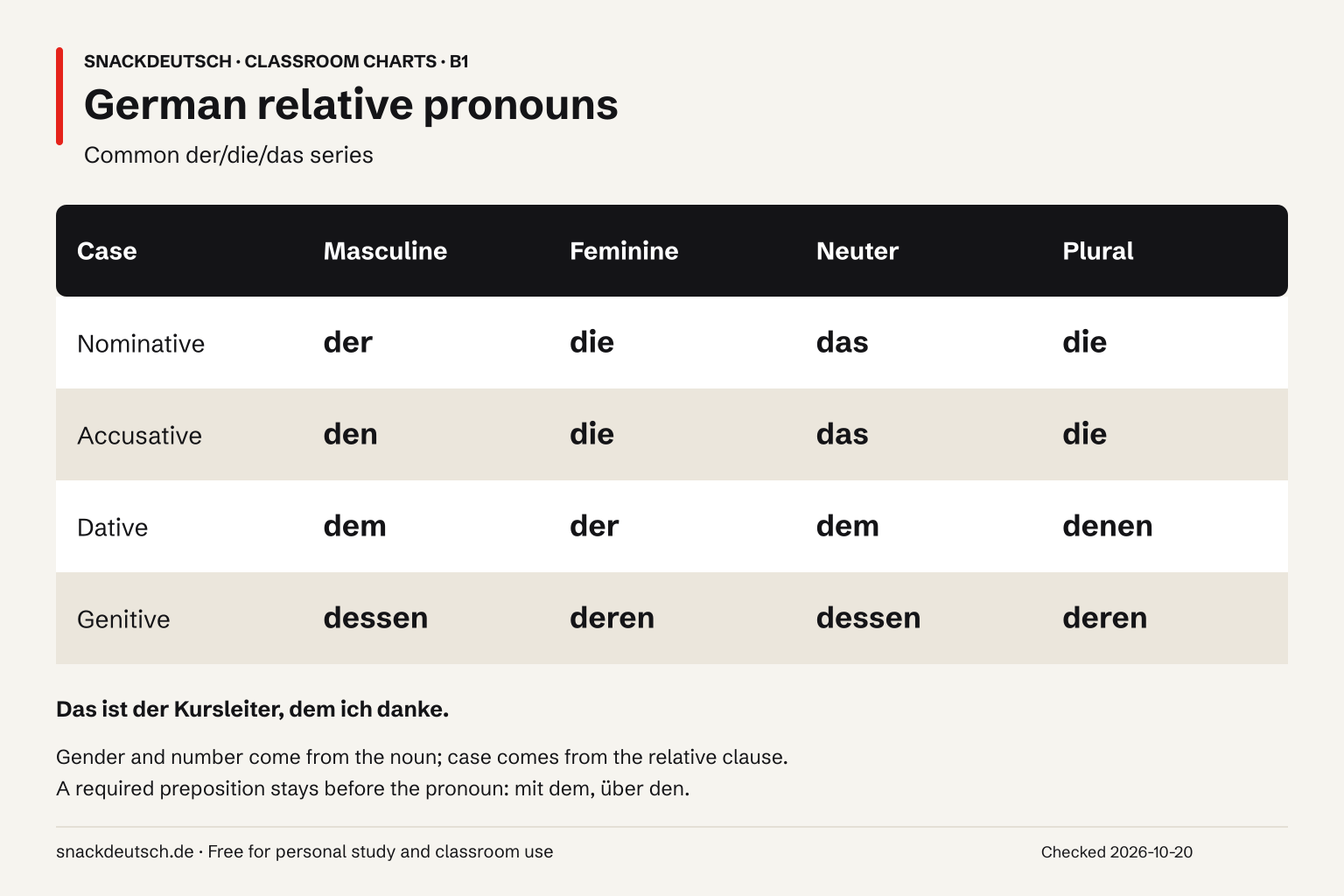
| Case | Masculine | Feminine | Neuter | Plural |
|---|---|---|---|---|
| Nominative | der | die | das | die |
| Accusative | den | die | das | die |
| Dative | dem | der | dem | denen |
| Genitive | dessen | deren | dessen | deren |
Das ist der Kursleiter, dem ich danke.
- Gender and number come from the noun; case comes from the relative clause.
- A required preposition stays before the pronoun: mit dem, über den.
German verbs with prepositions
Selected classroom meanings; learn the whole pattern. Suggested level: B1.
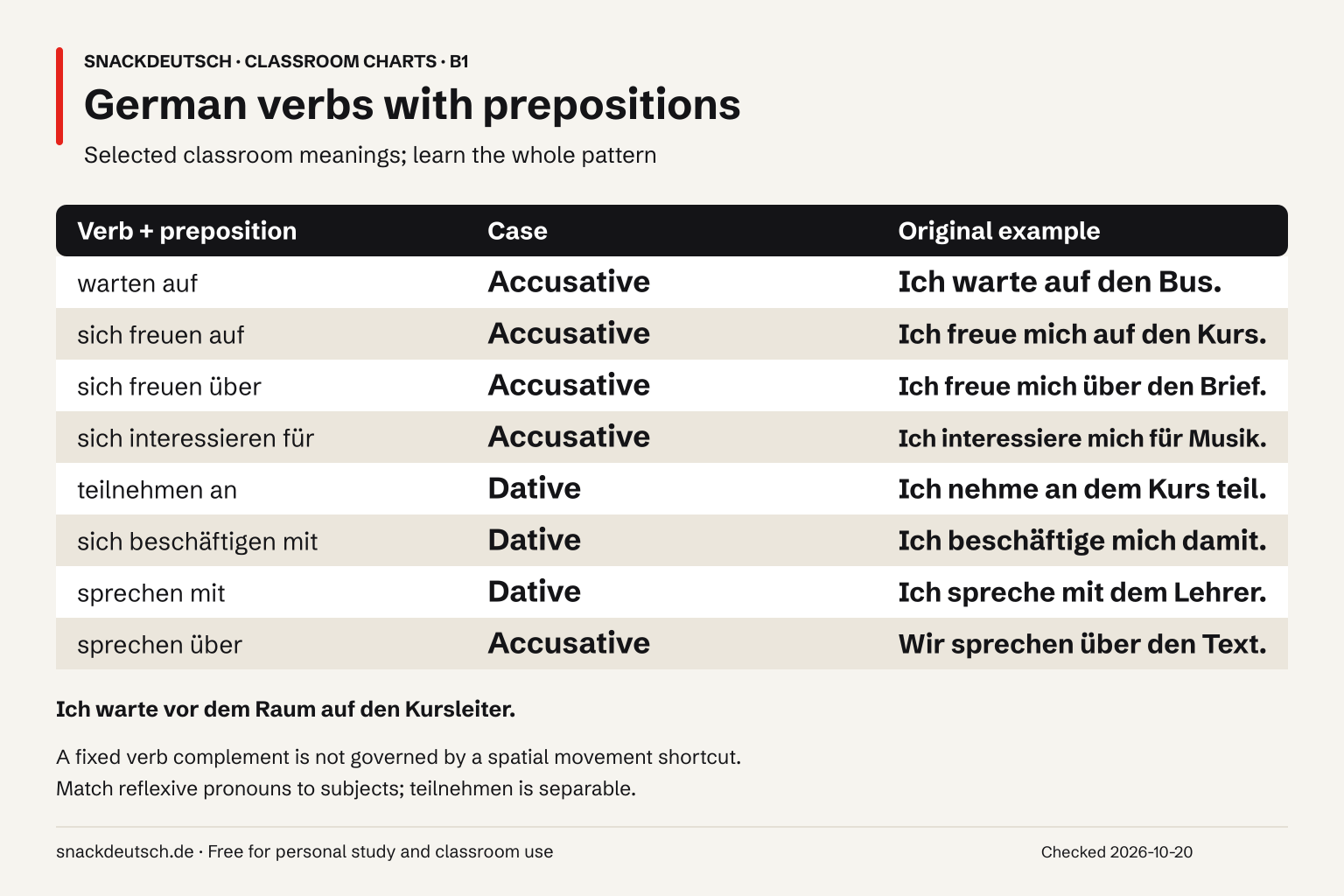
| Verb + preposition | Case | Original example |
|---|---|---|
| warten auf | Accusative | Ich warte auf den Bus. |
| sich freuen auf | Accusative | Ich freue mich auf den Kurs. |
| sich freuen über | Accusative | Ich freue mich über den Brief. |
| sich interessieren für | Accusative | Ich interessiere mich für Musik. |
| teilnehmen an | Dative | Ich nehme an dem Kurs teil. |
| sich beschäftigen mit | Dative | Ich beschäftige mich damit. |
| sprechen mit | Dative | Ich spreche mit dem Lehrer. |
| sprechen über | Accusative | Wir sprechen über den Text. |
Ich warte vor dem Raum auf den Kursleiter.
- A fixed verb complement is not governed by a spatial movement shortcut.
- Match reflexive pronouns to subjects; teilnehmen is separable.
German da- and wo-compounds
Things, topics and ideas; keep the preposition. Suggested level: B1.
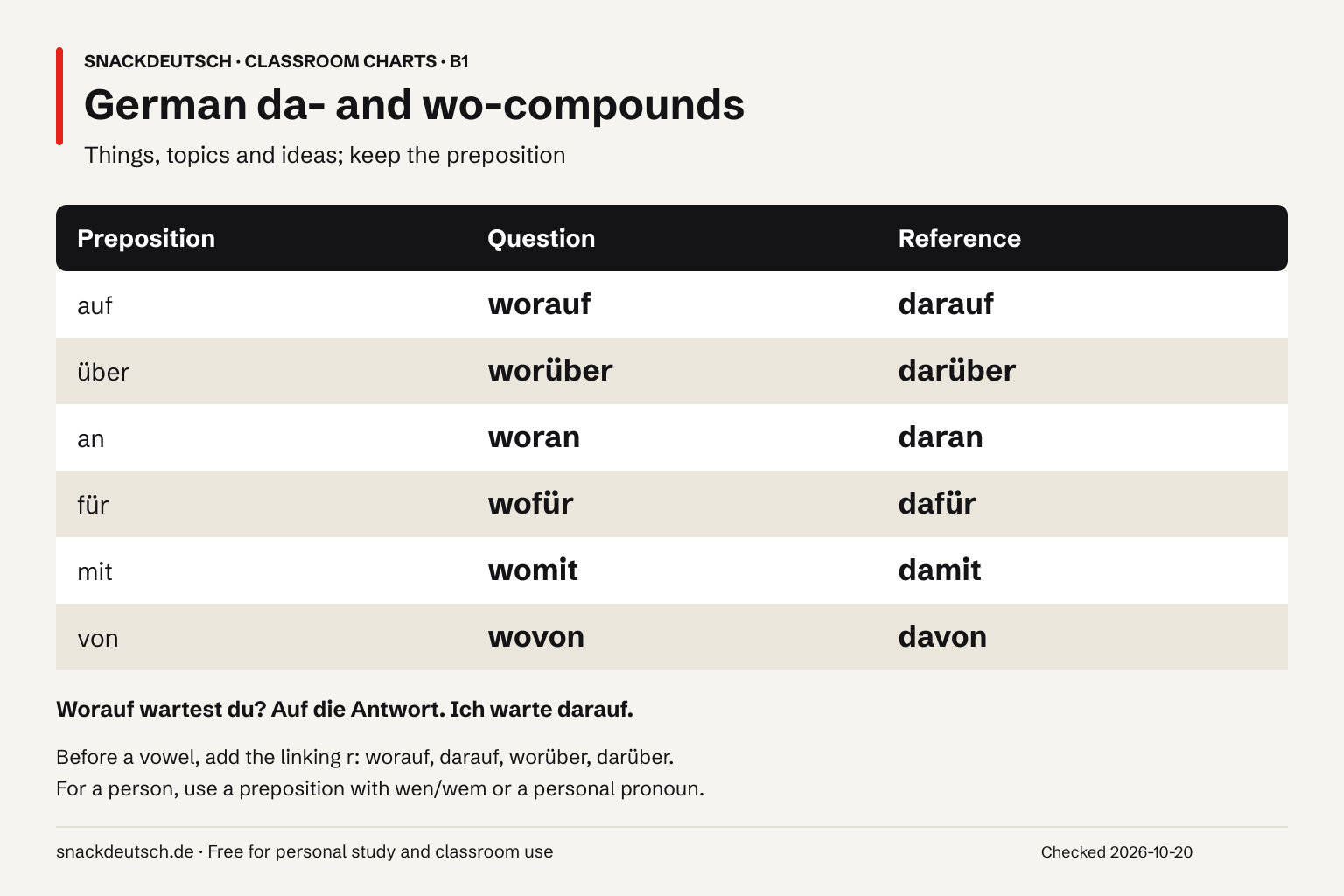
| Preposition | Question | Reference |
|---|---|---|
| auf | worauf | darauf |
| über | worüber | darüber |
| an | woran | daran |
| für | wofür | dafür |
| mit | womit | damit |
| von | wovon | davon |
Worauf wartest du? Auf die Antwort. Ich warte darauf.
- Before a vowel, add the linking r: worauf, darauf, worüber, darüber.
- For a person, use a preposition with wen/wem or a personal pronoun.
German weak nouns
Selected masculine singular nouns and their nominative plurals. Suggested level: B1.
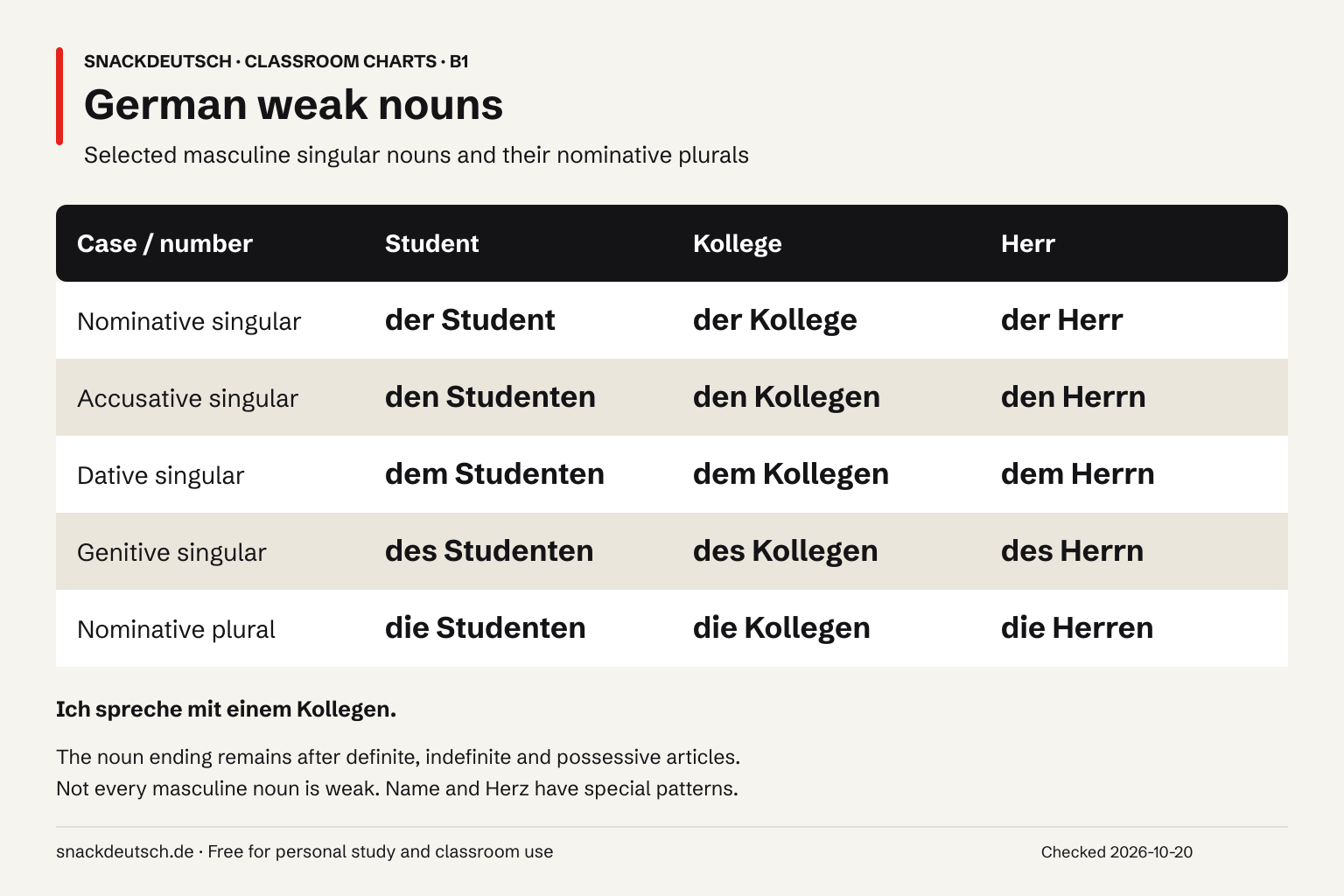
| Case / number | Student | Kollege | Herr |
|---|---|---|---|
| Nominative singular | der Student | der Kollege | der Herr |
| Accusative singular | den Studenten | den Kollegen | den Herrn |
| Dative singular | dem Studenten | dem Kollegen | dem Herrn |
| Genitive singular | des Studenten | des Kollegen | des Herrn |
| Nominative plural | die Studenten | die Kollegen | die Herren |
Ich spreche mit einem Kollegen.
- The noun ending remains after definite, indefinite and possessive articles.
- Not every masculine noun is weak. Name and Herz have special patterns.
German genitive noun phrases
Articles and selected noun endings. Suggested level: B1.
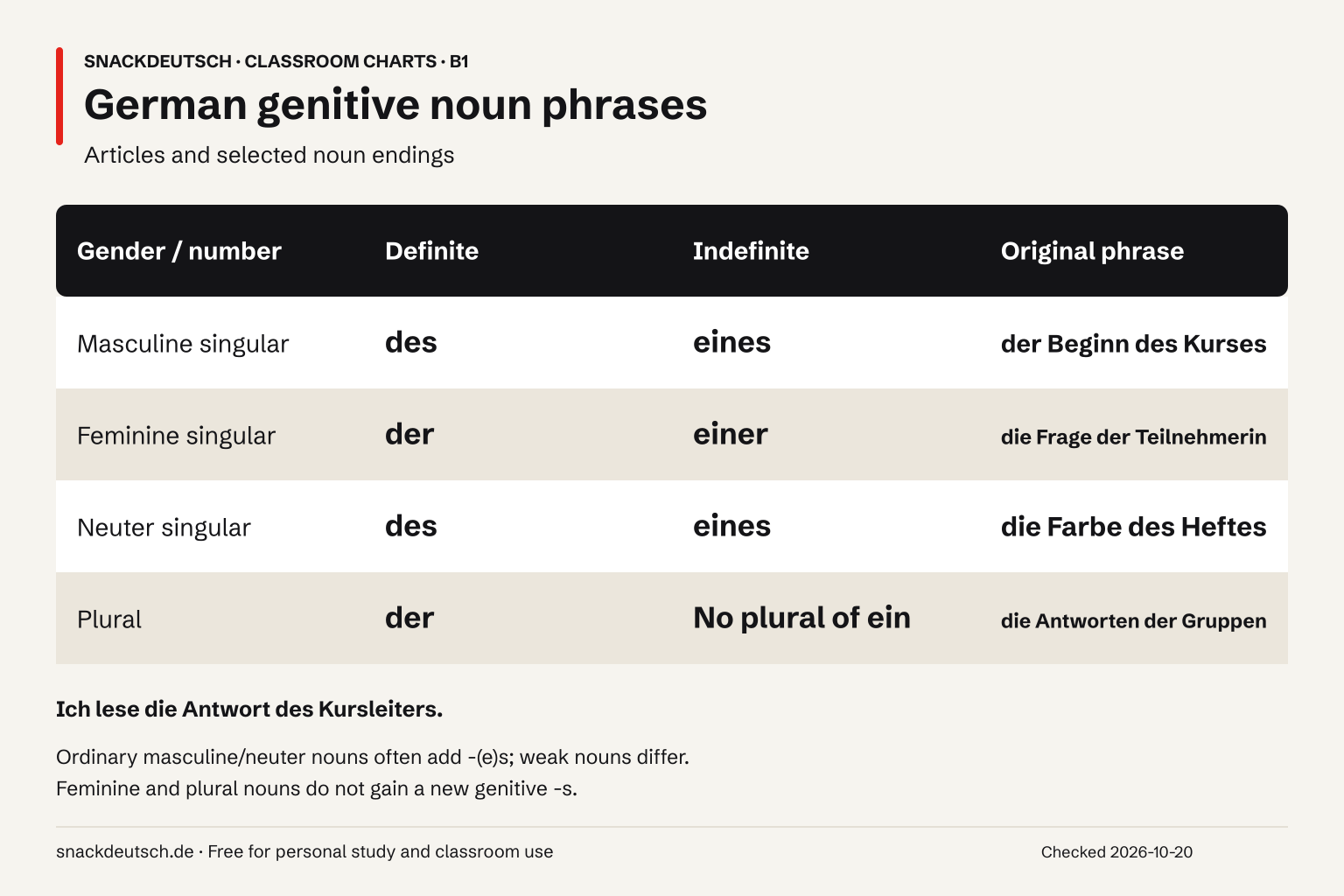
| Gender / number | Definite | Indefinite | Original phrase |
|---|---|---|---|
| Masculine singular | des | eines | der Beginn des Kurses |
| Feminine singular | der | einer | die Frage der Teilnehmerin |
| Neuter singular | des | eines | die Farbe des Heftes |
| Plural | der | No plural of ein | die Antworten der Gruppen |
Ich lese die Antwort des Kursleiters.
- Ordinary masculine/neuter nouns often add -(e)s; weak nouns differ.
- Feminine and plural nouns do not gain a new genitive -s.
Present hypothetical situations
Forms for imagining a different situation. Suggested level: B2.
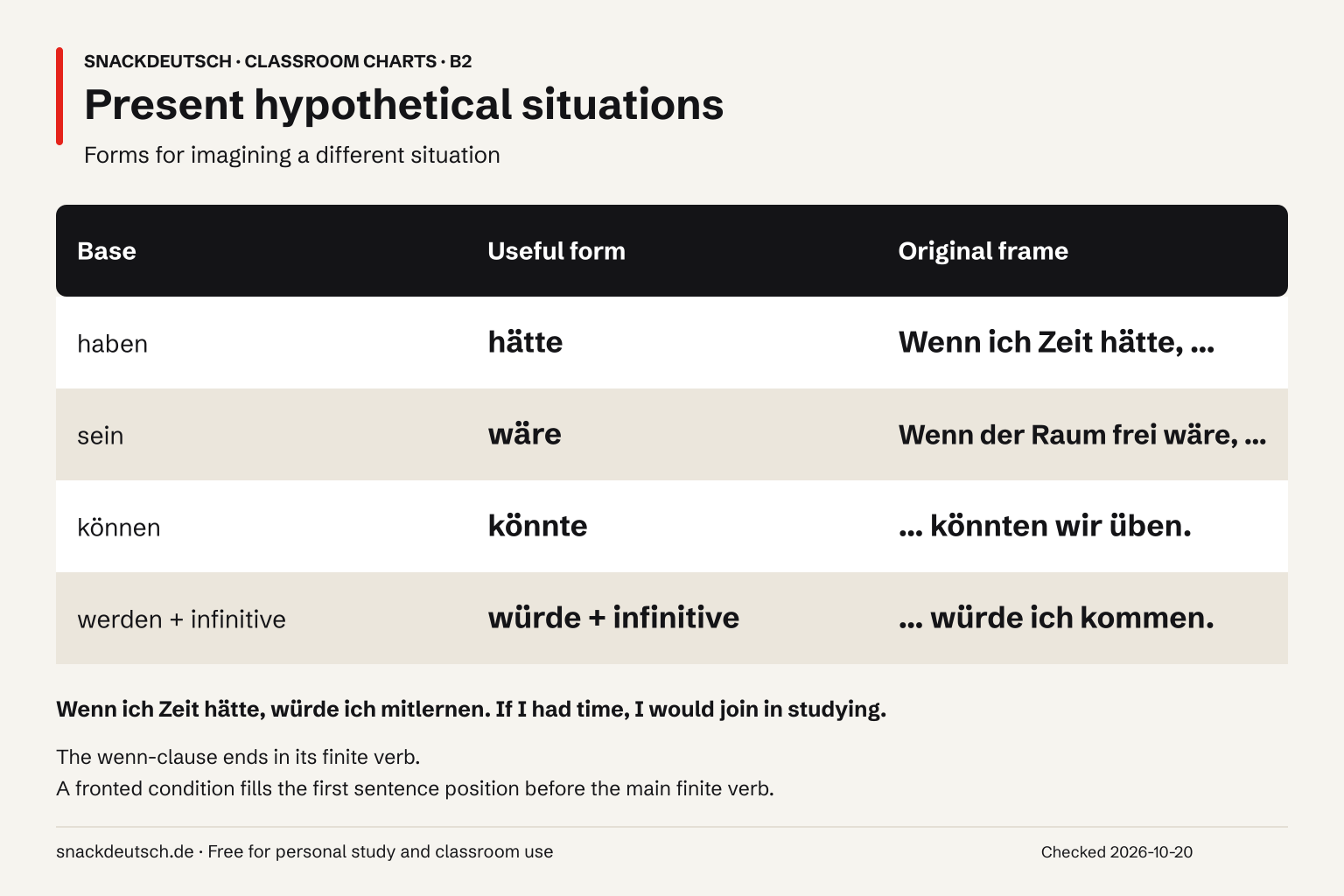
| Base | Useful form | Original frame |
|---|---|---|
| haben | hätte | Wenn ich Zeit hätte, … |
| sein | wäre | Wenn der Raum frei wäre, … |
| können | könnte | … könnten wir üben. |
| werden + infinitive | würde + infinitive | … würde ich kommen. |
Wenn ich Zeit hätte, würde ich mitlernen. If I had time, I would join in studying.
- The wenn-clause ends in its finite verb.
- A fronted condition fills the first sentence position before the main finite verb.
Past hypothetical situations
Hätte/wäre + participle · modal uses a double infinitive. Suggested level: B2.
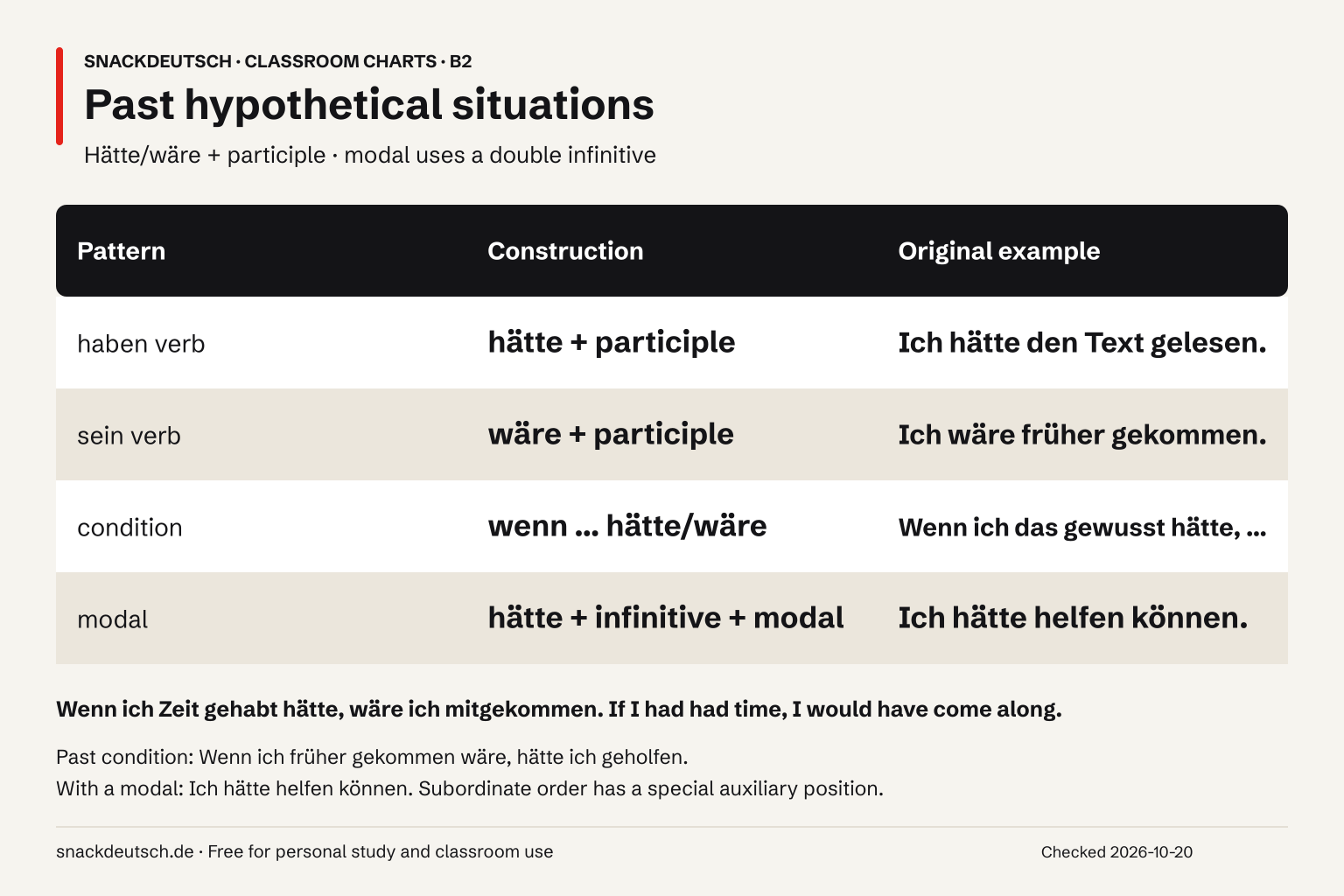
| Pattern | Construction | Original example |
|---|---|---|
| haben verb | hätte + participle | Ich hätte den Text gelesen. |
| sein verb | wäre + participle | Ich wäre früher gekommen. |
| condition | wenn … hätte/wäre | Wenn ich das gewusst hätte, … |
| modal | hätte + infinitive + modal | Ich hätte helfen können. |
Wenn ich Zeit gehabt hätte, wäre ich mitgekommen. If I had had time, I would have come along.
- Past condition: Wenn ich früher gekommen wäre, hätte ich geholfen.
- With a modal: Ich hätte helfen können. Subordinate order has a special auxiliary position.
German process passive
Werden + Partizip II · one action across tenses. Suggested level: B2.
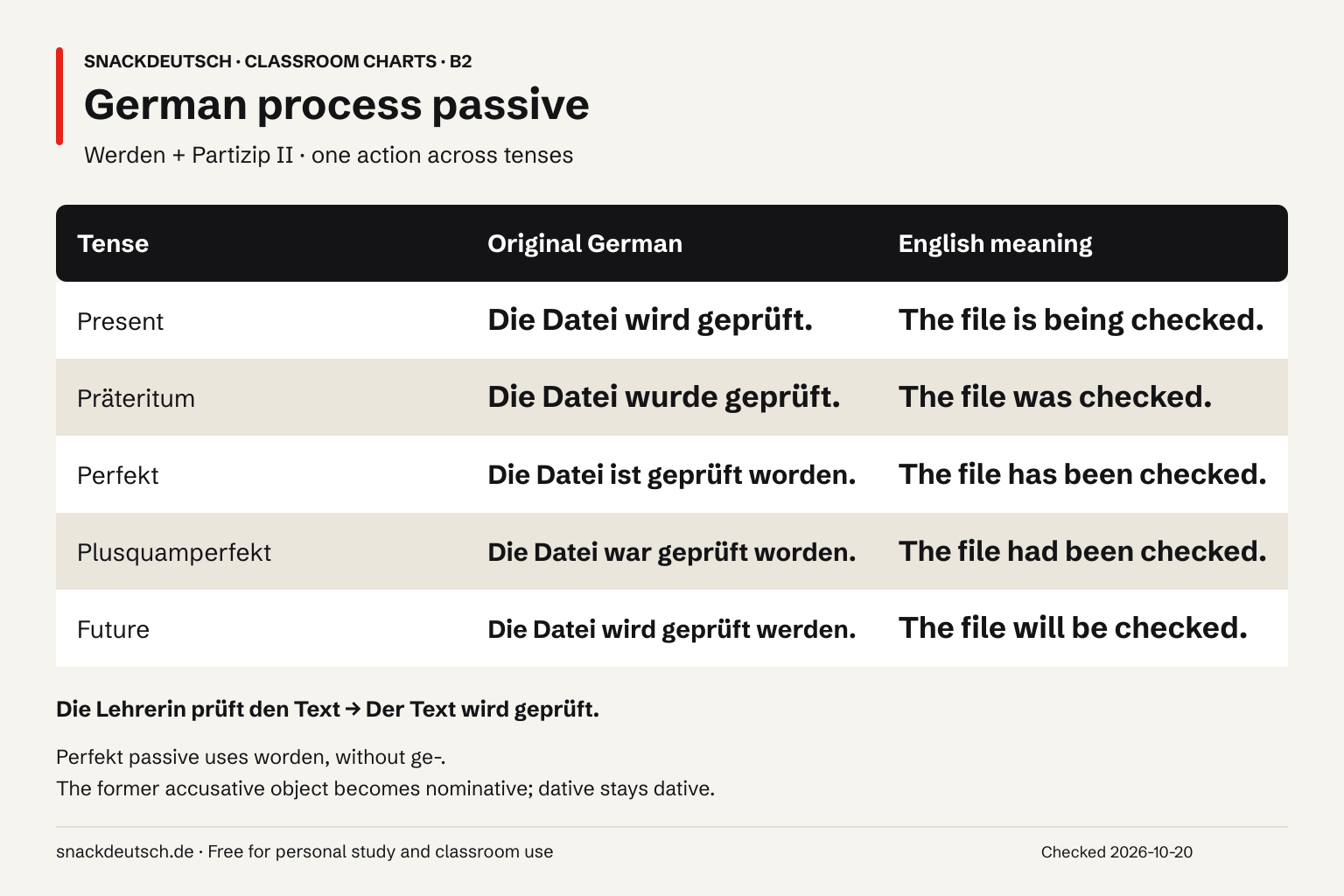
| Tense | Original German | English meaning |
|---|---|---|
| Present | Die Datei wird geprüft. | The file is being checked. |
| Präteritum | Die Datei wurde geprüft. | The file was checked. |
| Perfekt | Die Datei ist geprüft worden. | The file has been checked. |
| Plusquamperfekt | Die Datei war geprüft worden. | The file had been checked. |
| Future | Die Datei wird geprüft werden. | The file will be checked. |
Die Lehrerin prüft den Text → Der Text wird geprüft.
- Perfekt passive uses worden, without ge-.
- The former accusative object becomes nominative; dative stays dative.
Process and state
Read the complete verb group and the intended perspective. Suggested level: B2.
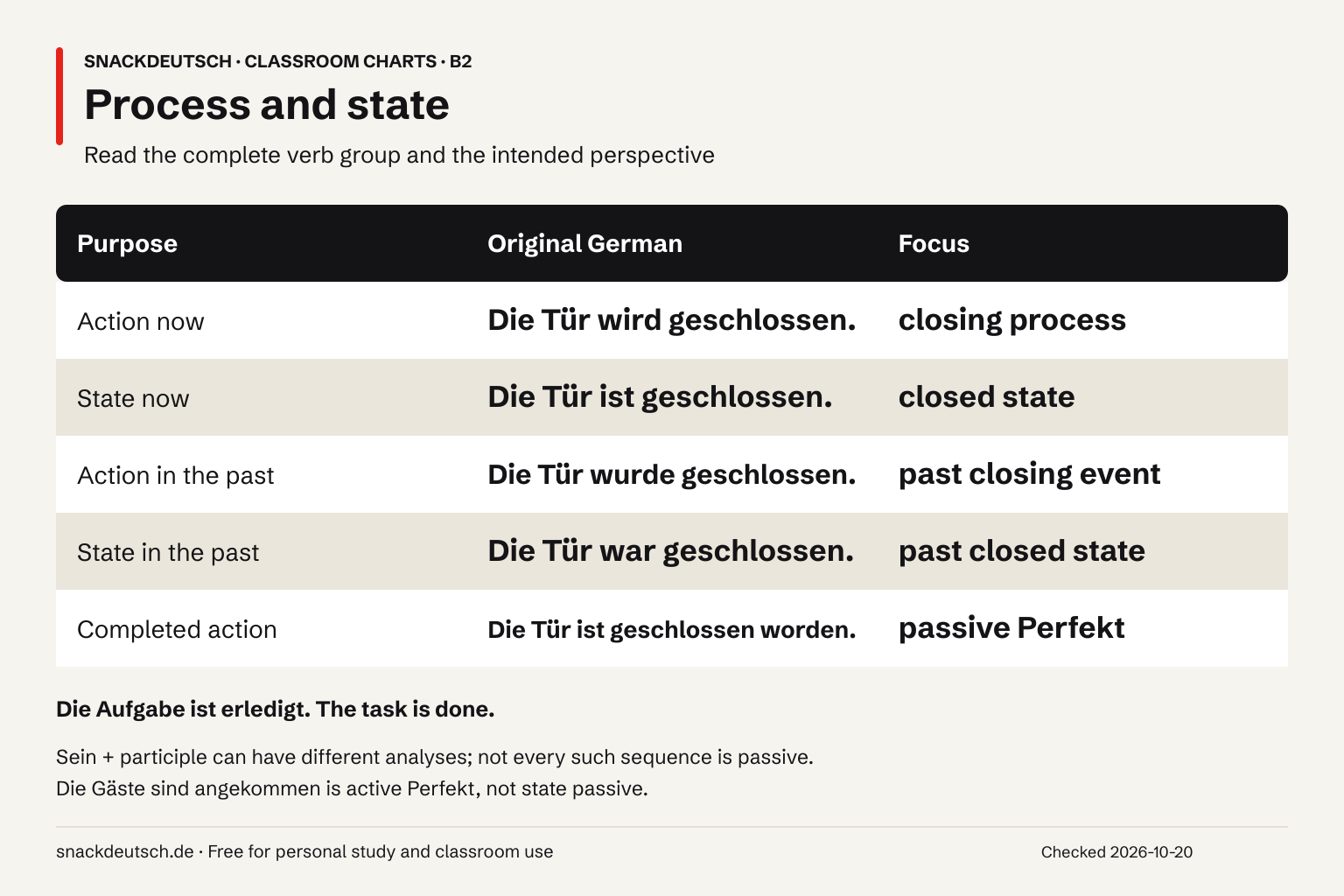
| Purpose | Original German | Focus |
|---|---|---|
| Action now | Die Tür wird geschlossen. | closing process |
| State now | Die Tür ist geschlossen. | closed state |
| Action in the past | Die Tür wurde geschlossen. | past closing event |
| State in the past | Die Tür war geschlossen. | past closed state |
| Completed action | Die Tür ist geschlossen worden. | passive Perfekt |
Die Aufgabe ist erledigt. The task is done.
- Sein + participle can have different analyses; not every such sequence is passive.
- Die Gäste sind angekommen is active Perfekt, not state passive.
Verbs and noun phrases
Keep the meaning, participants and agreement. Suggested level: B2.
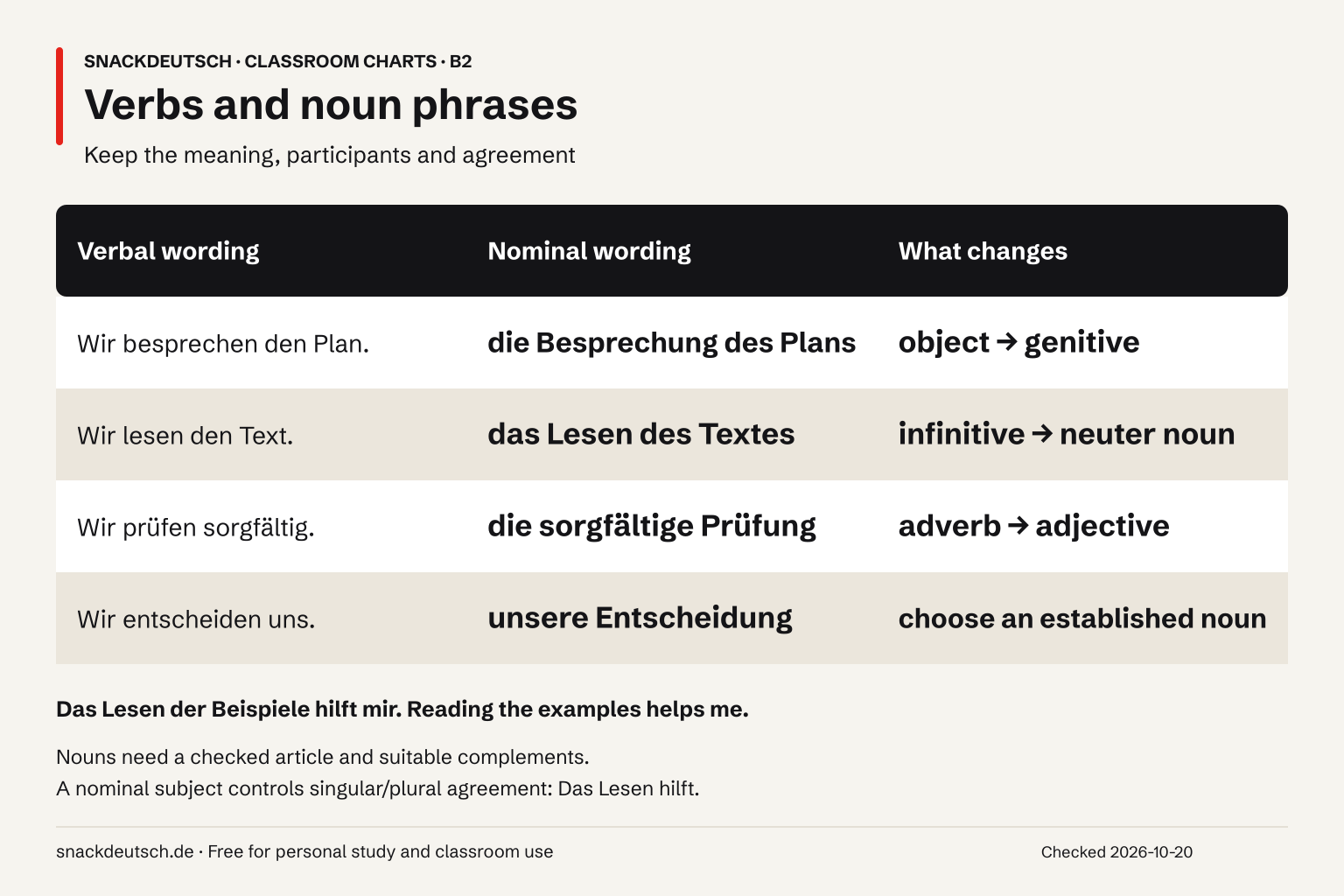
| Verbal wording | Nominal wording | What changes |
|---|---|---|
| Wir besprechen den Plan. | die Besprechung des Plans | object → genitive |
| Wir lesen den Text. | das Lesen des Textes | infinitive → neuter noun |
| Wir prüfen sorgfältig. | die sorgfältige Prüfung | adverb → adjective |
| Wir entscheiden uns. | unsere Entscheidung | choose an established noun |
Das Lesen der Beispiele hilft mir. Reading the examples helps me.
- Nouns need a checked article and suitable complements.
- A nominal subject controls singular/plural agreement: Das Lesen hilft.
Participles before nouns
Unpack the phrase to check the relationship. Suggested level: B2.
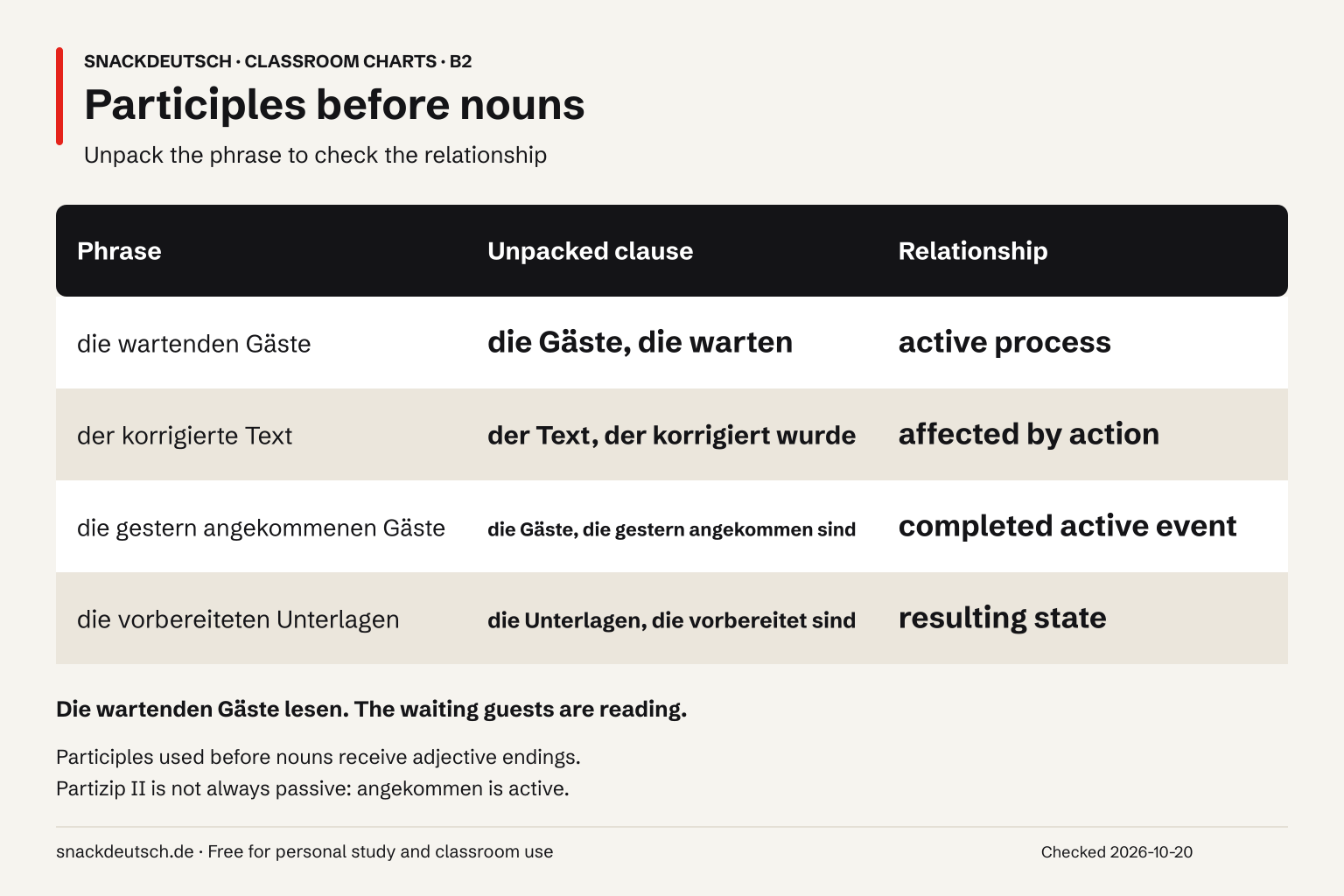
| Phrase | Unpacked clause | Relationship |
|---|---|---|
| die wartenden Gäste | die Gäste, die warten | active process |
| der korrigierte Text | der Text, der korrigiert wurde | affected by action |
| die gestern angekommenen Gäste | die Gäste, die gestern angekommen sind | completed active event |
| die vorbereiteten Unterlagen | die Unterlagen, die vorbereitet sind | resulting state |
Die wartenden Gäste lesen. The waiting guests are reading.
- Participles used before nouns receive adjective endings.
- Partizip II is not always passive: angekommen is active.
Je … desto
Two comparative phrases · two changing quantities. Suggested level: B2.
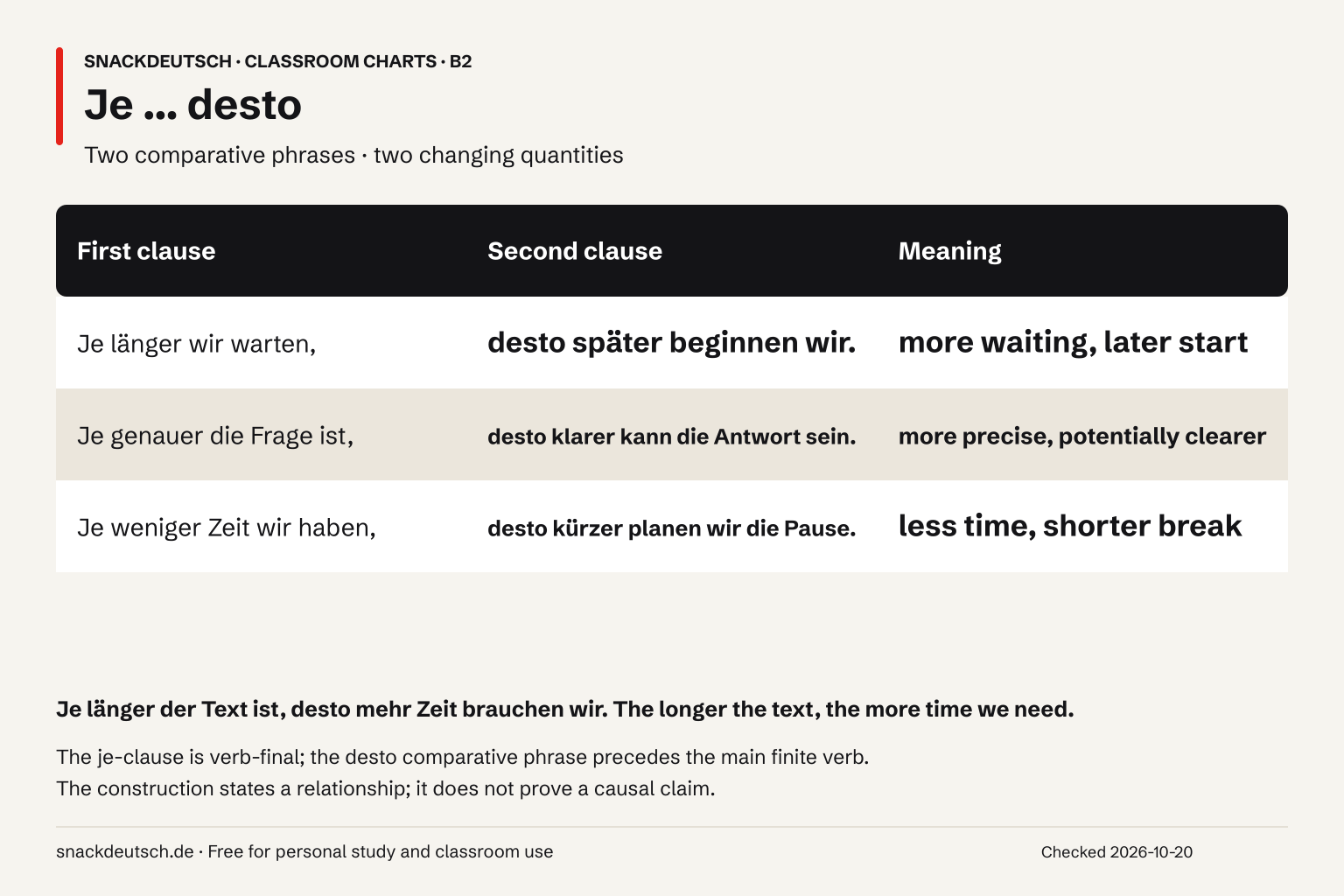
| First clause | Second clause | Meaning |
|---|---|---|
| Je länger wir warten, | desto später beginnen wir. | more waiting, later start |
| Je genauer die Frage ist, | desto klarer kann die Antwort sein. | more precise, potentially clearer |
| Je weniger Zeit wir haben, | desto kürzer planen wir die Pause. | less time, shorter break |
Je länger der Text ist, desto mehr Zeit brauchen wir. The longer the text, the more time we need.
- The je-clause is verb-final; the desto comparative phrase precedes the main finite verb.
- The construction states a relationship; it does not prove a causal claim.
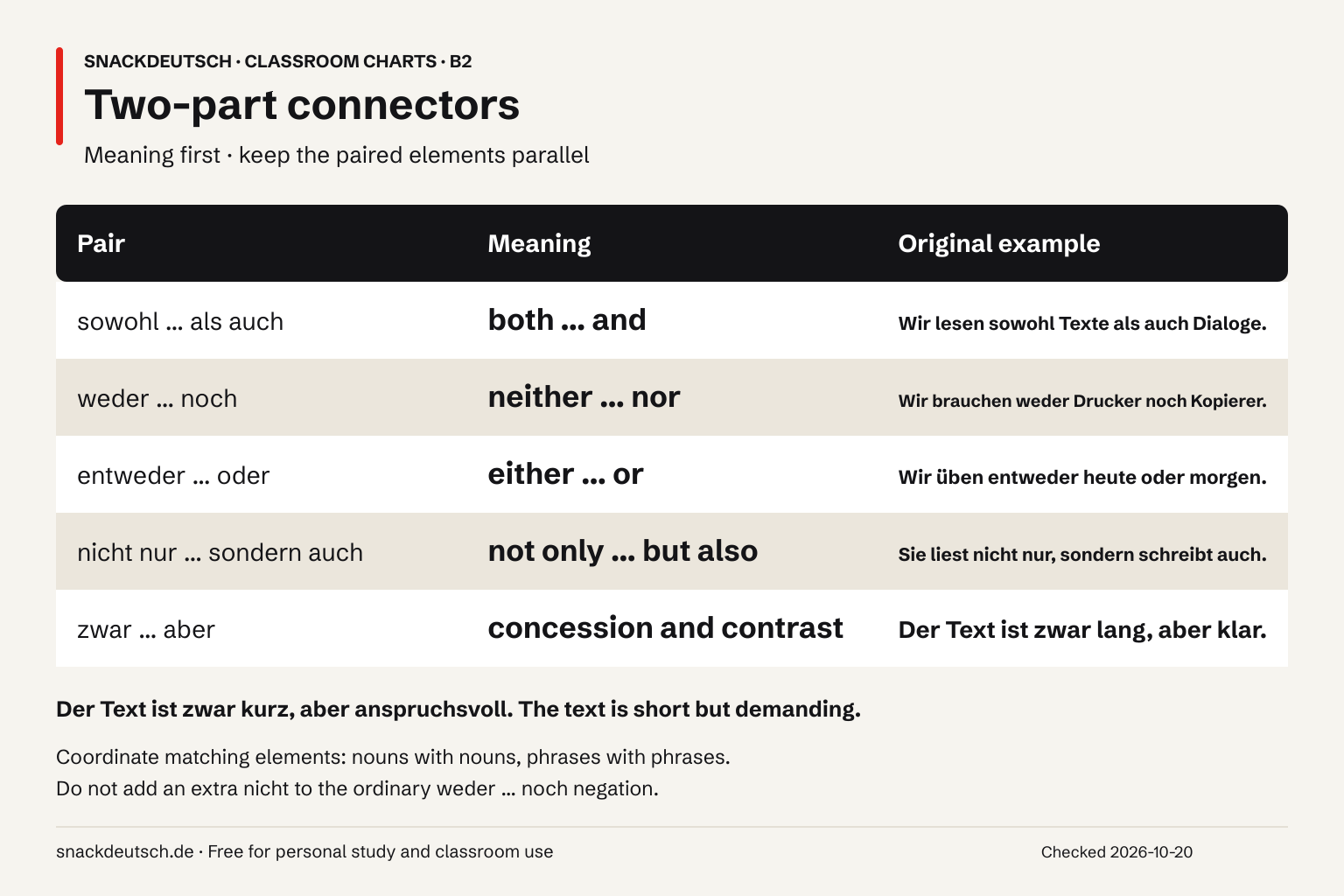
Two-part connectors
Meaning first · keep the paired elements parallel. Suggested level: B2.
| Pair | Meaning | Original example |
|---|---|---|
| sowohl … als auch | both … and | Wir lesen sowohl Texte als auch Dialoge. |
| weder … noch | neither … nor | Wir brauchen weder Drucker noch Kopierer. |
| entweder … oder | either … or | Wir üben entweder heute oder morgen. |
| nicht nur … sondern auch | not only … but also | Sie liest nicht nur, sondern schreibt auch. |
| zwar … aber | concession and contrast | Der Text ist zwar lang, aber klar. |
Der Text ist zwar kurz, aber anspruchsvoll. The text is short but demanding.
- Coordinate matching elements: nouns with nouns, phrases with phrases.
- Do not add an extra nicht to the ordinary weder … noch negation.
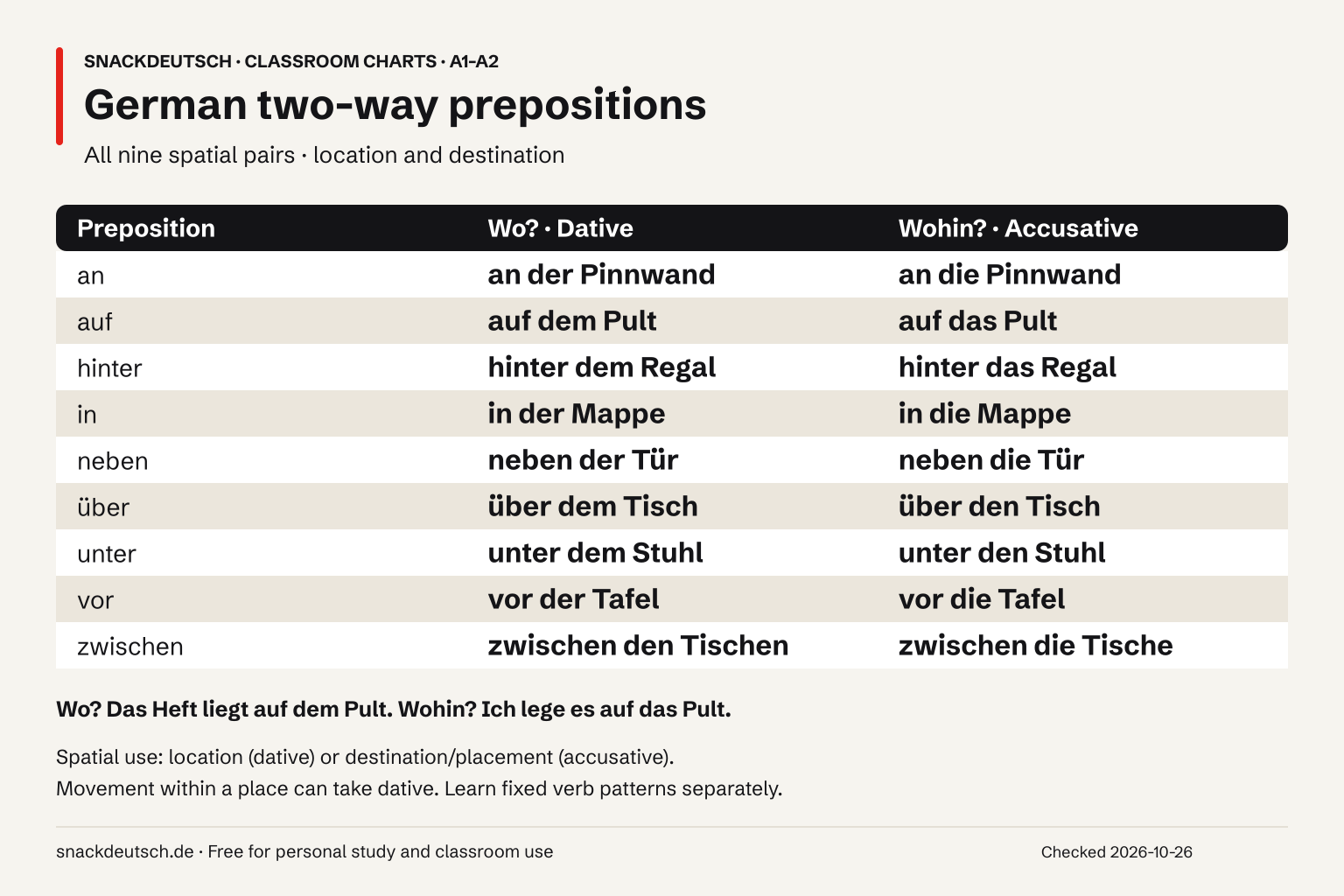
German two-way prepositions
All nine spatial pairs · location and destination. Suggested level: A1–A2.
| Preposition | Wo? · Dative | Wohin? · Accusative |
|---|---|---|
| an | an der Pinnwand | an die Pinnwand |
| auf | auf dem Pult | auf das Pult |
| hinter | hinter dem Regal | hinter das Regal |
| in | in der Mappe | in die Mappe |
| neben | neben der Tür | neben die Tür |
| über | über dem Tisch | über den Tisch |
| unter | unter dem Stuhl | unter den Stuhl |
| vor | vor der Tafel | vor die Tafel |
| zwischen | zwischen den Tischen | zwischen die Tische |
Wo? Das Heft liegt auf dem Pult. Wohin? Ich lege es auf das Pult.
- Spatial use: location (dative) or destination/placement (accusative).
- Movement within a place can take dative. Learn fixed verb patterns separately.
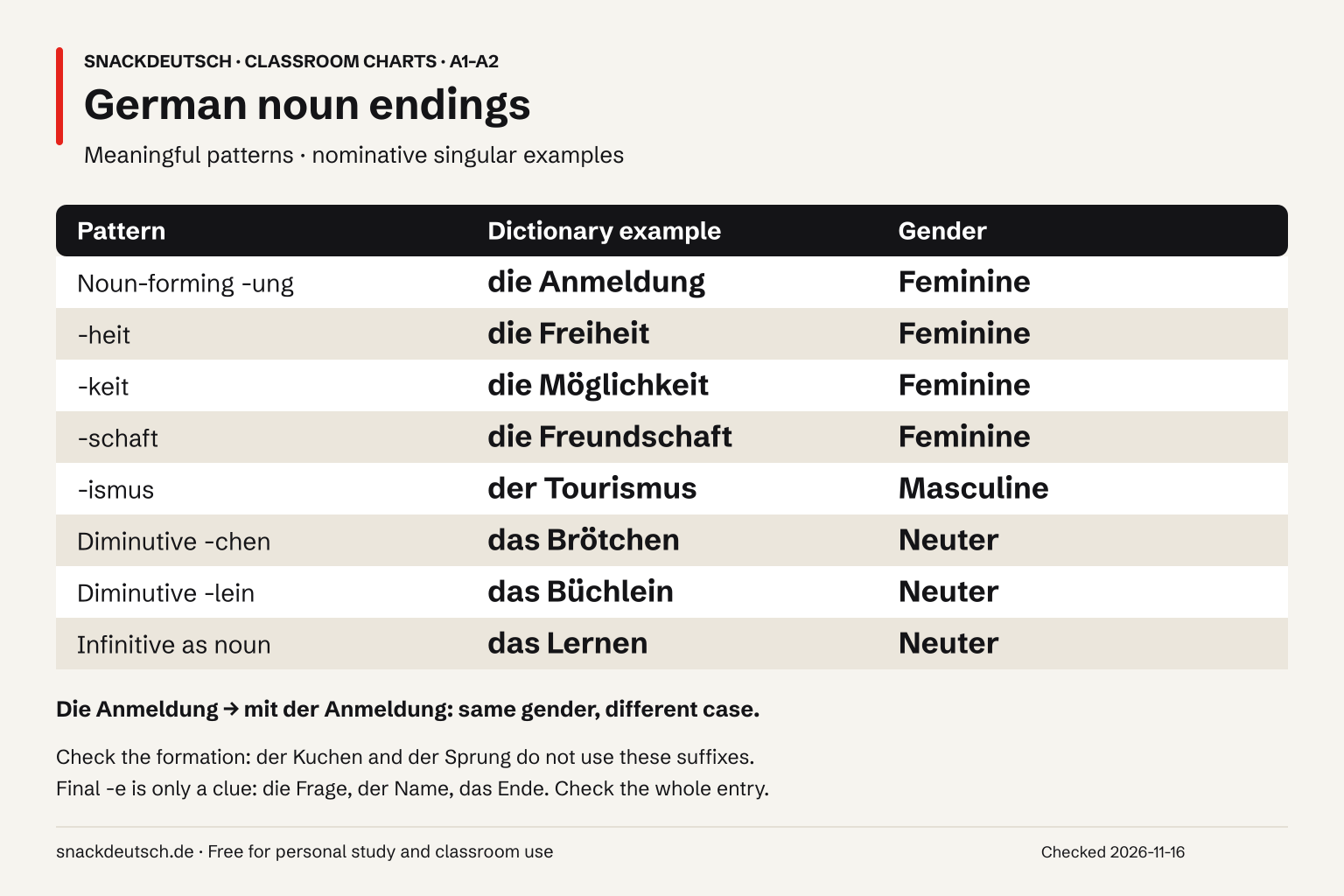
German noun endings
Meaningful patterns · nominative singular examples. Suggested level: A1–A2.
| Pattern | Dictionary example | Gender |
|---|---|---|
| Noun-forming -ung | die Anmeldung | Feminine |
| -heit | die Freiheit | Feminine |
| -keit | die Möglichkeit | Feminine |
| -schaft | die Freundschaft | Feminine |
| -ismus | der Tourismus | Masculine |
| Diminutive -chen | das Brötchen | Neuter |
| Diminutive -lein | das Büchlein | Neuter |
| Infinitive as noun | das Lernen | Neuter |
Die Anmeldung → mit der Anmeldung: same gender, different case.
- Check the formation: der Kuchen and der Sprung do not use these suffixes.
- Final -e is only a clue: die Frage, der Name, das Ende. Check the whole entry.
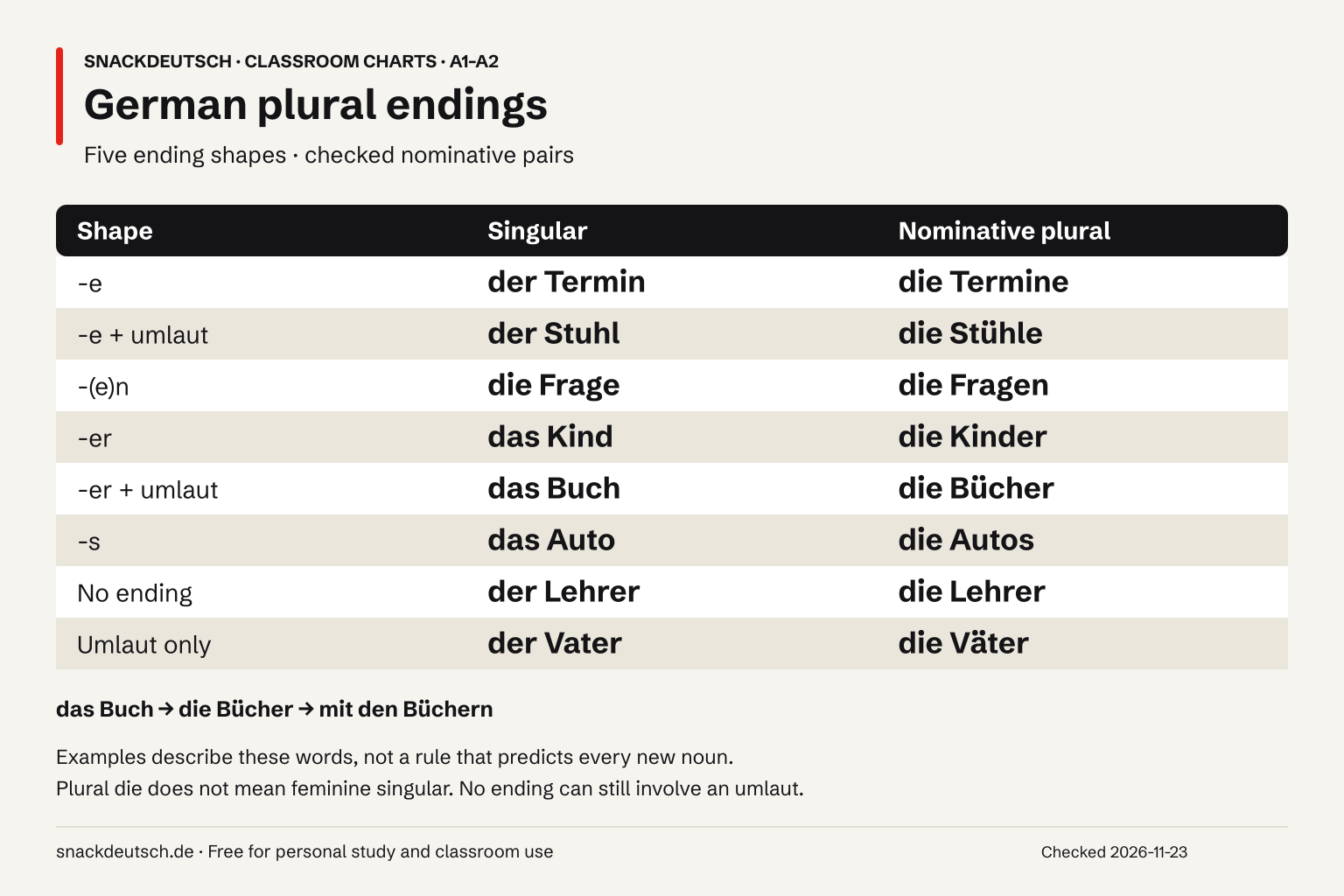
German plural endings
Five ending shapes · checked nominative pairs. Suggested level: A1–A2.
| Shape | Singular | Nominative plural |
|---|---|---|
| -e | der Termin | die Termine |
| -e + umlaut | der Stuhl | die Stühle |
| -(e)n | die Frage | die Fragen |
| -er | das Kind | die Kinder |
| -er + umlaut | das Buch | die Bücher |
| -s | das Auto | die Autos |
| No ending | der Lehrer | die Lehrer |
| Umlaut only | der Vater | die Väter |
das Buch → die Bücher → mit den Büchern
- Examples describe these words, not a rule that predicts every new noun.
- Plural die does not mean feminine singular. No ending can still involve an umlaut.
Use one chart with one sentence
Take a corrected sentence from your notebook, such as Ich schreibe mit einem neuen Stift: I am writing with a new pen. Work through the decisions separately:
- Meaning: you mean a pen, not a previously identified particular pen, so choose an indefinite article.
- Gender: the dictionary form is der Stift, so use the masculine column.
- Case: mit takes dative. The article table gives einem.
- Adjective: after an ein-word, dative masculine takes -en: neuen.
Now replace Stift with Heft: mit einem neuen Heft. The noun is neuter, but the dative article and adjective happen to look the same. This is why a chart should support a sentence, rather than become an isolated row of sounds to memorize.
A small routine for the week
After class, choose three sentences that contain a structure you have just studied. Find the relevant row, mark the part you changed, and say the sentence aloud. The next day, cover the chart and try the same sentences again. Before your next lesson, bring one example you still cannot explain to your teacher.
Use the vocabulary notebook template for your nouns, plurals and example sentences. If you prefer to keep course vocabulary in an app, SnackDeutsch supports personal vocabulary chapters and practice between lessons. These charts remain usable on their own.
What these charts do and do not cover
The article sheets show all four cases, including genitive. The personal-pronoun sheet covers nominative, accusative and dative. The modal-verb sheet covers the present tense of six verbs, with a separate lesson on meaning and sentence patterns. The adjective sheets distinguish definite articles, ein-words and no determiner; unusual determiner combinations may need a separate reference.
A table cannot decide the case for you. Verbs, prepositions and sentence structure matter. If mit dem Bus seems surprising because the bus is moving, see the location and destination lesson: movement alone does not determine case.
The collection’s explanatory articles include source links and practice answers. The original layouts and examples were prepared by SnackDeutsch; no competitor charts or textbook pages are reproduced. You may print or adapt these resources for personal study and classroom teaching. Please keep the source credit so learners can find corrections and the full explanation.
How the resources are checked
Grammar forms are compared with linked reference sources, while examples and answer keys are checked as complete sentences. The image and text table are generated from the same checked data, which helps keep the versions consistent. Suggested levels are editorial judgments, not certification. If you spot an error, contact us with the chart name and the example that needs attention.