
Free resources
German plural endings: five patterns, umlauts and dative practice
Compare five German plural shapes, keep umlauts in complete noun pairs, and practise dictionary plurals and dative forms with eight explained tasks.
Read as Markdown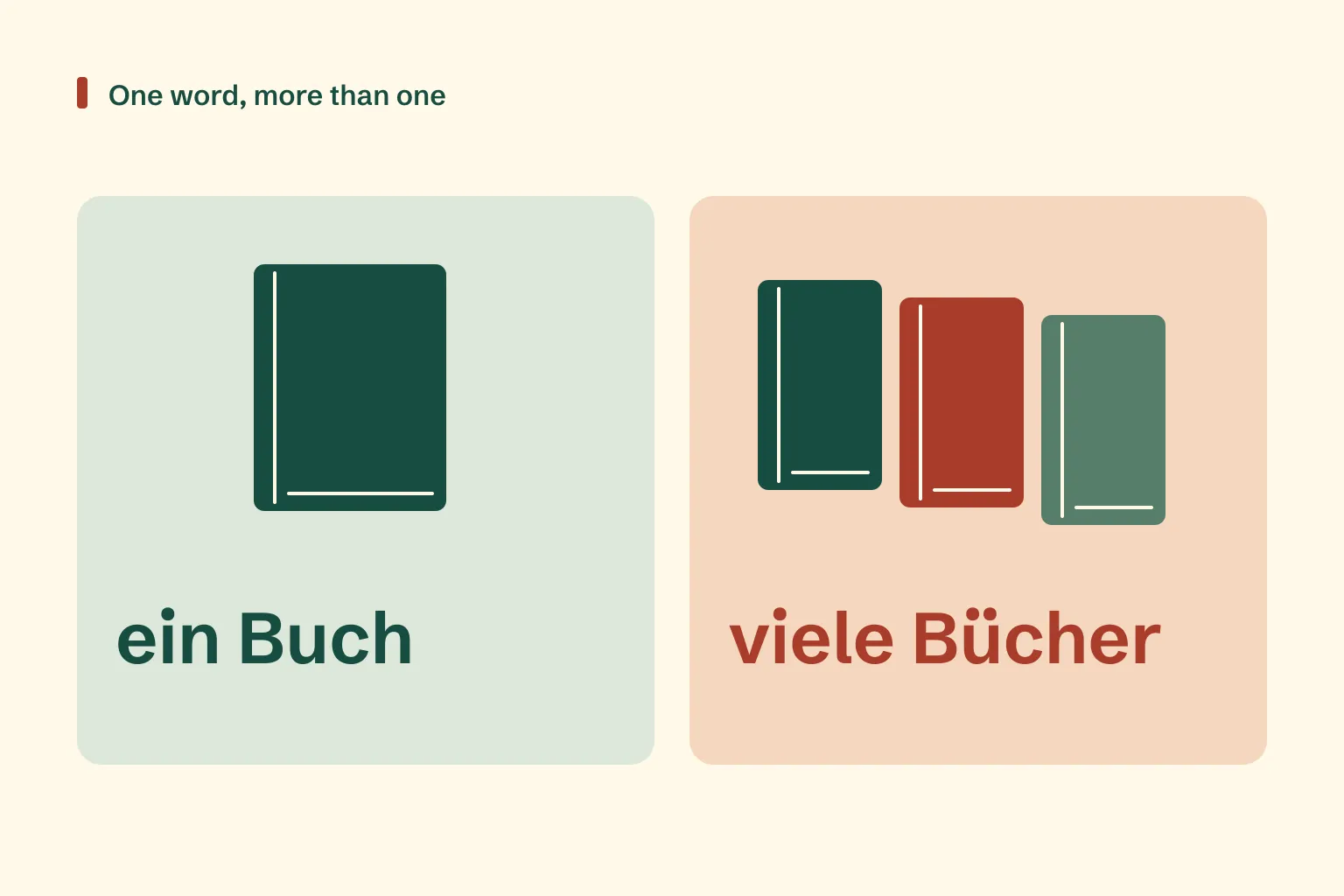
German nouns have several common plural shapes: -e, -(e)n, -er, -s and no added ending. An umlaut can appear with an ending or without one. Learn a complete pair, such as das Buch, die Bücher, instead of predicting every plural from the last letters. Then treat mit den Büchern as a case form of that plural.
Your class notes have ein Buch and zwei Bücher. On the next line, der Lehrer becomes die Lehrer. One noun changes its vowel and gains letters; the other keeps the same noun form. A useful notebook preserves those exact forms rather than recording one rule for the whole list.
Takeaway: Check the dictionary plural, including any umlaut. Then check the case needed in your sentence. Plural formation and dative marking are two separate steps.
Read the five plural shapes
The chart groups checked examples by their visible changes. It is a reference for these nouns, not a complete system for predicting an unfamiliar noun. The definite nominative plural article is die for all three singular genders. In accusative it is also die; other cases have different article forms.
German plural endings
Five ending shapes · checked nominative pairs. Suggested level: A1–A2.
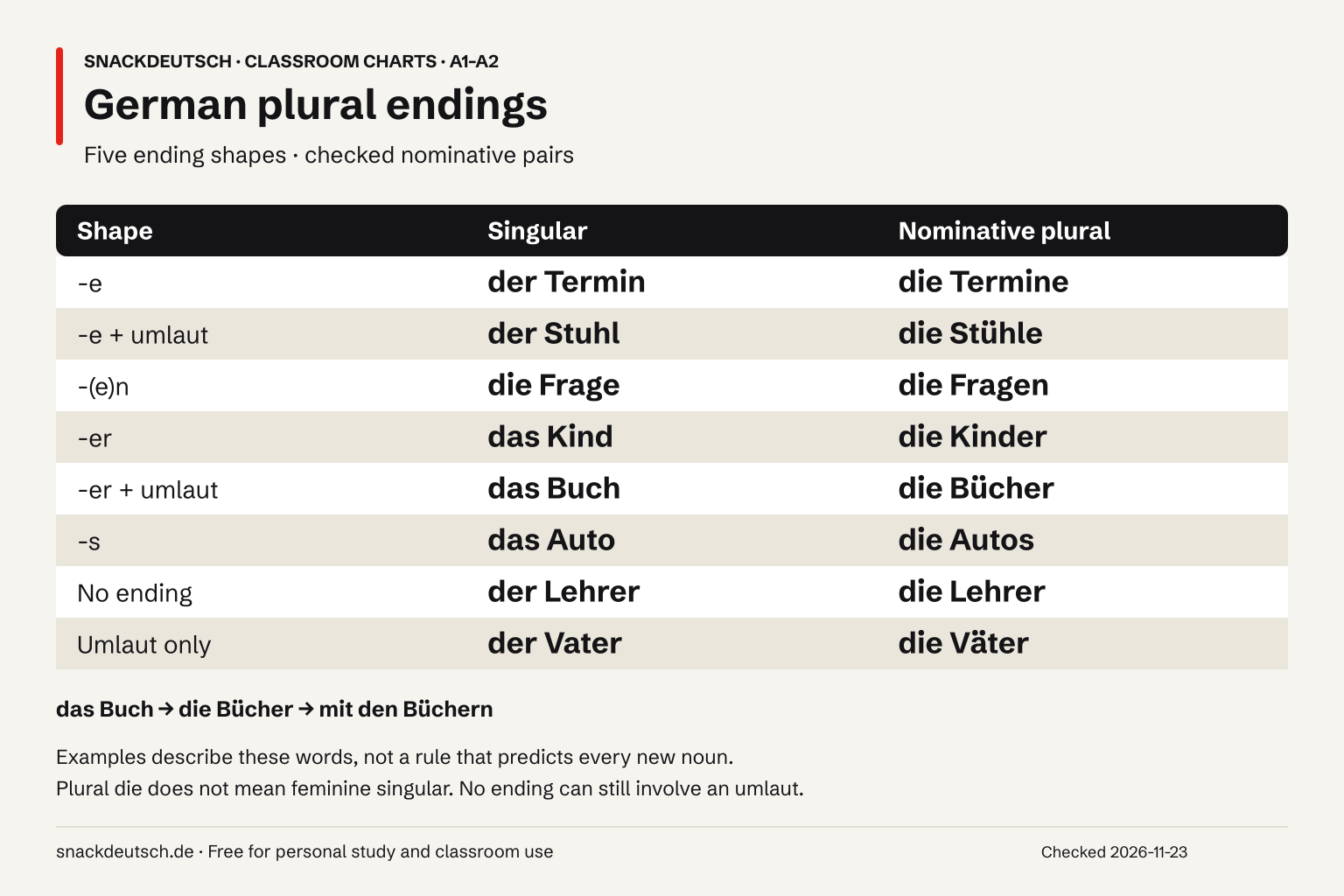
| Shape | Singular | Nominative plural |
|---|---|---|
| -e | der Termin | die Termine |
| -e + umlaut | der Stuhl | die Stühle |
| -(e)n | die Frage | die Fragen |
| -er | das Kind | die Kinder |
| -er + umlaut | das Buch | die Bücher |
| -s | das Auto | die Autos |
| No ending | der Lehrer | die Lehrer |
| Umlaut only | der Vater | die Väter |
das Buch → die Bücher → mit den Büchern
- Examples describe these words, not a rule that predicts every new noun.
- Plural die does not mean feminine singular. No ending can still involve an umlaut.
In -(e)n, the brackets cover endings written -n or -en. Here Frage becomes Fragen, so the added letter is n. The chart separates examples with an umlaut from examples without one: Kinder has -er without an umlaut, while Bücher has both.
Keep the grammar chart collection available when your teacher moves between noun forms and articles in sentences.
No ending can still mean a changed vowel
Compare der Lehrer, die Lehrer with der Vater, die Väter. Neither plural adds a suffix. Only the second pair changes a vowel. “No added ending” describes the ending, not a promise that the whole word stays unchanged.
Likewise, der Termin, die Termine and der Stuhl, die Stühle both add -e. Stühle also needs ü. If you record only “plural: -e,” you can lose that information. Write the complete plural and mark every change that matters.
These examples do not make “every noun ending in -er stays unchanged” a reliable new rule. Check the actual entry. The noun-ending lesson explains why the last letters of a word need careful interpretation.
Keep the singular gender and plural number separate
Das Buch is neuter in the singular. Die Bücher is its nominative plural. The article die does not change the singular noun’s gender to feminine.
A compact dictionary bank gives you complete pairs and meanings for the practice below:
| Singular and plural | Meaning |
|---|---|
| der Termin, die Termine | appointment |
| der Stuhl, die Stühle | chair |
| die Frage, die Fragen | question |
| das Kind, die Kinder | child |
| das Buch, die Bücher | book |
| das Auto, die Autos | car |
| der Lehrer, die Lehrer | teacher (masculine noun) |
| der Vater, die Väter | father |
Use the relevant meaning and form from your lesson. A word can have different uses, so do not assume that every sense of every noun has a useful plural. For this practice, all eight pairs refer to countable people or things.
Add the case form after checking the dictionary plural
Start with die Bücher. In mit den Büchern (with the books), mit requires dative. The article becomes den, and the noun gains -n: Bücher → Büchern. The dictionary plural remains Bücher.
For the common plural forms practised here, dative adds -n when that addition is possible. A plural already ending in -n keeps that ending; a plural in -s does not receive an extra dative -n.
| Dictionary plural | Dative phrase | What to notice |
|---|---|---|
| die Bücher | mit den Büchern | Add n to Bücher |
| die Lehrer | mit den Lehrern | Add n to Lehrer |
| die Fragen | mit den Fragen | The noun already ends in n |
| die Autos | mit den Autos | The s plural keeps its form |
The dictionary plural and the sentence form answer different questions. If you see mit den Lehrern, recover die Lehrer before saving the noun pair. This short reference does not cover every loanword or plural type. Check unfamiliar forms in a dictionary and use the case guide for your sentence’s structure.
Use a number in one sentence
Compare Ich habe ein Buch (I have a book) with Ich habe zwei Bücher (I have two books). The second sentence uses the checked plural after zwei. The indefinite article ein has no plural form. Here the number is followed by the checked plural noun.
Keep the practice focused: choose one noun, say the quantity, and check the noun form. When you build a longer noun from your lesson, the compound-noun guide shows how to find its head noun. Confirm that complete noun’s plural too.
Mini practice: eight tasks
Use the reference and dictionary bank above. Unless dative is explicitly requested, give the nominative plural.
- Complete the entry: The singular is das Auto. Write its full plural with die.
- Match the shapes: Match Termine, Fragen, Kinder, Autos, Lehrer to -e, -(e)n, -er, -s, no added ending. Use each shape once.
- Compare unchanged endings: What changes in Vater → Väter? What changes in Lehrer → Lehrer?
- Check the vowel: Both Kinder and Bücher have -er. Which pair needs an umlaut, and what is its complete singular–plural pair?
- Repair a claim: Correct “Die Bücher shows that Buch is feminine.”
- Recover the entry: In mit den Büchern, identify the dictionary plural and the extra case ending. Which word requires dative here?
- Complete the dative phrases: Use the dictionary plurals Lehrer, Fragen, Autos: mit den ___; mit den ___; mit den ___. Explain which noun gains a letter.
- Use a quantity: Change Ich habe ein Buch to say that you have two books. Then write the complete singular–plural pair for your notebook.
Answers and reasons
- Die Autos. This checked noun has an -s plural. That does not establish -s as the answer for every German noun.
- Termine: -e; Fragen: -(e)n; Kinder: -er; Autos: -s; Lehrer: no added ending. These labels describe the supplied forms.
- Vater → Väter changes a to ä and adds no ending. Lehrer → Lehrer changes neither the ending nor the vowel.
- Das Buch, die Bücher needs ü as well as -er. Das Kind, die Kinder has -er without an umlaut.
- Buch is neuter in the singular: das Buch. Die Bücher is plural. Nominative plural die is used with nouns of all three singular genders.
- The dictionary plural is die Bücher. Büchern adds n for dative; mit requires that case. The phrase does not introduce a different dictionary plural.
- Mit den Lehrern; mit den Fragen; mit den Autos. Only Lehrer gains n. Fragen already ends in n, and the s plural Autos keeps its form.
- Ich habe zwei Bücher. The notebook pair is das Buch, die Bücher. The number uses the checked plural, including ü; the indefinite article ein has no plural form.
Turn one class list into usable noun pairs
Choose three countable nouns from your own lesson. For each, write the singular with its article, the full dictionary plural, a meaning and one short phrase with a quantity. If your sentence uses dative, keep that phrase beside the dictionary pair so you can see the extra case step.
The vocabulary notebook template gives those entries a consistent home. The worksheet above includes its own bank, eight varied tasks and explained answers, so you can practise without another handout or an app.
Sources and further reading
- University of Texas at Austin, Grimm Grammar: noun plurals, endings, umlaut combinations and learning complete plural forms.
- Leibniz Institute for the German Language, grammis: Nomen, gender, number, case and noun inflection.
- IDS grammis: Kasusflexion, dative plural marking and the -(e)n/-s limits.
- Duden’s entries for Termin, Stuhl, Frage, Kind, Buch, Auto, Lehrer and Vater.