
Free resources
German modal verbs chart: present tense and sentence patterns
Check all six German modal verbs in the present tense, build statements and questions, and practise with six explained answers and a free worksheet.
Read as Markdown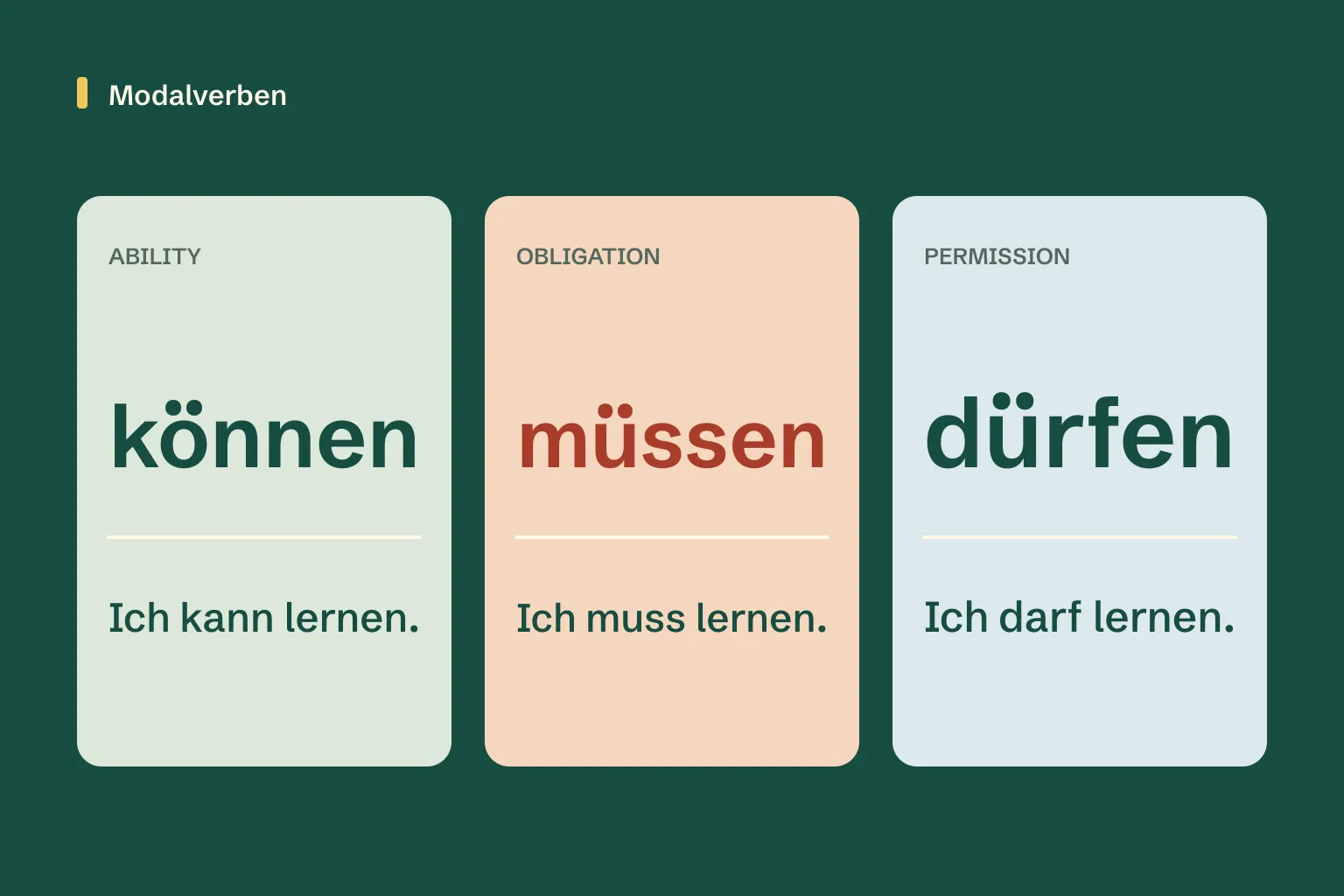
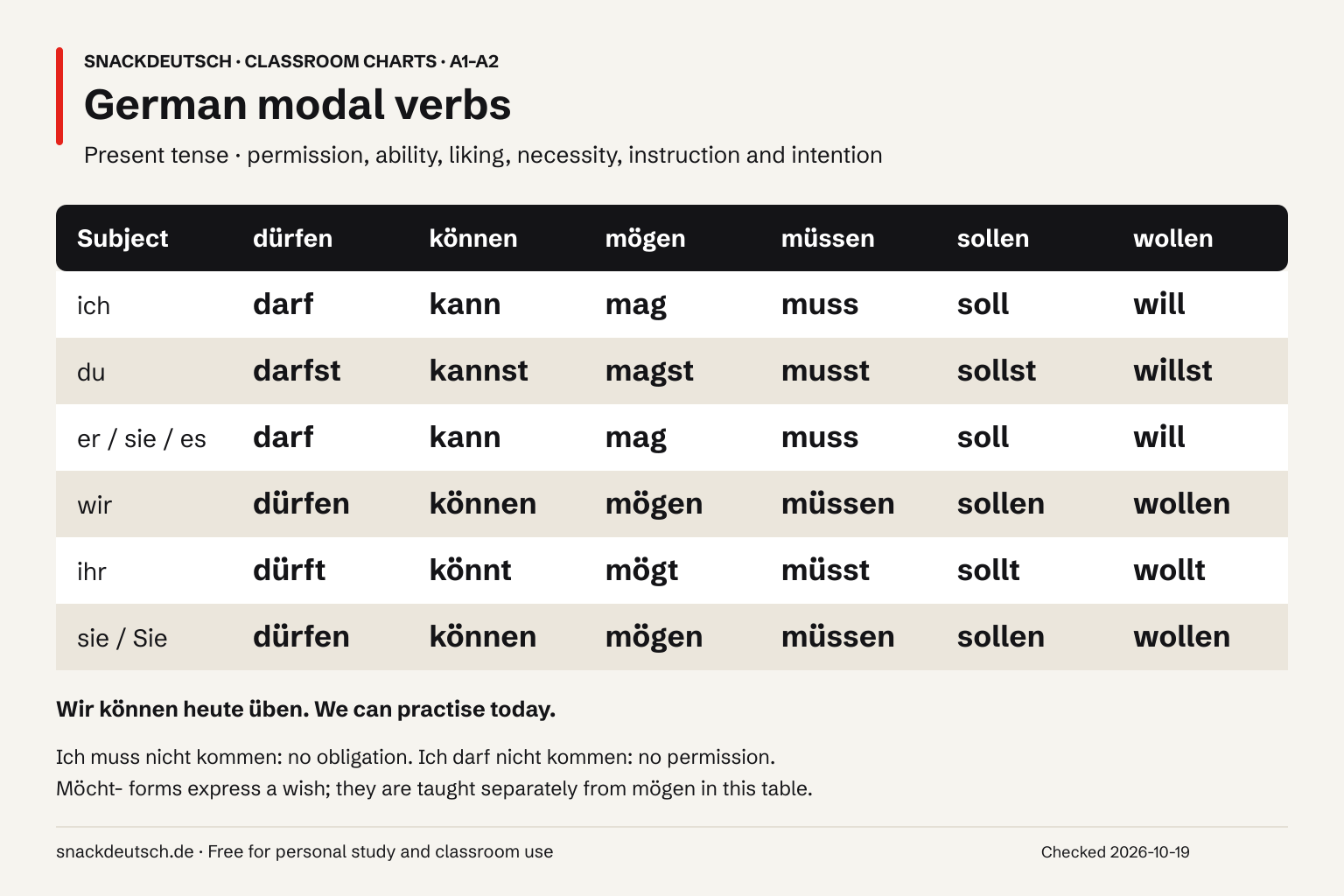
Your teacher writes Wir können heute üben on the board. The conjugated modal, können, says what is possible; üben names the activity. In a simple German statement, the modal takes the second sentence position and the infinitive goes at the end. The chart below gives the present-tense forms of dürfen, können, mögen, müssen, sollen and wollen.
Takeaway: Choose the meaning, match the modal to the subject, then check the final infinitive. Keep nicht müssen (not have to) separate from nicht dürfen (not be allowed to).
German modal verbs: present-tense chart
German modal verbs
Present tense · permission, ability, liking, necessity, instruction and intention. Suggested level: A1–A2.
| Subject | dürfen | können | mögen | müssen | sollen | wollen |
|---|---|---|---|---|---|---|
| ich | darf | kann | mag | muss | soll | will |
| du | darfst | kannst | magst | musst | sollst | willst |
| er / sie / es | darf | kann | mag | muss | soll | will |
| wir | dürfen | können | mögen | müssen | sollen | wollen |
| ihr | dürft | könnt | mögt | müsst | sollt | wollt |
| sie / Sie | dürfen | können | mögen | müssen | sollen | wollen |
Wir können heute üben. We can practise today.
- Ich muss nicht kommen: no obligation. Ich darf nicht kommen: no permission.
- Möcht- forms express a wish; they are taught separately from mögen in this table.
Lowercase sie here means “they”; capitalized Sie means formal “you.” The forms match. Ihr is informal plural “you,” for example when speaking to two classmates.
Notice the matching ich and er/sie/es forms: ich kann, sie kann. These six verbs have no -e or -t ending in those singular forms. For the full conjugation, check the University of Texas present-tense reference.
Choose a meaning before choosing a form
These are useful starting meanings for lessons and everyday plans. Modal verbs also have other uses; this guide does not cover reported claims or deductions.
| Verb | Starting meaning | Original example | English meaning |
|---|---|---|---|
| dürfen | have permission | Wir dürfen das Wörterbuch benutzen. | We are allowed to use the dictionary. |
| können | have the ability or possibility | Lea kann den Satz erklären. | Lea can explain the sentence. |
| mögen | like | Ich mag diese Übung. | I like this exercise. |
| müssen | have to | Ich muss die Seite noch lesen. | I still have to read the page. |
| sollen | be supposed to, following an instruction | Wir sollen die Verben markieren. | We are supposed to mark the verbs. |
| wollen | want to | Ihr wollt zusammen lernen. | You want to study together. |
With sollen, imagine the teacher has given an instruction. With wollen, the wish comes from the learners. Ich will means “I want,” not the English future marker “I will.”
Mögen often appears with a noun in beginner lessons, as in Ich mag diese Übung. That sentence is complete without another infinitive. Do not add an extra verb just because mögen is included in a modal-verb chart. The IDS grammar reference describes the broader modal-verb group and its meanings.
Build statements and yes/no questions
Here finite modal means the form that matches the subject, such as kann or können. Infinitive means the dictionary form, such as üben.
| Sentence type | Frame | Original example |
|---|---|---|
| Statement, subject first | subject + finite modal + other information + infinitive | Wir können heute üben. |
| Statement, time phrase first | time phrase + finite modal + subject + other information + infinitive | Nach dem Kurs können wir zusammen üben. |
| Yes/no question | finite modal + subject + other information + infinitive? | Können wir heute üben? |
| Question about time | wann + finite modal + subject + other information + infinitive? | Wann können wir zusammen üben? |
“Second position” means the second sentence element, not the second written word. Nach dem Kurs is one opening time phrase. The subject wir follows können in that example.
In the yes/no question, start directly with Können. You do not add an English-style “do.” Compare the sentence patterns in the IDS explanation of verb-first and verb-second sentences.
The wann frame asks about time. A subject question such as Wer kann helfen? (Who can help?) has no separate subject after kann: wer is already the subject.
Does the infinitive need zu?
When the modal directly takes another verb in these simple present-tense patterns, use the infinitive without zu: Wir müssen warten, not Wir müssen zu warten. This rule concerns the infinitive attached to the modal. It does not mean that the word zu can never appear elsewhere in a sentence. IDS lists these core modal verbs with a bare infinitive.
These frames describe main clauses. A clause introduced by weil has a different pattern: Ich bleibe hier, weil ich noch üben muss (I am staying here because I still have to practise). Keep that pattern separate while learning the present-tense chart.
Mögen and möchte: liking or a wish?
Ich mag Partnerarbeit means “I like pair work.” Ich möchte mit Lea arbeiten means “I would like to work with Lea.” One describes a preference; the other expresses a wish about what to do.
The möcht- forms come from the Konjunktiv II of mögen. They are often taught separately because they are so useful for requests. They do not replace mag in the present-tense table above. For the classification and relationship, see the IDS modal-verb reference.
| Subject | Useful request form |
|---|---|
| ich | möchte |
| du | möchtest |
| er / sie / es | möchte |
| wir | möchten |
| ihr | möchtet |
| sie / Sie | möchten |
Try a classroom request: Ich möchte die Frage noch einmal hören (I would like to hear the question again). Möchte expresses the wish; hören stays at the end.
Nicht müssen and nicht dürfen change the message
Imagine the teacher gives two different instructions about a worksheet:
- Ihr müsst die letzte Aufgabe nicht machen. You do not have to do the last exercise. It is optional.
- Ihr dürft die Antworten noch nicht lesen. You are not allowed to read the answers yet. There is a restriction.
If you translate English “must not” with muss nicht, you can accidentally turn a prohibition into permission to skip something. Check whether you mean “unnecessary” or “forbidden.” The University of Texas reference explains this negation contrast.
Try it with your class notes
Choose one activity from your latest lesson, for example einen Satz schreiben (write a sentence). Make a small set:
- Ich kann einen Satz schreiben. I can write a sentence.
- Ich muss einen Satz schreiben. I have to write a sentence.
- Darf ich einen Satz schreiben? Am I allowed to write a sentence?
Circle kann, muss and darf, then underline schreiben once in each sentence. Explain the change of meaning aloud before copying another conjugation. Keep a useful sentence beside its course vocabulary in your physical or digital notebook. The vocabulary notebook template gives you space for an example and a correction.
Six practice tasks
- Match the subject. Use können: Lea ___ die Frage beantworten. Then change Lea to Lea und Amir and write the whole sentence.
- Follow an instruction. Your teacher says, “Mark the nouns.” Complete with sollen: Wir ___ die Nomen markieren.
- Build a statement. Put these parts in order, starting with Nach dem Kurs: zusammen lernen / wir / Nach dem Kurs / wollen.
- Ask about permission. Turn Ihr dürft das Fenster öffnen into a yes/no question. Keep ihr as the subject.
- Separate optional from forbidden. Translate both: “You do not have to read the text today” and “You are not allowed to read the answers.” Use informal singular du and the infinitives lesen.
- Like or would like? Choose mag or möchte: “I like this book”: Ich ___ dieses Buch. “I would like to read the book”: Ich ___ das Buch lesen. Explain your choices.
Answers
- Lea kann die Frage beantworten. Lea und Amir können die Frage beantworten. One person takes the er/sie/es form kann. Two people take the plural können. Beantworten stays unchanged at the end.
- Wir sollen die Nomen markieren. Sollen reports the teacher’s instruction here. Wir takes sollen, not soll.
- Nach dem Kurs wollen wir zusammen lernen. The whole time phrase fills the first position. Wollen takes the second; lernen closes this statement.
- Dürft ihr das Fenster öffnen? Move the finite modal to the beginning. The ihr form remains dürft, and öffnen stays at the end.
- Du musst den Text heute nicht lesen. Du darfst die Antworten nicht lesen. The first removes an obligation. The second removes permission. Both use lesen without zu after the modal.
- Ich mag dieses Buch. Ich möchte das Buch lesen. Mag describes liking the book; möchte expresses a wish to read it. The second sentence also needs the activity lesen.
Sources and further reading
Grammar references checked on 19 October 2026. All lesson examples and practice tasks above are original.
- University of Texas, Grimm Grammar: modal verbs in the present tense: conjugations and the negative meanings of müssen and dürfen.
- Leibniz Institute for the German Language, grammis: Modalverb: modal meanings and the relationship between mögen and möchte.
- IDS grammis: Modalverben im Verbalkomplex: the infinitive construction.
- IDS grammis: Satzarten: statement and question patterns.
For your next lesson, choose one more reference from the German grammar chart collection, then write a sentence using your own course words.