
Free resources
German personal pronouns chart: ich, mich, mir
Choose ich, mich or mir with a German pronoun chart, clear verb and preposition examples, and a free classroom practice sheet with explained answers.
Read as Markdown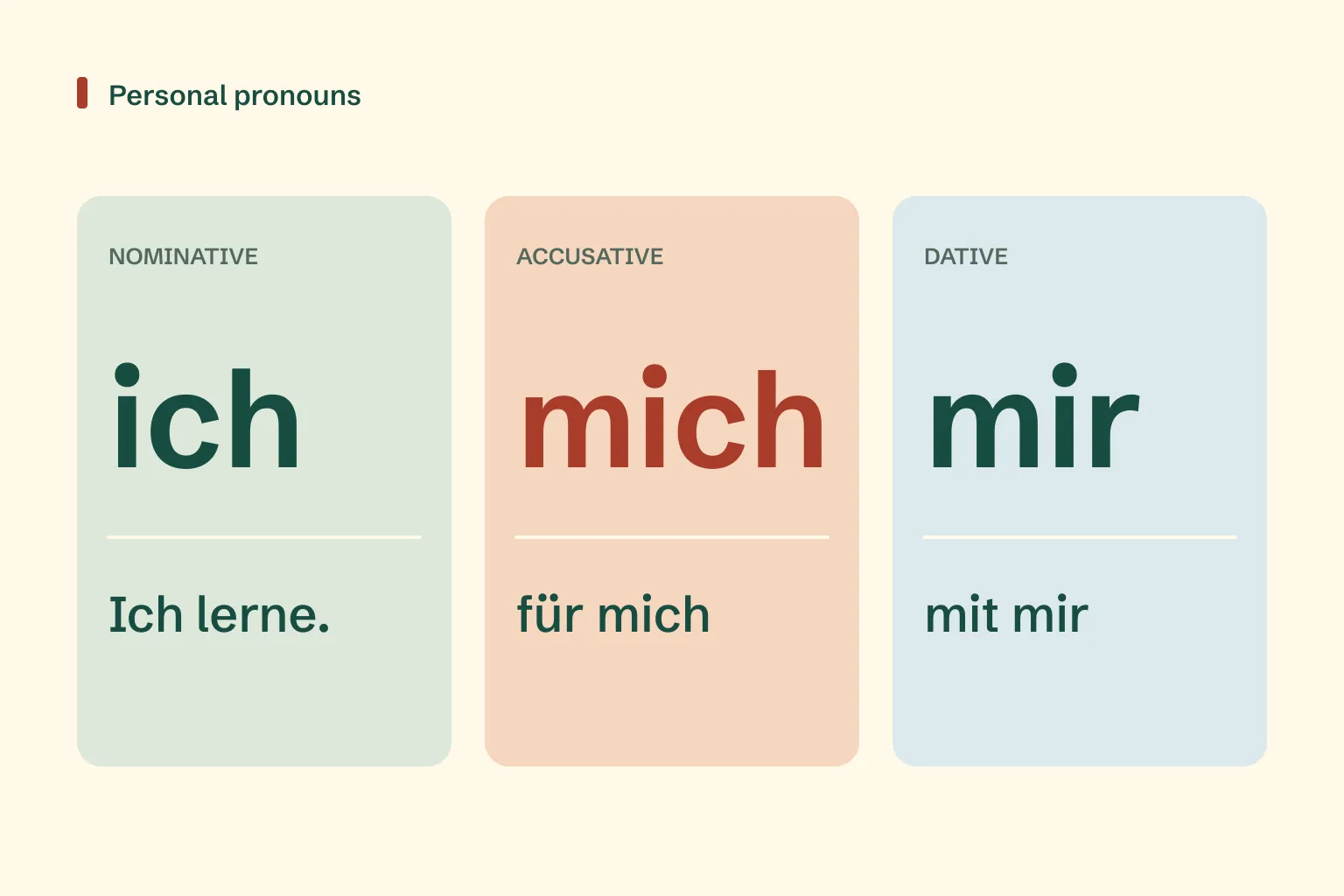
German personal pronouns change with their role in a sentence: ich is a subject, mich is an accusative object, and mir is a dative object. To choose the form, check the verb or preposition. Learn a small complete example, such as Kannst du mir helfen?, alongside each pronoun you want to remember.
This is part of our German classroom chart collection. The level label is a teaching suggestion, not an exam syllabus. Start with the forms your class is using this week.
Ich, mich or mir? A quick table
English “I” and “me” do not tell you every German case. Keep the pronoun with the construction that requires it:
| Form | Classroom example | Why this form? |
|---|---|---|
| ich | Ich stelle eine Frage. I ask a question. | Ich is the subject: the person asking. |
| mich | Die Lehrerin fragt mich. The teacher asks me. | Fragen takes an accusative object for the person asked. |
| mir | Die Lehrerin hilft mir. The teacher helps me. | Helfen takes a dative object. |
| mich | Ist die Kopie für mich? Is the copy for me? | Für requires accusative. |
| mir | Übst du mit mir? Will you practise with me? | Mit requires dative. |
The useful question is “What case does this verb or preposition require here?” Avoid treating mir as a general translation of “to me”: Die Lehrerin fragt mich still needs mich, even if you describe the situation in English as a question directed to you.
The personal pronouns chart
Choose Image for the complete reference sheet, or Table to read and copy individual forms.
German personal pronouns
Subject and object forms · ich, mich, mir. Suggested level: A1–A2.
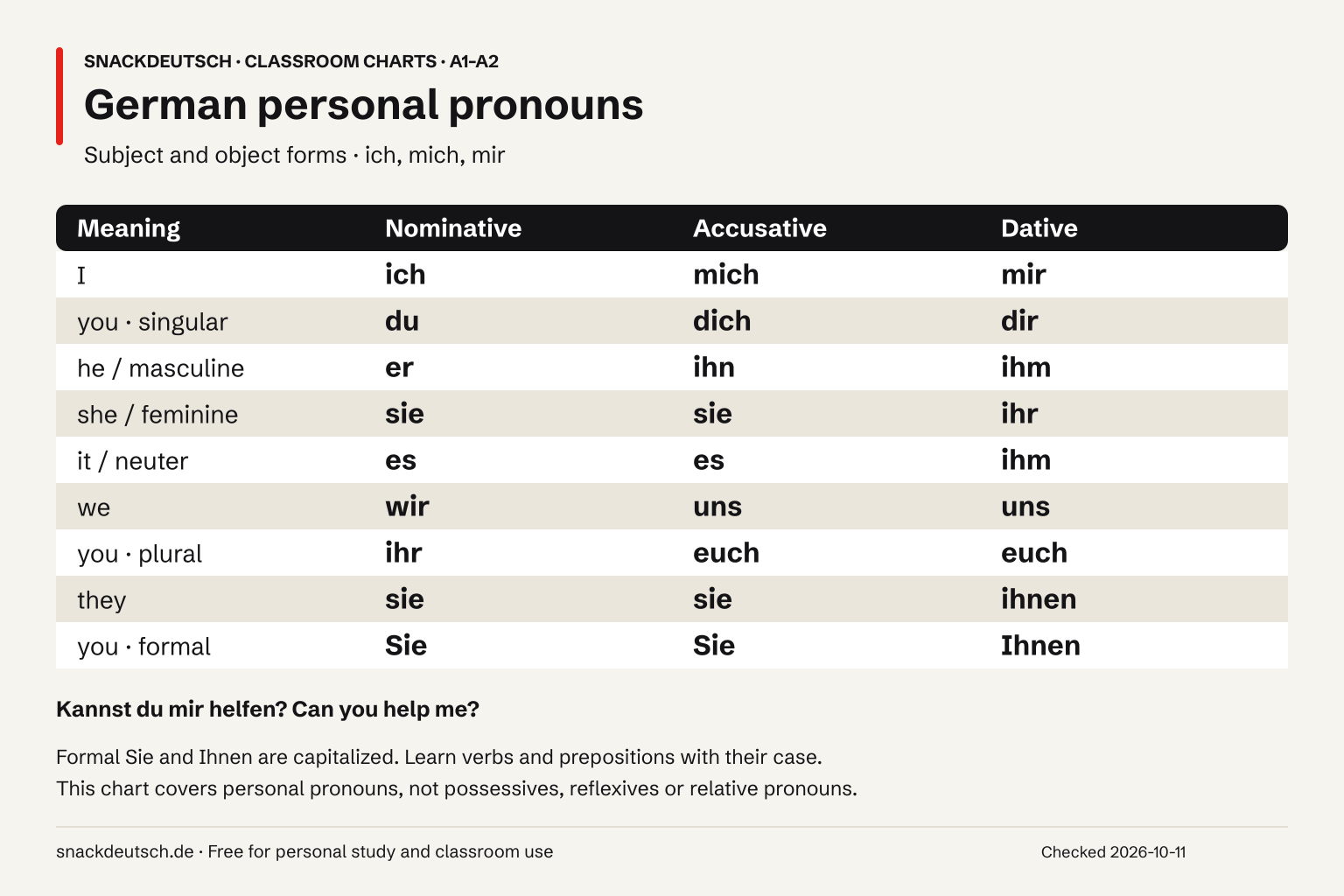
| Meaning | Nominative | Accusative | Dative |
|---|---|---|---|
| I | ich | mich | mir |
| you · singular | du | dich | dir |
| he / masculine | er | ihn | ihm |
| she / feminine | sie | sie | ihr |
| it / neuter | es | es | ihm |
| we | wir | uns | uns |
| you · plural | ihr | euch | euch |
| they | sie | sie | ihnen |
| you · formal | Sie | Sie | Ihnen |
Kannst du mir helfen? Can you help me?
- Formal Sie and Ihnen are capitalized. Learn verbs and prepositions with their case.
- This chart covers personal pronouns, not possessives, reflexives or relative pronouns.
Choose a pronoun in three steps
First, identify the person or thing you mean. In Ich suche den Stift, you are talking about der Stift, a masculine noun. Replacing it with a pronoun does not turn it into neuter simply because English calls a pen “it.”
Second, find the construction. Suchen takes an accusative object here, so den Stift becomes ihn: Ich suche ihn: I am looking for it. For a person after a preposition, compare Ich übe mit dem Kursleiter: I practise with the course instructor. Mit takes dative, so mit dem Kursleiter becomes mit ihm: with him.
Third, check that the reference is clear. If your paragraph mentions several masculine nouns, ihn may leave the reader guessing. Repeating den Stift is sometimes better than replacing every noun mechanically.
Mich or mir in a classroom question?
Compare these two requests:
- Hörst du mich? Can you hear me? Hören takes an accusative object here.
- Hilfst du mir? Will you help me? Helfen takes a dative object.
Both English translations contain “me,” so English alone does not tell you which German form to choose. Write jemanden hören and jemandem helfen in your notes, or keep the two example sentences if those grammar labels feel distracting.
Another useful pair is Ich sehe dich (I see you) and Ich antworte dir: I answer you. Changing the verb can change the pronoun form even when you are addressing the same classmate.
Sie, sie and ihr are easy to mix up
Capitalized Sie is formal “you”; its dative form is Ihnen. Lowercase sie can refer to a feminine singular noun or mean “they.” The verb and surrounding sentence help you tell them apart: Sie kommt can mean “she is coming”; Sie kommen can mean “they are coming” or formal “you are coming.” At the start of a sentence, capitalization alone cannot settle the meaning.
Ihr can be nominative informal plural “you,” as in Ihr lernt Deutsch, or the dative of feminine sie, as in Ich helfe ihr. In other contexts ihr can also be a possessive determiner. This chart covers personal pronouns only; it is not a table for every use of those letters.
For a polite classroom request, practise Können Sie mir das bitte erklären? Could you please explain that to me? Sie is the subject; mir is the person receiving the explanation.
Practise six classroom requests
These short exchanges practise the chart in situations you can use before your next lesson. Fill each blank with the appropriate personal pronoun. Keep the whole sentence in your notebook, including the verb or preposition.
- Kannst du ___ sagen, wann der Kurs beginnt? (me)
- Frau Nguyen, kann ich ___ etwas fragen? (formal you)
- Das ist Lea. Ich gebe ___ mein Heft. (her)
- Meine Kollegen üben auch Deutsch. Ich lerne mit ___. (them)
- Ihr beide kommt morgen, oder? Ich warte auf ___. (you, both)
- Danke, Mila. Dein Beispiel hilft ___. (me)
Classroom request answers
- mir: in jemandem etwas sagen, the person receiving the information is dative. The following clause supplies what is being said.
- Sie: jemanden etwas fragen uses accusative for the person asked. Formal Sie keeps its capital letter.
- ihr: jemandem etwas geben takes a dative recipient. Lea becomes ihr; mein Heft is the accusative thing given.
- ihnen: mit takes dative. Lowercase ihnen refers to the colleagues; capitalized Ihnen would be formal “you.”
- euch: the construction auf jemanden warten takes accusative. The informal plural “you” is euch here. This is a verb-preposition combination, not a location/destination example.
- mir: helfen requires dative. Dein Beispiel is the subject and mir is the person helped.
Download the six-request practice sheet to keep the reference, questions and answers together. After checking, change one sentence to fit a real question from your class.
A five-minute class-note exercise
Choose three short sentences from your notebook. Underline one noun phrase in each, identify its case, then replace it with a pronoun. Read the result aloud and check whether someone could still understand what the pronoun refers to.
For example: Ich habe das Heft. Ich brauche das Heft morgen. becomes Ich habe das Heft. Ich brauche es morgen. The second sentence stays accusative; das Heft becomes es.
Keep the original sentence and your revision together. If you later save the vocabulary in SnackDeutsch, include a checked example with the word. A pronoun table can remind you of forms, but the sentence shows you how to use them.
Mini practice
Fill each blank with the appropriate personal pronoun.
- Ich habe eine Frage. Kannst du ___ helfen? (me)
- Wo ist der Schlüssel? Ich suche ___. (it)
- Wir sind im Kurs. Die Lehrerin hört ___. (us)
- Frau Weber, kann ich mit ___ sprechen? (formal you)
- Das ist meine Kollegin. Ich antworte ___ morgen. (her)
- Lernt ___ auch Deutsch? (informal plural you)
Answers and reasons
- mir: the dative form required by helfen.
- ihn: der Schlüssel is masculine; suchen takes accusative here.
- uns: the accusative form of wir; it happens to match the dative form.
- Ihnen: formal “you” after dative mit, with a capital letter.
- ihr: feminine singular dative with antworten.
- ihr: the subject is informal plural “you,” matching lernt.
Sources and the next step
Forms were checked against the University of Texas at Austin’s personal pronoun overview, accusative pronouns and dative pronouns. The classroom examples and practice questions here are original.
The classroom verb patterns were checked on 19 October 2026 using Duden’s entries for fragen, sagen, geben and warten. These references support the constructions; they are not the source of our exercise sentences.
If selecting the case is the difficult part, use our accusative and dative guide before memorizing more forms. Return to the chart collection when you need articles or adjective endings.