
Free resources
Der, die or das? A German noun-endings chart with practice
Use a checked German noun-endings chart, spot misleading final letters, and practise article, noun and plural entries with eight explained tasks.
Read as Markdown
German noun endings help most when you recognize a real word-building pattern. Nouns formed with -ung, -heit, -keit or -schaft are feminine; diminutives in -chen or -lein are neuter. A matching string of final letters is not enough: der Kuchen is not a diminutive. Check the complete noun, then save its article and plural.
Your course notes contain Anmeldung, Brötchen and Kuchen. Highlighting their last letters is a start, but it leaves an important question unanswered: do those letters form a meaningful suffix? A useful notebook records the checked word and why the pattern does or does not apply.
Takeaway: First identify the word-building pattern. Then confirm the dictionary form. An ending can help with gender; it cannot choose a sentence’s case or decide between “the” and “a.”
Use this three-step noun check
- Look for a meaningful pattern. In Anmeldung, the noun-forming -ung is useful. In Brötchen, -chen forms a diminutive from Brot. Do not simply remove the last letters from every word.
- Check the full entry. Read the nominative singular article and the plural in a dictionary. Keep der Kuchen even though a final-letter shortcut might suggest something else.
- Save a usable phrase. Pair die Anmeldung, die Anmeldungen with a phrase such as die Anmeldung abschicken (send off the registration). A pattern is easier to use when it belongs to a real classroom task.
German noun endings: the reference chart
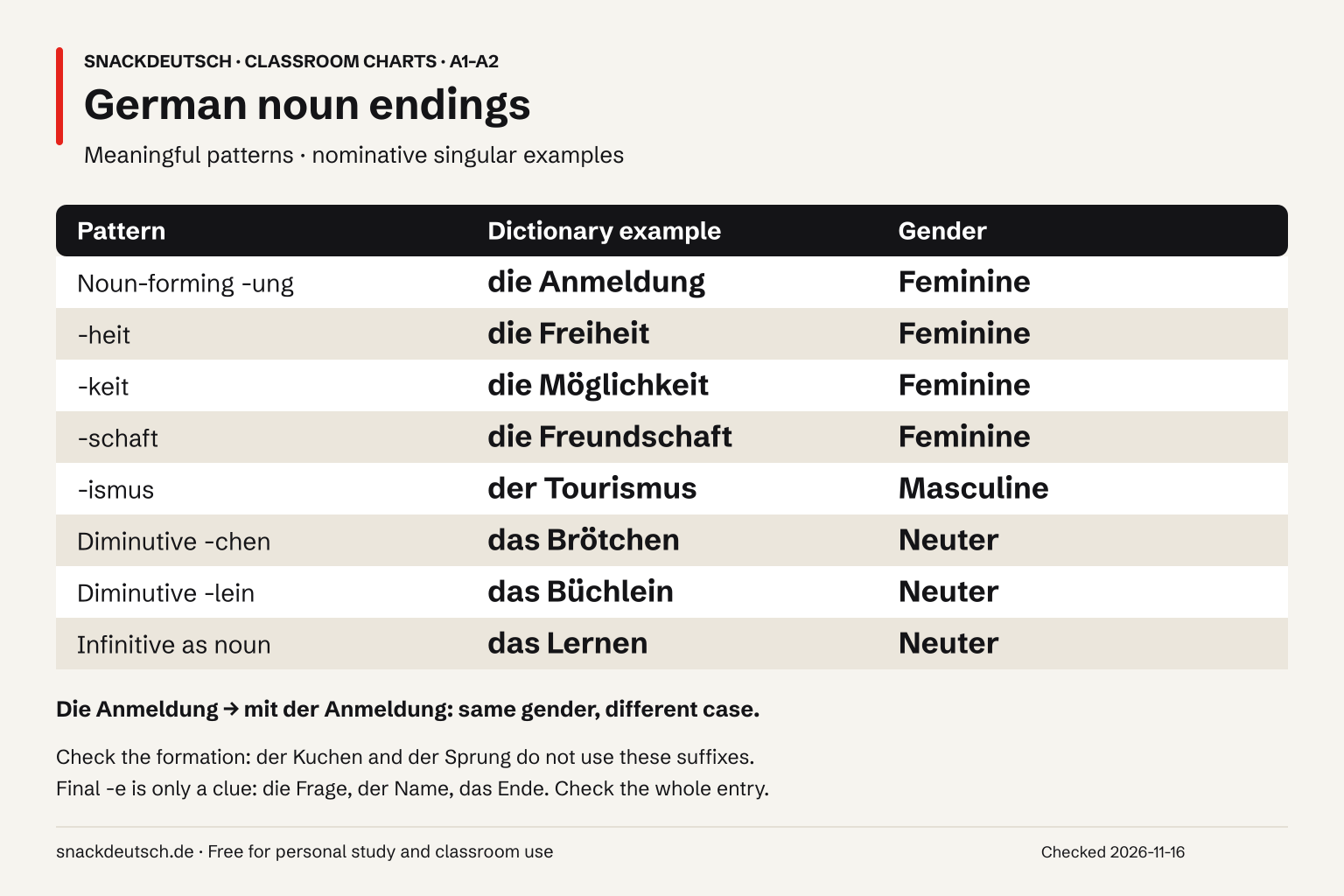
The chart shows selected patterns in the dictionary form, with nominative singular articles. The final row is a different word-formation process: an infinitive used as a noun. Use Image for the reference graphic and Table for the same selectable text.
German noun endings
Meaningful patterns · nominative singular examples. Suggested level: A1–A2.
| Pattern | Dictionary example | Gender |
|---|---|---|
| Noun-forming -ung | die Anmeldung | Feminine |
| -heit | die Freiheit | Feminine |
| -keit | die Möglichkeit | Feminine |
| -schaft | die Freundschaft | Feminine |
| -ismus | der Tourismus | Masculine |
| Diminutive -chen | das Brötchen | Neuter |
| Diminutive -lein | das Büchlein | Neuter |
| Infinitive as noun | das Lernen | Neuter |
Die Anmeldung → mit der Anmeldung: same gender, different case.
- Check the formation: der Kuchen and der Sprung do not use these suffixes.
- Final -e is only a clue: die Frage, der Name, das Ende. Check the whole entry.
Keep the grammar chart collection nearby when your lesson moves from dictionary gender to article forms in sentences.
A suffix is more than the last few letters
Die Anmeldung uses the noun-forming suffix -ung. Der Sprung also ends in the letters ung, but it does not use that suffix. Sprung is related to springen; the point is not that it has no relationship to a verb. It simply is not formed with the -ung pattern used in Anmeldung.
Das Brötchen is a diminutive related to Brot. Der Kuchen is not a noun built by adding the diminutive suffix -chen to a base. Write the contrast as two complete entries: das Brötchen and der Kuchen. Do not invent a chopped-off base to force Kuchen into the rule.
Final -e is a weaker clue. Compare die Frage, der Name and das Ende. The letters alone cannot distinguish those genders. Treat a tendency as a reason to check a prediction, rather than confirmation that you are right.
Infinitive used as a noun: das Lernen
In Wir lernen Deutsch, lernen is a verb. In Das Lernen braucht Zeit (learning takes time), Lernen names the activity and is a neuter noun. It is capitalized and can have the article das.
This is not the same explanation as “every word ending in -en is neuter.” An infinitive has been used as a noun. Der Kuchen, which also ends in en, does not become neuter. Learn the construction and the whole word, not just the spelling at the end.
Keep article, noun and plural together
| Dictionary entry | Meaning | What to record |
|---|---|---|
| die Anmeldung, die Anmeldungen | registration | Feminine -ung noun; plural adds -en |
| die Möglichkeit, die Möglichkeiten | possibility | Feminine -keit noun; plural adds -en |
| das Brötchen, die Brötchen | bread roll | Neuter diminutive; the plural noun keeps the same form |
| der Name, die Namen | name | Learn the complete entry; final -e does not establish gender |
| das Ende, die Enden | end | Another checked final-e counterexample |
The plural article die is used with nouns of all three singular genders. Die Brötchen is plural; its dictionary singular is still das Brötchen. Plural die is not evidence that a noun is feminine. The plural-pattern guide develops this separate decision.
Why you can see der with a feminine noun
Die Anmeldung is feminine in its dictionary form. In mit der Anmeldung (with the registration), it is still feminine. Mit takes dative, and the feminine definite article in dative is der. That form does not turn the noun masculine.
Keep three questions separate:
- Gender: What is the noun’s dictionary gender?
- Definiteness: Does this context call for a definite or indefinite expression?
- Case: Which form does the sentence or preposition require?
For example, Ich notiere einen Termin (I write down an appointment) still contains the masculine noun der Termin. Einen is an indefinite accusative form. A noun ending alone does not make all three decisions. Use the ein, eine, einen lesson and case reference when those forms are your current lesson.
Mini practice: eight tasks
Use the reference and explanations above. Dictionary articles here mean nominative singular, unless a question explicitly asks for plural.
- Transfer: Choose the article for ___ Abmeldung (cancellation of a registration), an -ung noun.
- Recognize the suffix: Choose the article for ___ Freundschaft (friendship) and name the useful pattern.
- Compare: Supply the two articles: ___ Brötchen and ___ Kuchen. Why does the same final-letter shortcut not work for both?
- Find the actual pattern: Which word uses the noun-forming -ung suffix: Anmeldung or Sprung? Give the checked singular article for each.
- Complete the entry: The singular is das Brötchen and the plural noun form is Brötchen. Write the full plural with its definite article. Has the singular gender changed?
- Repair a claim: Correct “Every noun ending in -e is feminine,” using two counterexamples from the entry table.
- Read the sentence form: In mit der Anmeldung, is Anmeldung masculine or feminine? What explains der here?
- Name an activity: Turn lernen into a noun meaning “learning,” with its definite article. Explain its capital letter and why this is not a rule for every word ending in -en.
Answers and reasons
- Die Abmeldung. It is a noun formed with -ung, the feminine pattern specified in the question.
- Die Freundschaft. The noun-forming suffix -schaft supports feminine gender.
- Das Brötchen; der Kuchen. Brötchen uses the diminutive suffix. Kuchen merely has the same final letters and is a checked masculine word.
- Die Anmeldung uses -ung. Der Sprung does not use this suffix, although it is related to springen. Do not equate every verb-related noun with an -ung formation.
- Die Brötchen. The plural article is die, but the singular noun remains neuter: das Brötchen.
- Final -e is only a clue, not a guarantee: der Name is masculine and das Ende is neuter. Die Frage is a feminine example, not proof of an absolute rule.
- Feminine. Mit requires dative; der is the feminine definite dative form in this phrase. The noun’s gender stays the same.
- Das Lernen. The infinitive is used as a neuter noun, so it is capitalized. This word-formation process does not classify an unrelated word such as der Kuchen by its final -en.
Turn today’s lesson into three checked entries
Choose an -ung noun, a diminutive and one word without a reliable clue from your course notes. For each, record article, noun, plural and a phrase you can use. If a suffix prediction fails, write the checked contrast next to it. Leave the word in a “learn the whole entry” group rather than inventing a rule.
The vocabulary notebook template gives you a place for those entries. The downloadable worksheet above includes eight varied tasks, a self-contained reference and explained answers, so you can practise without another handout or an app.
Sources and further reading
- University of Texas at Austin, Grimm Grammar: noun gender, an overview of gender and ending patterns. The limits and counterexamples above matter when using broad ending lists.
- Leibniz Institute for the German Language, grammis: Nomen, noun gender, case and number.
- IDS grammis: gender and conversion, why an infinitive used as a noun is neuter.
- IDS grammis: substantivization, recognizing nouns formed from other word classes.
- Duden’s checked entries for Anmeldung, Kuchen, Sprung, Brötchen, Möglichkeit, Name and Ende.