
Classroom companion
Ein, eine, einen: choosing “a” and “the” in German
Separate meaning, gender, and case to choose German articles. Practise ein, eine, einen, and definite articles with clear classroom examples.
Read as Markdown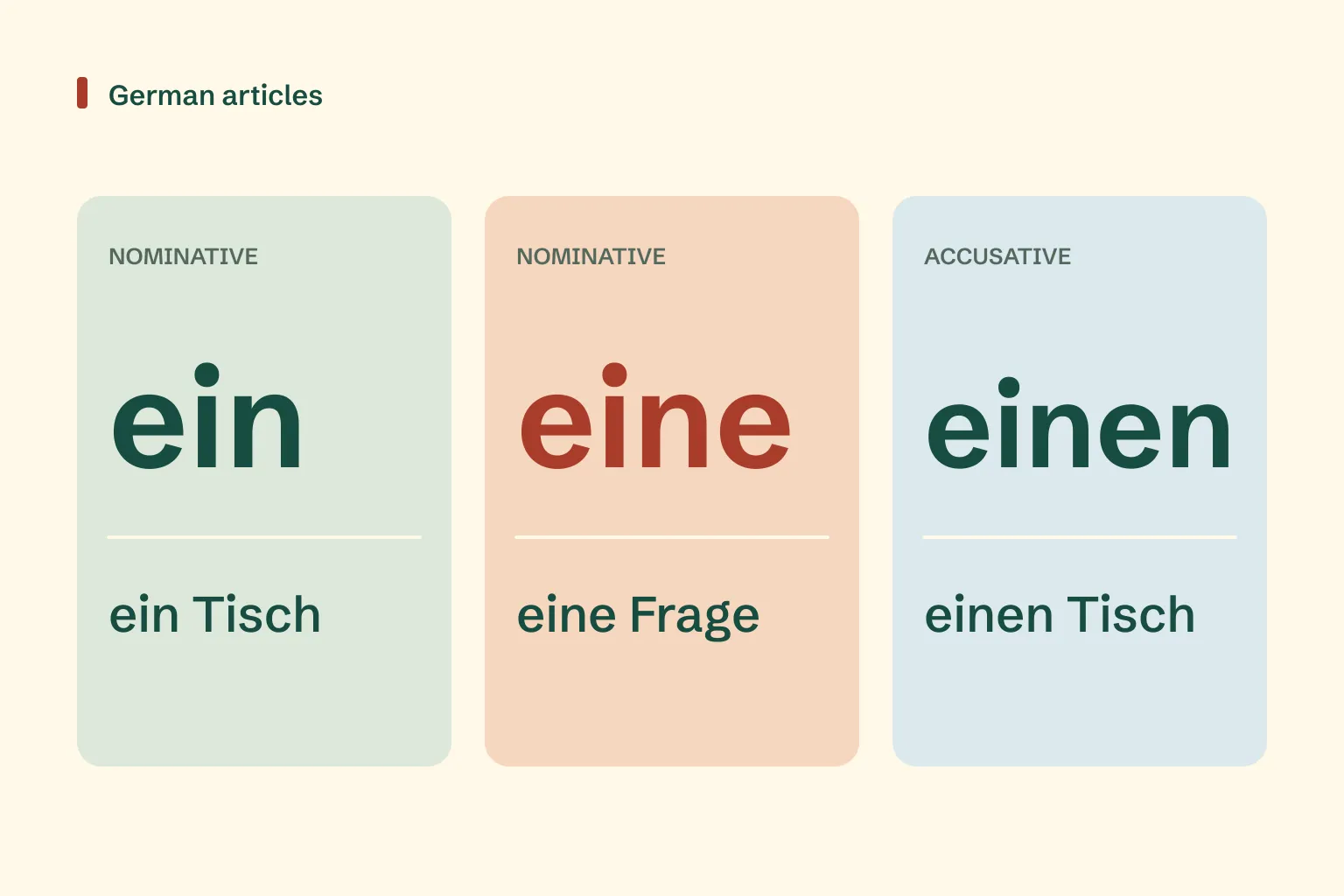
Ein, eine, and einen all belong to the German indefinite article, roughly “a” or “an.” The form depends on the noun’s gender and case. Der, die, and das are definite article forms, roughly “the.” First decide what you mean, then use gender and the sentence structure to choose the form.
Three decisions, in a useful order
Imagine someone asks for a pen. Ich brauche einen Stift means “I need a pen.” No particular pen has been identified. If both people can see the pen being discussed, Ich brauche den Stift means “I need the pen.” Both sentences have a masculine accusative noun; the change is definite versus indefinite meaning.
Next, compare Ich brauche eine Tasche: I need a bag. The case is still accusative, but Tasche is feminine. That gives you eine, not einen. The noun’s gender and the article’s meaning are separate pieces of information.
Finally, Das ist ein Stift uses ein because Stift is nominative in this construction with sein. The word is still masculine. You have changed the sentence structure, not the noun’s gender.
A small article table for the first lessons
Start with nominative and accusative. Add the other cases when your course reaches them rather than trying to memorize every form on your first day.
| Gender | Nominative: the | Nominative: a | Accusative: the | Accusative: a |
|---|---|---|---|---|
| Masculine | der | ein | den | einen |
| Feminine | die | eine | die | eine |
| Neuter | das | ein | das | ein |
| Plural | die | no indefinite article | die | no indefinite article |
The obvious change here is masculine der → den and ein → einen. Feminine and neuter look the same across these two cases, even though their role in the sentence may differ.
The table does not cover adjective endings. Ein guter Stift adds another decision. Get comfortable with the noun and article first, then connect adjective endings to that structure in your course.
Introduce something, then refer to it again
Try this miniature classroom scene:
Auf dem Tisch liegt ein Buch. Das Buch gehört meiner Lehrerin.
“There is a book on the table. The book belongs to my teacher.”
The first sentence introduces a book; the second points back to that book. This is a useful starting pattern, although German article use is not a mechanical copy of English. Some contexts use no article at all: Ich bin Lehrerin (I am a teacher) is a normal way to state a profession.
Plural nouns also need care. You can say Ich brauche Bücher: I need books. There is no plural form of “a.” Ich brauche die Bücher identifies particular books.
When do einer and einem appear?
They appear in other case forms. For example, mit takes the dative: mit einem Stift: with a pen; mit einer Tasche: with a bag. Do not replace these with nominative forms just because your notebook says der Stift and die Tasche.
Keep two lines in the notebook: the dictionary form and the useful sentence. Der Stift; Ich schreibe mit einem Stift preserves both gender and usage. If an explanation only says “use einem because it sounds right,” ask which case or construction is responsible.
The complete singular reference chart
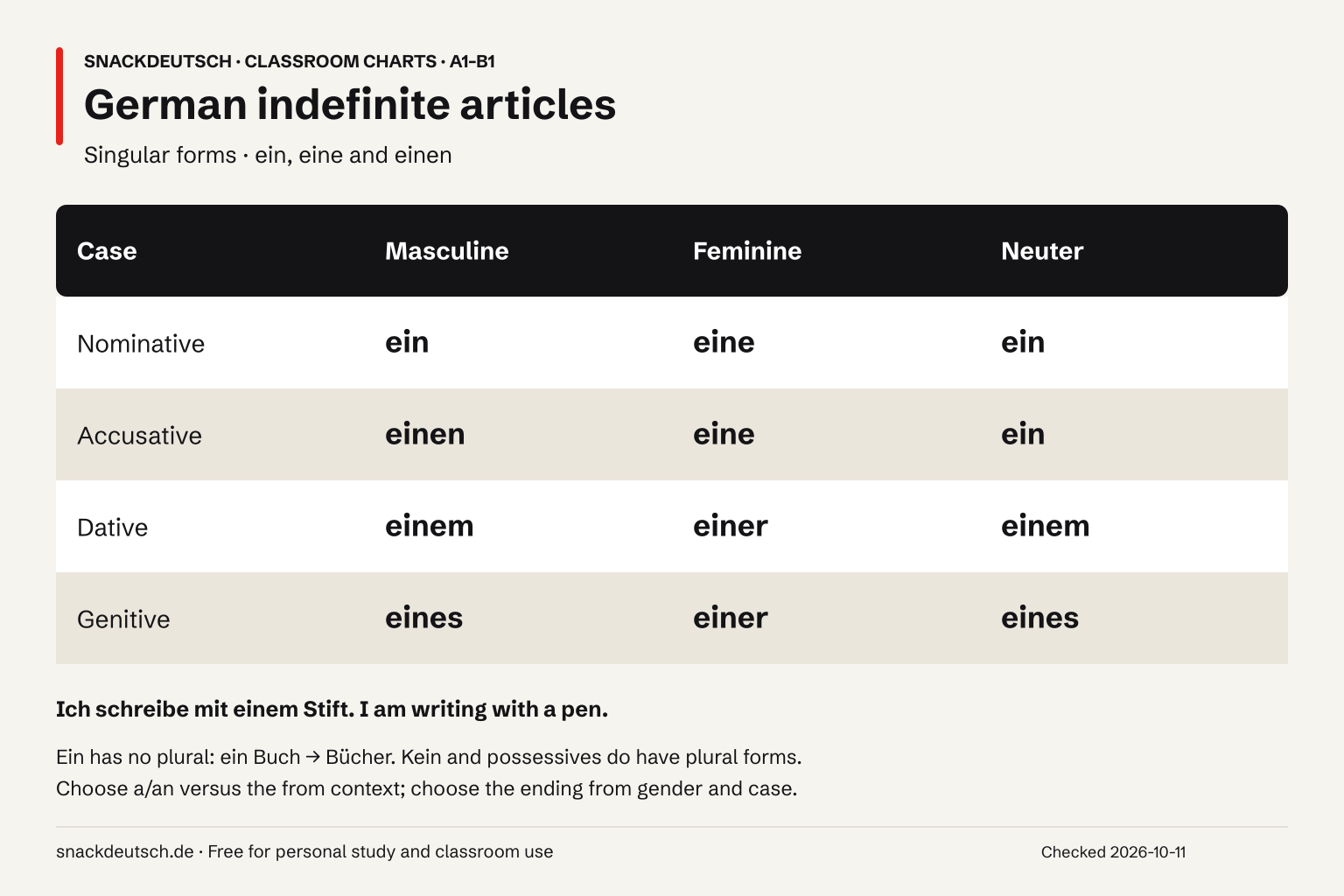
Use the chart for the full set of forms, including genitive. Switch to Table to select and copy the forms. Return to the classroom chart collection for related reference sheets.
German indefinite articles
Singular forms · ein, eine and einen. Suggested level: A1–B1.
| Case | Masculine | Feminine | Neuter |
|---|---|---|---|
| Nominative | ein | eine | ein |
| Accusative | einen | eine | ein |
| Dative | einem | einer | einem |
| Genitive | eines | einer | eines |
Ich schreibe mit einem Stift. I am writing with a pen.
- Ein has no plural: ein Buch → Bücher. Kein and possessives do have plural forms.
- Choose a/an versus the from context; choose the ending from gender and case.
Mini practice
Use an indefinite article unless the question says otherwise.
- Das ist ___ Stift. (der Stift)
- Ich brauche ___ Stift. (der Stift)
- Ich habe ___ Frage. (die Frage)
- Wir lesen ___ Buch. (das Buch)
- Ich habe einen Stift. ___ Stift ist blau. (Use a definite article.)
- Ich spreche mit ___ Lehrerin. (die Lehrerin; use an indefinite article.)
Answers
- ein: masculine nominative in Das ist ein Stift.
- einen: masculine accusative object of brauchen.
- eine: feminine accusative object of haben.
- ein: neuter accusative object of lesen.
- Der: the already introduced pen is now the subject.
- einer: feminine dative after mit.
Read each answer in its sentence. A sequence of article forms without nouns will not tell you which decision you understood. For the next lesson, write one pair that changes definiteness and one pair that changes case.
Sources and further reading
The University of Texas at Austin explains definite and indefinite articles. To work on the dictionary form first, use our noun-ending guide. To practise a sentence with two objects, continue with accusative and dative.
Next, compare das neue Heft with ein neues Heft in the adjective-ending charts, or practise replacing noun phrases with the personal pronouns chart.