
Free resources
A German vocabulary notebook template for your next class
Download a free German vocabulary notebook template. Record articles, plurals, useful phrases, and lesson context, then turn your notes into practice.
Read as Markdown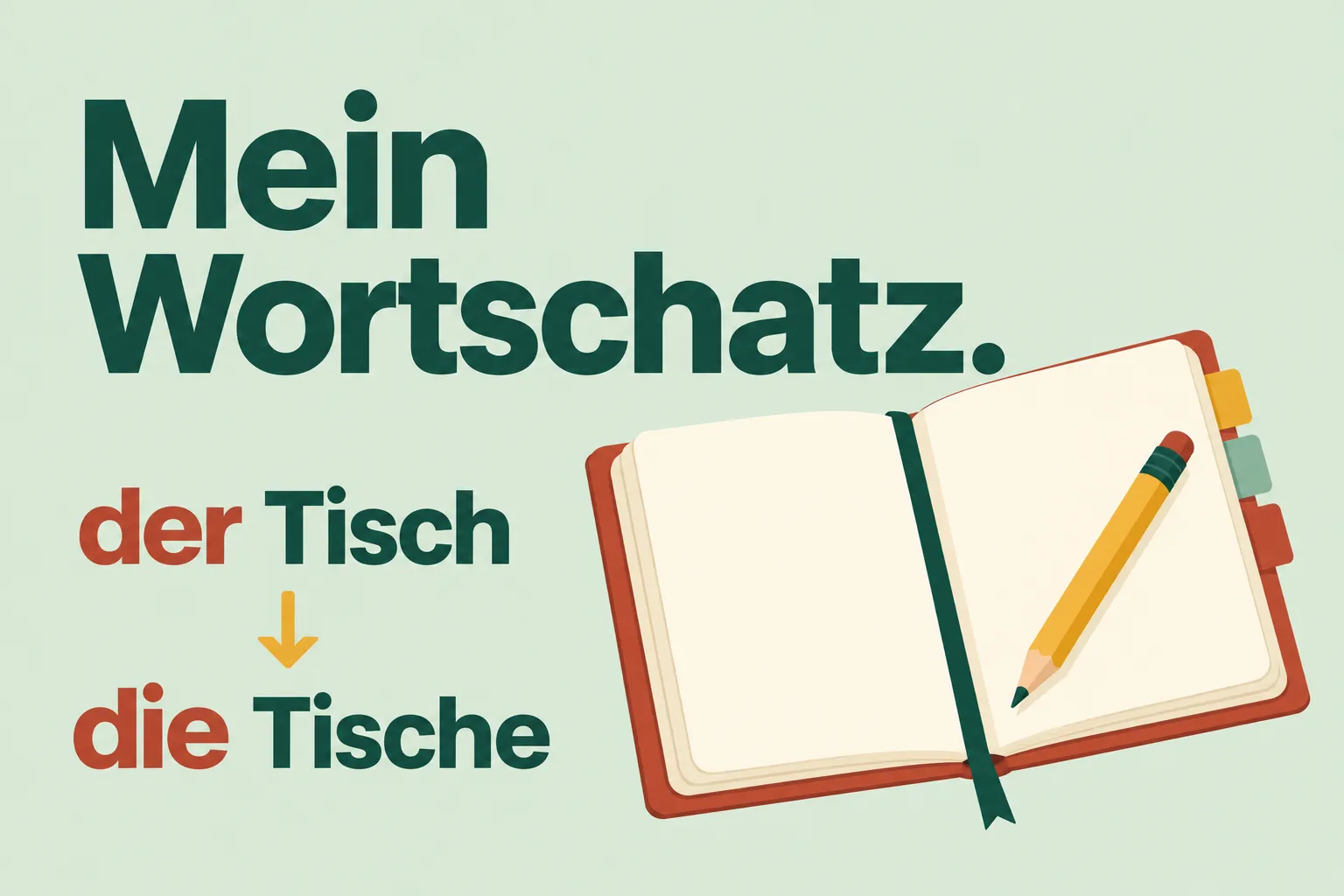
A useful German vocabulary notebook records more than a translation. Save the noun with its article and plural, one phrase you might actually say, and where you met it. The free template below works on paper or in a text editor. Start with five words from your next lesson rather than copying an entire chapter.
Download the German class vocabulary notebook. It is an editable Markdown file, not a PDF. You can open it in a text editor, copy it into your notes, or print it.
What belongs in a German vocabulary notebook?
Imagine leaving a lesson with just this note: Anmeldung = registration. Next week, you may recognize the meaning but still hesitate over the article or the sentence. An entry with a little context answers those questions before you need the word again.
| Field | Completed example | Why keep it? |
|---|---|---|
| Word with article | die Anmeldung | The article travels with the noun |
| Plural | die Anmeldungen | You do not have to guess later |
| Meaning in this lesson | registration; registration form in this context | One word can have several uses |
| Useful phrase | die Anmeldung ausfüllen | A phrase gives you something to say |
| Example | Ich fülle die Anmeldung aus. | The separable verb has a visible sentence pattern |
| English meaning | I fill in the registration form. | Meaning stays tied to this use |
| Source | My course notes, lesson on appointments | You can return to the original context |
| Question | Is this the form or the registration process here? | Uncertainty becomes a question for class |
Do not fill every field for every word. A verb needs different information from a noun. For mitbringen, a useful note is Ich bringe meinen Ausweis mit: I bring my ID with me. For pünktlich, record pünktlich zum Unterricht kommen: arrive at class on time.
Fill one page after a lesson
First, choose a situation from class. “Making an appointment” is more useful as a heading than “New words.” Then select five words you expect to use in that situation. Keep the original page or lesson reference beside the group.
Add the grammatical information you already know. Check the rest with a dictionary or your teacher. Do not leave a guessed article looking like a confirmed answer. A question mark is a useful part of a learning notebook.
Next, write one short sentence for each word. Reuse a structure you understand. An A1 sentence that you can say confidently is more useful here than a complex sentence copied from a translation tool.
Finally, underline the part you want to practise. With der Termin, that might be the article. With einen Termin vereinbaren, it may be the whole phrase. Those are different recall tasks, so avoid testing both accidentally on one overloaded card.
Use a small, repeatable page layout
Give each lesson three spaces: words, useful sentences, and questions. The questions space prevents your notebook from becoming a collection of polished but unverified guesses. Write “Why einen Termin?” there and resolve it when you study the article forms.
Keep a separate place for words you noticed but do not need yet. You do not have to promote every unfamiliar word into your review routine. If the lesson is about booking a room, an interesting word from a side conversation can wait.
When you meet a word again, add a new example to the existing entry instead of starting a duplicate. Two contexts show how a word behaves. Ten disconnected copies make it harder to find what you learned.
Turn the notebook into practice
If your lesson introduces können, müssen or dürfen, use the modal-verbs chart and sentence patterns to turn one activity from your notebook into an ability, obligation or permission sentence. If a request contains “me,” check the ich/mich/mir guide and classroom practice before saving it.
Cover the German column and try to say the phrase from the English meaning. Then uncover it and compare. If you remembered the noun but missed its article, mark that specific problem. Do not treat every mistake as “I know nothing.”
Try the reverse direction as well: read Ich fülle die Anmeldung aus and explain the situation in English. Recognition and production are different tasks. A notebook lets you notice which one needs attention.
Before the next class, pick three entries and use them in a short spoken account: “I have an appointment. I need my ID. I fill in the form.” You can keep that account simple. Its job is to connect the words.
Paper, a notes app, or a vocabulary app?
Paper gives you an easy place to sketch and annotate. A general notes app can hold full lesson notes and links. A vocabulary companion such as SnackDeutsch is designed around individual words, chapter organization, and review. You can use more than one: keep the full lesson in your notebook and select a smaller vocabulary set for practice.
The template is deliberately portable. You do not need an account or an app to use it. If you later move your words into an app, check each entry rather than assuming a file import will preserve all your fields.
Your next lesson
Bring one completed entry and one unresolved question to class. After the lesson, revise the entry instead of keeping both the old and corrected versions. For a worked next step, follow turning class notes into flashcards.
Sources and further reading
The template and examples are original. For the distinction between definite and indefinite articles, see the University of Texas at Austin’s Grimm Grammar article guide.