
Classroom companion
Wo or wohin? All nine German two-way prepositions
Use all nine German two-way prepositions with location and destination pairs, a classroom chart, movement exceptions and eight explained practice tasks.
Read as Markdown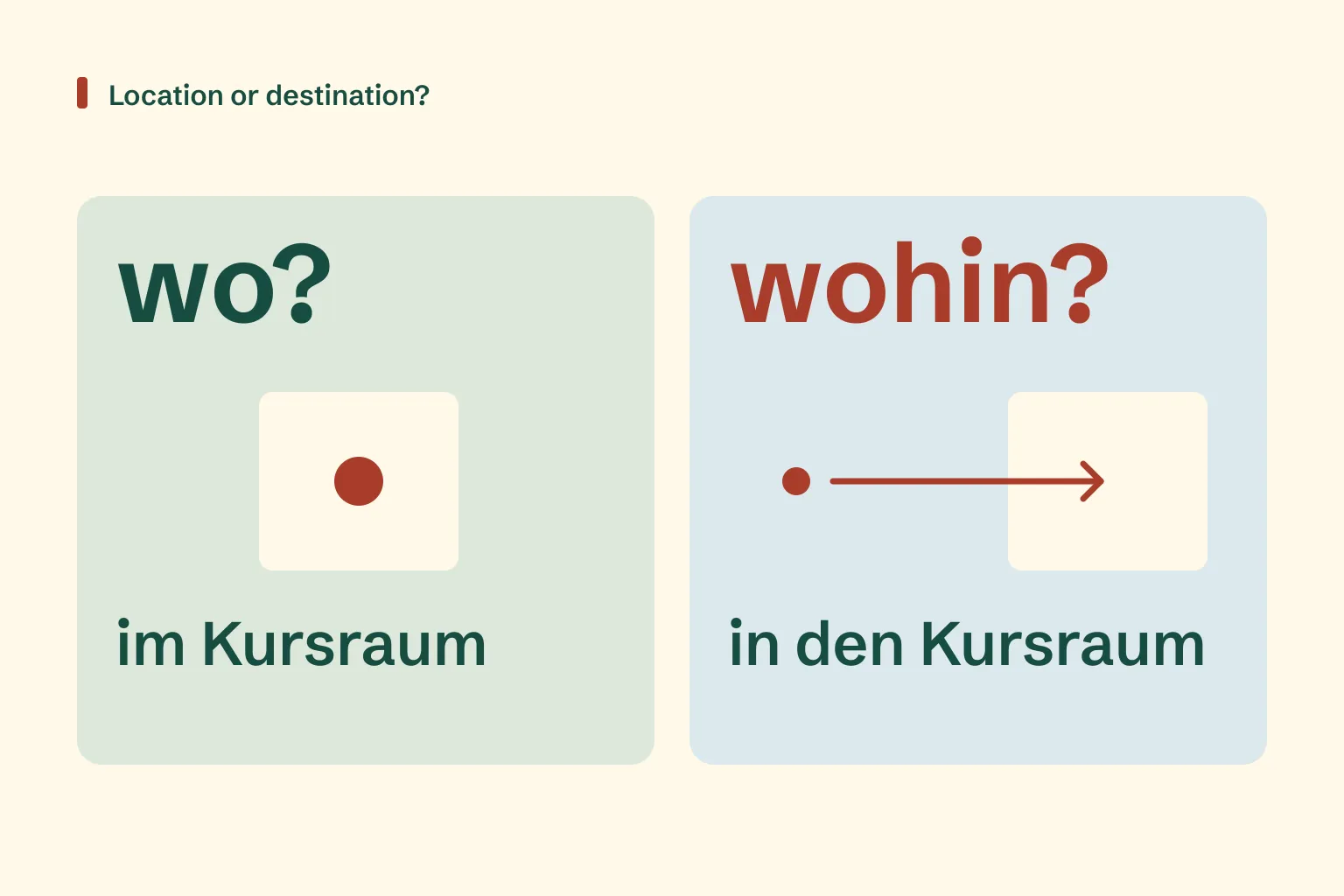
German has nine two-way prepositions: an, auf, hinter, in, neben, über, unter, vor, zwischen. In their spatial use, choose dative for the location where something is or happens, and accusative for a destination or new position. Wo? asks where; wohin? asks where to. A moving person can still need dative.
Your teacher asks you to put a folder beside the door. A minute later, a classmate asks where it is. Those two moments need different phrases: neben die Tür for the placement, then neben der Tür for its location. The noun is still feminine, die Tür. Its case changes, not its gender.
Takeaway: With spatial two-way prepositions, check what the phrase tells you: the place of an activity, or the place being reached. Do not use “movement means accusative” as a rule for all prepositions.
A three-step check for your class notes
- Identify the construction. Is the preposition one of the nine above, and is it describing a spatial relationship? Fixed phrases and other prepositions need their own patterns.
- Decide the meaning. Is the object or activity already in that location, or does the phrase name a destination or placement? Compare Das Heft liegt auf dem Pult with Ich lege das Heft auf das Pult.
- Apply the case ending. Dative gives dem for masculine and neuter, der for feminine, and den for plural. Accusative gives den, die, das, die. In dative plural, a noun often adds -n: die Tische → zwischen den Tischen.
For the full article forms, use the accusative and dative reference. A prepositional phrase has its own case even when another part of the sentence has accusative: in Ich lege das Heft auf das Pult, both das Heft (the thing placed) and auf das Pult (its destination) use accusative for different reasons.
All nine two-way prepositions: classroom chart
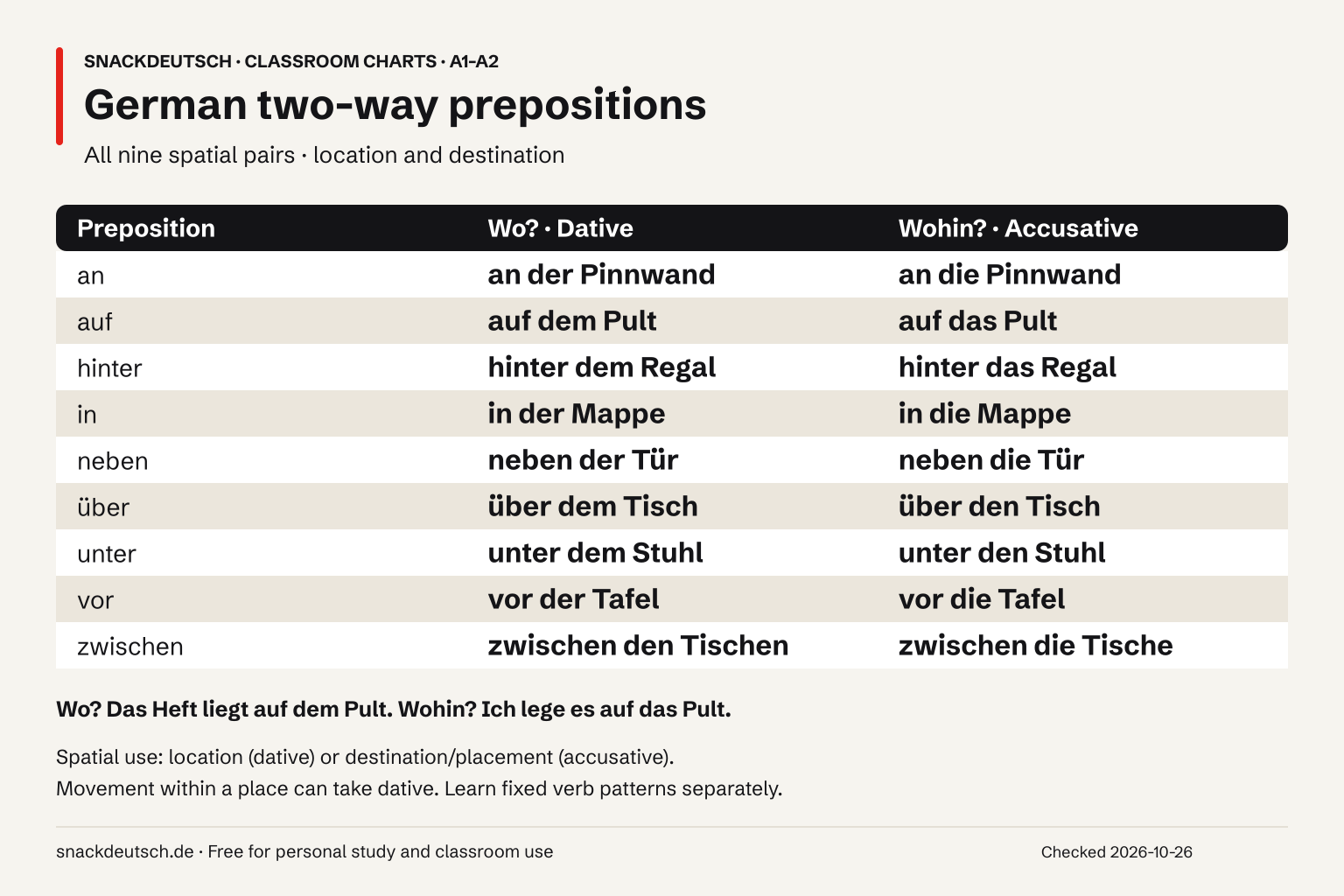
These are spatial examples. Read the left phrase as an existing location and the right phrase as the destination of a placement. Switch to Table to copy the same checked forms. The full-size image is available for zooming or printing.
German two-way prepositions
All nine spatial pairs · location and destination. Suggested level: A1–A2.
| Preposition | Wo? · Dative | Wohin? · Accusative |
|---|---|---|
| an | an der Pinnwand | an die Pinnwand |
| auf | auf dem Pult | auf das Pult |
| hinter | hinter dem Regal | hinter das Regal |
| in | in der Mappe | in die Mappe |
| neben | neben der Tür | neben die Tür |
| über | über dem Tisch | über den Tisch |
| unter | unter dem Stuhl | unter den Stuhl |
| vor | vor der Tafel | vor die Tafel |
| zwischen | zwischen den Tischen | zwischen die Tische |
Wo? Das Heft liegt auf dem Pult. Wohin? Ich lege es auf das Pult.
- Spatial use: location (dative) or destination/placement (accusative).
- Movement within a place can take dative. Learn fixed verb patterns separately.
The chart belongs with the German grammar chart collection. It is a reference for this contrast, rather than a list of every meaning each preposition can have.
Say the placement, then describe the result
Use these original pairs with classroom objects. The second sentence in each pair tells someone where to find the object afterward.
- An, at or against a surface: Ich hänge den Plan an die Pinnwand. Der Plan hängt an der Pinnwand. I hang the plan on the noticeboard. It is then hanging there.
- Auf, on a surface: Ich lege das Heft auf das Pult. Das Heft liegt auf dem Pult. I put the notebook on the teacher’s desk. It is then lying there.
- Hinter, behind: Ich stelle die Kiste hinter das Regal. Die Kiste steht hinter dem Regal. I put the box behind the shelf. It is then standing there.
- In, inside: Ich lege das Blatt in die Mappe. Das Blatt liegt in der Mappe. I put the sheet into the folder. It is then inside it.
- Neben, beside: Ich stelle die Tasche neben die Tür. Die Tasche steht neben der Tür. I put the bag beside the door. It is then standing there.
- Über, above: Ich hänge die Lampe über den Tisch. Die Lampe hängt über dem Tisch. I hang the lamp above the table. It is then hanging there, without resting on the table.
- Unter, under: Ich schiebe die Kiste unter den Stuhl. Die Kiste steht unter dem Stuhl. I slide the box under the chair. It is then standing there.
- Vor, in front of: Ich stelle den Stuhl vor die Tafel. Der Stuhl steht vor der Tafel. I put the chair in front of the board. It is then standing there.
- Zwischen, between: Ich stelle den Wagen zwischen die Tische. Der Wagen steht zwischen den Tischen. I put the trolley between the tables. It is then standing there.
The verbs help communicate the situation: legen/liegen for placing/lying, stellen/stehen for putting upright/standing, and sich setzen/sitzen for sitting down/being seated. Hängen can describe either hanging something up or something already hanging. Read the whole sentence instead of assigning one permanent case to a verb.
Movement within a location still takes dative
Wir laufen im Kursraum herum. We walk around in the classroom. The room is where the walking happens; nobody is described as entering it. Im means in dem, so this is dative.
Wir laufen in den Kursraum. We walk into the classroom. Here the room is the destination, so use accusative. The verb laufen appears in both sentences.
The same contrast works with a ball: Der Ball rollt unter dem Tisch hin und her describes it rolling back and forth while staying under the table. Der Ball rollt unter den Tisch describes it rolling into that position. Both involve motion.
“New position” does not require walking or crossing into a room. Ich hänge den Plan an die Pinnwand describes establishing a position on the noticeboard. That is enough for the accusative destination phrase.
Contractions: im, ins, am and ans
| Full form | Contraction | Case |
|---|---|---|
| in dem Kursraum | im Kursraum | Dative |
| in das Zimmer | ins Zimmer | Accusative |
| an dem Fenster | am Fenster | Dative |
| an das Fenster | ans Fenster | Accusative |
A contraction does not change the case. In der Mappe stays three words; there is no corresponding contraction of in der. An die Pinnwand also stays uncontracted.
Where this rule stops
Zu takes dative, even when you go somewhere: Ich gehe zur Schule means zu der Schule. Do not turn it into zu die Schule because it answers a direction question. Mit also takes dative in Ich fahre mit dem Bus. Learn the case patterns of other prepositions separately in the prepositions and cases guide.
A fixed construction such as warten auf + accusative is different again: Wir warten auf den Bus. This does not mean we are moving onto a bus. Compare Wir warten vor der Schule auf den Bus: vor der Schule gives the location, while auf den Bus says what we are waiting for. The verb and preposition guide develops that distinction. Time expressions such as am Montag also need their own patterns; this article’s location/destination test concerns spatial uses.
Mini practice: eight tasks
Use the stated situation. Fill only the missing article unless a task asks for a full phrase or sentence. Noun genders are supplied.
- Location: Der Plan hängt an ___ Pinnwand. (die Pinnwand)
- Placement: Ich stelle die Kiste hinter ___ Regal. (das Regal)
- Movement inside: Wir laufen in ___ Kursraum herum. (der Kursraum; we stay inside.)
- Destination: Wir laufen in ___ Kursraum. (der Kursraum; we enter from the corridor.)
- Plural location: Der Wagen steht zwischen ___ Tischen. (die Tische)
- Contraction: Shorten an das Fenster without changing its case.
- Repair: Correct Ich gehe zu die Schule. Keep the preposition zu.
- Placement to result: Rewrite Ich lege das Blatt in die Mappe as a sentence beginning Das Blatt liegt ….
Answers and reasons
- Der Plan hängt an der Pinnwand. Feminine dative gives the existing location.
- Ich stelle die Kiste hinter das Regal. Neuter accusative marks the position being established behind the shelf.
- Wir laufen in dem Kursraum herum, usually im Kursraum. Dative identifies where the walking happens.
- Wir laufen in den Kursraum. Masculine accusative marks the room being entered.
- Der Wagen steht zwischen den Tischen. Dative plural uses den; Tische also becomes Tischen.
- Ans Fenster. Ans combines an das, still neuter accusative.
- Ich gehe zu der Schule, normally zur Schule. Zu requires dative, including when it expresses a destination.
- Das Blatt liegt in der Mappe. The sheet’s location takes feminine dative. Nothing is being put into the folder in this sentence.
Try it with your class notes
Choose one object and one place from today’s lesson. Write a placement sentence, act it out, then write the resulting location. Keep both sentences with the noun’s dictionary form: das Heft, auf das Pult legen, auf dem Pult liegen. The vocabulary notebook template gives you a place to keep these paired examples.
Download the editable worksheet above for eight varied tasks, including all nine prepositions, movement contrasts, error correction and a room-description exercise. You can change its classroom objects after checking their genders and plural forms.
Sources and further reading
- University of Texas at Austin, Grimm Grammar: two-way prepositions, the nine prepositions, case forms and common contractions.
- Leibniz Institute for the German Language, grammis: Wechselpräpositionen, the difference between the location of movement and its destination.
- IDS grammis: Präpositionalgruppe, spatial phrases and verb-selected prepositional complements.
- University of Texas at Austin, Grimm Grammar: dative, dative prepositions including zu and mit.
The examples and exercises here are original. For your next lesson, take one pair from your own room description and explain why its two article forms differ.