
Free resources
German adjective endings: three charts with practice
Choose German adjective endings after der, ein or no article. Explore three free classroom charts in image or table mode, with practice and explained answers.
Read as Markdown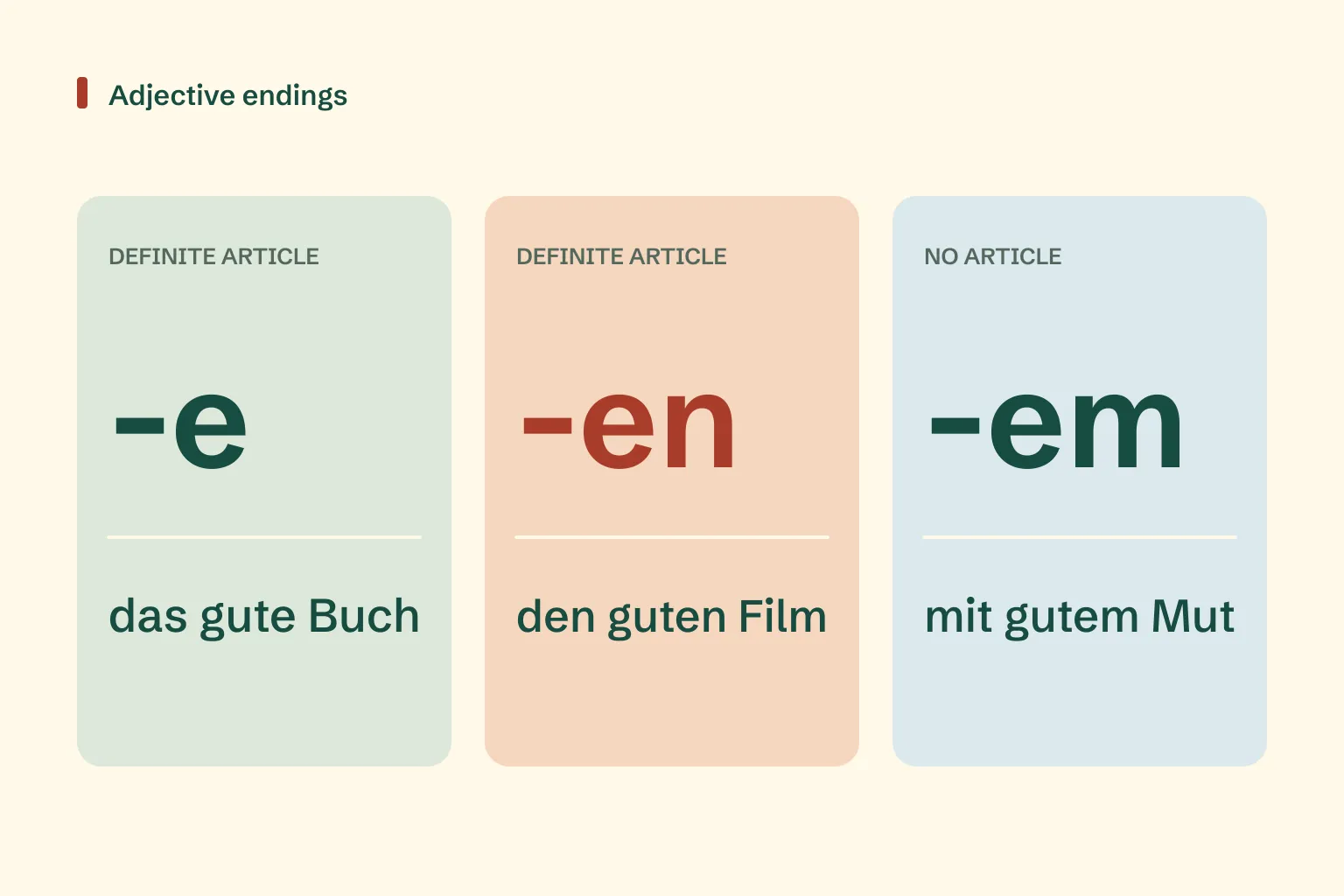
To choose a German adjective ending before a noun, identify the determiner, the noun’s gender or number, and its case. After der/die/das, most adjective endings are -en. After an ein-word, some forms need -er or -es. Without a determiner, use the strong-ending table. The three charts below keep these patterns separate.
Suggested level: A2–B1. If your class has just introduced adjectives, begin with nominative and accusative; return to the full tables as your course introduces the other cases. These are reference sheets, not a requirement to learn every ending at once.
Start with the whole noun phrase
Suppose your class notes contain das Heft (the notebook) and the adjective neu: new. Compare:
- Das neue Heft liegt hier. The new notebook is here.
- Ein neues Heft liegt hier. A new notebook is here.
The noun is neuter and nominative in both sentences. The adjective changes because das and ein do different jobs in the phrase. Looking only at Heft will not tell you which adjective ending to use.
For a classroom routine, circle the determiner, mark the case, and then select the row and column. Use the article chart if you are still deciding between ein and einen.
The three adjective charts
Choose Image or Table for each chart. Both views contain the same forms; Table mode lets you select and copy them.
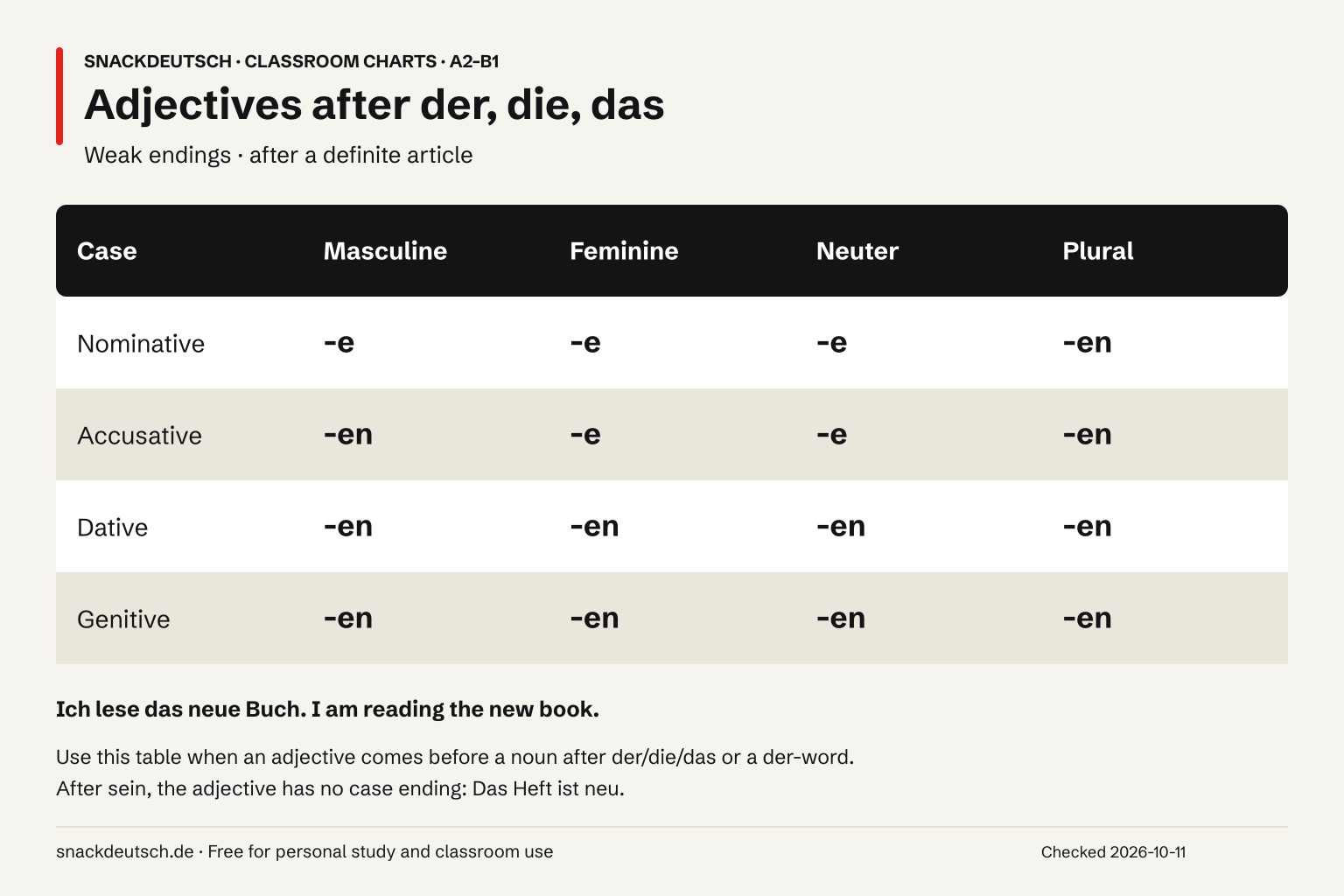
Adjectives after der, die, das
Weak endings · after a definite article. Suggested level: A2–B1.
| Case | Masculine | Feminine | Neuter | Plural |
|---|---|---|---|---|
| Nominative | -e | -e | -e | -en |
| Accusative | -en | -e | -e | -en |
| Dative | -en | -en | -en | -en |
| Genitive | -en | -en | -en | -en |
Ich lese das neue Buch. I am reading the new book.
- Use this table when an adjective comes before a noun after der/die/das or a der-word.
- After sein, the adjective has no case ending: Das Heft ist neu.
Adjectives after ein and kein
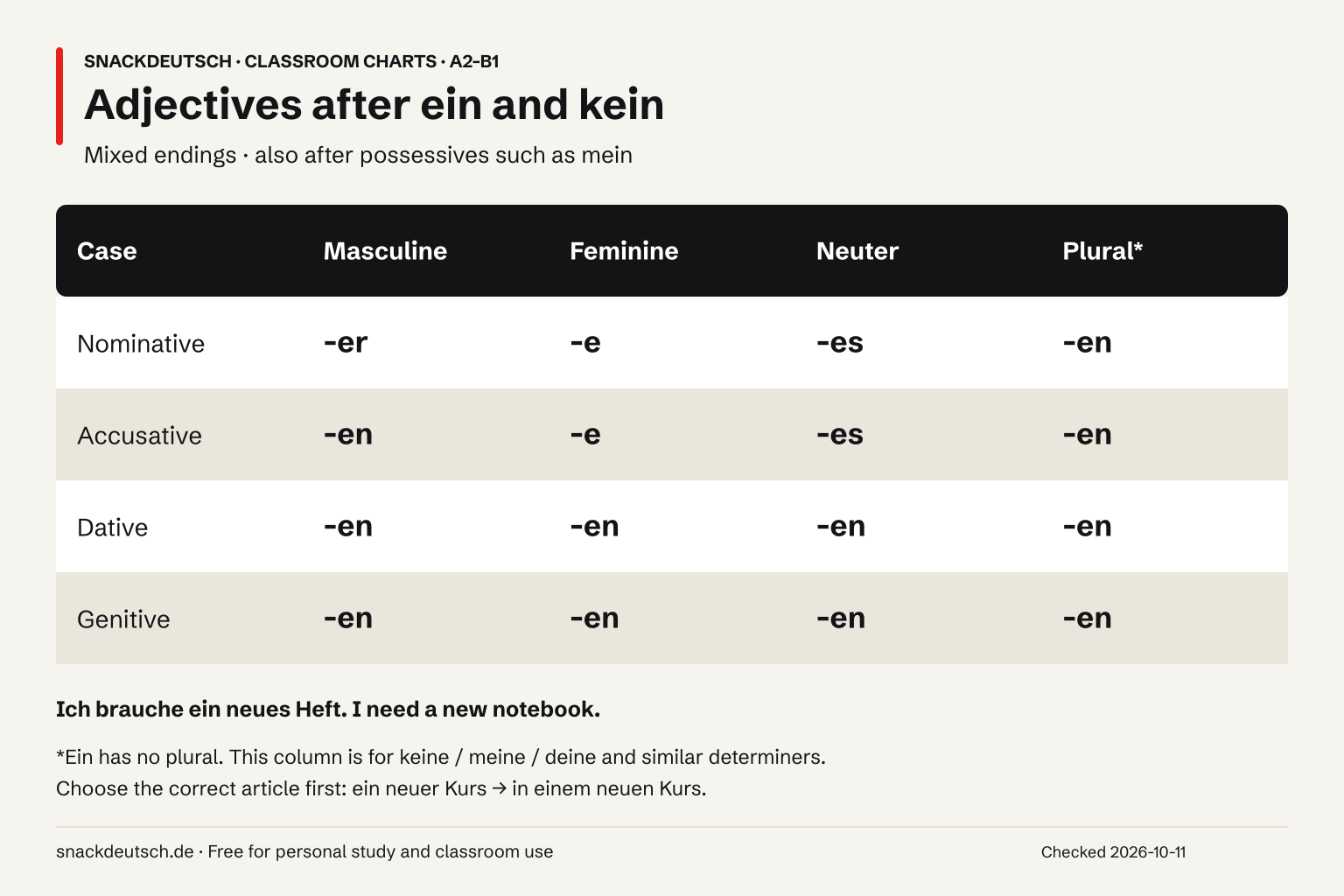
Mixed endings · also after possessives such as mein. Suggested level: A2–B1.
| Case | Masculine | Feminine | Neuter | Plural* |
|---|---|---|---|---|
| Nominative | -er | -e | -es | -en |
| Accusative | -en | -e | -es | -en |
| Dative | -en | -en | -en | -en |
| Genitive | -en | -en | -en | -en |
Ich brauche ein neues Heft. I need a new notebook.
- *Ein has no plural. This column is for keine / meine / deine and similar determiners.
- Choose the correct article first: ein neuer Kurs → in einem neuen Kurs.
Adjectives without an article
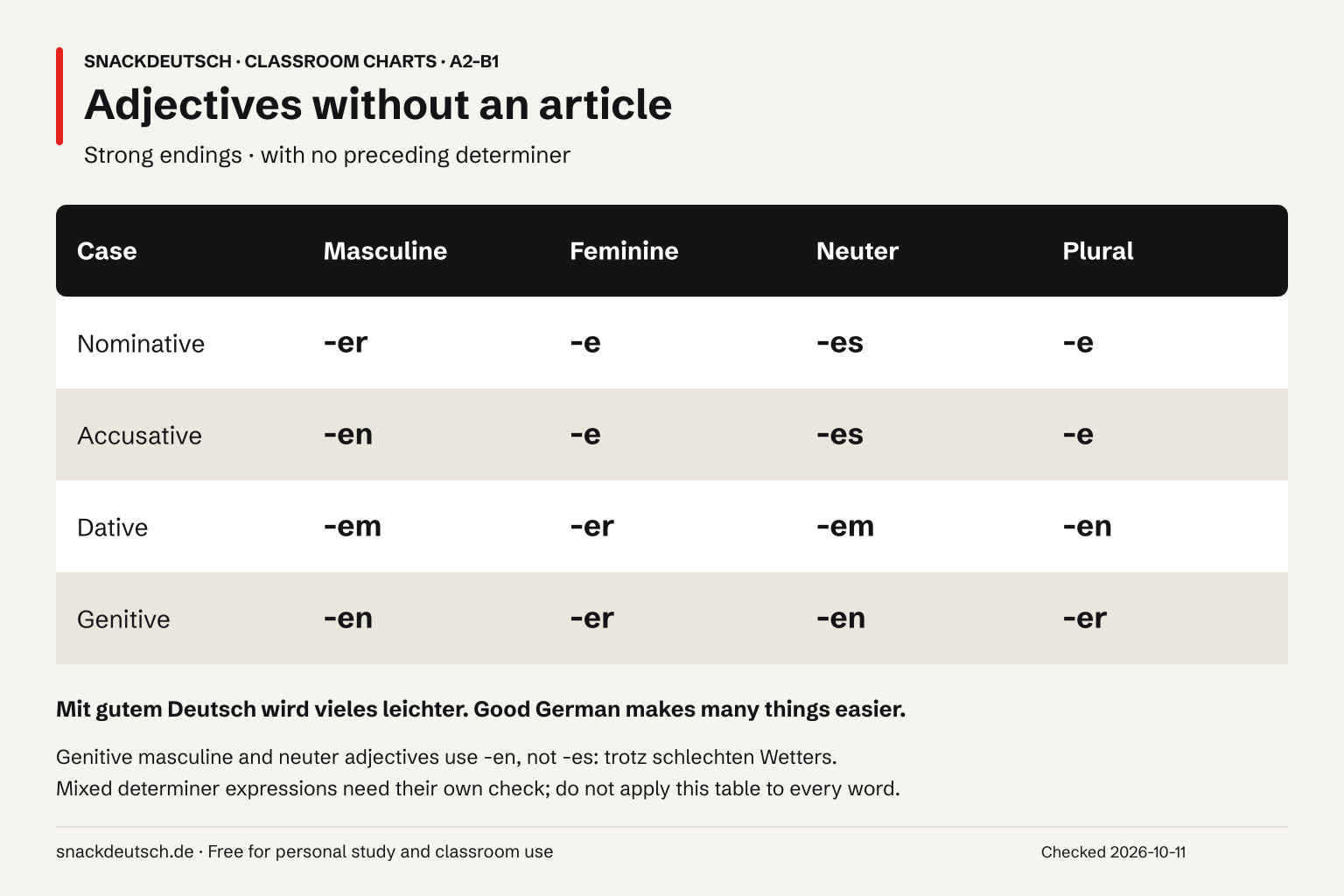
Strong endings · with no preceding determiner. Suggested level: A2–B1.
| Case | Masculine | Feminine | Neuter | Plural |
|---|---|---|---|---|
| Nominative | -er | -e | -es | -e |
| Accusative | -en | -e | -es | -e |
| Dative | -em | -er | -em | -en |
| Genitive | -en | -er | -en | -er |
Mit gutem Deutsch wird vieles leichter. Good German makes many things easier.
- Genitive masculine and neuter adjectives use -en, not -es: trotz schlechten Wetters.
- Mixed determiner expressions need their own check; do not apply this table to every word.
Work through one word in three patterns
Use der Kurs and neu. In the nominative, write der neue Kurs, ein neuer Kurs and, when the context allows no article, neuer Kurs. Now put the phrase after in to describe being in a course: in dem neuen Kurs, in einem neuen Kurs. These phrases use dative because they describe the setting, not entry into a new destination.
Do not memorize only the adjective ending. Keep the article, adjective and noun together. A sentence such as Ich bin in einem neuen Kurs gives you a complete usable phrase.
Here is a different example without a determiner: Ich trinke kalten Kaffee: I am drinking cold coffee. Kaffee is masculine and the phrase is accusative, so kalt takes -en. No article does not mean no adjective ending.
Four traps worth marking in your notebook
An adjective after sein usually has no case ending. Compare Das Heft ist neu with das neue Heft. The charts cover an adjective before its noun; do not write Das Heft ist neues.
Ein has no plural. In the mixed chart, the plural column belongs to forms such as meine neuen Hefte and keine neuen Hefte. Without a determiner, use neue Hefte from the strong chart.
Strong genitive masculine and neuter use -en. A pattern such as trotz schlechten Wetters contains -en, even though the definite article is des. “Copy the article ending everywhere” is not a complete rule.
The noun can change too. In mit den neuen Büchern, neuen has an adjective ending and Büchern has the additional dative plural -n. They are separate changes. Our German plural guide explains the noun side.
Practise with your own lesson vocabulary
Pick one masculine, one feminine and one neuter noun from a lesson you have already studied. Use familiar adjectives such as neu, klein and gut, and make one nominative sentence for each. Then change a sentence so the phrase becomes an accusative object.
For example: Ein neuer Stift liegt hier becomes Ich brauche einen neuen Stift. Both the article and adjective change. Compare that with Ein neues Heft liegt hier and Ich brauche ein neues Heft: the neuter forms remain the same.
Check these pairs before saving them as practice examples. The goal is to see one controlled change, rather than generate a large list whose endings you cannot yet explain.
Mini practice
Complete the adjective ending. The dictionary noun and relevant case are supplied so you can concentrate on selecting the chart.
- Das ist der neu___ Kurs. (der Kurs, nominative)
- Ich brauche ein neu___ Heft. (das Heft, accusative)
- Wir sprechen mit der nett___ Lehrerin. (die Lehrerin, dative)
- Ich trinke warm___ Wasser. (das Wasser, accusative, no determiner)
- Meine alt___ Bücher liegen hier. (plural, nominative)
- Wegen schlecht___ Wetters fällt der Ausflug aus. (das Wetter, genitive, no determiner)
Answers and reasons
- neue: weak table, nominative masculine after der.
- neues: mixed table, accusative neuter after ein.
- netten: weak table, dative feminine after der.
- warmes: strong table, accusative neuter with no determiner.
- alten: mixed table, plural after meine.
- schlechten: strong genitive neuter uses -en; Wetters also has its noun ending.
Sources and further practice
The forms were checked against Lingolia’s adjective declension tables and the University of Texas at Austin’s separate references for adjectives after ein-words, after der-words and without a determiner. Examples and exercises here are original.
Use the classroom chart collection to keep related reference sheets together. If the case is uncertain, work through our accusative and dative examples before selecting an adjective ending.