
Classroom companion
Accusative or dative? Start with the German sentence
Use verbs and prepositions to choose accusative or dative. Practise classroom examples without relying on the misleading “movement means accusative” shortcut.
Read as Markdown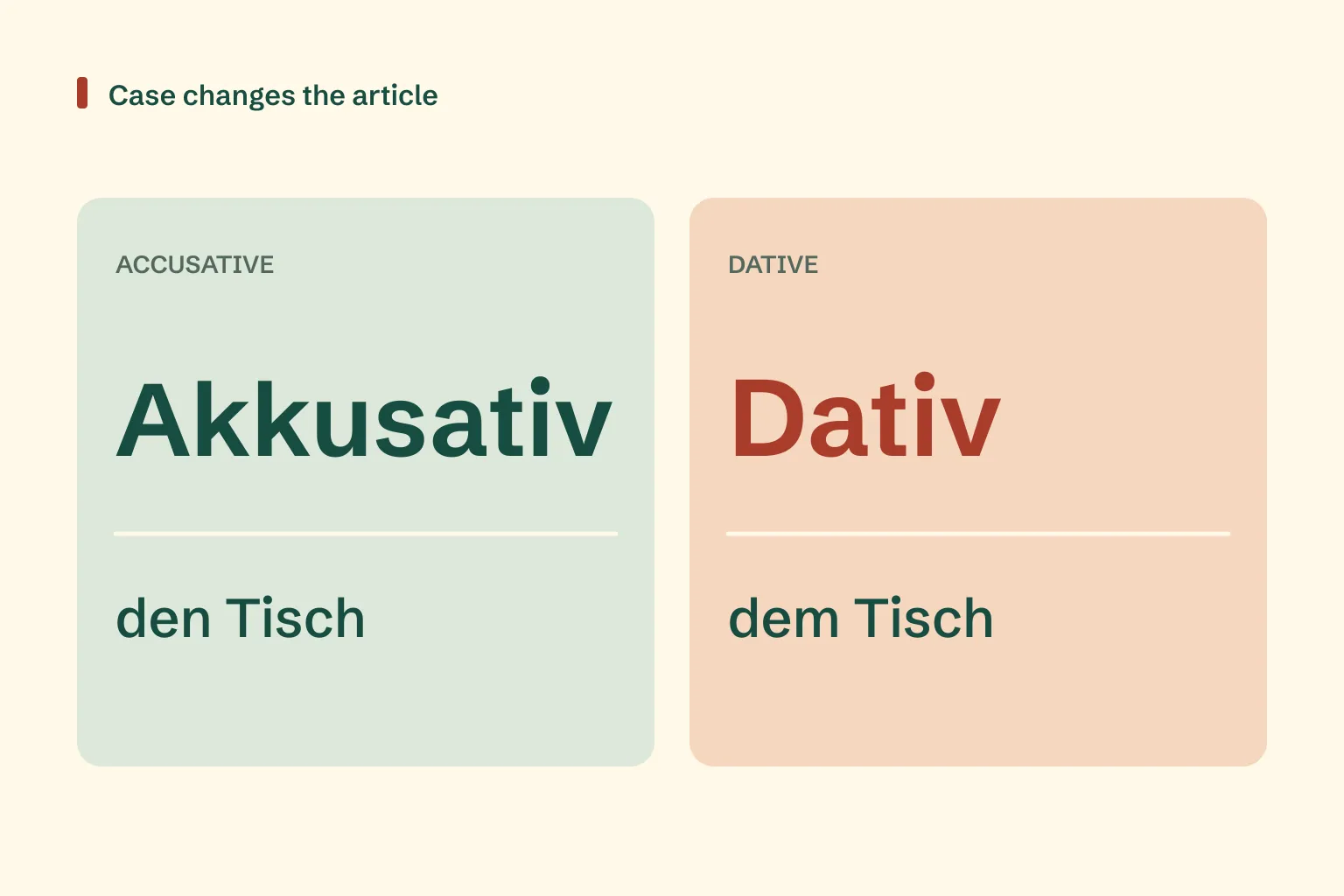
To choose accusative or dative in German, check the verb or preposition governing the noun phrase. Many direct objects use accusative, and a recipient with geben uses dative, but not every sentence follows an English “direct versus indirect” shortcut. Learn constructions such as jemandem helfen and mit + dative with examples.
Begin with one sentence that shows both
Die Lehrerin gibt dem Kind das Buch. The teacher gives the child the book.
Die Lehrerin is the subject. Das Buch is the thing given and is accusative. Dem Kind is the recipient and is dative. The article dem does not make Kind masculine; the dictionary form is still das Kind.
A sentence like this lets you see the roles together. It is more useful than memorizing a row of endings without knowing which phrase each ending belongs to.
A compact table for definite articles
| Gender or number | Nominative | Accusative | Dative |
|---|---|---|---|
| Masculine | der | den | dem |
| Feminine | die | die | der |
| Neuter | das | das | dem |
| Plural | die | die | den |
The same printed form can have different jobs. Der may be nominative masculine or dative feminine, among other uses. Identify the noun and construction before deciding what a form means.
Dative plurals can also change the noun: mit den Büchern. See the plural guide for that additional n.
Some verbs need a case pattern
Compare Ich sehe den Lehrer (I see the teacher) with Ich helfe dem Lehrer: I help the teacher. English places “the teacher” after both verbs, but German uses accusative with sehen and dative with helfen.
Your notebook should therefore record more than helfen = help. Add Ich helfe meiner Freundin or the notation jemandem helfen if your course uses it. The example makes the case requirement visible.
Likewise, learn jemandem etwas geben as a pattern. You can replace the recipient and the thing while preserving the structure: Ich gebe meinem Kollegen den Schlüssel: I give my colleague the key.
Prepositions can decide the case
Mit takes the dative: mit dem Stift, mit der Tasche, mit dem Buch. The noun’s role as an object in a broad English sense does not override that requirement.
Some prepositions take accusative, some dative, and some change case according to the relationship expressed. Do not apply the slogan “movement means accusative” to every preposition. Ich fahre mit dem Bus includes movement, but mit still takes the dative.
For two-way prepositions such as in and auf, work with location versus destination. Our wo and wohin guide covers that narrower distinction.
The four-case reference chart
Use the chart for the full set of forms, including genitive. Switch to Table to select and copy the forms. Return to the classroom chart collection for related reference sheets.
German definite articles
Four cases · der, die, das and plural die. Suggested level: A1–B1.
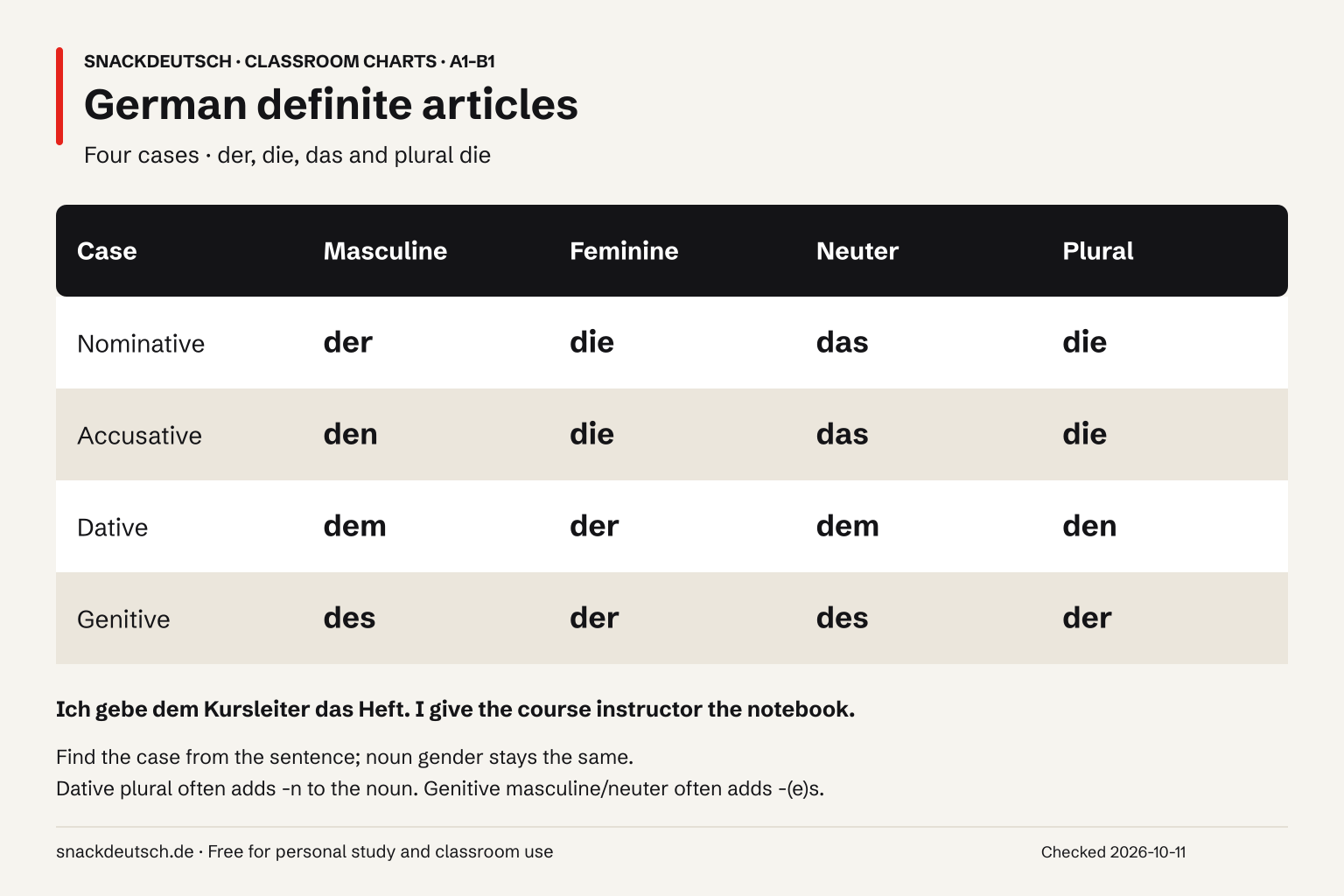
| Case | Masculine | Feminine | Neuter | Plural |
|---|---|---|---|---|
| Nominative | der | die | das | die |
| Accusative | den | die | das | die |
| Dative | dem | der | dem | den |
| Genitive | des | der | des | der |
Ich gebe dem Kursleiter das Heft. I give the course instructor the notebook.
- Find the case from the sentence; noun gender stays the same.
- Dative plural often adds -n to the noun. Genitive masculine/neuter often adds -(e)s.
Mini practice
Fill the definite article. Use the verb or preposition to explain your choice.
- Ich sehe ___ Lehrer. (der Lehrer)
- Ich helfe ___ Lehrer. (der Lehrer)
- Sie gibt ___ Kind das Buch. (das Kind)
- Wir schreiben mit ___ Stift. (der Stift)
- Er braucht ___ Tasche. (die Tasche)
Answers
- den: masculine accusative with sehen.
- dem: masculine dative with helfen.
- dem: neuter dative, the recipient with geben.
- dem: masculine dative after mit.
- die: feminine accusative with brauchen.
Make the rule useful in class
Take a sentence your teacher corrected and underline the governing verb or preposition. Then write a second sentence with the same pattern and different vocabulary. You are practising a reusable construction rather than a single corrected answer.
Sources and further reading
Use the University of Texas at Austin’s Grimm Grammar case overview and two-way preposition guide. For the difference between “a” and “the,” return to ein, eine, einen.
To replace a noun phrase, use the personal pronouns chart. If the phrase includes an adjective, choose the matching adjective-ending table.