
Free resources
German dative verbs: learn the person with the sentence
Learn eight useful German dative-verb patterns, distinguish the subject from the dative person, and practise with a complete worksheet and explained answers.
Read as Markdown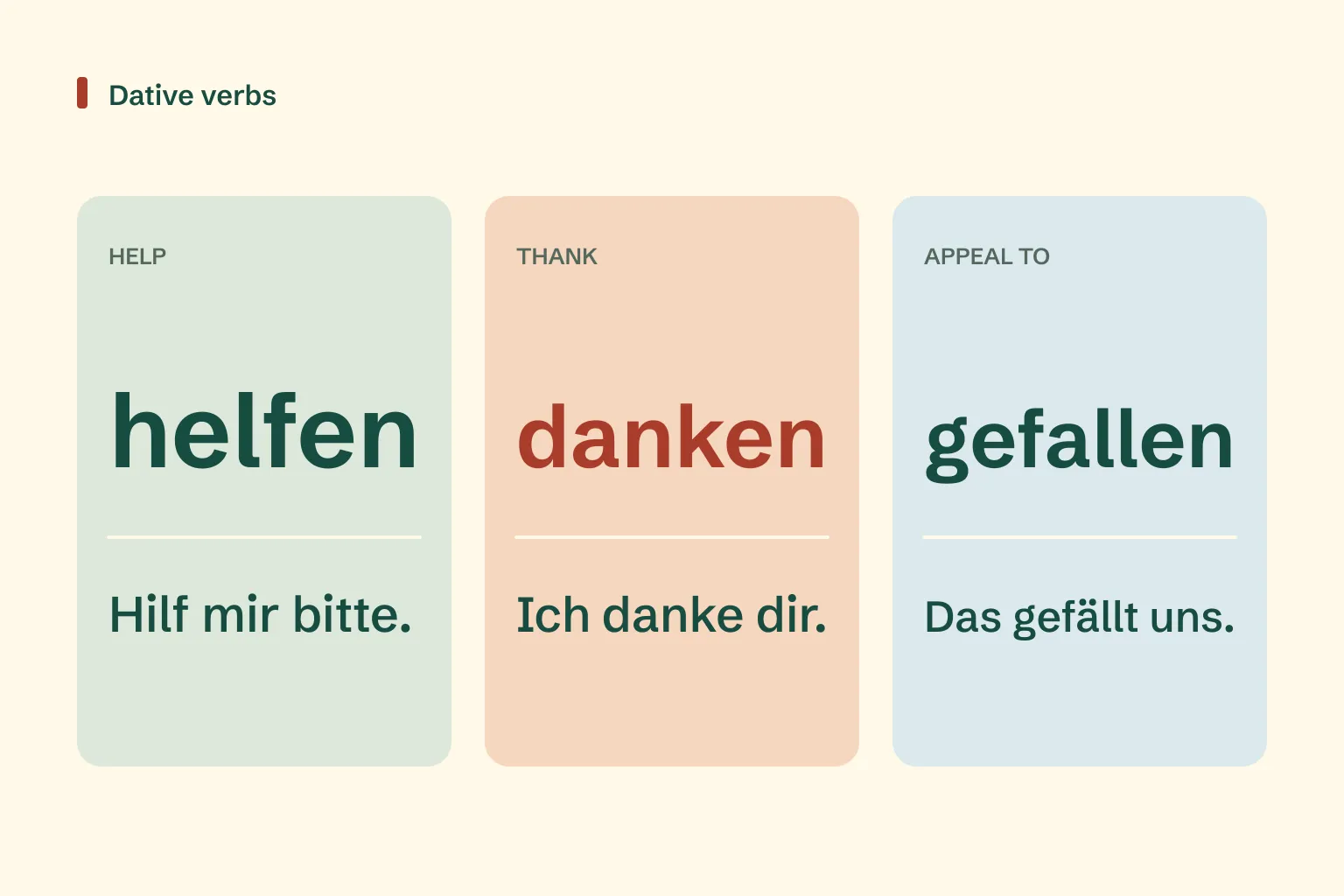
Your teacher asks, Kannst du mir helfen? The person receiving help is mir, not mich. German verbs choose their own sentence patterns, so translating the English object is not enough. Learn a short sentence with each verb: jemandem helfen, jemandem danken, jemandem antworten. Then change the person while keeping the pattern.
Takeaway: Ask which verb controls the person. Learn helfen + dative as one unit. “Person” does not automatically mean dative: Ich sehe dich uses accusative.
Eight patterns for class and everyday plans
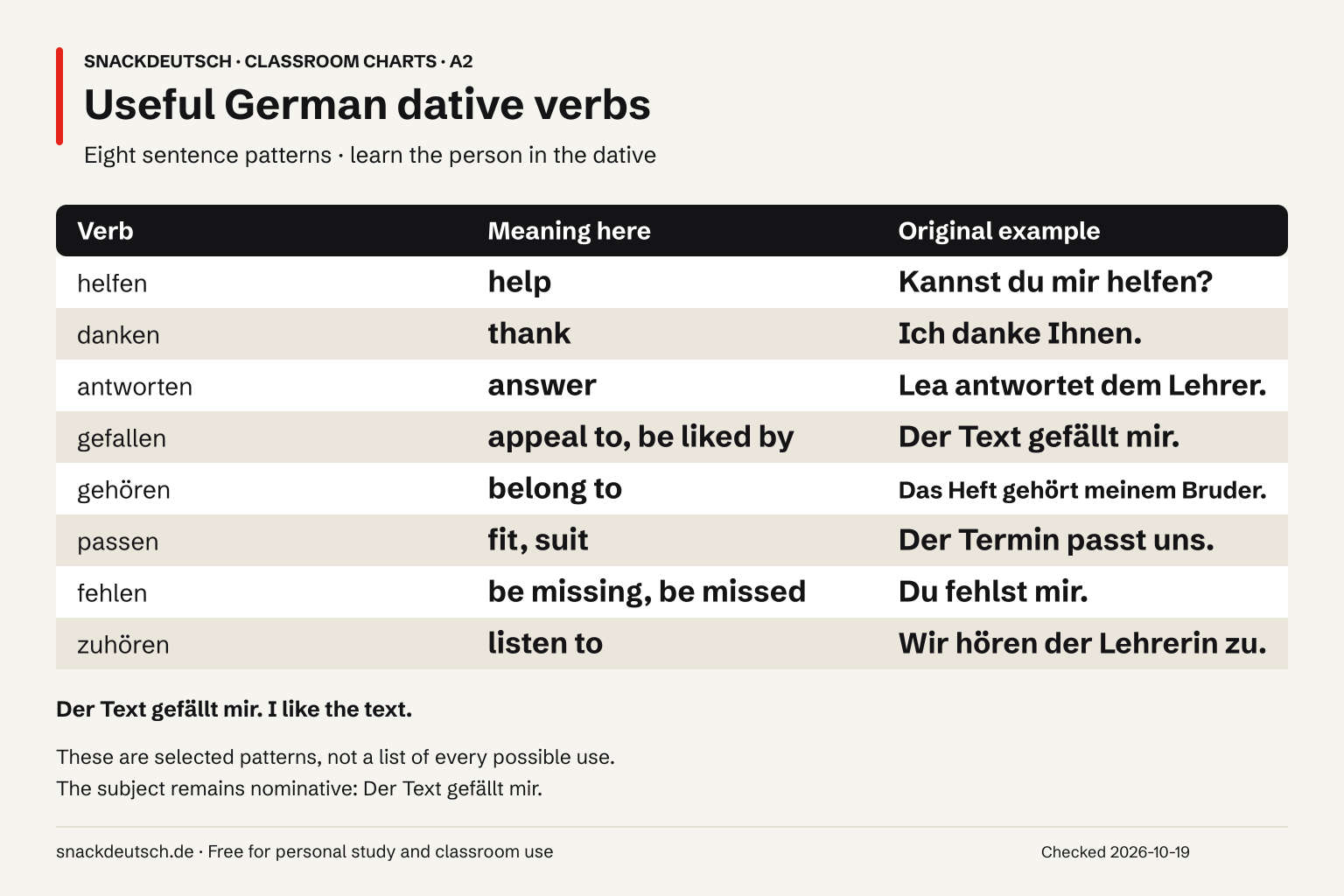
Useful German dative verbs
Eight sentence patterns · learn the person in the dative. Suggested level: A2.
| Verb | Meaning here | Original example |
|---|---|---|
| helfen | help | Kannst du mir helfen? |
| danken | thank | Ich danke Ihnen. |
| antworten | answer | Lea antwortet dem Lehrer. |
| gefallen | appeal to, be liked by | Der Text gefällt mir. |
| gehören | belong to | Das Heft gehört meinem Bruder. |
| passen | fit, suit | Der Termin passt uns. |
| fehlen | be missing, be missed | Du fehlst mir. |
| zuhören | listen to | Wir hören der Lehrerin zu. |
Der Text gefällt mir. I like the text.
- These are selected patterns, not a list of every possible use.
- The subject remains nominative: Der Text gefällt mir.
The meanings describe the examples, not every dictionary meaning. Passen can refer to a suitable time or a garment that fits. Fehlen can describe absence: Ein Blatt fehlt (A sheet is missing). In Du fehlst mir, du is the person missed and mir identifies the person who misses them.
With antworten, distinguish the person from the topic: Ich antworte dem Lehrer auf die Frage (I answer the teacher’s question). Dem Lehrer is dative; auf die Frage is a separate prepositional phrase. Do not copy that preposition to helfen: a useful pattern is jemandem bei einer Aufgabe helfen.
Find the subject before replacing a noun
Compare these three sentences:
- Die Erklärung hilft meinem Bruder. The explanation helps my brother.
- Mein Bruder hilft der Lehrerin. My brother helps the teacher.
- Ich sehe meinen Bruder. I see my brother.
The first noun does not have one permanent case. Mein Bruder is the subject in the second sentence and nominative. Meinem Bruder is the dative complement of hilft in the first. Meinen Bruder is the accusative object of sehe in the third. The noun’s masculine gender remains the same.
To shorten the first example, write Die Erklärung hilft ihm. To shorten the second, write Er hilft ihr. Those pronouns refer to the brother and teacher; they do not follow a rule that “the second person is always mir.” Use the personal-pronoun chart when the person changes.
Why gefällt mir feels reversed
Der Dialog gefällt mir is naturally translated as “I like the dialogue.” Grammatically, however, der Dialog is the German subject. With two dialogues, the verb changes: Die Dialoge gefallen mir. The person mir stays dative.
Use a small substitution test:
- Keep mir and replace der Dialog with die Übungen.
- Change singular gefällt to plural gefallen.
- Read the result: Die Übungen gefallen mir (I like the exercises).
Avoid Ich gefalle den Übungen for that meaning. It reverses who appeals to whom. Mögen offers another construction, Ich mag die Übungen, but its case pattern differs.
Make useful notebook cards
Write zuhören → Ich höre dir zu, with the separated zu visible. On the reverse, use “I am listening to you.” A card containing only “listen = zuhören” will not remind you of the case or the separated prefix. Add a classroom situation: a partner explains the next task and you put away your phone.
Practice: choose and explain
- Complete: Kannst du ___ helfen? You are asking for help for yourself.
- Replace der Lehrerin: Wir hören der Lehrerin zu.
- Choose the verb form: Die neuen Aufgaben gefällt / gefallen mir.
- Complete with the correct article: Das Buch gehört ___ Lehrer (der Lehrer).
- Correct: Ich danke dich für die Erklärung.
- Translate: “The appointment suits us.”
- Why is meinen Bruder correct in Ich sehe meinen Bruder, although helfen uses dative?
Answers with reasons
- mir. Helfen takes the person helped in the dative; the speaker is ich → mir.
- Wir hören ihr zu. The feminine singular dative pronoun is ihr. The prefix stays at the end.
- gefallen. The subject die neuen Aufgaben is plural. Mir does not control the verb ending.
- dem. Gehören uses a dative possessor; masculine der Lehrer becomes dem Lehrer.
- Ich danke dir für die Erklärung. Danken takes dative dir; für die Erklärung names what you are thanking them for.
- Der Termin passt uns. Der Termin is singular and controls passt. Uns is the dative person here.
- Sehen has its own accusative pattern. Do not transfer one verb’s case to another verb.
Sources and next practice
The University of Texas dative reference supports the selected verb and case patterns; its dative-pronoun reference supplies the forms. All lesson examples and tasks above are original. Continue in the A2 learning path and bring one new verb-plus-person sentence to class.