
Classroom companion
Sein and haben: forms you can use in your first German class
Learn all present-tense forms of sein and haben, choose between being and having, and practise classroom questions with six explained answers.
Read as Markdown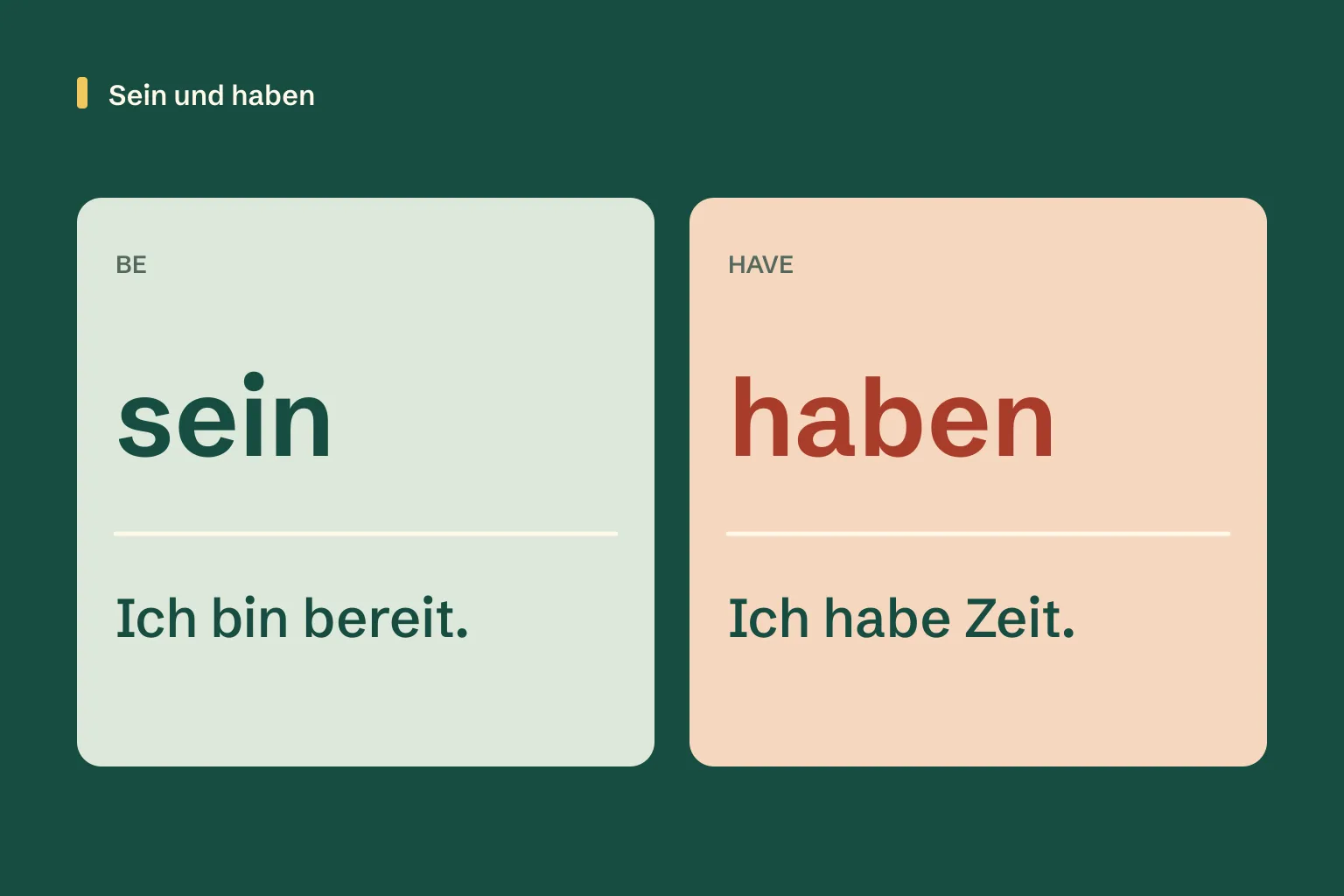
Your teacher asks Bist du bereit? (Are you ready?) and a classmate asks Hast du einen Stift? (Do you have a pen?). Sein describes being in a state, place or identity in these examples. Haben describes having something. Both verbs are irregular in the present tense, so learn their complete forms with short sentences you can actually use.
Takeaway: Choose the message first, then match the verb to its subject: ich bin, but ich habe; du bist, but du hast.
Sein and haben in the present
Sein and haben
Present tense · being and having. Suggested level: A1.
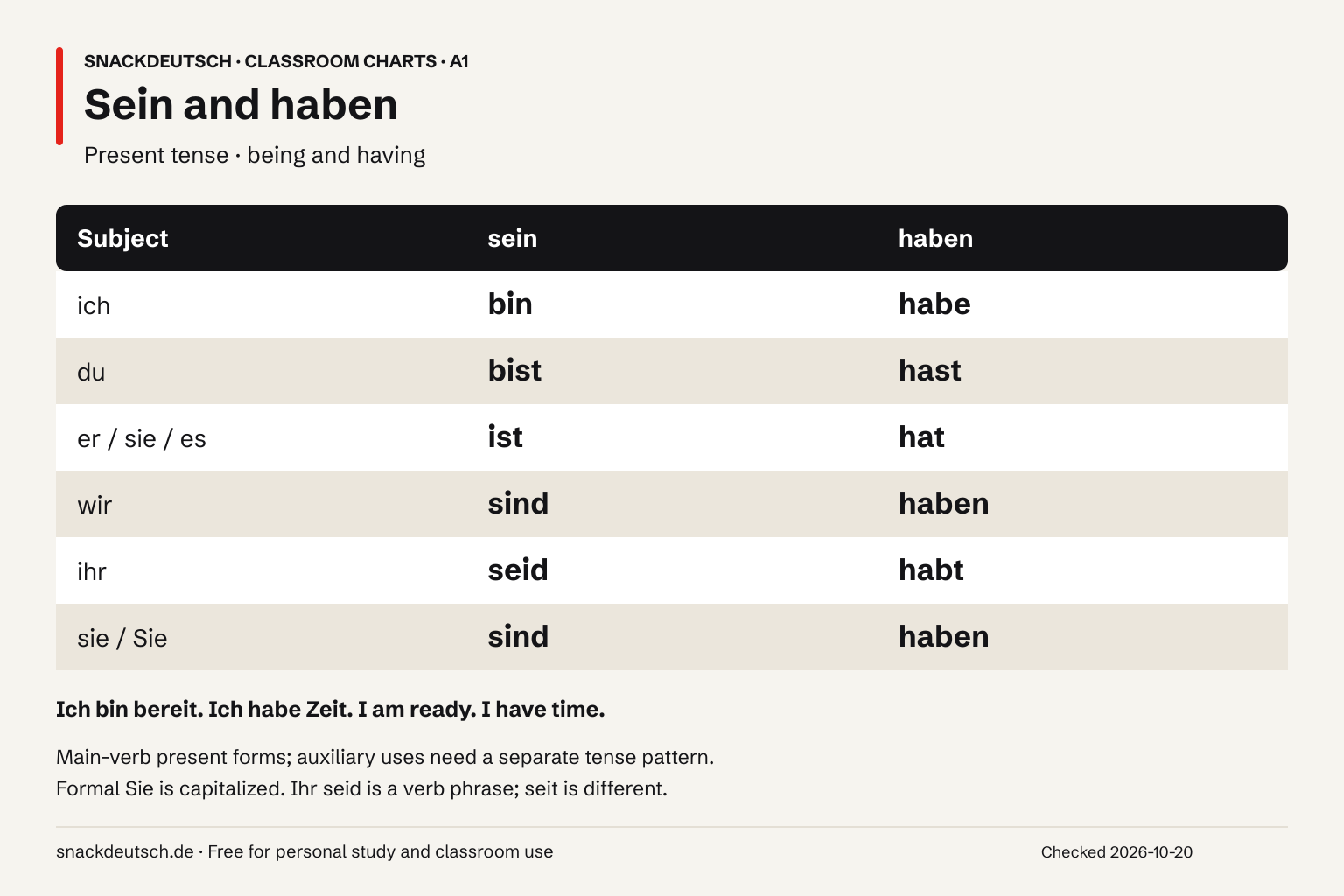
| Subject | sein | haben |
|---|---|---|
| ich | bin | habe |
| du | bist | hast |
| er / sie / es | ist | hat |
| wir | sind | haben |
| ihr | seid | habt |
| sie / Sie | sind | haben |
Ich bin bereit. Ich habe Zeit. I am ready. I have time.
- Main-verb present forms; auxiliary uses need a separate tense pattern.
- Formal Sie is capitalized. Ihr seid is a verb phrase; seit is different.
Lowercase sie in the final row means “they”; formal Sie means “you.” Their verb forms match, although their meanings differ. Ihr addresses more than one person informally. In Ihr seid bereit (You are ready), do not confuse seid, a verb, with seit, the word used in expressions such as seit Montag (since Monday).
The forms hast and hat have no b. Starting from the infinitive and adding a regular ending would produce a wrong form. Sein has several different stems, which is another reason to practise whole subject-and-verb pairs instead of trying to build every form from sein.
Choose between being and having
| Situation | Original German | English meaning |
|---|---|---|
| State | Ich bin müde. | I am tired. |
| Location | Der Kursraum ist hier. | The classroom is here. |
| Age | Lea ist zwanzig Jahre alt. | Lea is twenty years old. |
| Possession | Lea hat ein Wörterbuch. | Lea has a dictionary. |
| Available time | Wir haben heute Zeit. | We have time today. |
| A common feeling phrase | Ich habe Hunger. | I am hungry. |
English and German do not always choose the same verb. English “I am hungry” corresponds to Ich habe Hunger, literally “I have hunger.” Learn Hunger haben and Durst haben as phrases. By contrast, müde sein uses sein. The goal is the correct German expression, not a word-for-word replacement of the English verb.
After haben, a possessed thing is normally an accusative object: Ich habe einen Stift. Einen goes with masculine der Stift in that sentence. After sein, Das ist ein Stift names what something is and uses ein. This lesson introduces that contrast; use the article guide for the wider ending system.
Turn your statement into a question
Move the conjugated verb before the subject for a simple yes/no question: Du bist im Kurs becomes Bist du im Kurs? (Are you in the course?). Ihr habt das Buch becomes Habt ihr das Buch? (Do you have the book?). You do not need an extra German word corresponding to English “do.”
A useful classroom exchange is Hast du ein Heft? (Do you have a notebook?), Ja, ich habe ein Heft (Yes, I have a notebook). If the answer is negative, Nein, ich habe kein Heft uses kein with the noun. Do not change the verb merely because the sentence becomes negative.
Practise a contrast, not just a column
Put two objects on a desk and name their owners. Then add one state: Das ist Leas Buch. Lea hat ein Buch. Lea ist bereit. These sentences share a person and an object but do different jobs. This chart covers the present with sein and haben as main verbs. Their use as helpers in the Perfekt belongs to a separate lesson.
Practise it
- Complete with sein: Lea und Omar ___ im Kursraum.
- Complete with haben: Du ___ ein Wörterbuch.
- Choose the German phrase for “I am hungry”: Ich bin Hunger or Ich habe Hunger.
- Make a yes/no question from Ihr seid bereit.
- Correct the verb only: Ihr seit im Kurs.
- Write two sentences about a fictional learner, using sein for a state and haben for an object. Give English meanings.
Answers and reasons
- Lea und Omar sind im Kursraum. Two people form a plural subject, equivalent to sie.
- Du hast ein Wörterbuch. The irregular form is hast, without b.
- Ich habe Hunger. German uses haben in this phrase.
- Seid ihr bereit? The finite verb moves before ihr, retaining the same form.
- Ihr seid im Kurs. Seid is the verb; seit is not a present form of sein.
- Model: Nora ist müde. Nora hat ein Buch. Nora is tired. Nora has a book. Other people, states and objects are acceptable if the verb and any article fit the sentence.
Use it in your next lesson
Look at your latest course notes and make two small lists: sein phrases and haben phrases. Add one original example to each. Model: Wir sind pünktlich (We are on time), Wir haben zwei Bücher (We have two books). Keep the subject the same so the choice of verb receives your attention.