
Classroom companion
German word order: statements and questions with practice
Build German statements and direct questions, understand what second position means, and practise moving a time phrase without losing the verb.
Read as Markdown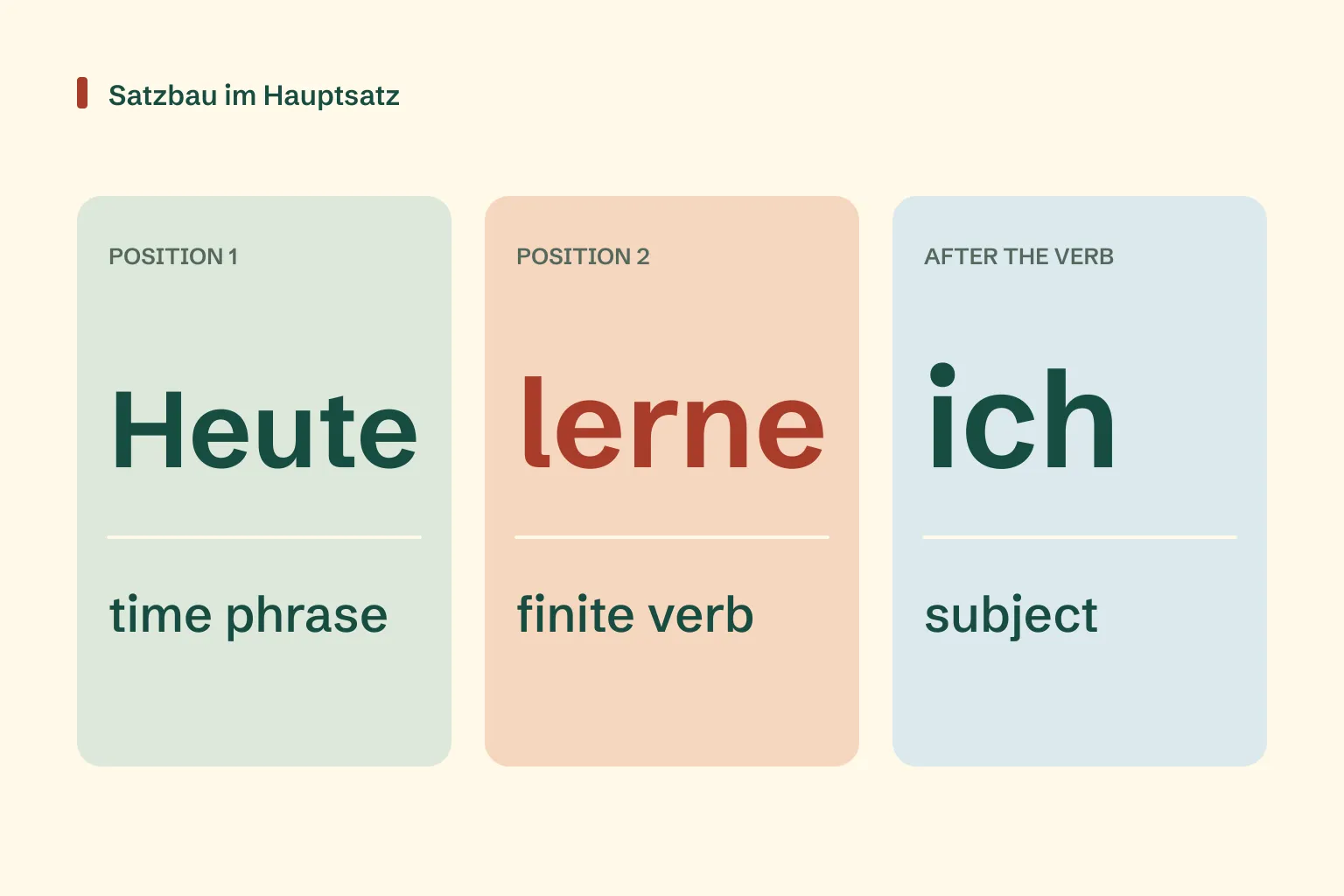
Your teacher changes Ich lerne heute Deutsch into Heute lerne ich Deutsch. Both mean that you are studying German today. The time phrase can move to the front, but the conjugated verb stays in second position in this ordinary main-clause statement. A yes/no question has a different pattern: Lernst du heute Deutsch? Start by recognizing which type of sentence you are building.
Takeaway: In a neutral statement, reserve the second sentence position for the finite verb. “Second position” does not mean the second written word.
A chart for three everyday patterns
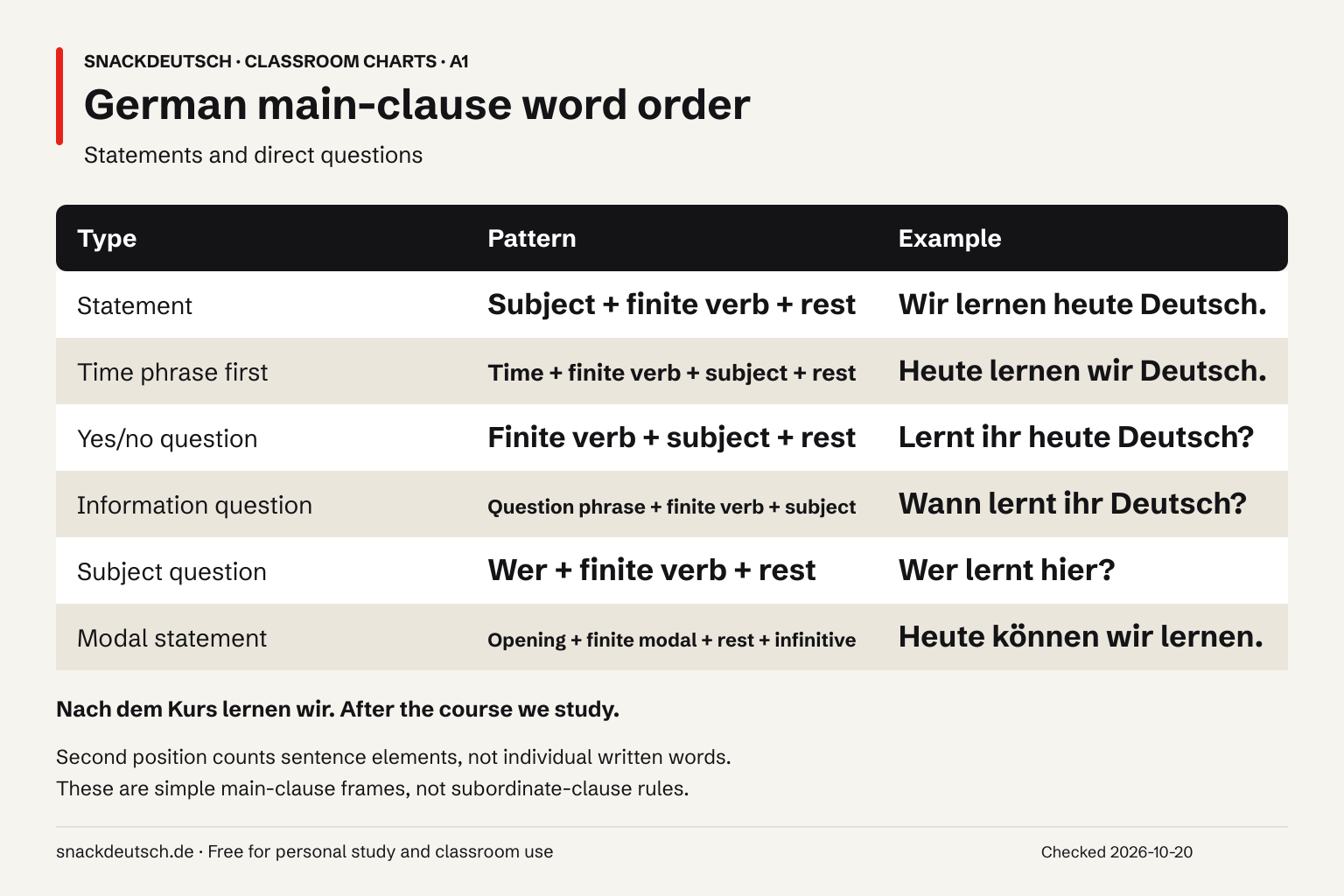
German main-clause word order
Statements and direct questions. Suggested level: A1.
| Type | Pattern | Example |
|---|---|---|
| Statement | Subject + finite verb + rest | Wir lernen heute Deutsch. |
| Time phrase first | Time + finite verb + subject + rest | Heute lernen wir Deutsch. |
| Yes/no question | Finite verb + subject + rest | Lernt ihr heute Deutsch? |
| Information question | Question phrase + finite verb + subject | Wann lernt ihr Deutsch? |
| Subject question | Wer + finite verb + rest | Wer lernt hier? |
| Modal statement | Opening + finite modal + rest + infinitive | Heute können wir lernen. |
Nach dem Kurs lernen wir. After the course we study.
- Second position counts sentence elements, not individual written words.
- These are simple main-clause frames, not subordinate-clause rules.
The finite verb is the form that matches the subject: lernen with wir, lernt with ihr. Finding it is easier than counting every word. Underline it first. In these simple statements, there is one finite verb, and it occupies the second position.
One opening unit can contain several words
Nach dem Kurs lernen wir zusammen means “After the course we study together.” Nach dem Kurs is a whole opening phrase, even though it contains three written words. Lernen occupies the next sentence position. You do not need Nach lernen dem Kurs … and you do not keep wir before lernen after moving the whole phrase.
Compare Wir schreiben am Montag einen Text with Am Montag schreiben wir einen Text. Both mean “We write a text on Monday.” Circle the entire am Montag phrase and move it as a unit. This is the useful beginner meaning of “verb second.” The order of everything after the verb has further options and constraints; this short chart does not settle every possible emphasis pattern.
Ask a real question
To ask whether an activity happens, place the finite verb first: Ihr arbeitet zusammen becomes Arbeitet ihr zusammen? (Are you working together?). To ask when, add wann in front: Wann arbeitet ihr zusammen? (When do you work together?). German does not add a separate “do” verb for these questions.
A question about the subject needs special attention: Wer lernt hier? means “Who studies here?” Wer is already the subject. Do not insert er automatically after the verb. This distinction prevents a simple question frame from turning into a rule that adds an unnecessary pronoun everywhere.
When another verb occupies the end
In Wir können heute lernen (We can study today), können is finite and lernen is an infinitive. Können takes second position while lernen closes this simple clause. In Heute können wir lernen, the opening time phrase changes place, but the two verb jobs remain the same. See the modal-verb guide for the forms and meanings.
This article covers simple independent statements and direct questions. Clauses introduced by weil or dass, relative clauses and longer verb combinations need additional patterns. When copying a sentence from your notes, identify the clause type before applying the chart. A sentence does not become wrong simply because a different construction has a different verb position.
Practise it
- Start with Heute: Wir schreiben heute drei Sätze.
- Start with the complete phrase Nach der Pause: Wir lesen nach der Pause den Text.
- Make a yes/no question: Du lernst am Abend.
- Ask about the time in Wir lernen am Dienstag, using wann and keeping wir.
- Explain why Nach dem Kurs does not violate the second-position rule in Nach dem Kurs lernen wir.
- Put in order, beginning with Heute: lernen / können / wir / Heute. Then identify the finite verb.
Answers and reasons
- Heute schreiben wir drei Sätze. Heute occupies position one; schreiben remains in position two.
- Nach der Pause lesen wir den Text. Move the whole phrase; wir follows the finite verb.
- Lernst du am Abend? The finite verb comes first in this yes/no question.
- Wann lernen wir? Wann replaces the time information being requested. Wann lernen wir am Dienstag? would ask for a more specific time on that day, which changes the question.
- The phrase is one sentence element. Three written words can occupy one opening position.
- Heute können wir lernen. Können matches wir and is finite; lernen is the infinitive. The modal frame does not put both verbs in second position.
Use it in your next lesson
Take one neutral statement from your notes and mark its opening phrase and finite verb. Write a second version with a time phrase first. Model: Ich übe am Morgen → Am Morgen übe ich. Keep the same message, then ask the matching yes/no question: Übst du am Morgen?
Sources and further reading
- UT: word order: Main-clause position and the separate roles of finite and non-finite verbs.
- UT: questions: Direct question patterns and question words.