
Free resources
German relative pronouns: build the clause step by step
Choose German relative pronouns from the noun and the job inside the relative clause. Includes a four-case chart, step-by-step examples and explained practice.
Read as Markdown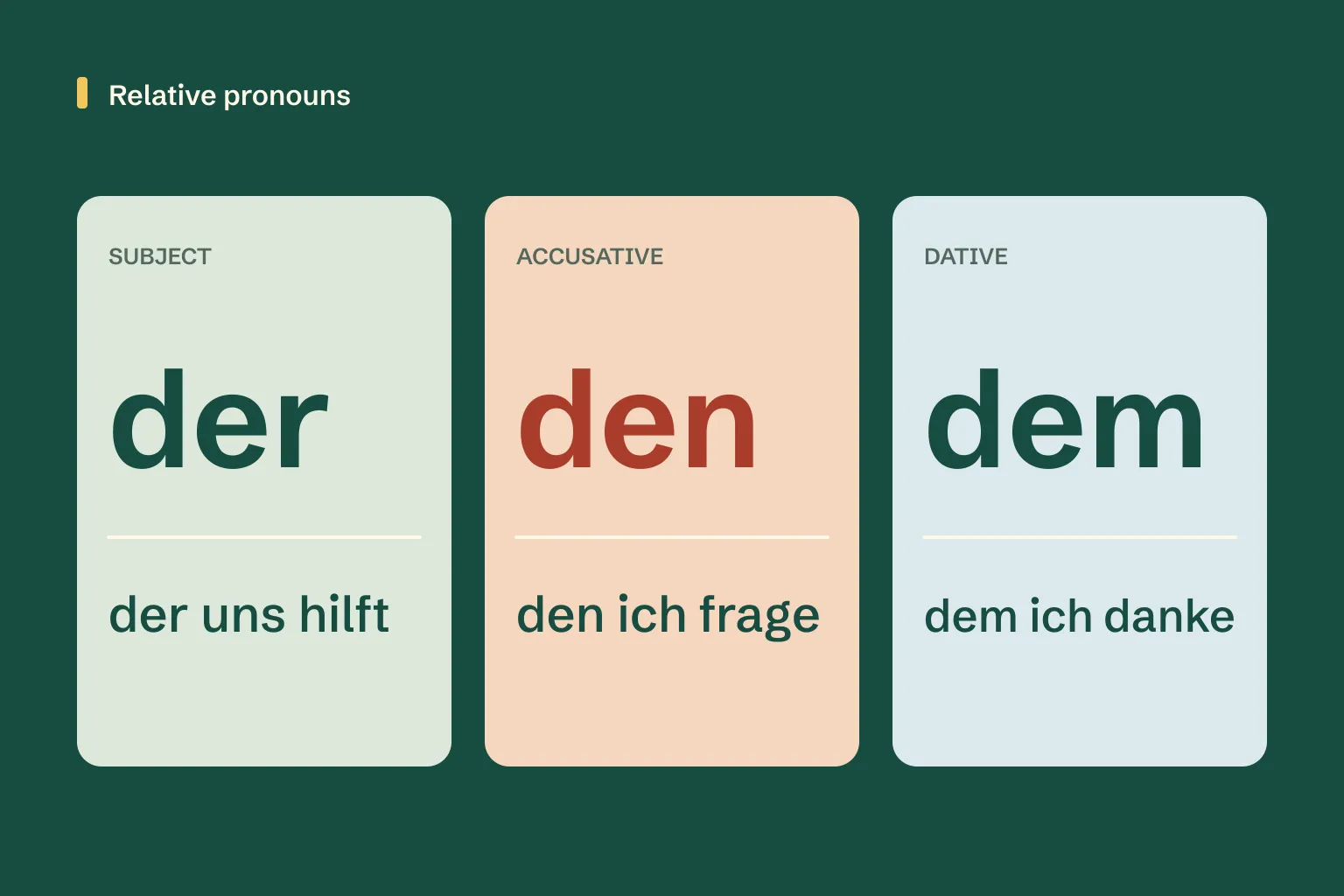
Your teacher asks you to describe der Kursleiter without repeating that noun. You can say Das ist der Kursleiter, der uns die Regel erklärt: that is the instructor who explains the rule to us. A German relative pronoun connects a description to a noun. Its gender and number come from that noun, but its case comes from its job inside the relative clause.
Takeaway: Identify the noun, rebuild the description as a small sentence, then choose the pronoun. Never copy the noun’s case automatically from the main clause.
German relative pronouns chart
German relative pronouns
Common der/die/das series. Suggested level: B1.
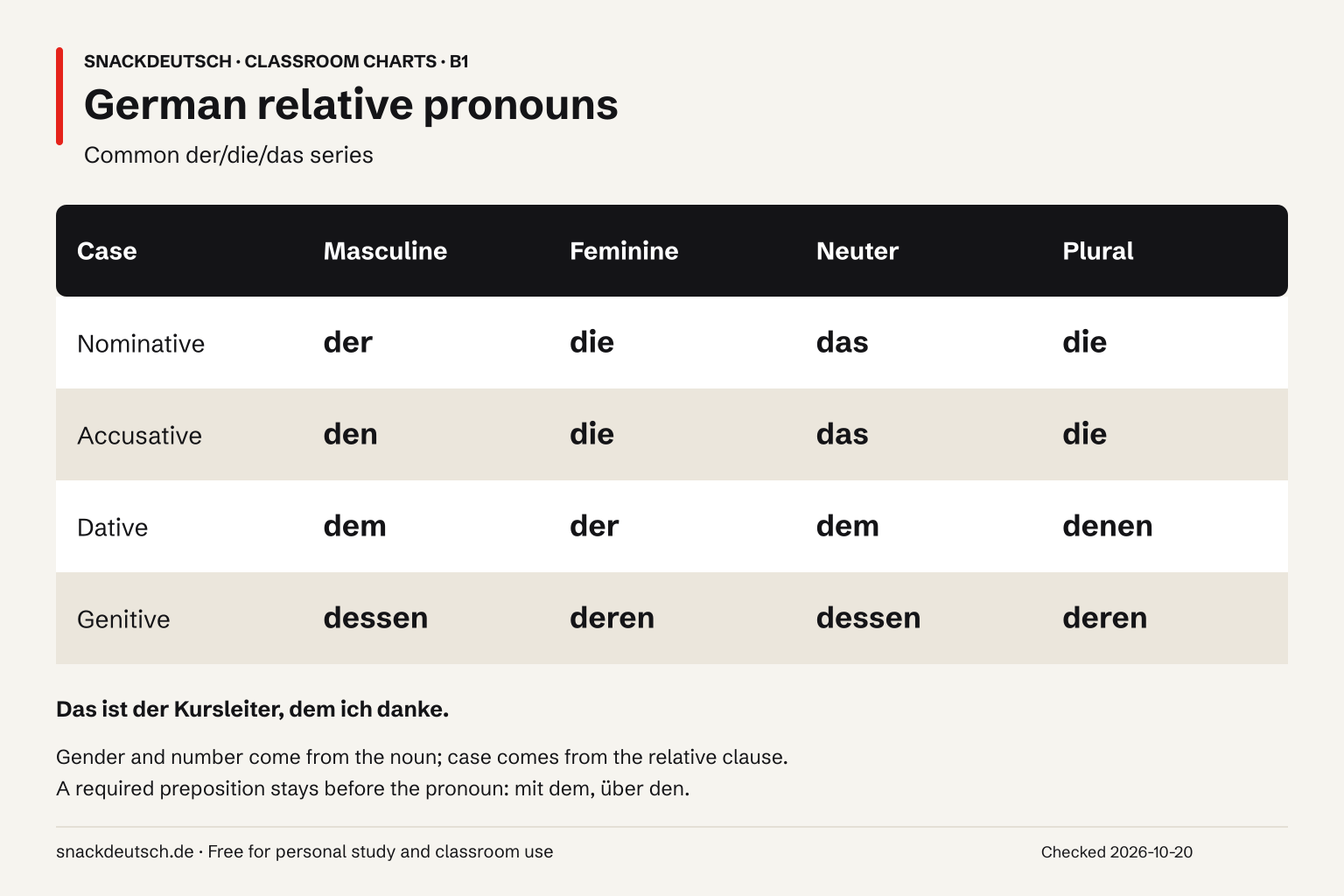
| Case | Masculine | Feminine | Neuter | Plural |
|---|---|---|---|---|
| Nominative | der | die | das | die |
| Accusative | den | die | das | die |
| Dative | dem | der | dem | denen |
| Genitive | dessen | deren | dessen | deren |
Das ist der Kursleiter, dem ich danke.
- Gender and number come from the noun; case comes from the relative clause.
- A required preposition stays before the pronoun: mit dem, über den.
This table gives the common der/die/das series. It is not a table of personal pronouns. Notice plural dative denen, and genitive dessen/deren. Do not substitute article forms den or des in those positions.
Work through one noun three times
The noun remains masculine singular der Kursleiter. Its role in each description changes:
- Der Kursleiter erklärt die Regel. The instructor explains the rule. He is the subject: Das ist der Kursleiter, der die Regel erklärt.
- Ich frage den Kursleiter. I ask the instructor. He is the accusative object: Das ist der Kursleiter, den ich frage.
- Ich danke dem Kursleiter. I thank the instructor. He is the dative object: Das ist der Kursleiter, dem ich danke.
In all three main clauses, der Kursleiter appears after ist. That does not decide the relative case. The embedded verbs erklären, fragen and danken determine the relevant roles. Rebuilding the short sentence makes the choice visible.
A particularly useful test is Ich spreche mit dem Kursleiter, der heute die Gruppe leitet. The main-clause phrase has dative dem after mit, but the relative pronoun is nominative der, because he leads the group.
Carry a necessary preposition into the clause
Start with Ich arbeite mit der Partnerin. When die Partnerin becomes the described noun, mit remains part of the relation: Das ist die Partnerin, mit der ich arbeite. Feminine singular plus dative after mit gives der.
For a place: Wir lernen in dem Raum becomes Das ist der Raum, in dem wir lernen. For a text: Wir sprechen über den Text becomes Das ist der Text, über den wir sprechen. The preposition stands directly before the relative pronoun.
Do not replace every place description with wo in this exercise. In dem states the specific grammatical relationship and lets you practise the case. Other relative constructions exist, but this lesson focuses on the chart above.
Keep the verb at the end and the commas visible
In the simple clauses here, the finite verb closes the relative clause: die Partnerin, mit der ich arbeite. With a modal, the finite modal is last: ein Text, den ich verstehen kann.
If the description interrupts the main clause, use a comma on each side: Die Partnerin, mit der ich arbeite, kommt heute später. After the second comma, continue the original main-clause frame: Die Partnerin kommt heute später. Do not add another subject sie just because the description was long.
Recognize whose with dessen and deren
Das ist der Teilnehmer, dessen Heft hier liegt means “That is the participant whose notebook is here.” Dessen refers back to masculine Teilnehmer. In Das ist die Teilnehmerin, deren Heft hier liegt, deren refers back to feminine Teilnehmerin. The gender of Heft does not choose dessen/deren.
These genitive forms indicate the possessive relationship. Start with the clearer pair sein Heft / ihr Heft, then connect it to the person. This section introduces recognition; it does not cover every adjective-ending pattern after genitive relatives.
Six tasks
- Fill the gap: Das ist die Lehrerin, ___ heute die Aufgabe erklärt.
- Fill the gap: Ich suche den Text, ___ wir gestern gelesen haben.
- Join: Das sind die Teilnehmer. Ich helfe den Teilnehmern.
- Join: Das ist das Heft. Ich schreibe in dem Heft. Use the location meaning.
- Choose dessen or deren: Das ist die Kursleiterin, ___ Fahrrad vor der Tür steht.
- Join, placing the relative clause after Partner: Mein Partner kommt später. Ich übe mit meinem Partner.
Answers and reasons
- Die. Feminine singular Lehrerin is the subject of erklärt inside the relative clause.
- Den. Masculine singular Text is what we read, an accusative object. Haben is final in the subordinate perfect construction.
- Das sind die Teilnehmer, denen ich helfe. Helfen takes dative; plural dative relative is denen.
- Das ist das Heft, in dem ich schreibe. Neuter singular and locative in + dative give dem. The preposition stays with the pronoun.
- Deren. It refers back to feminine singular Kursleiterin, not to neuter Fahrrad.
- Mein Partner, mit dem ich übe, kommt später. Masculine dative dem follows mit. Both commas mark the inserted description; kommt completes the main clause.
Sources and next practice
Checked on 19 October 2026: University of Texas, relative pronouns, and IDS grammis, relative elements, supporting forms, independent case choice and preposition placement. All tasks are original. B1 is an editorial teaching estimate; the chart includes genitive forms for reference, not a claim that every construction is equally easy.
Use the case guide if you need to rebuild a simple clause first. Continue with the B1 learning path and describe one person and one object from your class.