
Free resources
German verbs with prepositions: learn the case in context
Learn German verbs with their preposition and case in complete B1 sentences. Compare fixed complements with location phrases and practise six checked tasks.
Read as Markdown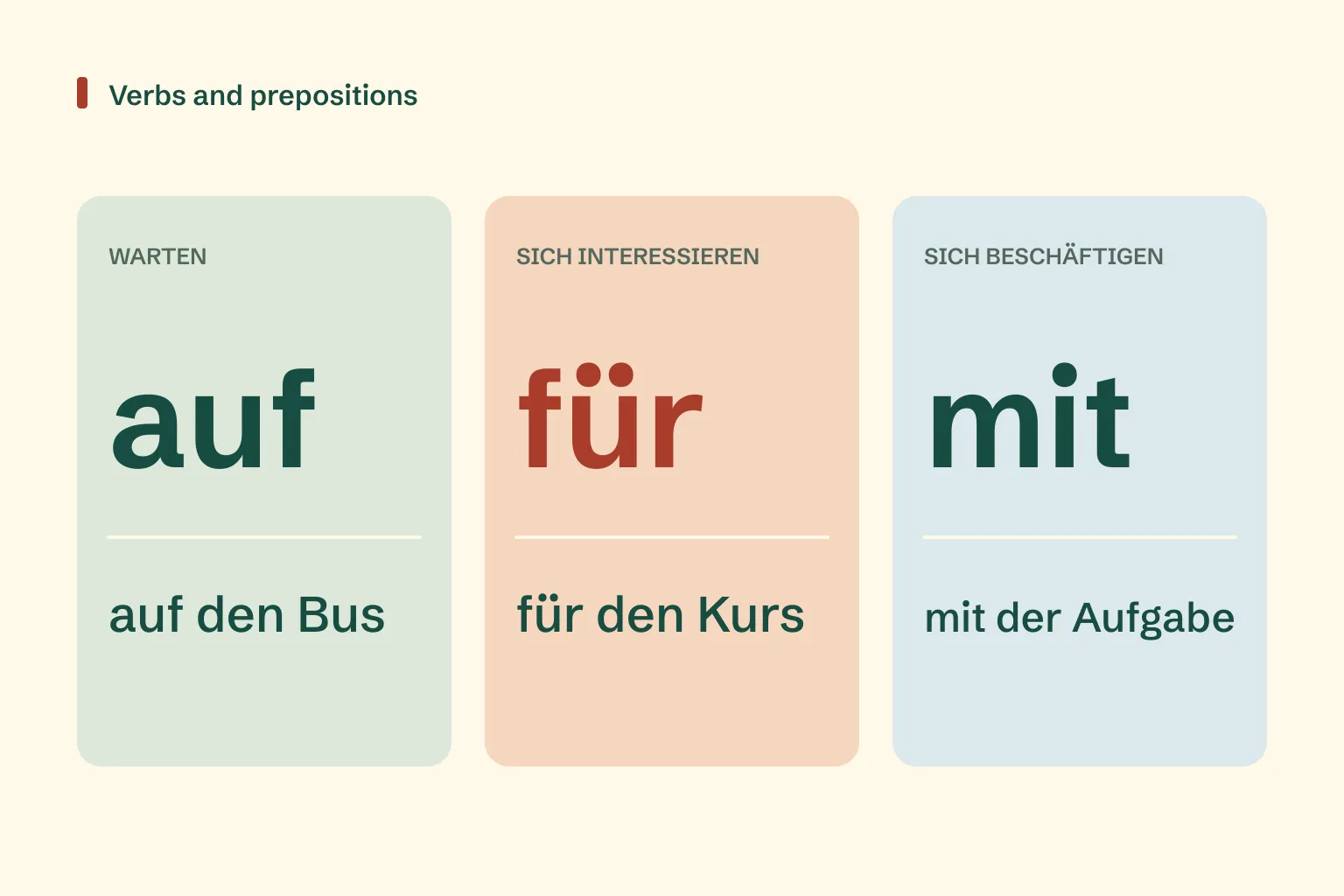
Your notes say warten = wait, but your next sentence still gets stuck. In German you usually wait auf someone or something: Ich warte auf den Bus. To use a verb confidently, save its preposition, the required case and an example together. The English preposition is not a reliable guide, and a familiar location rule does not decide every verb complement.
Takeaway: Treat warten auf + accusative as one learning unit. Add the noun form and a short context, then practise replacing that noun with a person or a question.
A focused verb and preposition chart
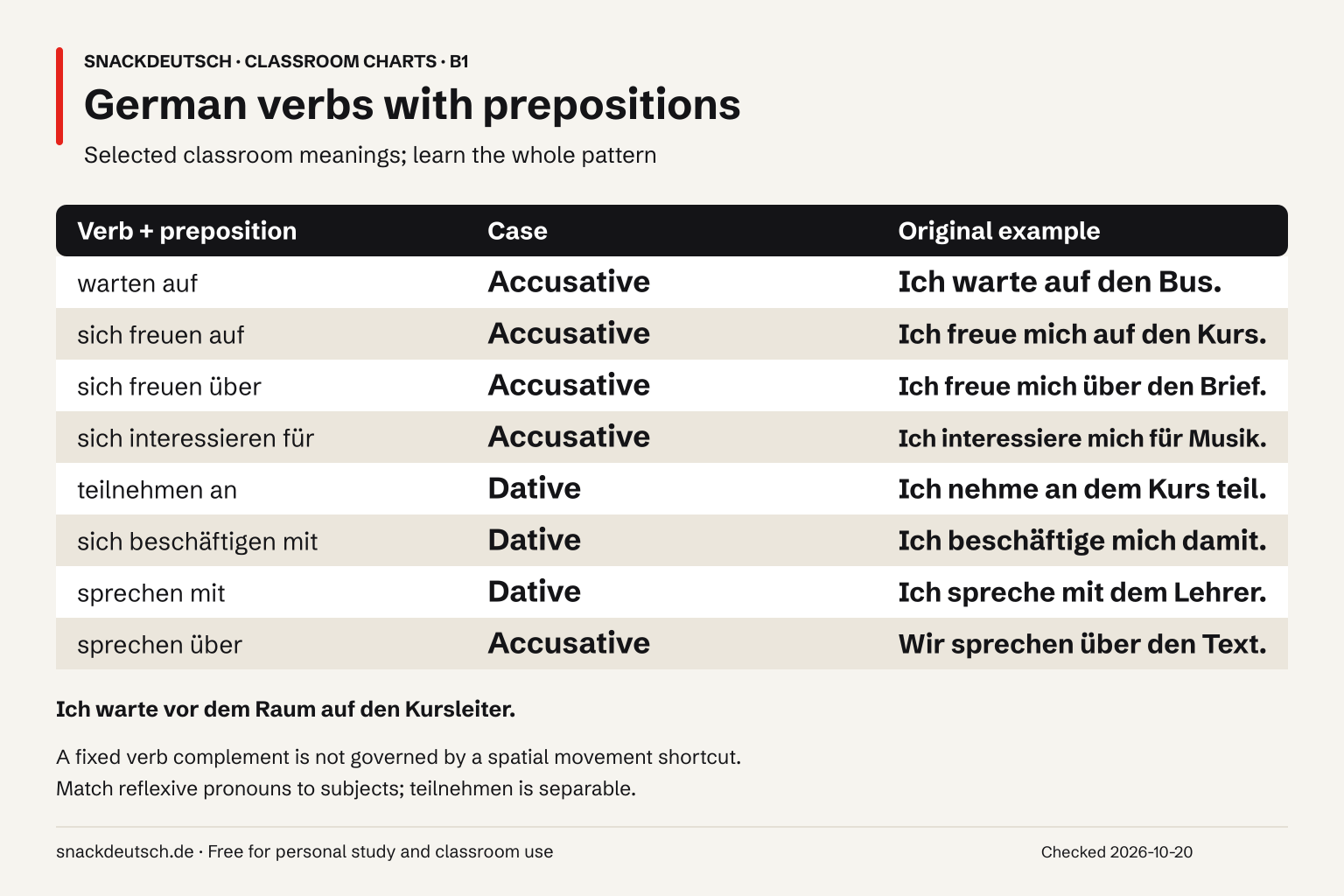
German verbs with prepositions
Selected classroom meanings; learn the whole pattern. Suggested level: B1.
| Verb + preposition | Case | Original example |
|---|---|---|
| warten auf | Accusative | Ich warte auf den Bus. |
| sich freuen auf | Accusative | Ich freue mich auf den Kurs. |
| sich freuen über | Accusative | Ich freue mich über den Brief. |
| sich interessieren für | Accusative | Ich interessiere mich für Musik. |
| teilnehmen an | Dative | Ich nehme an dem Kurs teil. |
| sich beschäftigen mit | Dative | Ich beschäftige mich damit. |
| sprechen mit | Dative | Ich spreche mit dem Lehrer. |
| sprechen über | Accusative | Wir sprechen über den Text. |
Ich warte vor dem Raum auf den Kursleiter.
- A fixed verb complement is not governed by a spatial movement shortcut.
- Match reflexive pronouns to subjects; teilnehmen is separable.
These are selected meanings, not a complete dictionary of each verb. Sprechen mit jemandem über etwas can combine the person and topic: Ich spreche mit Lea über den Text. You need not choose only one of them.
Fixed complements are not direction phrases
Compare Ich lege das Heft auf den Tisch and Ich warte auf den Kursleiter. The first describes a destination. The second uses a fixed verb-preposition relation; the course instructor is not a surface that somebody moves onto.
Therefore, do not use “no movement, so dative” to produce Ich warte auf dem Kursleiter. In this waiting meaning, the selected pattern is auf + accusative. To practise spatial contrasts separately, use the wo and wohin guide.
Similarly, Wir nehmen an einem Gespräch teil uses dative an because that is the complement pattern of teilnehmen, not because a conversation is a place. A complete notebook entry keeps the two systems apart.
Keep the reflexive pronoun and separable prefix
Four entries in the table include sich. Match it to the subject:
- Ich freue mich auf den Kurs.
- Du interessierst dich für das Thema.
- Wir beschäftigen uns mit der Aufgabe.
Do not copy dictionary sich unchanged after ich. It tells you the verb is being used reflexively, not that every subject takes that exact form.
Teilnehmen is separable in a present-tense main clause: Ich nehme an dem Gespräch teil. With weil, the form joins again at the end: Ich komme früher, weil ich an dem Gespräch teilnehme. If you use a modal: Ich möchte an dem Gespräch teilnehmen. Learn the complement and the verb frame together.
Future pleasure or pleasure about something?
The two sich freuen entries are worth separate examples:
Ich freue mich auf die Nachricht means you look forward to the message arriving. Ich freue mich über die Nachricht says the message gives you pleasure, typically after you receive or learn it.
This is a useful starting contrast, not a claim that time alone mechanically determines every possible use. Say what is happening in the scene: are you anticipating an event, or reacting happily to something? That is more helpful than attaching a preposition to the translation “happy.”
Make a notebook entry that you can test
For warten, write four lines:
- Pattern: warten auf + accusative.
- Context: Ich warte vor dem Raum auf den Kursleiter.
- Person replacement: Ich warte auf ihn.
- Question: Auf wen wartest du?
The location vor dem Raum uses its own spatial rule. It does not change the case of auf den Kursleiter. Hide the example and rebuild it from warten / Kursleiter. If you cannot choose den, review the full entry rather than only the English meaning.
Six tasks
- Supply the article: Ich warte auf ___ Bus. Use masculine der Bus.
- Supply the reflexive pronoun: Wir freuen ___ auf den Ausflug.
- Choose auf or über for a reaction: Dein freundlicher Brief ist heute angekommen. Ich freue mich ___ deinen Brief.
- Complete with teilnehmen in the present: Lea ___ an dem Gespräch ___.
- Use the noun die Aufgabe: Ich beschäftige mich mit ___.
- Translate both parts: “I speak with the instructor about the text.” Use der Kursleiter and der Text.
Answers and reasons
- Den Bus. This waiting pattern requires accusative after auf; masculine definite der becomes den.
- Uns. The reflexive pronoun matches wir: Wir freuen uns …
- Über. The sentence describes pleasure about the received letter. Auf would focus on anticipating a future arrival.
- Lea nimmt an dem Gespräch teil. Nimmt is the singular form, and teil closes the separable frame. Am Gespräch is also possible for an dem Gespräch.
- Der Aufgabe. Mit requires dative; feminine singular die becomes der.
- Ich spreche mit dem Kursleiter über den Text. Mit + dative marks the conversation partner; über + accusative marks the topic in this construction. Neither phrase describes movement.
Sources and next practice
Dictionary checks on 19 October 2026: Duden entries for warten, freuen, teilnehmen, beschäftigen, interessieren and sprechen. The chart’s examples are original and B1 is an editorial teaching estimate.
Use the personal pronoun guide for ihn/ihm, then return to the B1 learning path. Save two complete verb patterns from your actual class notes.