
Classroom companion
German compound nouns: find the meaning and the article
Break German compound nouns into useful parts. Find the final noun, choose the article, check the plural, and practise with words from class.
Read as Markdown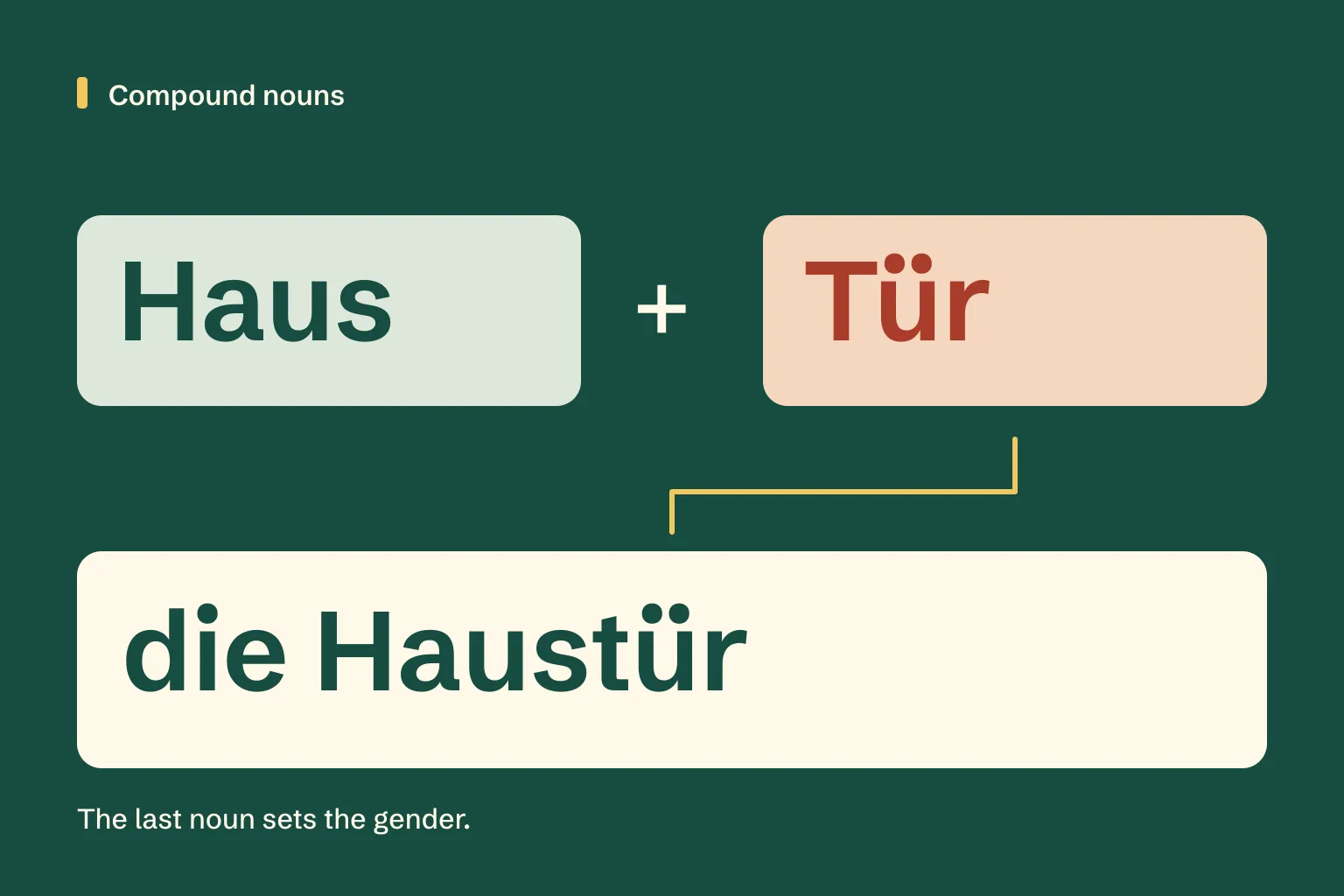
For an ordinary German compound noun, the final noun usually gives you the grammatical gender and the main category of meaning. Das Kursbuch is a kind of Buch, so it is neuter. Work from the right, identify the meaningful parts, and then check what the whole word actually means.
Read the last noun first
An English speaker may try to translate a long German word from left to right and lose track halfway through. Start with the last noun instead. It tells you what sort of thing you are talking about; the earlier part narrows it down.
| Compound | Main noun | Meaning |
|---|---|---|
| der Deutschkurs | der Kurs | a German course |
| das Kursbuch | das Buch | a coursebook |
| die Kursgebühr | die Gebühr | a course fee |
| die Haustür | die Tür | the entrance door of a house |
| das Arbeitszimmer | das Zimmer | a study or home office |
Do not choose the article from the first part. The fact that Arbeit is feminine does not make Arbeitszimmer feminine. The final noun is das Zimmer.
Some joining letters do not need a translation
Compare die Arbeit and das Arbeitszimmer. The s connects the parts. It does not mean that you should insert the English word “of” every time you see it. Similarly, der Stundenplan contains Stunde, a linking n, and Plan.
A word may contain a plural-looking form: das Wörterbuch combines Wörter with Buch. That does not make the entire noun plural. One dictionary is ein Wörterbuch; several are Wörterbücher.
Do not invent a universal rule for when to insert a linking letter. Learn the established compound as a complete word. Breaking it down is a reading aid, not permission to assemble any two nouns in any spelling.
The plural follows the head
The final noun is also helpful when checking the plural. Compare das Buch → die Bücher with das Kursbuch → die Kursbücher. Likewise, der Plan → die Pläne gives you der Stundenplan → die Stundenpläne.
Record the complete plural rather than a vague “add something at the end.” Umlauts matter. A notebook entry with Kursbuch, plural +er loses the change from u to ü.
Use plural patterns to recognize what you see, but keep a checked plural with each new noun. Some words and meanings need individual attention.
A breakdown is not the full definition
Die Hausaufgabe is made of recognizable parts, but “house task” does not fully communicate its usual classroom meaning: a homework task. Der Handschuh is a glove, not a shoe you happen to hold in your hand.
After splitting a compound, ask whether your literal interpretation makes sense in the sentence. If it does not, check the whole word in a dictionary. The surrounding lesson often tells you which meaning is intended.
For a classroom note, save three things: the complete noun, the useful breakdown, and one natural phrase. For example: die Hausaufgabe; Haus + Aufgabe; die Hausaufgabe machen. You can explain the structure without pretending that every compound’s history is obvious from its modern parts.
Mini practice
Use the noun in brackets to identify the article of the compound. Then explain its ordinary meaning.
- ___ Wörterbuch (das Buch)
- ___ Bushaltestelle (die Haltestelle)
- ___ Arbeitszimmer (das Zimmer)
- ___ Haustür (die Tür)
- ___ Sprachkurs (der Kurs)
- ___ Kursgebühr (die Gebühr)
Answers
- Das Wörterbuch: a dictionary. Buch is the head.
- Die Bushaltestelle: a bus stop. Haltestelle is the head.
- Das Arbeitszimmer: a study or home office. Zimmer is the head.
- Die Haustür: the house’s entrance door. Tür is the head.
- Der Sprachkurs: a language course. Kurs is the head.
- Die Kursgebühr: a course fee. Gebühr is the head.
For your next lesson, choose one long noun from the handout and write its head first. Then reconstruct the whole word and check its meaning. SnackDeutsch’s word explanations can help you explore word parts; keep the actual lesson sentence nearby when reviewing a generated breakdown.
Sources and further reading
See the University of Texas at Austin’s word-formation guide. The practice here is original. Use the notebook template to keep compounds with their articles, plurals, and phrases.