
Free resources
The German infinitive with zu: patterns and practice
Build German infinitive clauses with zu, check separable verbs and choose the understood subject. Includes original classroom examples and six explained tasks.
Read as Markdown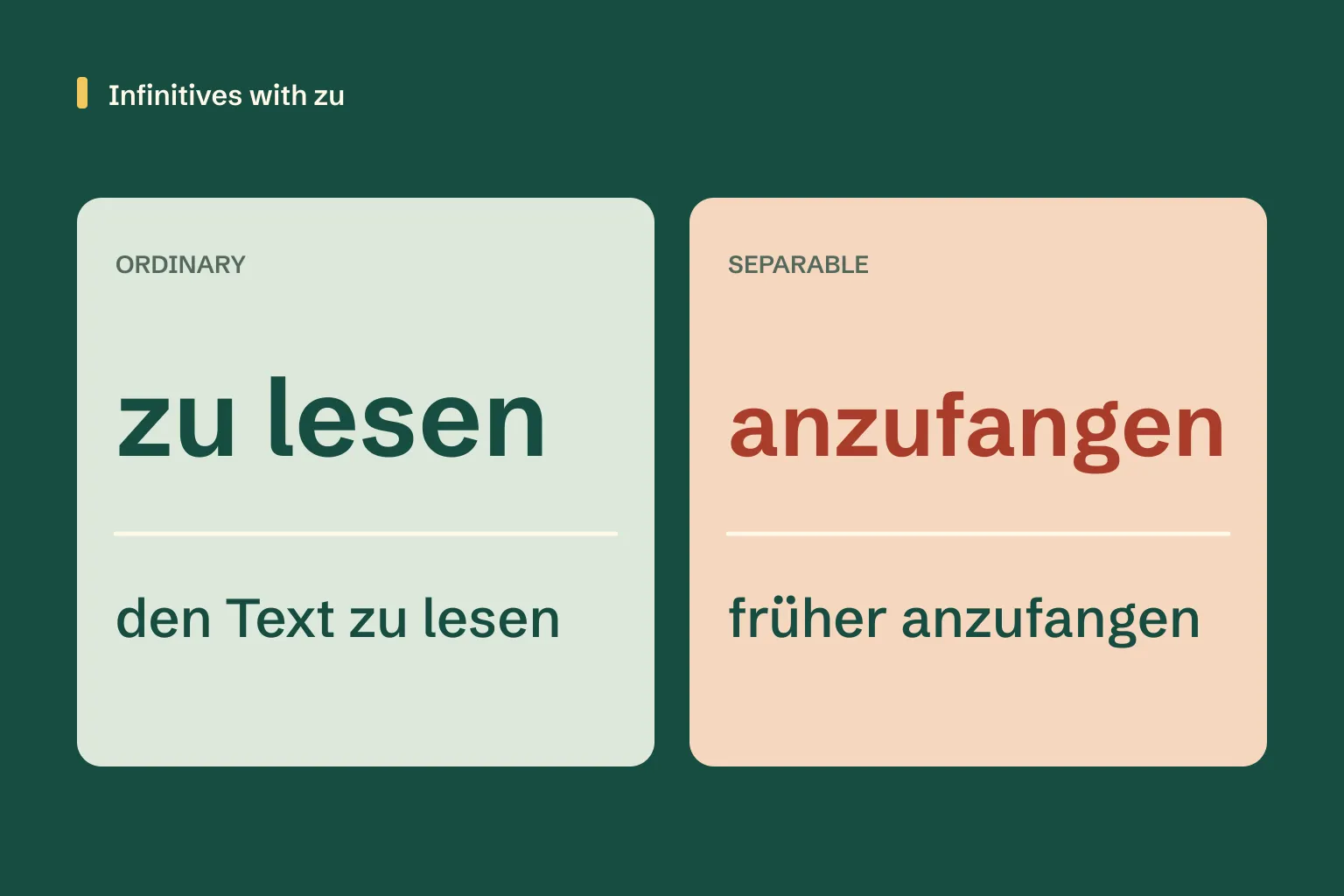
Your teacher asks what you plan to do before the next lesson. You can answer Ich habe vor, den Text zu lesen: I intend to read the text. The second action is an infinitive clause. It has no separate ich written inside it, and zu belongs with its final verb. The expression before it helps you understand who will act.
Takeaway: Learn a complete frame, such as vorhaben, etwas zu tun. Put zu before an ordinary infinitive, inside a separable infinitive, and leave it out after a directly governing modal such as müssen.
Useful infinitive patterns
| Starting expression | Original example | Who does the second action? |
|---|---|---|
| vorhaben | Ich habe vor, die Wörter zu wiederholen. | I intend to review them. |
| versuchen | Lea versucht, die Regel zu erklären. | Lea tries to explain it. |
| Zeit haben | Wir haben Zeit, den Text zu lesen. | We have time to read it. |
| es ist wichtig | Es ist wichtig, genau zuzuhören. | The relevant person or people, from context. |
| jemanden bitten | Ich bitte Amir, die Tür zu schließen. | Amir is asked to close it. |
| versprechen | Ich verspreche Amir, die Datei zu schicken. | I promise to send it. |
The last two examples explain why “both actions always have the same subject” is a poor universal rule for zu clauses. In Ich bitte Amir, …, Amir performs the requested action. In Ich verspreche Amir, …, I perform the promised action. Learn that relationship as part of the verb pattern.
Place zu accurately
German infinitives with zu
Ordinary, inseparable and separable infinitive forms. Suggested level: B1.
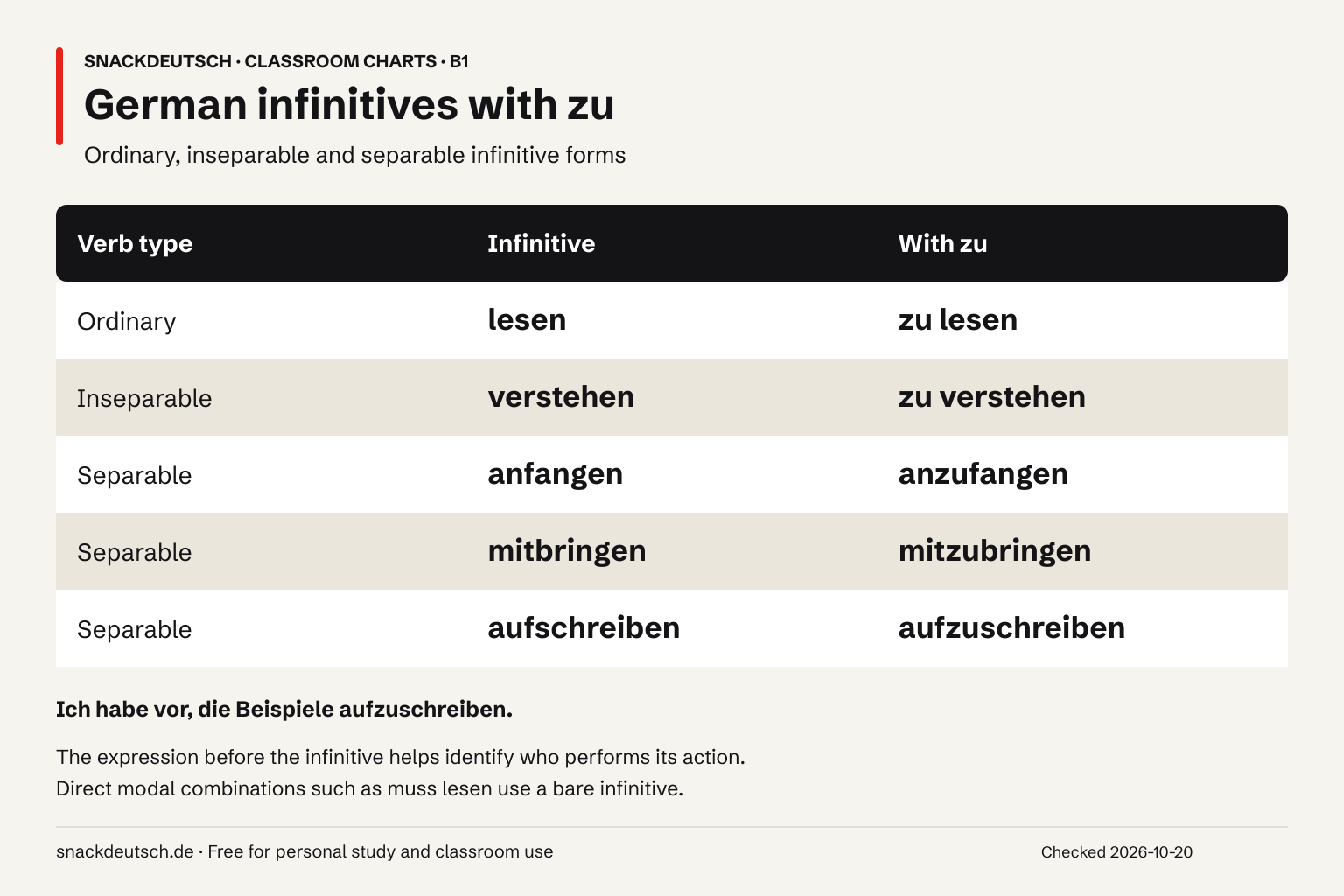
| Verb type | Infinitive | With zu |
|---|---|---|
| Ordinary | lesen | zu lesen |
| Inseparable | verstehen | zu verstehen |
| Separable | anfangen | anzufangen |
| Separable | mitbringen | mitzubringen |
| Separable | aufschreiben | aufzuschreiben |
Ich habe vor, die Beispiele aufzuschreiben.
- The expression before the infinitive helps identify who performs its action.
- Direct modal combinations such as muss lesen use a bare infinitive.
Do not write zu mitbringen or mit zu bringen for this infinitive. Mitbringen becomes mitzubringen. With inseparable verstehen, zu remains a separate word before the whole infinitive.
An infinitive group can contain objects, time phrases and other information: Ich versuche, die neue Regel bis Freitag mit drei Beispielen zu erklären. All that information sits before the final zu erklären. Start with a short version; then add only the detail your reader needs.
A modal verb changes the construction
Compare these original pairs:
- Ich versuche, den Text zu lesen. I try to read the text.
- Ich muss den Text lesen. I have to read the text.
- Wir haben vor, früher anzufangen. We intend to start earlier.
- Wir wollen früher anfangen. We want to start earlier.
In these direct modal combinations, muss lesen and wollen anfangen use a bare infinitive. They do not take zu between the modal and its dependent verb. This does not forbid the preposition zu elsewhere: Ich muss zu Hause lernen contains a location phrase, zu Hause, followed by bare lernen. For the basic modal frame, see the present-tense modal guide.
Keep punctuation visible
This lesson consistently separates expanded infinitive clauses with a comma: Wir haben vor, am Freitag gemeinsam zu üben. A comma is obligatory with infinitive groups introduced by um, ohne, statt/anstatt, and in other regulated constructions. The official spelling rules now treat sentence-like infinitive groups explicitly. Rather than using a word-count shortcut, check the actual clause construction.
The comma is especially helpful when a recipient might otherwise look like the second subject: Ich verspreche meinem Partner, die Notizen zu schicken. The recipient receives the promise, but ich sends the notes. If ambiguity matters, use a full dass clause: Ich verspreche meinem Partner, dass ich die Notizen schicke.
Try it with a class plan
Write three headings in your notebook: Plan, Difficulty, Request. Under each, write one specific action:
Ich habe vor, die Beispiele zu ordnen. Ich versuche, den Unterschied zu verstehen. Ich bitte meinen Partner, einen Beispielsatz vorzulesen.
Underline the zu form and identify its understood subject. In the first two, it is ich. In the last, it is mein Partner. The point of the exercise is to connect a verb form with a real responsibility, not simply insert zu into every sentence.
Six tasks
- Complete: Ich versuche, die Tabelle ___. Use verstehen.
- Complete: Wir haben vor, morgen früher ___. Use anfangen.
- Choose lesen or zu lesen: Lea muss den Brief ___.
- Write the full sentence: Ich / habe Zeit / die Notizen aufschreiben.
- In Ich bitte Tom, das Fenster zu öffnen, who should open it? In Ich verspreche Tom, das Fenster zu öffnen, who promises to open it?
- Write a two-sentence plan: you intend to bring the notebook; you ask a classmate to explain one example. Use vorhaben and bitten.
Answers and a model
- … die Tabelle zu verstehen. Verstehen is inseparable, so zu precedes the whole infinitive.
- … morgen früher anzufangen. Anfangen is separable: an + zu + fangen.
- Lea muss den Brief lesen. Directly dependent lesen follows modal muss without zu.
- Ich habe Zeit, die Notizen aufzuschreiben. The object precedes final aufzuschreiben. The separable prefix stays attached around zu.
- Tom is asked to open it in the first sentence. Ich promises to do so in the second. The main verb controls that interpretation.
- Model: Ich habe vor, das Heft mitzubringen. Ich bitte Lea, mir ein Beispiel zu erklären. A different name or object is fine. Check mitzubringen, the person asked, and the final infinitive.
Sources and next practice
Checked on 19 October 2026: University of Texas, infinitive constructions, IDS, modal verbs with a bare infinitive, and official spelling rules hosted by IDS. All lesson sentences are original. B1 is an editorial estimate, not certification.
Continue through the B1 learning path. If the prefix pattern is difficult, revisit separable verbs in class notes.