
Classroom companion
German separable verbs: keep both pieces in your notes
Understand separable verbs with practical German class examples. Learn the main-clause pattern, modal-verb contrast, and five exercises with answers.
Read as Markdown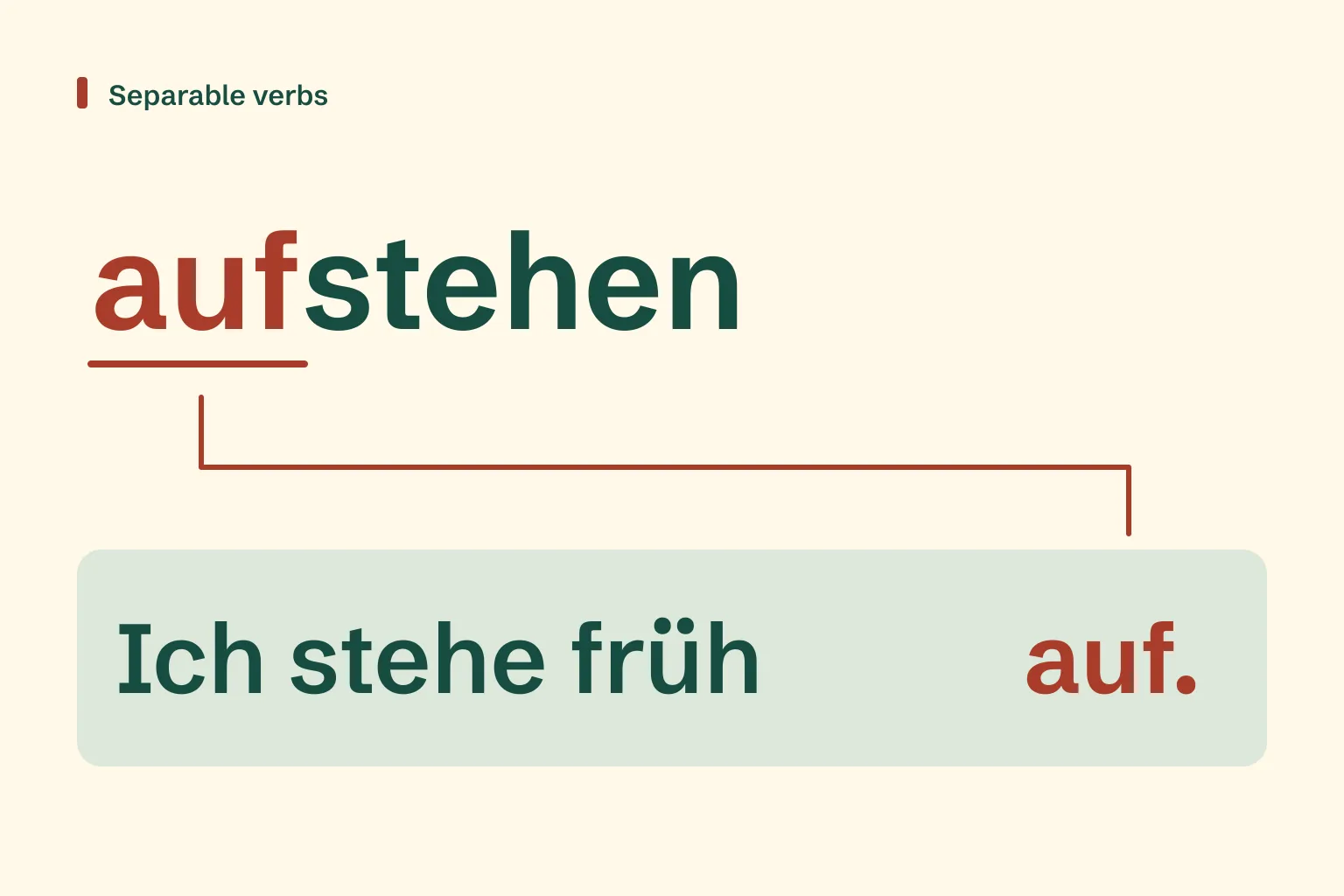
A German separable verb such as ausfüllen splits in a simple main clause: Ich fülle das Formular aus: I fill in the form. The conjugated part takes the normal verb position, and the prefix goes to the end. Save the whole infinitive and a complete example so you do not lose either piece.
Follow the verb across the sentence
Your teacher writes Wir kaufen morgen ein. If you look up only kaufen, you find “buy.” The full verb here is einkaufen, meaning to shop. The final ein belongs to the verb; it is not an indefinite article in this sentence.
Similarly, Ich bringe meinen Ausweis mit contains mitbringen, to bring along. The prefix helps determine the meaning, so leaving it out of your vocabulary entry loses useful information.
| Infinitive | Main-clause example | Meaning |
|---|---|---|
| aufstehen | Ich stehe um sieben auf. | I get up at seven. |
| einkaufen | Wir kaufen morgen ein. | We go shopping tomorrow. |
| ausfüllen | Sie füllt das Formular aus. | She fills in the form. |
| mitbringen | Ich bringe meinen Ausweis mit. | I bring my ID along. |
Save the infinitive and the sentence
A useful entry has ausfüllen on its first line, not just füllen. Under it, write the lesson sentence and mark the separated prefix. Add a phrase such as ein Formular ausfüllen so you know what usually goes with the verb.
Do not attach a literal English meaning to every prefix and assume that the full word will always equal the sum. Prefixes can give clues, but established verb meanings still need checking in context.
If you record a verb from a photograph, inspect the end of the sentence. A line break can put the prefix on the next line, making a correctly recognized text fragment misleading as a vocabulary item.
With a modal verb, the infinitive stays together
Compare Ich kaufe heute ein with Ich möchte heute einkaufen. In the second sentence, möchte is the finite verb. Einkaufen remains an infinitive at the end and is written together.
This distinction is useful when your class moves from describing a habit to expressing a plan. Ich bringe meinen Ausweis mit describes what I bring. Ich muss meinen Ausweis mitbringen says that I must bring it.
A subordinate clause gives another pattern: …, weil ich meinen Ausweis mitbringe: because I am bringing my ID. The finite verb is at the end and the prefix stays attached. Learn one construction at a time rather than treating the main-clause separation as a universal spelling rule.
Do not split every long verb
Unterschreiben in the sense “to sign” is not separated: Ich unterschreibe das Formular. You cannot apply the ausfüllen pattern merely because both verbs have several syllables.
Some prefixes can be separable or inseparable with different meanings and stress patterns. When a verb is new, check that specific entry. A beginner notebook should preserve a reliable example before trying to build an exhaustive prefix system.
Mini practice
Make a normal statement beginning with the subject. Conjugate the verb.
- ich / um sieben / aufstehen
- wir / morgen / einkaufen
- sie (she) / das Formular / ausfüllen
- ich / meinen Ausweis / mitbringen
- wir / morgen / einkaufen / möchten
Answers
- Ich stehe um sieben auf. The prefix goes to the end.
- Wir kaufen morgen ein. Ein belongs to einkaufen.
- Sie füllt das Formular aus. Keep the umlaut in füllt.
- Ich bringe meinen Ausweis mit. The phrase is den Ausweis mitbringen.
- Wir möchten morgen einkaufen. The modal is finite; the infinitive stays together.
Sources and further reading
See Grimm Grammar: separable-prefix verbs. For the next step, practise Perfekt with haben and sein, or use the notes-to-flashcards guide to turn these patterns into clear prompts.