
Free resources
Um zu or damit? Express a purpose in German
Choose um ... zu or damit to explain a purpose in German. Compare subjects, build verb-final clauses and practise with six explained B1 tasks.
Read as Markdown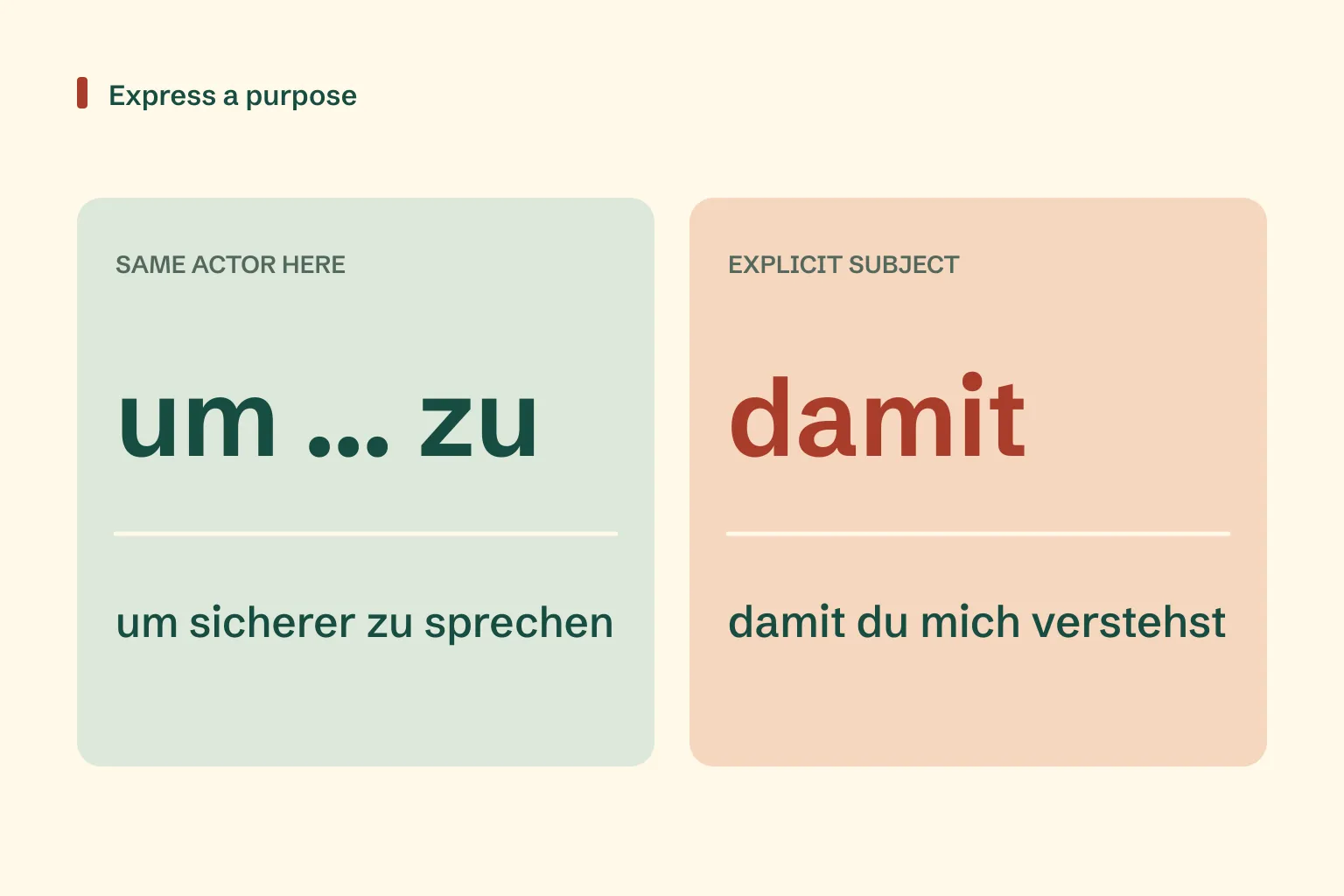
In class, someone asks why you record a new word with an example. You want to express a goal: Ich schreibe einen Beispielsatz, um das Wort besser zu verstehen. You are writing a sentence in order to understand the word better. Um … zu and damit both introduce a purpose, but they package the person doing the intended action differently.
Takeaway: For a simple purpose with the same person acting, um … zu is often concise. When the purpose needs its own explicit subject, use damit and a finite verb at the end. Damit can also have the same subject.
Ask what the action is intended to achieve
A purpose is a wanted result. It does not guarantee success. Ich lese den Text zweimal, um ihn besser zu verstehen tells us the reader’s aim, not that the second reading definitely worked.
Compare a reason: Ich lese den Text zweimal, weil er schwierig ist. The text’s difficulty explains the action. In Ich lese den Text zweimal, damit ich die Fragen beantworten kann, answering the questions is the intended result.
A useful test is the question Wozu? (For what purpose?). Warum? can ask about purposes too, so the question word alone is not proof; think about the direction of the relationship.
Two original models, side by side
| Situation | Purpose construction | Explanation |
|---|---|---|
| I make notes so that I remember the plan. | Ich mache Notizen, um mir den Plan zu merken. | I do both actions; no new subject in the infinitive group. |
| I make notes so that I remember the plan. | Ich mache Notizen, damit ich mir den Plan merke. | Same subject is possible with damit too. |
| I send notes so that Lea can prepare. | Ich schicke Lea die Notizen, damit sie sich vorbereiten kann. | Lea, not I, prepares. |
| Lea speaks slowly so that we understand. | Lea spricht langsam, damit wir sie verstehen. | The purpose has its own subject, wir. |
Do not reduce damit wir sie verstehen to um sie zu verstehen while keeping Lea spricht langsam if you mean that we should understand her. In the resulting simple active sentence, the understood learner would be Lea, which changes the intended relationship.
The same-person guideline covers the active models in this lesson. German also has more complex constructions with passive and impersonal readings; it is not a universal claim that every um … zu group has a visible matching subject.
Build um … zu from the final verb
Start with a main clause: Ich komme früher. Add the purpose einen ruhigen Platz finden. The completed sentence is Ich komme früher, um einen ruhigen Platz zu finden.
The frame is um + other information + zu + infinitive. With separable aufschreiben, place zu inside the verb: Ich nehme ein Heft mit, um die neuen Wörter aufzuschreiben. With a modal, the final zu belongs to the modal: Ich übe regelmäßig, um freier sprechen zu können. Here sprechen is a bare infinitive before zu können. Do not write um zu können freier sprechen.
Use a comma before the um group. Put the purpose after the action while you are learning; it makes the comparison easier to inspect.
Build damit with a full clause
Start with the purpose as a full idea: Lea kann sich vorbereiten. Introduce damit and move the finite modal to the end: Ich schicke Lea die Fragen, damit sie sich vorbereiten kann.
Without a modal, the lexical verb closes the clause: Ich schreibe groß, damit alle den Satz lesen. With a separable present-tense verb, prefix and verb join again: Ich schicke dir eine Erinnerung, damit du das Heft mitbringst.
You can also start with the purpose: Damit alle den Satz lesen können, schreibe ich groß. The whole subordinate clause fills the opening position, followed by schreibe ich. Choose this version when the goal is the information you want to emphasize.
A classroom decision that makes the choice real
Your group is preparing a short presentation. Give every action an aim and an actor:
Ich sammle Beispiele, um meine Idee genauer zu erklären. Amir schreibt die Reihenfolge auf, damit niemand einen Punkt vergisst. Wir proben zusammen, um sicherer zu sprechen.
Ask who explains, who might forget and who speaks. If the answer is unclear, name the person in a damit clause. Clear responsibility matters more than showing off the shorter construction.
Six tasks
- Join with um … zu: Ich lese laut. Ich möchte die Aussprache üben.
- Join with damit: Ich schicke dir den Link. Du kannst die Aufgabe öffnen.
- Is this meaning preserved? Lena erklärt das Wort, damit ich es verstehe becomes Lena erklärt das Wort, um es zu verstehen. Explain.
- Add the purpose die Beispiele aufschreiben: Wir bringen Papier mit, …
- Put these supplied groups in order after the comma: üben zu können / in Ruhe / um: Wir treffen uns früh, …
- Write one sentence about your own study goal with um … zu, then a fictional action that helps your partner with damit.
Answers and models
- Ich lese laut, um die Aussprache zu üben. I read and practise. The purpose group has no separate ich.
- Ich schicke dir den Link, damit du die Aufgabe öffnen kannst. Du is explicit; finite kannst closes the clause.
- No. The first says I should understand. The second presents Lena as trying to understand. Use damit ich to preserve the intended actor.
- Wir bringen Papier mit, um die Beispiele aufzuschreiben. Aufschreiben is separable, so its infinitive is aufzuschreiben.
- Wir treffen uns früh, um in Ruhe üben zu können. Modal können carries zu; üben precedes it without zu.
- Model: Ich wiederhole die Wörter, um sie im Gespräch zu benutzen. Ich spreche langsam, damit mein Partner mich versteht. Other goals work; check the actor and final verb.
Sources and next practice
Checked on 19 October 2026: IDS grammis, purpose clauses and University of Texas, infinitive constructions. These support the purpose distinction and infinitive formation; all practice is original. B1 is a teaching estimate.
Return to the B1 learning path, or use the modal verb guide to check können before creating another purpose sentence.