
Free resources
German connectors for B1 writing: meaning and word order
Choose German connectors by meaning and sentence pattern. Practise reasons, results, contrast and additions with a B1 writing task and explained answers.
Read as Markdown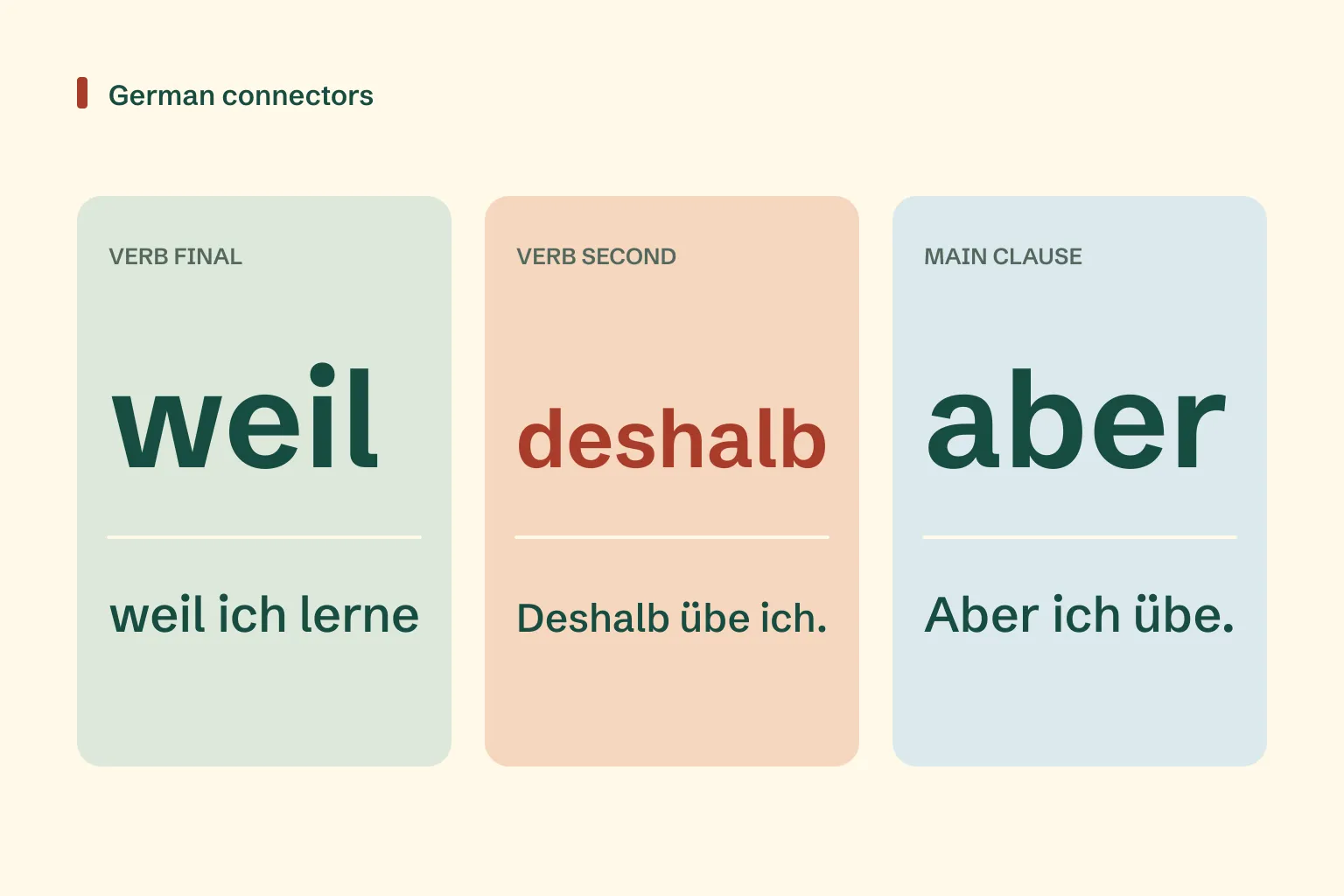
In class, you have three correct sentences: Ich arbeite lange. Ich komme später. Ich möchte mitmachen. To turn them into a clear message, decide which information is a reason, a result or a contrast. German connectors help the reader follow that decision, but they do not all use the same word order.
Takeaway: Choose the relationship first. Then identify the connector family: und/aber/denn, weil/obwohl/dass, or linking adverbs such as deshalb/trotzdem/außerdem.
A small chart for connected writing
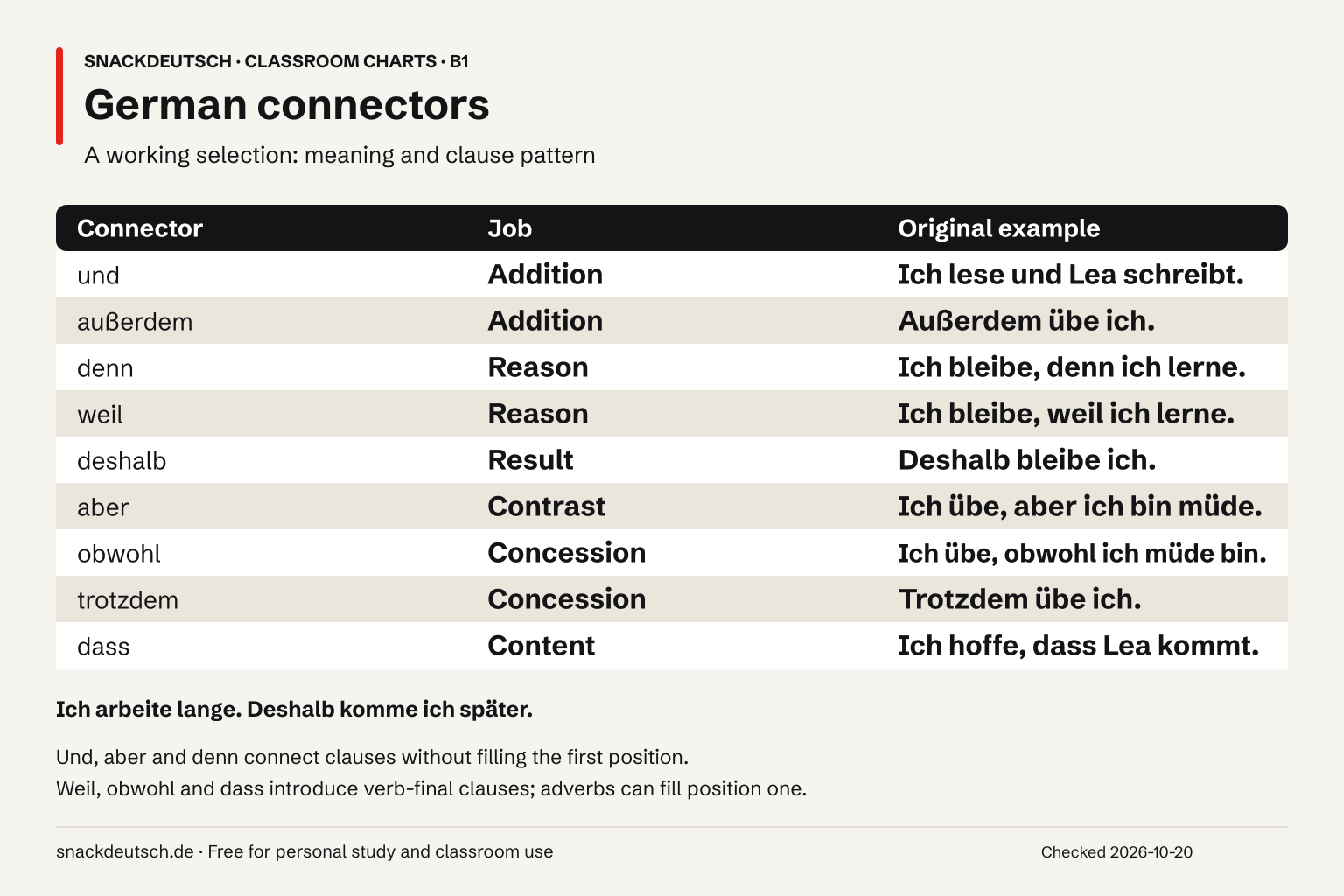
German connectors
A working selection: meaning and clause pattern. Suggested level: B1.
| Connector | Job | Original example |
|---|---|---|
| und | Addition | Ich lese und Lea schreibt. |
| außerdem | Addition | Außerdem übe ich. |
| denn | Reason | Ich bleibe, denn ich lerne. |
| weil | Reason | Ich bleibe, weil ich lerne. |
| deshalb | Result | Deshalb bleibe ich. |
| aber | Contrast | Ich übe, aber ich bin müde. |
| obwohl | Concession | Ich übe, obwohl ich müde bin. |
| trotzdem | Concession | Trotzdem übe ich. |
| dass | Content | Ich hoffe, dass Lea kommt. |
Ich arbeite lange. Deshalb komme ich später.
- Und, aber and denn connect clauses without filling the first position.
- Weil, obwohl and dass introduce verb-final clauses; adverbs can fill position one.
This is a working selection, not a complete list of German connectors. Dass introduces what someone hopes, knows or says; it does not mean “because.” Learn each item with a complete model rather than a single English equivalent.
Reason and result point in different directions
Start with two facts: Die Bibliothek schließt früh. Wir treffen uns im Café. The first fact explains the second decision.
- Decision + reason: Wir treffen uns im Café, weil die Bibliothek früh schließt. We are meeting at the café because the library closes early.
- Reason + result: Die Bibliothek schließt früh. Deshalb treffen wir uns im Café. The library closes early. That is why we are meeting at the café.
Do not keep weil and merely swap the clauses if you want the same causal message. Die Bibliothek schließt früh, weil wir uns im Café treffen says our meeting causes the early closure. That is a different claim, even though its word order is grammatical.
If you need a slower explanation of those two reason patterns, use the existing weil and denn lesson.
Three ways of handling the first position
With aber, think of a connector outside the ordinary main-clause frame: Aber | heute | lerne | ich zu Hause. In the complete sentence Ich gehe gern in die Bibliothek, aber heute lerne ich zu Hause, heute is the first element of the second clause, and lerne is second.
With deshalb, the connector itself is an element: Deshalb | lerne | ich zu Hause. Do not write Deshalb ich lerne. A linking adverb can also occur later: Ich lerne deshalb zu Hause. The opening-position model is a useful place to start, not the word’s only possible position.
With obwohl, build a subordinate clause: obwohl | ich heute zu Hause | lerne. When that whole clause comes first, it fills the opening position of the larger sentence: Obwohl ich heute zu Hause lerne, nehme ich am Gespräch teil. Nehme follows the comma, then ich.
Edit one real message
A learner drafts: Heute kann ich nicht in die Bibliothek kommen. Ich muss arbeiten. Ich lese den Text. Ich schreibe eine Frage. A clearer version is:
Heute kann ich nicht in die Bibliothek kommen, weil ich arbeiten muss. Trotzdem lese ich den Text zu Hause. Außerdem schreibe ich eine Frage für unsere Gruppe.
The revision preserves the facts. It adds a reason, shows participation despite the difficulty and adds one more action. More connectors would not necessarily improve it. In a short message, two or three clear links are often enough.
Six tasks
- Choose weil or deshalb: Ich habe die Seite nicht verstanden. ___ frage ich im Kurs nach.
- Join with denn: Wir nehmen den Bus. Es regnet stark. Keep the decision first.
- Start with Weil: Ich lerne heute zu Hause, weil die Bibliothek geschlossen ist.
- Correct the word order: Ich habe wenig Zeit. Trotzdem ich helfe der Gruppe.
- Add außerdem, beginning the second sentence with it: Lea bringt ein Wörterbuch mit. Sie druckt die Aufgaben aus.
- Write three sentences about fictional group work: you cannot meet on Tuesday because you work; you can still read the text; you can also send two questions. Use a reason, an unexpected continuation and an addition.
Answers and a model
- Deshalb frage ich im Kurs nach. Asking is the result of not understanding. Frage follows the first-position connector.
- Wir nehmen den Bus, denn es regnet stark. After denn, the main clause es regnet stark retains its own subject-first pattern.
- Weil die Bibliothek geschlossen ist, lerne ich heute zu Hause. Ist ends the subordinate clause; the whole clause is followed by lerne ich.
- Trotzdem helfe ich der Gruppe. Trotzdem occupies the opening position, so helfe comes next.
- Außerdem druckt sie die Aufgaben aus. The separable verb has finite druckt second and aus at the end.
- One model: Am Dienstag kann ich mich nicht mit euch treffen, weil ich arbeite. Trotzdem lese ich den Text zu Hause. Außerdem schicke ich euch zwei Fragen. Different wording is fine if the facts, relationships and verb positions remain clear.
Sources and next practice
Grammar checked on 19 October 2026: University of Texas, coordinating conjunctions, subordinating conjunctions, and IDS grammis, connected units. These support clause patterns; the examples are original. B1 is an editorial teaching estimate.
Return to the B1 learning path, or use the vocabulary notebook to save one connector with a complete sentence and its purpose.