
Free resources
German prepositions with fixed cases: a practical reference
Choose accusative or dative after common fixed-case German prepositions, understand useful contractions, and practise with explained answers.
Read as Markdown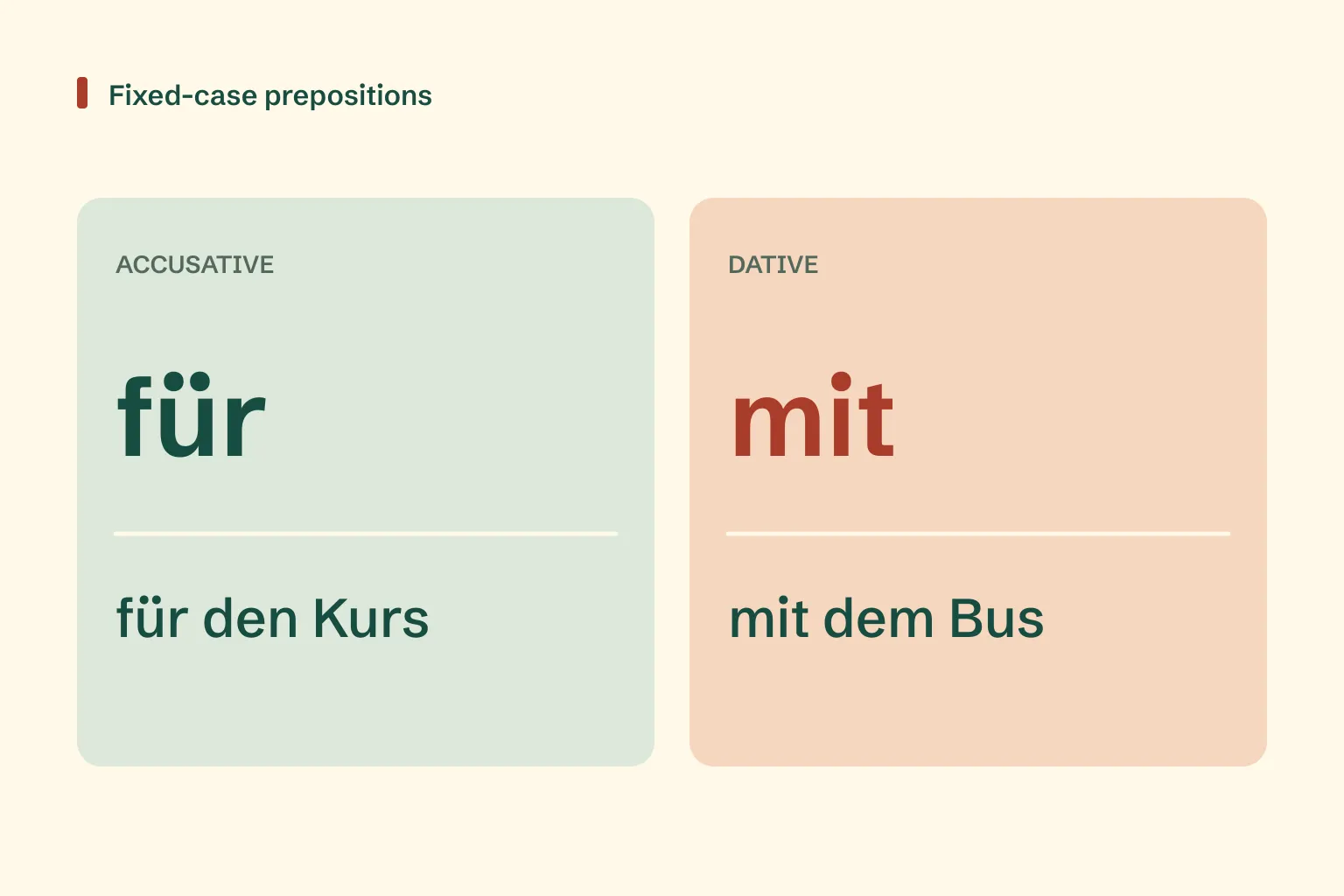
You know der Bus, but your course notes say mit dem Bus. Mit requires the dative in this phrase, so masculine der changes to dem. For common fixed-case prepositions, choose the preposition for the meaning first, then apply its case. A trip can involve movement and still use dative: Ich fahre mit dem Bus.
Takeaway: Fixed-case prepositions keep their case when the meaning includes movement. The location-versus-destination choice belongs to a separate group of two-way prepositions.
A practical reference
Fixed-case prepositions
Selected common accusative and dative uses. Suggested level: A2.
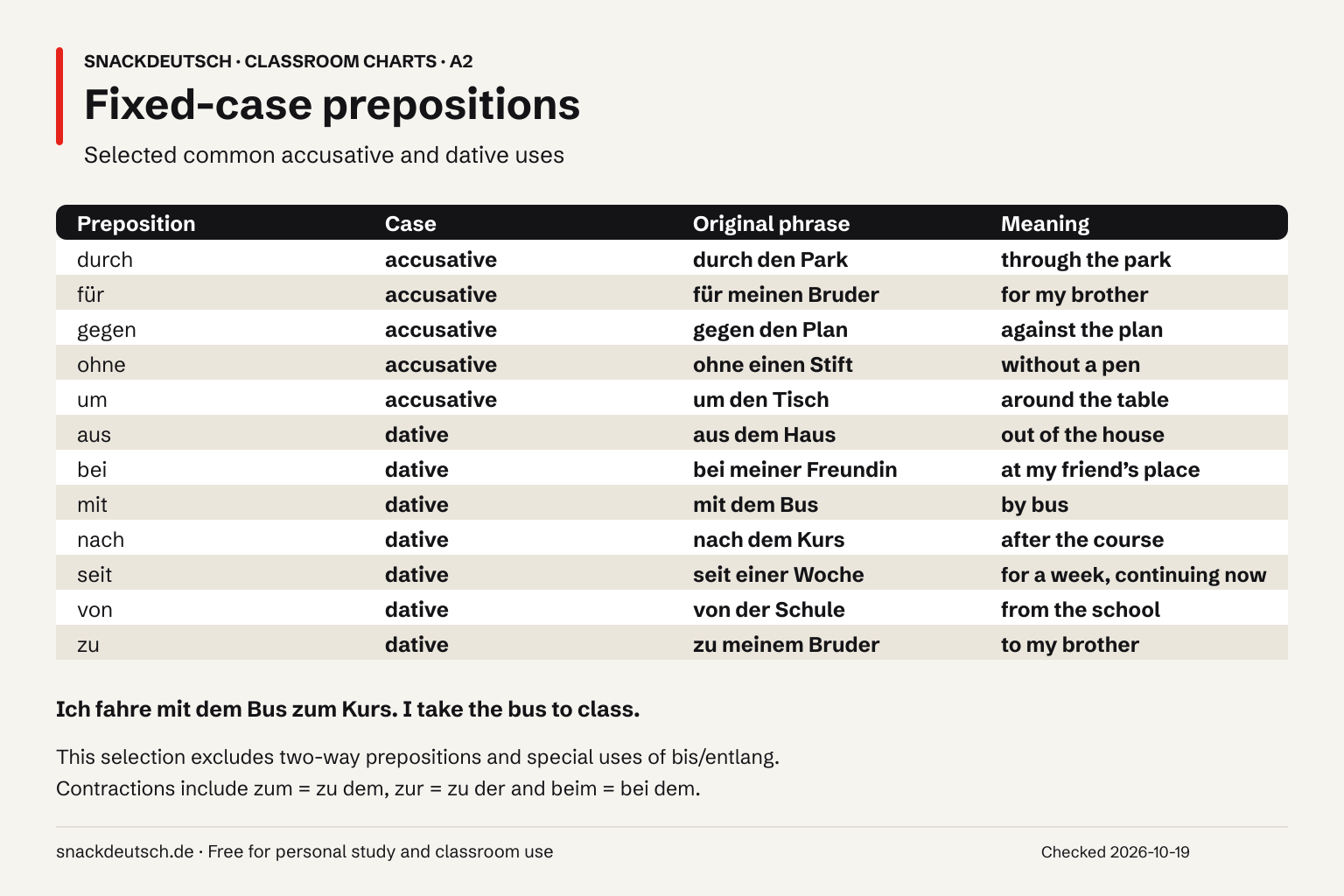
| Preposition | Case | Original phrase | Meaning |
|---|---|---|---|
| durch | accusative | durch den Park | through the park |
| für | accusative | für meinen Bruder | for my brother |
| gegen | accusative | gegen den Plan | against the plan |
| ohne | accusative | ohne einen Stift | without a pen |
| um | accusative | um den Tisch | around the table |
| aus | dative | aus dem Haus | out of the house |
| bei | dative | bei meiner Freundin | at my friend’s place |
| mit | dative | mit dem Bus | by bus |
| nach | dative | nach dem Kurs | after the course |
| seit | dative | seit einer Woche | for a week, continuing now |
| von | dative | von der Schule | from the school |
| zu | dative | zu meinem Bruder | to my brother |
Ich fahre mit dem Bus zum Kurs. I take the bus to class.
- This selection excludes two-way prepositions and special uses of bis/entlang.
- Contractions include zum = zu dem, zur = zu der and beim = bei dem.
This table is intentionally a manageable selection. It does not cover genitive prepositions, idiomatic government after every verb, or the special constructions of bis and entlang. Learn the phrase in its sentence rather than trying to squeeze all German prepositions into two lists.
Change the article, keep the gender
Use für den Kurs (for the course) and nach dem Kurs (after the course). Kurs remains masculine; its role after the preposition changes the article. With a feminine noun, compare für die Lehrerin and mit der Lehrerin. With a neuter noun, compare ohne das Buch and aus dem Buch.
The dative plural often needs an extra -n on the noun: mit den Freunden. A plural already ending in -n does not receive another one: mit den Kolleginnen. Plurals ending in -s keep it: mit den Autos. Use the case guide if the article forms are new.
A preposition can also govern a pronoun: für dich, mit dir, ohne uns, bei ihnen. The accusative and dative forms of uns happen to match. That does not mean the case has disappeared.
Notice contractions in real notices
Zum combines zu + dem, zur combines zu + der, and beim combines bei + dem. Thus zum Kurs has a dative article even though you cannot see dem as a separate word. Vom Bahnhof similarly contains von dem.
In Ich gehe zum Bahnhof, zu stays dative despite the destination. In Ich gehe in den Bahnhof, in belongs to the two-way group and marks entering the station. Those sentences describe related situations through different constructions. The two-way-preposition lesson can help you keep the groups separate.
Use meaning to choose between near neighbours
Nach dem Kurs means after the course. Zum Kurs describes going to the course. Bei der Lehrerin can describe being with or at the teacher’s place; mit der Lehrerin describes doing something together with her. Case alone will not choose the intended meaning.
For time, seit einer Woche describes a period that began in the past and continues at the reference time: Ich lerne seit einer Woche hier (I have been studying here for a week). English uses a perfect form here; German commonly uses the present when the situation continues now. Nach einer Woche means after a week, a different relationship.
A notebook task before class
Choose one real route and one real study routine. Write mit dem Bus, zum Kurs and nach dem Kurs in full sentences. Underline the preposition, box the article, and say why you chose that relationship. Do not change mit dem Bus to accusative merely because the bus moves.
Practice
- Complete: Ich kaufe ein Heft für ___ Kurs (der Kurs).
- Complete: Wir sprechen mit ___ Lehrerin (die Lehrerin).
- Expand the contraction: zum Bahnhof.
- Correct: Sie fährt mit den Bus.
- Complete: Er übt seit ___ Woche (eine Woche), and explain the time relationship.
- Complete the plural: Ich lerne mit den Freund___ (die Freunde).
- Choose nach or zu: ___ dem Kurs trinken wir Tee. The tea follows the lesson.
Explained answers
- den. Für requires accusative; masculine der Kurs becomes den Kurs.
- der. Mit requires dative; feminine die Lehrerin becomes der Lehrerin.
- zu dem Bahnhof. The contraction contains the dative masculine article.
- Sie fährt mit dem Bus. Mit remains dative even during travel.
- einer. Feminine dative follows seit. The practice started a week ago and continues now in this example.
- Freunden. Dative plural den Freunden adds -n to Freunde.
- Nach. Nach dem Kurs expresses the stated sequence; zum Kurs would concern the destination or purpose.
Sources and next step
The University of Texas accusative and dative references support these selected case groups. Its two-way reference explains the separate location/destination construction. Continue through the A2 learning path with three sentences about your own route.