
Free resources
Darauf, worauf and other German da- and wo-compounds
Use darauf, worauf, damit and related German compounds for things and topics. Compare people, vowel links and six original tasks with explained answers.
Read as Markdown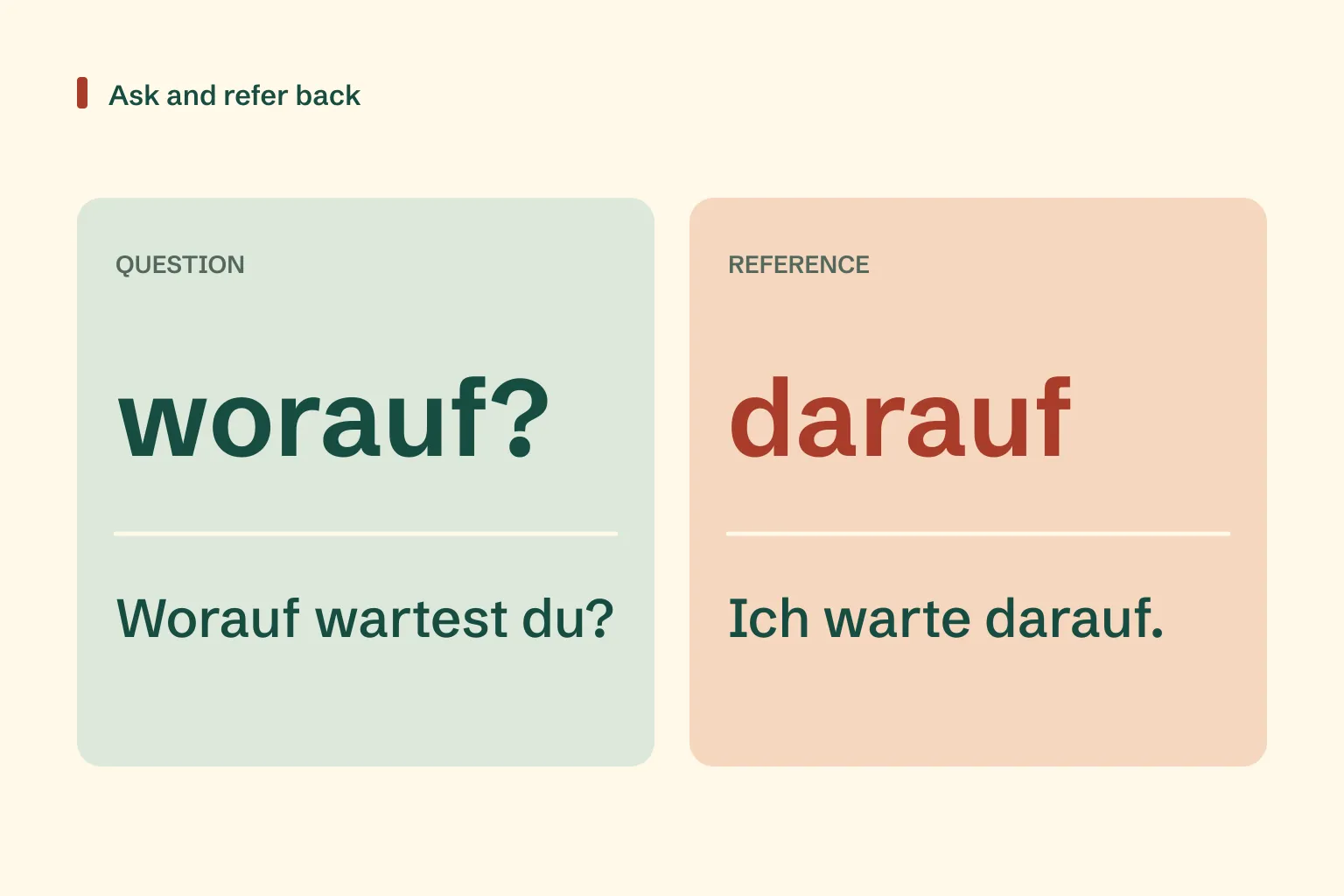
In class, you hear Wir sprechen über das Projekt. The project has already been named, so the next speaker says Ja, darüber möchte ich auch sprechen: yes, I would like to talk about that too. German da- compounds can refer back to a thing, topic or whole idea. Matching wo- compounds ask about it: Worüber sprecht ihr?
Takeaway: Keep the preposition from the verb pattern. Use da(r)- to refer back and wo(r)- to ask about a non-personal topic. For a person, use a preposition with wen/wem or a personal pronoun.
A focused da- and wo-chart
German da- and wo-compounds
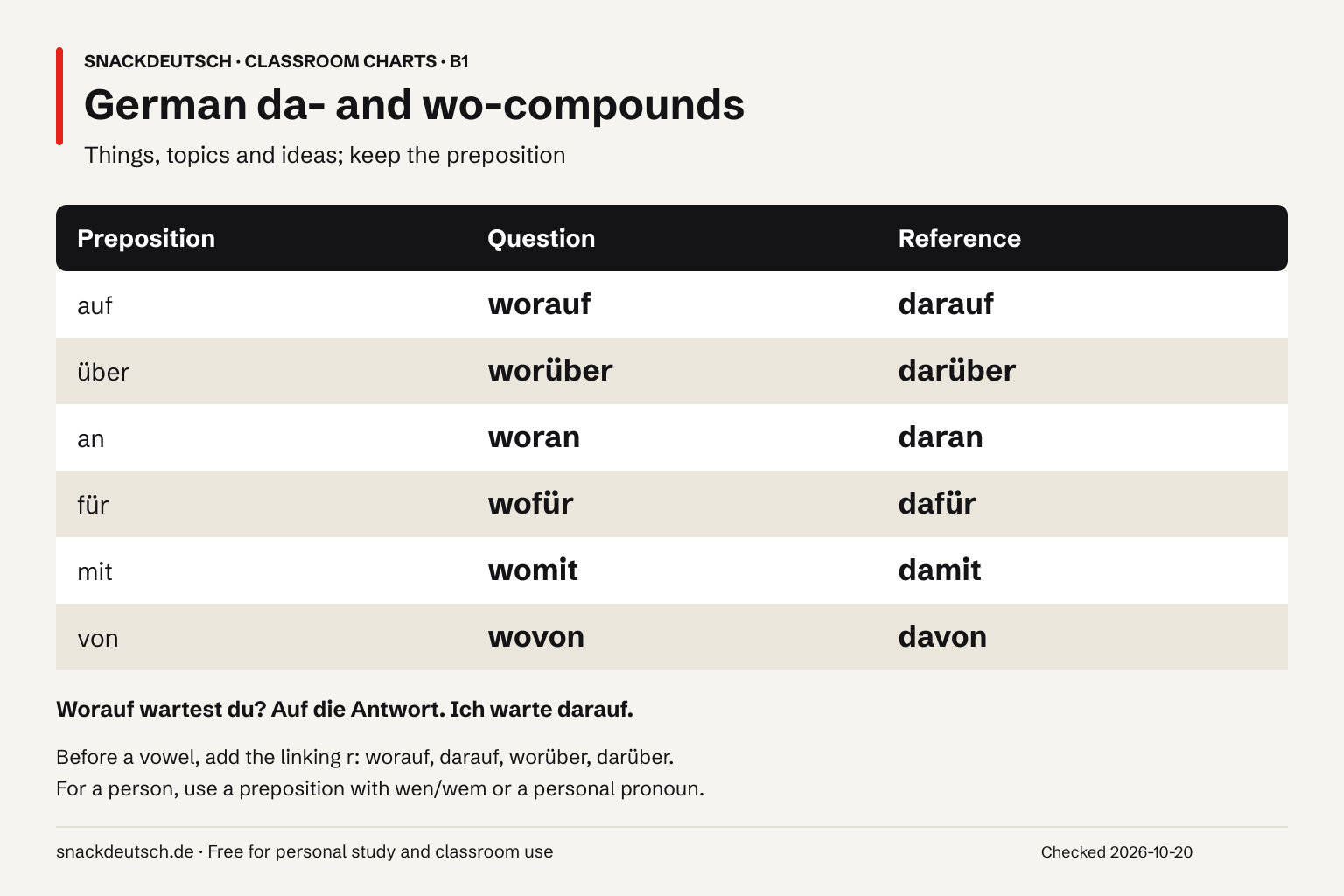
Things, topics and ideas; keep the preposition. Suggested level: B1.
| Preposition | Question | Reference |
|---|---|---|
| auf | worauf | darauf |
| über | worüber | darüber |
| an | woran | daran |
| für | wofür | dafür |
| mit | womit | damit |
| von | wovon | davon |
Worauf wartest du? Auf die Antwort. Ich warte darauf.
- Before a vowel, add the linking r: worauf, darauf, worüber, darüber.
- For a person, use a preposition with wen/wem or a personal pronoun.
The r appears before a vowel at the start of the preposition: dar-auf, wor-über, dar-an. With consonant-initial mit, the forms are damit/womit, not darmit/wormit. Learn the written forms as words, not as separate phrases da mit or wo für in this meaning.
First recover the original preposition
If the sentence is Ich warte auf die Antwort, the short reference is darauf. If it is Ich freue mich über die Antwort, it is darüber. The noun is identical, but the verb-preposition relation differs.
A good notebook entry therefore has three stages:
- Full phrase: Wir sprechen über den neuen Plan.
- Question: Worüber sprecht ihr?
- Reference: Wir sprechen darüber.
The compound is not a universal replacement for a noun. Ich lese den Plan becomes Ich lese ihn, not Ich lese darüber, if you mean reading that plan. Darüber lesen would mean reading about it. Preserve the relationship, not just the topic word.
People need a different question
Compare these original scenes:
- Ich warte auf den Bus. Worauf wartest du? Auf den Bus. Ich warte darauf.
- Ich warte auf meinen Partner. Auf wen wartest du? Auf meinen Partner. Ich warte auf ihn.
- Ich spreche mit der Lehrerin. Mit wem sprichst du? Mit der Lehrerin. Ich spreche mit ihr.
The person forms show case: auf wen, mit wem. Worauf is not the right question for the identity of the waiting person’s partner in this exercise. Likewise damit does not normally replace a particular conversation partner in Ich spreche mit ihr.
People can of course appear inside a larger event that darüber refers to: Lea hat den Kurs gewechselt. Wir sprechen darüber. Here darüber refers to the news or event, not directly to Lea as a person.
The same written word can have another job
In Ich beschäftige mich damit, damit replaces a mit phrase: I am working on that. In Ich schreibe groß, damit du den Satz lesen kannst, damit introduces a purpose clause: so that you can read the sentence.
Ask whether you can recover a phrase such as mit der Aufgabe, or whether a full clause with its own subject and final finite verb follows. That distinction is more useful than treating all damit occurrences as one identical grammar rule.
Some da- words also have literal spatial meanings. This lesson focuses on their role with prepositions and topics. Do not assume every darauf in a story must replace an abstract verb complement; context determines what it points to.
Refer forward to an idea carefully
You can introduce an upcoming clause with a compound: Ich freue mich darauf, dich morgen zu sehen. The thing anticipated is explained by the following infinitive clause. In Ich denke daran, dass der Kurs morgen früher beginnt, daran points to the content of the dass clause.
For practice, start with clear reference back before using these longer structures. If your partner cannot tell what darauf means in your paragraph, repeat the noun once. Avoid replacing every phrase when the result becomes vague.
Six tasks
- Replace auf die Antwort: Ich warte auf die Antwort.
- Ask about the topic: Wir sprechen über die neue Aufgabe. Address the speakers as ihr.
- Ask about the person: Lea wartet auf ihren Bruder. Keep Lea as the subject.
- Replace mit dem Kursleiter: Ich spreche mit dem Kursleiter.
- Choose dafür/darüber: Ich interessiere mich für Fotografie. Interessierst du dich auch ___?
- Explain the two uses of damit: Wir haben Papier. Damit können wir die Karten basteln. / Wir bringen Papier mit, damit alle Karten basteln können.
Answers and reasons
- Ich warte darauf. The verb’s auf remains in the compound. The r links da to a vowel-initial preposition.
- Worüber sprecht ihr? A non-personal topic plus über gives worüber.
- Auf wen wartet Lea? Her brother is a person; auf + accusative gives wen.
- Ich spreche mit ihm. A particular person is replaced with mit + dative pronoun, not damit.
- Dafür. The complete pattern is sich interessieren für. The preposition does not change because the noun is omitted.
- First: damit means mit dem Papier, with that material. Second: damit introduces the purpose clause alle … basteln können. It cannot simply be expanded to mit dem Papier in that position.
Sources and next practice
Checked on 19 October 2026: IDS grammis, W-clauses and personal reference, interrogative elements, and Duden, darauf. All examples are original; B1 is an editorial estimate.
Use the personal pronoun reference for ihn/ihm/ihr, then return to the B1 learning path. Practise one full phrase, its question and its reference together.