
Classroom companion
Am, um or im? German time expressions with examples
Choose am, um or im for common German time expressions, handle heute and next-week phrases, and put day and clock time together in a class plan.
Read as Markdown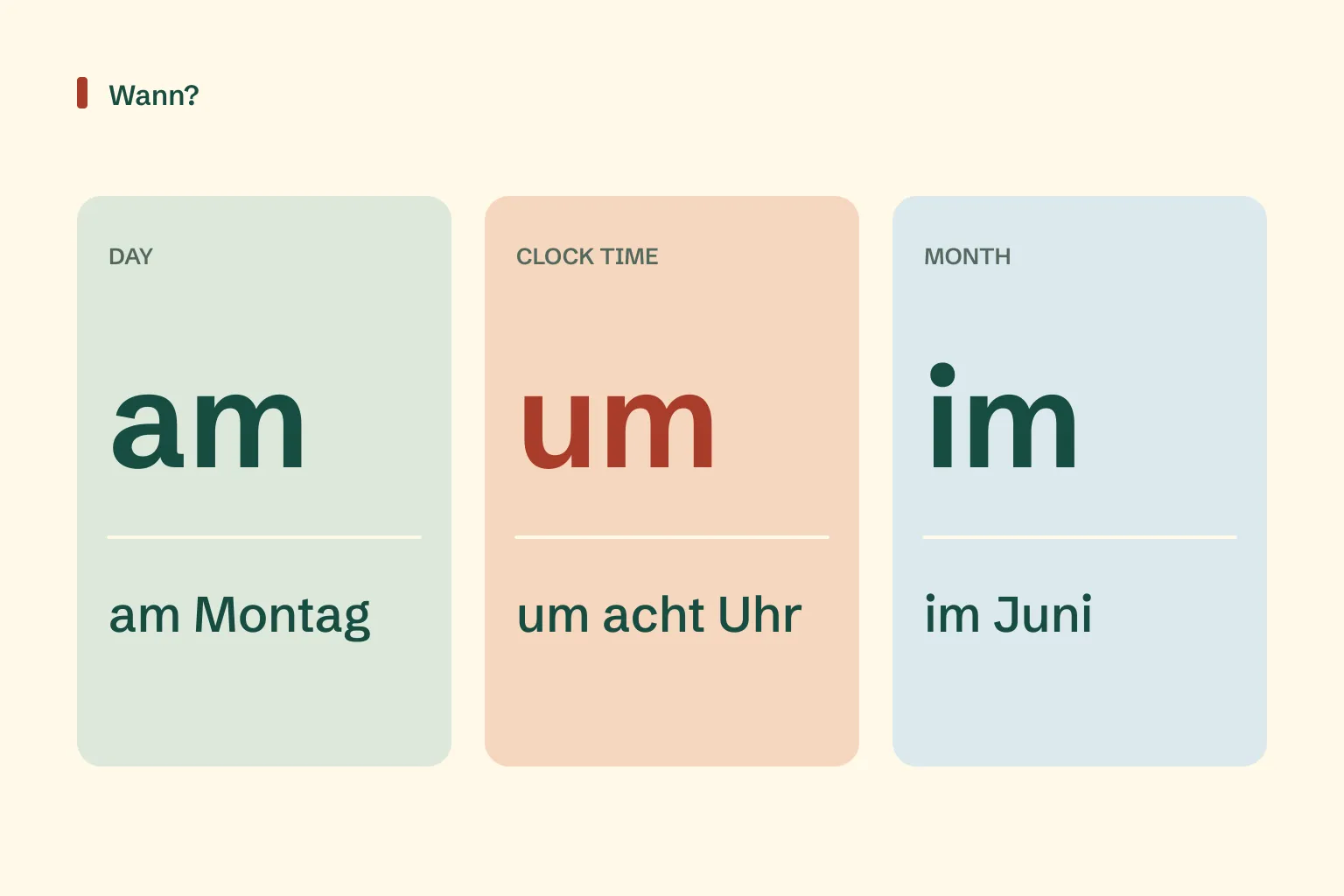
Your notes say Montag, 18 Uhr, Juni. To turn them into a useful plan, add am Montag, um 18 Uhr and im Juni. These are common German time patterns, but not every time expression takes a preposition. Say heute (today) and nächste Woche (next week) without adding am. This lesson shows the common choices and their practical limits.
Takeaway: Learn complete phrases: am Montag, um acht Uhr, im Juni, but heute and nächste Woche.
A chart for common time phrases
Am, um or im?
Common beginner time expressions. Suggested level: A1.
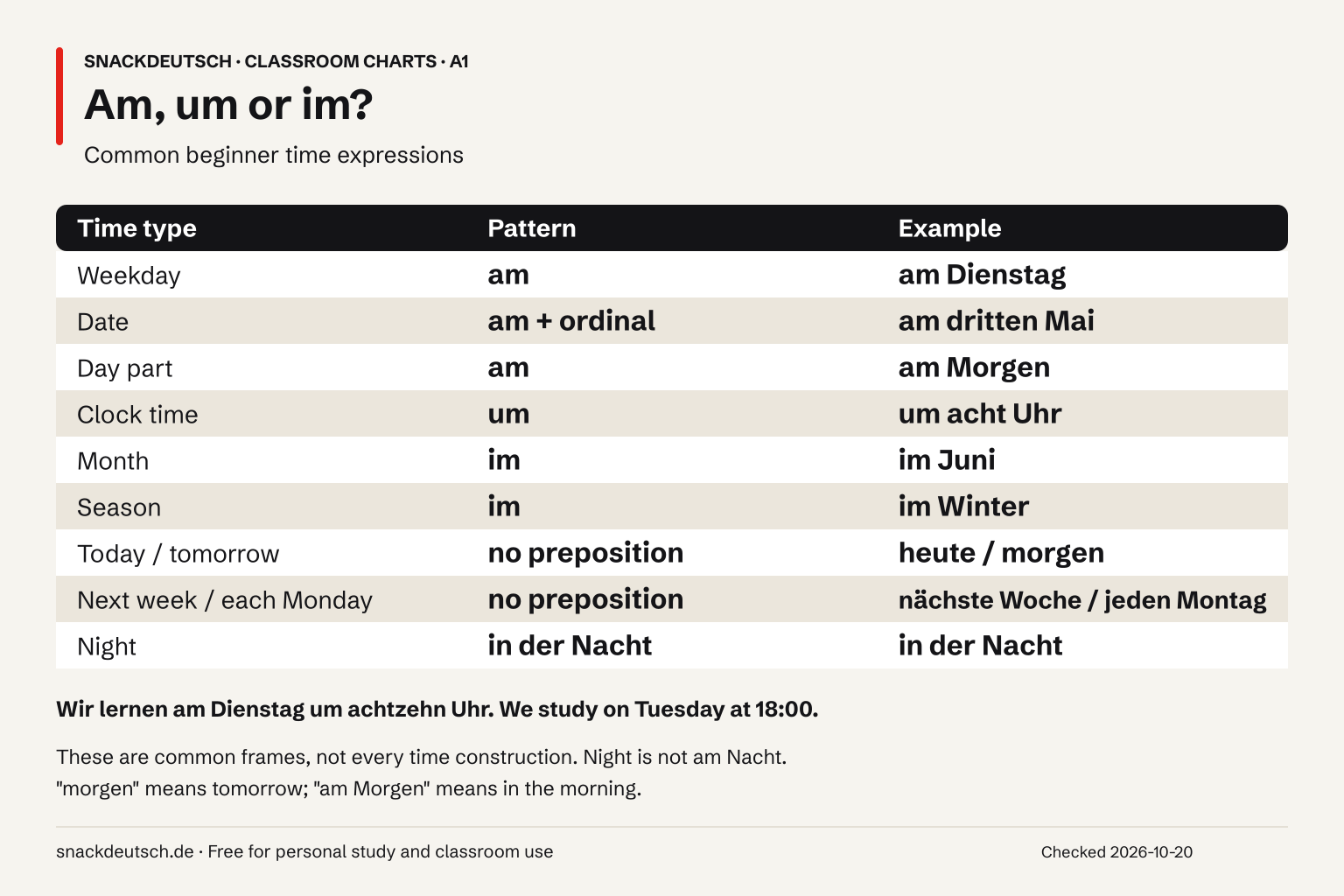
| Time type | Pattern | Example |
|---|---|---|
| Weekday | am | am Dienstag |
| Date | am + ordinal | am dritten Mai |
| Day part | am | am Morgen |
| Clock time | um | um acht Uhr |
| Month | im | im Juni |
| Season | im | im Winter |
| Today / tomorrow | no preposition | heute / morgen |
| Next week / each Monday | no preposition | nächste Woche / jeden Montag |
| Night | in der Nacht | in der Nacht |
Wir lernen am Dienstag um achtzehn Uhr. We study on Tuesday at 18:00.
- These are common frames, not every time construction. Night is not am Nacht.
- “morgen” means tomorrow; “am Morgen” means in the morning.
Am combines an dem, and im combines in dem. For this beginner task, treat the phrases as reusable chunks rather than expanding every contraction while speaking. Um stays a separate word before a clock time. The exception in der Nacht shows why “all parts of a day take am” would be too broad.
Put a day and a time together
Wir lernen am Dienstag um achtzehn Uhr means “We study on Tuesday at 18:00.” It has both a day and a time, each with its own marker. Start with the time phrase if it is the topic: Am Dienstag lernen wir um achtzehn Uhr. The finite verb lernen still follows the opening phrase.
You can also write Im Juni beginnt ein neuer Kurs (A new course begins in June). Im Juni introduces a month, not an exact day. If the day is important, give it: Der Kurs beginnt am dritten Juni. Adding information precisely is better than making a long sentence that leaves the actual appointment unclear.
Avoid adding a marker where German does not need one
Heute üben wir means “We practise today.” Do not write am heute. Nächste Woche schreiben wir einen Text means “Next week we write a text.” In this frame, nächste Woche needs no preposition. Likewise, jeden Montag means “every Monday” without am in front of it.
Am Montag can refer to a particular Monday supplied by context; montags often describes a repeated Monday routine. If you mean every Monday, jeden Montag makes that meaning clear. Do not use an adverb ending or a preposition as a substitute for checking whether the plan is one event or a routine.
Morgen and am Morgen have different jobs
Lowercase morgen means “tomorrow.” Am Morgen is a noun phrase meaning “in the morning.” Compare Morgen habe ich Deutschkurs (Tomorrow I have German class) with Am Morgen lerne ich zehn Minuten (In the morning I study for ten minutes). Morgen am Morgen is grammatically possible, but morgen früh is often a simpler way to say “tomorrow morning.”
This guide covers the starting patterns above, not durations such as seit zwei Jahren, date ranges or deadlines. In your course notes, label an expression as a day, clock time, month or unmarked time phrase before choosing the marker. That classification makes a correction explainable.
Practise it
- Complete: Wir treffen uns ___ Freitag.
- Complete: Die Pause beginnt ___ zehn Uhr.
- Complete: ___ Winter lernen wir zu Hause.
- Correct by removing one word: Am heute lesen wir den Text.
- Translate “tomorrow” and “in the morning” as two separate German time expressions.
- Combine wir / lernen / Dienstag / 18 Uhr into a full statement. Then start a second version with the day phrase.
Answers and reasons
- Am. A weekday in this pattern uses am Freitag.
- Um. Zehn Uhr is a clock time.
- Im Winter lernen wir zu Hause. A season uses im in this frame.
- Heute lesen wir den Text. Heute stands without am; the finite verb remains second.
- morgen / am Morgen. Lowercase morgen means tomorrow; the capitalized noun in the second phrase means morning.
- Wir lernen am Dienstag um achtzehn Uhr. Am Dienstag lernen wir um achtzehn Uhr. Keep am and um with their respective information; the finite verb is second in both.
Use it in your next lesson
Write one note for a single class and one for a routine. Model: Am Freitag übe ich um neun Uhr and Jeden Freitag übe ich. Ask a partner which one makes the repetition explicit. Store each phrase beside an example in your course vocabulary notebook.
Sources and further reading
- UT: weekdays: Reference for am with weekdays and repeated-day expressions.
- UT: time: Reference for clock and day-part expressions.
- UT: months and seasons: Reference for im with months and seasons.