
Classroom companion
Ordering food in German: an A1 dialogue and practice lesson
Practise an original German café order, make a polite request, ask a simple ingredient question and close the exchange with explained answers.
Read as Markdown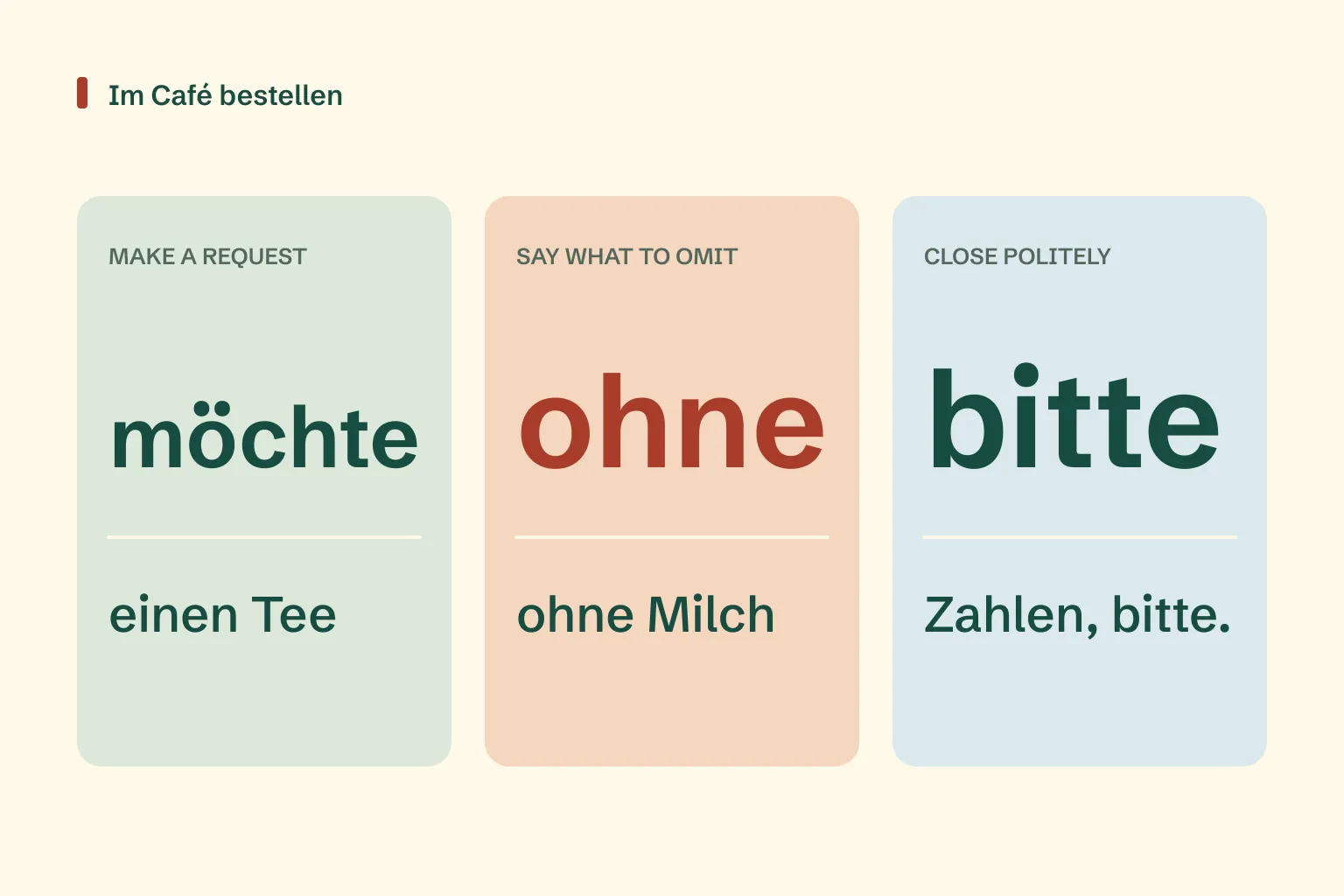
Your German class practises a café order, but the waiter’s follow-up question makes you lose your place. Build the exchange in small steps: order with Ich möchte …, bitte, answer the follow-up, then ask to pay with Zahlen, bitte. Keep ohne (without) beside a specific ingredient. You do not need a long restaurant script to make one clear request.
Takeaway: Practise the order and the likely response together. Ich möchte einen Tee, bitte is a request, while Ich mag Tee states a preference.
An original café dialogue
The menu and prices here are invented for practice: Tee 2,50 €; Kaffee 3,00 €; Käsebrot 4,20 €.
Service: Guten Tag. Was möchten Sie? Hello. What would you like?
Ada: Ich möchte einen Tee und ein Käsebrot, bitte. I would like a tea and a cheese sandwich, please.
Service: Den Tee mit Zitrone? The tea with lemon?
Ada: Ja, bitte. Und das Käsebrot ohne Butter, bitte. Yes, please. And the cheese sandwich without butter, please.
Service: Sonst noch etwas? Anything else?
Ada: Nein, danke. No, thank you.
Later, Ada: Zahlen, bitte. The bill, please.
Service: Zusammen sind das sechs Euro siebzig. Together that is six euros seventy.
Ada: Danke. Thank you.
The bill is 2,50 + 4,20 = 6,70 €. Read the actual amounts in a role-play instead of inventing a total unrelated to the menu. The request ohne Butter changes the order, but this dialogue does not promise that any real café can provide that change.
Choose an ordering frame
| Purpose | Original German | English |
|---|---|---|
| Request | Ich möchte einen Kaffee, bitte. | I would like a coffee, please. |
| Choose | Ich nehme einen Tee. | I’ll take a tea. |
| Omit | Ohne Milch, bitte. | Without milk, please. |
| Ask price | Was kostet der Tee? | How much is the tea? |
| Decline more | Nein, danke. | No, thank you. |
| Ask to pay | Zahlen, bitte. | The bill, please. |
Der Tee and der Kaffee are masculine nouns. As objects in these requests, they take einen. Das Käsebrot takes ein. You can learn the whole ordering chunk first, then use the article guide to understand the ending.
Ich will means “I want” and can sound more direct than the wish frame ich möchte in this service situation. Möchte is a useful polite choice, although tone and context matter too. Bitte helps, but it does not turn every blunt statement into the best request.
Clarify an ingredient rather than guessing
A simple ingredient question is Ist da Milch drin? (Is there milk in it?). For a specific item, Ist in dem Brot Butter? asks whether the bread contains butter. If you did not understand, say Noch einmal, bitte. After the reply, repeat the detail you understood: Also ohne Milch? (So, without milk?). If you cannot follow the answer, ask for repetition before completing the order.
In pair practice, the service partner can change one detail: tea with or without lemon, one item unavailable, or payment together or separately. Change only one thing at first. The learner’s task is to listen and respond, rather than recite the original dialogue through an unanswered question.
Finish by checking the order: drink, food, requested change and total. Those four details give your partner something concrete to assess.
Practise it
- Order one coffee politely using möchte.
- Translate ohne Milch.
- Give a short answer declining the offer Sonst noch etwas?
- Using the invented menu, calculate a tea and a cheese sandwich. Write the total in German words.
- Ask for the bill with the supplied short phrase.
- Write a four-turn exchange for one tea without lemon. Include a service question and an appropriate answer.
Answers and reasons
- Ich möchte einen Kaffee, bitte. Kaffee is masculine and the requested item is an accusative object.
- Without milk. Ohne signals an omission, not an extra ingredient.
- Nein, danke. This politely declines anything more.
- Sechs Euro siebzig. 2,50 € plus 4,20 € is 6,70 €. Sechs Euro und siebzig Cent is also clear.
- Zahlen, bitte. It asks to pay; a full alternative is Ich möchte zahlen, bitte.
- Model: Was möchten Sie? / Einen Tee, bitte. / Mit Zitrone? / Nein, ohne Zitrone, bitte. Full sentences such as Ich möchte einen Tee are also valid. The response must match the lemon question.
Use it in your next lesson
Create a new invented menu with three items and practise ordering two. Your partner changes one option, and you confirm it. Model: Ohne Zitrone, bitte. Record a correction next to der Tee, einen Tee, so the article and useful request stay connected in your vocabulary notes.
Sources and further reading
- Goethe-Institut A1 vocabulary: Reference for eating, drinking, café and shopping as beginner vocabulary domains.
- UT: modal verbs: Reference for möchte as a wish/request form distinct from liking with mag.