
Classroom companion
Shopping in German: ask about prices and choose what you need
Ask the price of a German classroom item, clarify quantity and colour, and practise a complete original shop exchange with a checked fictional receipt.
Read as Markdown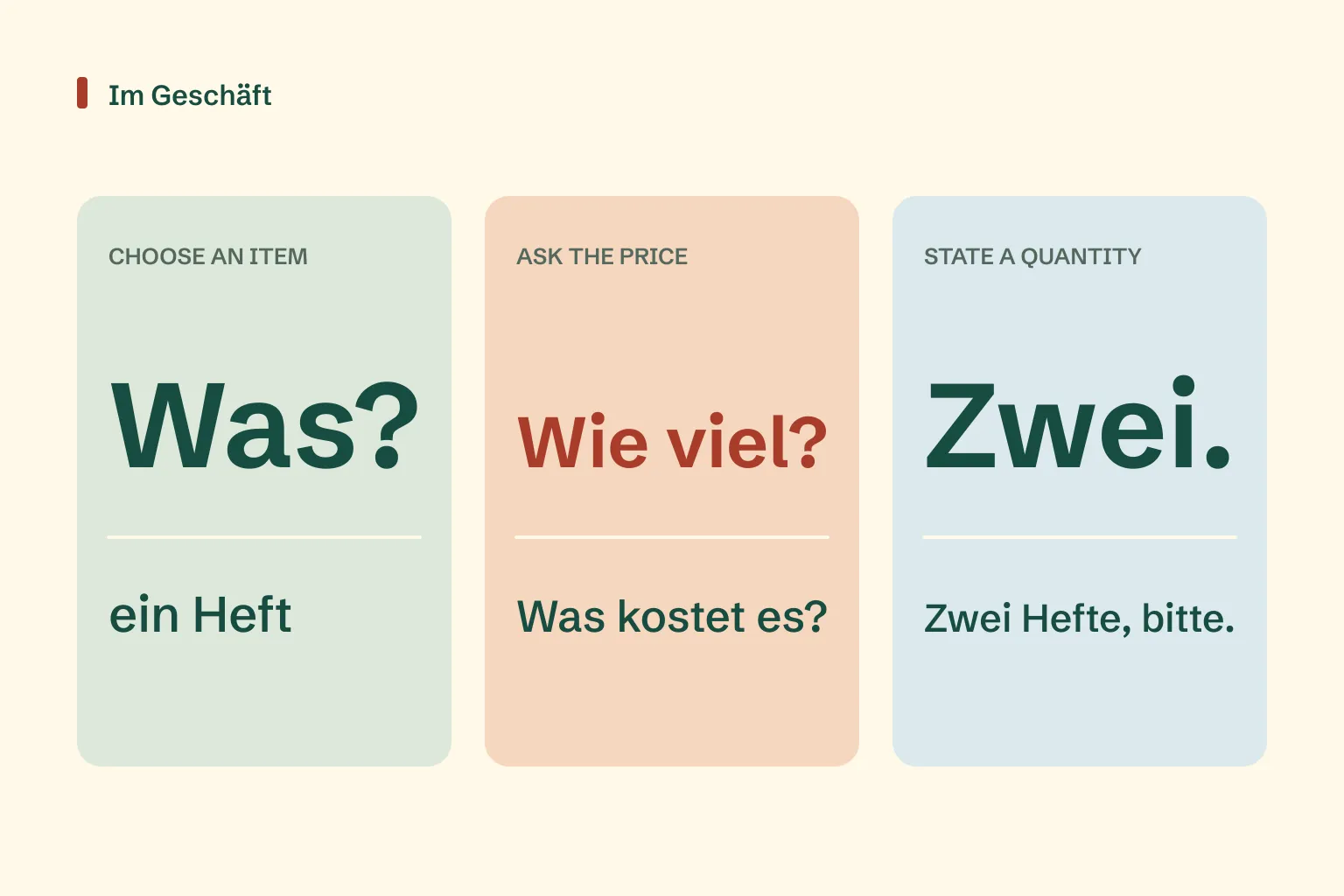
Before your next German lesson, you need a notebook and pens. In a shop, three useful questions are Haben Sie Hefte? (Do you have notebooks?), Was kostet das Heft? (How much is the notebook?) and Kann ich mit Karte zahlen? (Can I pay by card?). Follow the answers before deciding. A quantity and a colour can matter as much as the price.
Takeaway: Separate one item’s price from the total. Repeat the quantity clearly before paying.
An original stationery-shop exchange
All stock and prices below are invented. The practice shelf lists Heft 2,40 €; Stift 1,30 €; Mappe 3,50 €.
Emil: Guten Tag. Haben Sie Hefte? Hello. Do you have notebooks?
Service: Ja. Hier sind die Hefte. Blau oder grün? Yes. Here are the notebooks. Blue or green?
Emil: Ein grünes Heft, bitte. Was kostet das Heft? One green notebook, please. How much is the notebook?
Service: Zwei Euro vierzig. Two euros forty.
Emil: Gut. Und zwei Stifte, bitte. Good. And two pens, please.
Service: Das macht fünf Euro. That comes to five euros.
Emil: Kann ich mit Karte zahlen? Can I pay by card?
Service: Ja. Yes.
Emil: Danke. Auf Wiedersehen. Thank you. Goodbye.
The receipt is one notebook 2,40 € plus two pens 2 × 1,30 € = 2,60 €, total 5,00 €. The service response about card payment belongs to this invented dialogue; it is not a claim about any particular shop.
Useful words with their forms
| Singular | Plural | Original request | Meaning |
|---|---|---|---|
| das Heft | die Hefte | ein Heft | one notebook |
| der Stift | die Stifte | zwei Stifte | two pens |
| die Mappe | die Mappen | eine Mappe | one folder |
| der Preis | die Preise | Was kostet das? | What does that cost? |
After a number such as zwei, use the noun’s plural: zwei Hefte, not zwei Heft. In einen Stift, the singular masculine object has the article ending -en. A plural quantity has a different shape: zwei Stifte. Do not carry the singular ending onto the numeral.
The dialogue includes ein grünes Heft. The colour word has an ending because it appears before a noun. For this first shop task, keep that whole chunk. A colour stated after sein has no such ending: Das Heft ist grün. The adjective-ending guide supplies the wider system when you are ready for it.
Clarify a detail you missed
Wie bitte? means “Pardon?” Zwei Euro vierzig? repeats a price as a confirmation. Nur ein Heft, bitte means “Only one notebook, please” and repairs a quantity mistake. Ich schaue nur, danke means “I’m just looking, thank you,” if you do not want to choose yet.
Practise with the shelf list hidden from the shopper. The service partner reads prices from the list; the shopper writes the item, quantity and price. Compare the note with the shelf only at the end. This tests whether the exchange communicated the right information, rather than whether both people could read the same table aloud.
Finish by reading the order back: ein Heft und zwei Stifte. Your partner checks the items and quantities, then you compare the receipt with the shelf list. Repeat with one new quantity so the conversation leads to a new result.
Practise it
- Ask politely whether the shop has notebooks. Use formal Sie.
- Ask the price of one folder, using die Mappe.
- Correct the noun form: zwei Stift.
- Calculate one notebook and two pens using the invented shelf. Write a total in German words.
- A service partner offers two notebooks, but you need one. Give a short repair using nur.
- Write a short purchase exchange for one folder. Include a price question, the correct reply and a payment-method question.
Answers and reasons
- Haben Sie Hefte? Sie is formal and takes haben. Haben Sie ein Heft? is also grammatical but asks for a singular item.
- Was kostet die Mappe? The subject die Mappe is singular, so kostet fits.
- Zwei Stifte. A quantity of two requires the plural Stifte.
- Fünf Euro. 2,40 + 1,30 + 1,30 = 5,00. Do not count the price of only one pen.
- Nur ein Heft, bitte. The correction identifies the quantity that should change.
- Model: Was kostet die Mappe? / Drei Euro fünfzig. / Eine Mappe, bitte. Kann ich mit Karte zahlen? A greeting or service confirmation can be added. The price must stay 3,50 € for this shelf.
Use it in your next lesson
Build your own imaginary stationery receipt using the three shelf prices. Model: zwei Hefte und eine Mappe = acht Euro dreißig. Check both the arithmetic and noun plurals. Put der Stift, die Stifte together in your vocabulary notebook, then try the exchange without reading the full script.
Sources and further reading
- Goethe-Institut A1 vocabulary: Reference for shopping, prices and everyday classroom nouns.
- Duden: Heft: Dictionary reference for das Heft and die Hefte.