
Classroom companion
Kein or nicht? Say what you mean in German
Learn a useful starting distinction between kein and nicht. Practise noun phrases, adjective negation, and clear contrasts with original examples.
Read as Markdown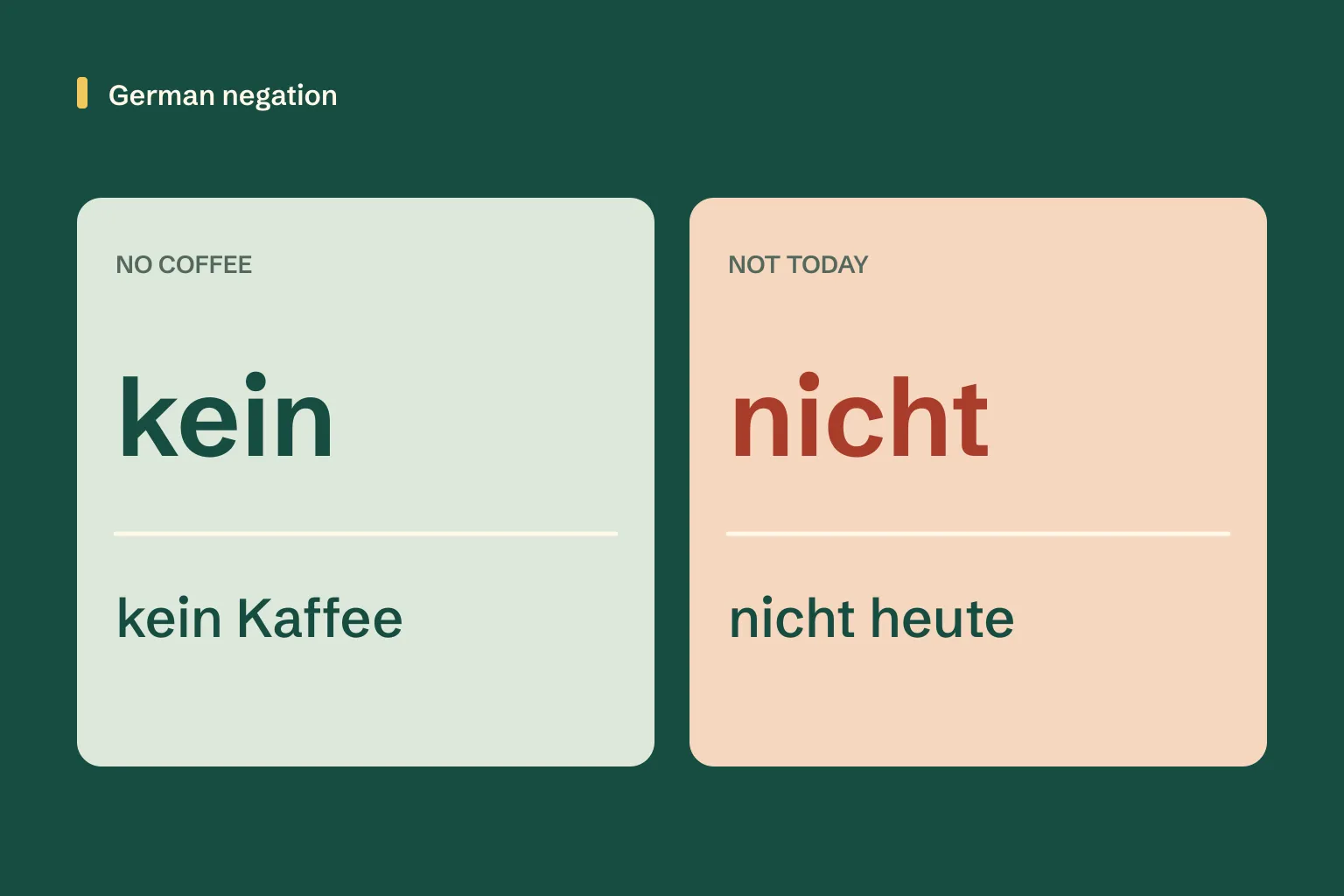
Use kein to negate a noun phrase that would otherwise have an indefinite article or often no article: Ich habe keinen Stift: I do not have a pen. Use nicht for many other kinds of negation, such as Das ist nicht teuer: that is not expensive. The position of nicht depends on what you want to negate.
Start with a positive sentence
Ich habe einen Stift becomes Ich habe keinen Stift. The noun is masculine and accusative in both sentences. Keinen keeps the appropriate ending; it is not an unchanging word that you place before every noun.
Compare Ich habe eine Frage and Ich habe keine Frage. Here the noun is feminine accusative, so the negative determiner is keine. First understand the positive phrase, then make it negative.
| Positive | Negative |
|---|---|
| ein Buch | kein Buch |
| eine Frage | keine Frage |
| einen Stift | keinen Stift |
| Fragen | keine Fragen |
These are selected forms, not the whole declension table. Kein also changes in dative and genitive constructions. Keep it tied to the article and case patterns you are learning.
Use nicht with an adjective
Das ist teuer (that is expensive) becomes Das ist nicht teuer. You are negating the description teuer, not introducing a negative noun phrase.
Likewise, Ich bin müde becomes Ich bin nicht müde: I am not tired. A beginner shortcut such as “put kein before anything that follows sein” would fail here. Identify the type of phrase and the intended meaning instead.
You can also negate a specific element: Ich komme nicht heute, sondern morgen: I am not coming today, but tomorrow. Nicht directly marks heute as the rejected option.
No article does not mean no kein
Ich trinke Kaffee (I drink coffee) can become Ich trinke keinen Kaffee: I do not drink coffee. The positive sentence has no article, but the negative noun phrase uses kein with the correct ending.
For plural homework tasks, Wir haben Hausaufgaben becomes Wir haben keine Hausaufgaben. Do not try to invent a plural ein in the positive sentence. German has no indefinite article corresponding to “a” in the plural.
The noun phrase and the surrounding meaning still matter. Proper names and some fixed expressions behave differently, so this is a practical starting distinction rather than a claim that every article-free noun must take kein.
Do not always put nicht last
A sentence’s final position is not a universal home for nicht. Compare Ich komme heute nicht with Ich komme nicht heute, sondern morgen. The first negates coming today; the second explicitly contrasts today with tomorrow.
In a sentence with an infinitive, nicht often comes before that final verbal element: Ich kann heute nicht kommen: I cannot come today. Learn a complete example for the structure in your current lesson.
Mini practice
Negate the intended idea.
- Ich habe einen Stift. (having a pen)
- Das ist teuer. (expensive)
- Wir haben Hausaufgaben. (homework)
- Ich komme heute. (today; instead tomorrow)
- Sie trinkt Kaffee. (coffee)
Answers
- Ich habe keinen Stift. Masculine accusative noun phrase.
- Das ist nicht teuer. The adjective is negated.
- Wir haben keine Hausaufgaben. Negative plural noun phrase.
- Ich komme nicht heute, sondern morgen. A contrast between days.
- Sie trinkt keinen Kaffee. Negative masculine accusative noun phrase.
Sources and further reading
See Grimm Grammar: negation. To explain a negative statement, add a reason using weil or denn, keeping the two sentence patterns clear.