
Classroom companion
Kennen or wissen? Examples for your German class
Learn the difference between kennen and wissen through classroom situations, useful sentence patterns, and five exercises with explained answers.
Read as Markdown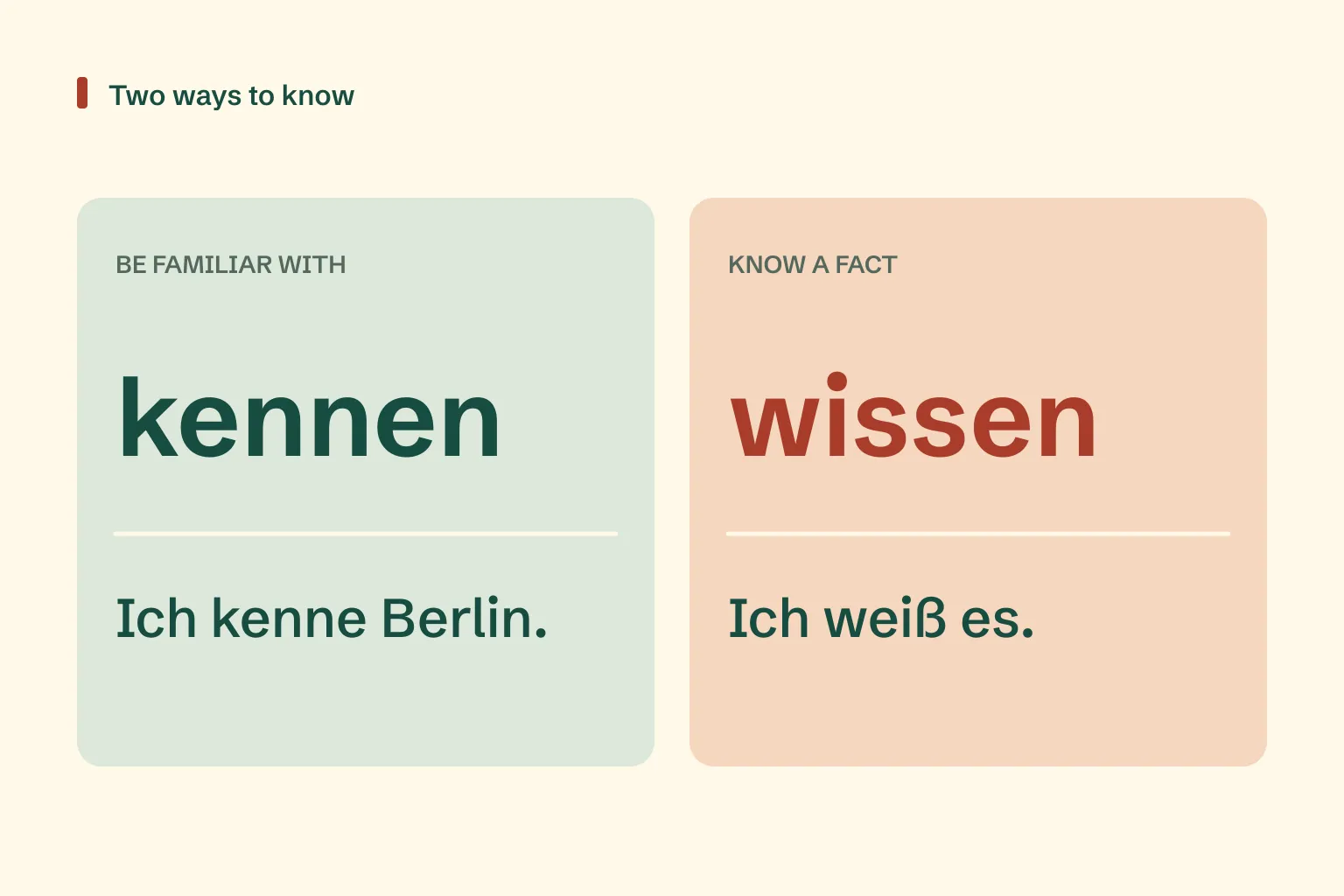
Use kennen when you mean being familiar with a person, place, or thing. Use wissen when you mean knowing information, often followed by a clause such as dass, wo, or wann. The distinction is about meaning and construction, not a rule that one verb can only be followed by a noun.
One classroom, two kinds of knowing
Ich kenne die Lehrerin. I know the teacher; I am familiar with her.
Ich weiß, wann der Kurs beginnt. I know when the course begins; I have that information.
These are useful starting patterns because the intended meaning is clear. You are not making a general claim about someone’s intelligence or how well they learned a subject. You are describing familiarity in one sentence and information in the other.
Now compare two sentences about getting to class: Ich kenne den Weg (I know the route) and Ich weiß, wo die Schule ist: I know where the school is. Both may be true, but they present your knowledge differently.
Learn the short forms you actually use
| Person | kennen | wissen |
|---|---|---|
| ich | kenne | weiß |
| du | kennst | weißt |
| er/sie/es | kennt | weiß |
| wir | kennen | wissen |
| ihr | kennt | wisst |
| sie/Sie | kennen | wissen |
The singular forms of wissen are easy to miss if you expect a regular stem. Save Ich weiß es nicht (I do not know) as a complete phrase. Then add Weißt du …? for a question to a classmate and Wissen Sie …? for a formal question.
In Weißt du, wann der Kurs beginnt?, the embedded question has its finite verb beginnt at the end. Knowing which verb to choose is only one part of the sentence; the word order needs practice too.
Avoid an over-simple shortcut
A common shortcut says “kennen before a noun, wissen before a sentence.” It is useful at first, but incomplete. You can say die Antwort wissen: know the answer. You can also say die Antwort kennen. A noun immediately after the verb does not settle every case.
Similarly, Ich weiß es uses the pronoun es, not a whole clause. The important question is whether you mean familiarity or having some information, and which construction is natural in that context.
Learn ambiguous cases as phrases. If a teacher accepts more than one version, ask what changes in emphasis instead of treating the overlap as a mistake in the language.
Repair two common errors
If you want to say “I know Berlin,” use Ich kenne Berlin. It means the city is familiar to you. Ich weiß Berlin does not express that meaning.
If you want to say “I know that the exam is tomorrow,” use Ich weiß, dass die Prüfung morgen ist. A direct substitution with kennen does not work in that construction. Keep the whole pattern wissen, dass … in your notebook.
There is also können: Ich kann schwimmen means I can swim, or I know how to swim. Do not use kennen to express every skill that English introduces with “know how.”
Mini practice
Choose and conjugate kennen or wissen. Item four tests a common use of wissen, although kennen can also be natural there.
- Ich ___ diese Stadt gut.
- ___ du, wann der Kurs beginnt?
- Wir ___ die neue Lehrerin noch nicht.
- Er ___ die Antwort nicht.
- Ich ___, dass wir morgen einen Test haben.
Answers
- kenne: familiarity with the city.
- Weißt: knowing the information expressed by the wann clause.
- kennen: familiarity with a person.
- weiß: knowing the answer. kennt is also possible; this is why the “noun versus clause” shortcut is not absolute.
- weiß: knowing a fact expressed by the dass clause.
Write two new sentences about your actual class: someone or something you know, and one fact you know about the next lesson. Read them aloud without translating word by word.
Sources and further reading
See Grimm Grammar: wissen and kennen. For another word-choice problem, try German false friends. Keep confused pairs in your vocabulary notebook with complete examples.