
Classroom companion
German false friends that can confuse your class notes
Avoid common German–English false friends such as bekommen, Gift, aktuell, and eventuell. Learn them through original situations and sentence practice.
Read as Markdown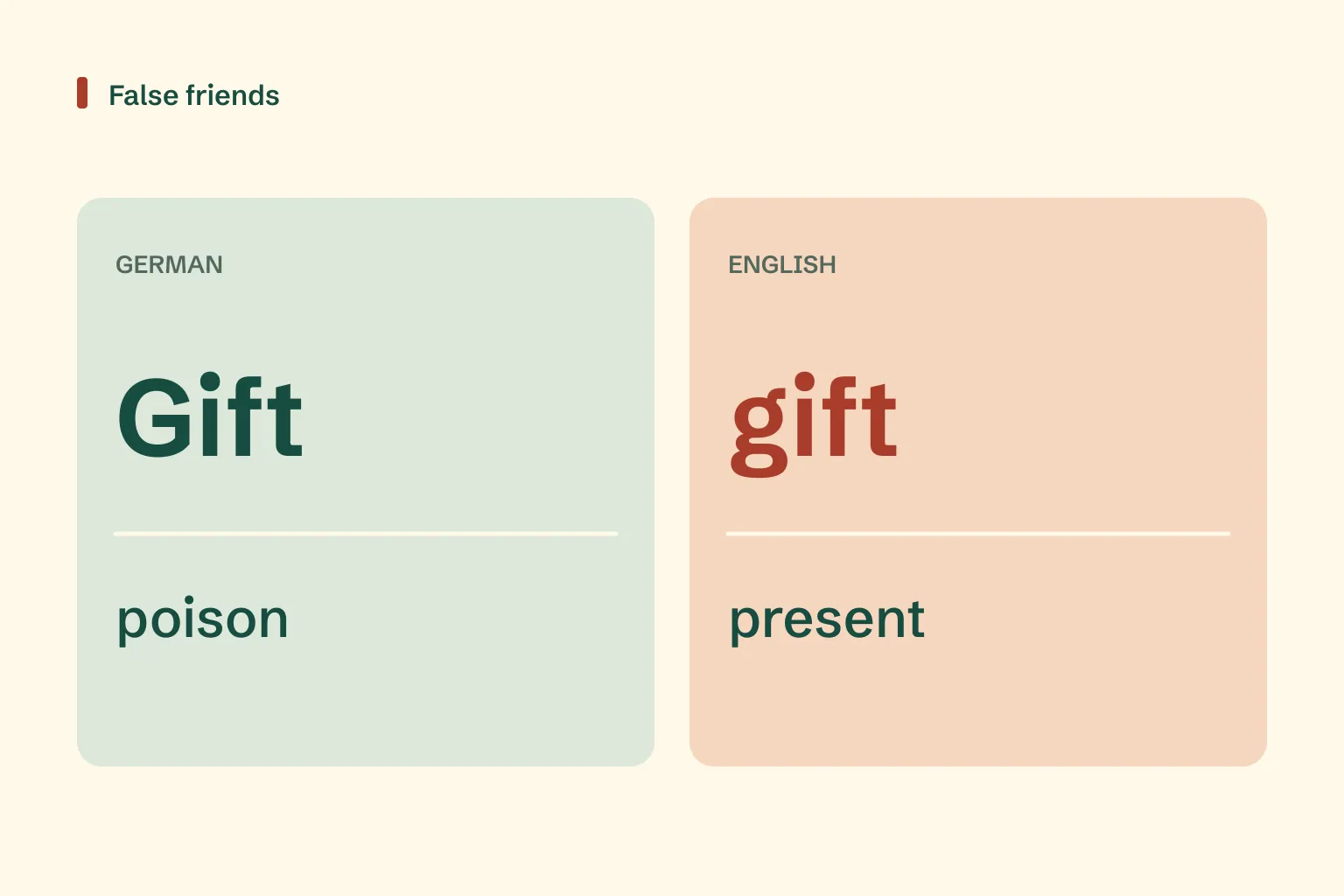
German and English share many similar-looking words, but some familiar shapes lead to the wrong meaning. Bekommen means to get or receive, not to become; das Gift means poison, not a present. Record a false friend with a complete sentence and its intended meaning so the resemblance stops controlling your translation.
Start with the situation
Suppose your classmate says Ich bekomme morgen eine E-Mail. They expect to receive an email tomorrow. If you translate bekomme as “become,” the sentence makes no sense. The situation helps you catch the wrong assumption.
Now compare Ich werde Lehrerin: I am becoming a teacher. Werden expresses that change. Learn these two verbs in a pair of clear contexts instead of memorizing “never translate this word like that” without a replacement.
| German word | Useful meaning | Watch out for |
|---|---|---|
| bekommen | get, receive | English “become” is usually werden |
| das Gift | poison | a present is das Geschenk |
| aktuell | current, up to date | “actually” often needs eigentlich or tatsächlich, depending on meaning |
| eventuell | possibly, perhaps | English “eventually” does not normally mean “possibly” |
| der Chef / die Chefin | boss | a cook is der Koch / die Köchin |
| das Gymnasium | an academic secondary school | a fitness gym is das Fitnessstudio |
The English column gives practical starting meanings, not an exhaustive dictionary entry. Some words vary by context, and an English word may need different German translations in different sentences.
Keep two examples when the confusion is strong
For aktuell, use Die Informationen sind aktuell: the information is up to date. For an “actually” contrast, use Ich wohne eigentlich in Berlin: I actually live in Berlin, in an appropriate corrective context.
For eventuell, use Ich komme eventuell später: I might come later. That sentence does not promise that the person will finally arrive after a long delay. If you want to say “eventually,” decide whether you mean “finally” or “at some future point” before choosing a German expression.
A flashcard can ask for the meaning of the whole example. This is often more useful than presenting one ambiguous English word and expecting only one possible translation.
Be careful with partial overlaps
Not every look-alike pair is completely unrelated. Sometimes the words overlap in one sense but differ in another. That makes a giant list of “wrong words” less useful than a set of contexts from your actual lessons.
When a teacher corrects your word choice, record what you intended to say and the sentence they recommend. Preserve the correction beside the original note. Otherwise the wrong version may be the one you keep reviewing.
Do not invent an etymological story to explain a false friend. You can notice a resemblance without claiming to know how the two words developed historically.
Mini practice
Translate the intended meaning. Several natural phrasings may be possible; compare the specific word choice in the answers.
- I get an email.
- The appointment is tomorrow. Use der Termin.
- That is a gift.
- Can I borrow your pen? Speak informally to one person.
- The information is current. Use die Informationen.
Suggested answers
- Ich bekomme eine E-Mail. Bekommen expresses receiving.
- Der Termin ist morgen. Here Termin means appointment.
- Das ist ein Geschenk. Use Geschenk for a present.
- Kann ich deinen Stift leihen? This asks to borrow the pen; ausleihen is also possible in an appropriate construction.
- Die Informationen sind aktuell. Aktuell expresses being current.
Use the correction in your next lesson
Pick one pair and create a realistic sentence about your work or course. Keep it in the notebook template. If two German words share one English translation, such as kennen and wissen, learn their sentence patterns as well.
Sources and further reading
The University of Texas at Austin offers a false-cognates reference. The situations and practice sentences here are original. Meanings should always be checked against the context in which you intend to use a word.