
Classroom companion
Talk about your weekend in German: A2 speaking practice
Talk about your weekend in German with a clear sequence, useful Perfekt chunks, follow-up questions and a complete A2 speaking worksheet.
Read as Markdown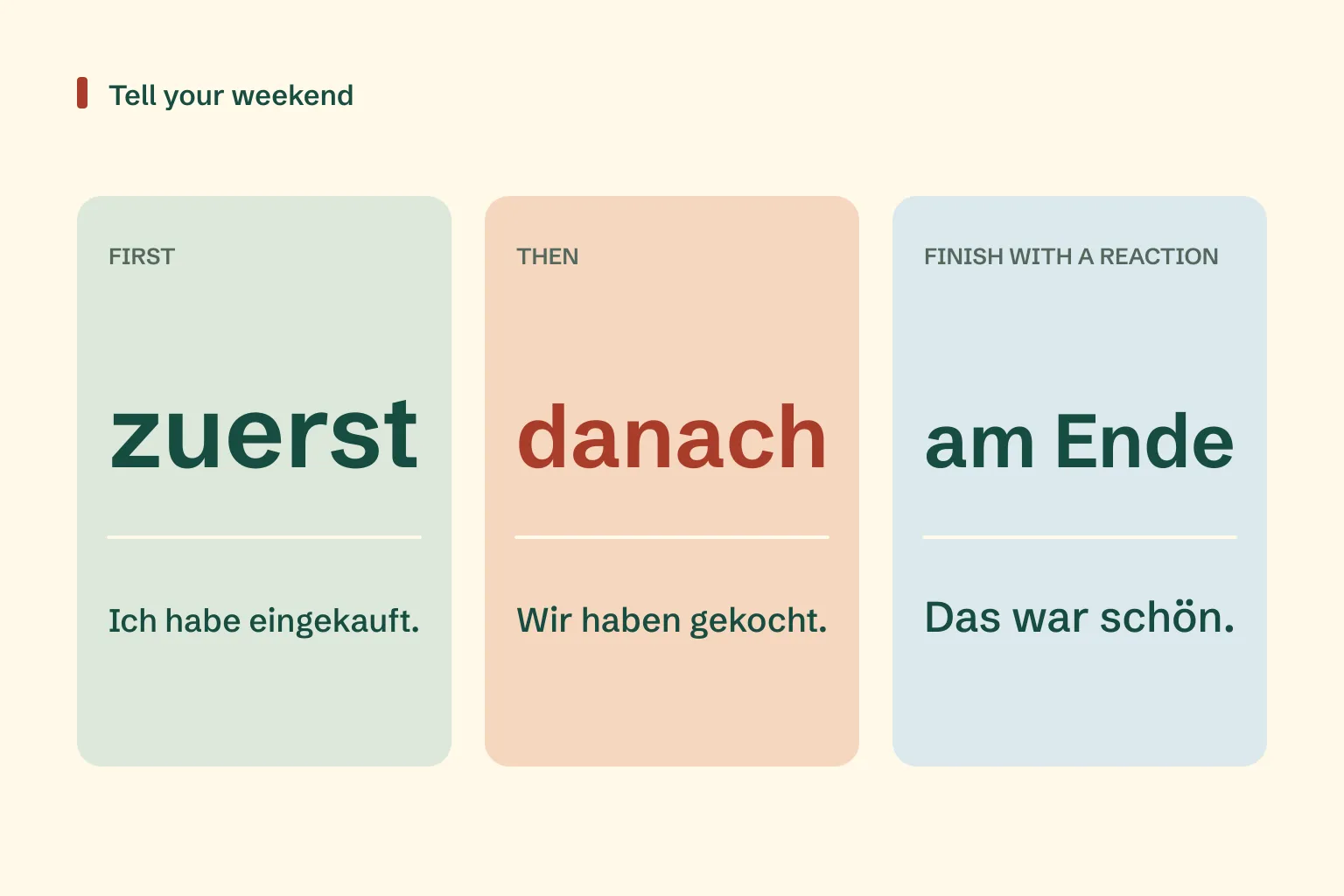
Your teacher asks, Was hast du am Wochenende gemacht? Choose two or three events, put them in order and add one reaction. You do not need an exciting trip to give a useful answer. Am Samstag habe ich eingekauft. Danach habe ich mit meiner Schwester gekocht. Das war schön is a complete starting account of an ordinary weekend.
Takeaway: Prepare events as auxiliary + participle chunks. Then connect them with time words instead of translating a long English story sentence by sentence.
A small speaking bank
| What you want to say | Original German chunk |
|---|---|
| I did the shopping. | Ich habe eingekauft. |
| I cooked with a friend. | Ich habe mit einer Freundin gekocht. |
| I read a text. | Ich habe einen Text gelesen. |
| I met my brother. | Ich habe meinen Bruder getroffen. |
| I went to the park. | Ich bin in den Park gegangen. |
| I stayed at home. | Ich bin zu Hause geblieben. |
| I had little time. | Ich hatte wenig Zeit. |
| It was relaxing. | Das war erholsam. |
War and hatte are useful simple-past forms of sein and haben. Mixing them with Perfekt events in an everyday account can be natural. Do not force Das hat schön gewesen into your story. Say Das war schön or, in the appropriate construction, Das ist schön gewesen.
An original weekend account
Am Samstag bin ich früh aufgestanden. Zuerst habe ich auf dem Markt Gemüse gekauft. Danach habe ich meine Schwester besucht. Wir haben zusammen eine Suppe gekocht und lange gesprochen. Am Nachmittag hat es geregnet. Deshalb sind wir zu Hause geblieben und haben ein Kartenspiel gespielt. Am Sonntag hatte ich mehr Zeit für Deutsch. Ich habe einen kurzen Text gelesen und fünf neue Wörter in mein Heft geschrieben. Abends habe ich meine Tasche für den Kurs vorbereitet. Das Wochenende war ruhig, aber schön.
The account follows Saturday, Sunday and the final evening. It adds a reason for staying in, deshalb, and an evaluation, ruhig, aber schön. The rain is part of this original fictional example; you can use a simpler reason from your own experience.
Keep the verb frame visible
Danach habe ich meine Schwester besucht begins with a time connector. Habe remains second, before ich. Compare Ich habe danach meine Schwester besucht. Both are possible; the first highlights the sequence.
For aufstehen, the participle is aufgestanden and the auxiliary is sein here: Ich bin aufgestanden. For besuchen, the participle is besucht, without ge-. Learn the real participle with the action rather than adding ge- to every verb.
The Perfekt guide explains the broader auxiliary and participle choices. For this speaking task, five well-checked event chunks are enough to start. A longer list is useful only if you can actually retrieve it.
Turn an account into a conversation
A partner should not simply wait for their own turn. Ask one concrete follow-up:
- Mit wem hast du gekocht? Who did you cook with?
- Was hast du gelesen? What did you read?
- Wie war das Wetter? What was the weather like?
- Hat dir das Spiel gefallen? Did you like the game?
Answer the question asked before returning to your prepared sequence. If you did not understand, say Meinst du am Samstag oder am Sonntag? (Do you mean on Saturday or Sunday?). That clarification is part of successful speaking.
A ten-minute practice session
Spend two minutes choosing three events and checking their verb forms. Speak for one minute without reading complete sentences. Your partner asks two questions, then gives one specific check: the auxiliary, participle or time sequence. Swap roles and repeat with fewer notes. You can describe an invented quiet weekend if you prefer not to share personal details.
Practice
- Complete: Am Samstag ___ ich in den Park gegangen.
- Complete: Danach habe ich einen Text ___ (lesen).
- Correct the order: Danach ich habe gekocht.
- Why do the people stay at home in the model account?
- Ask a German question to find out who your partner visited.
- Give a four-sentence weekend account with two events, one time connector and one reaction.
- Your partner says Ich habe ein Buch gelesen. Ask a relevant follow-up rather than changing the topic.
Explained answers and model
- bin. The speaker uses ich, and gehen takes sein in this travel use.
- gelesen. The irregular participle belongs at the end; lese would be a present finite form.
- Danach habe ich gekocht. The time word occupies first position and the finite auxiliary follows.
- Because it rained in the afternoon. Deshalb connects that reason with staying home.
- Wen hast du besucht? Wen asks about the accusative object of besuchen.
- Am Samstag habe ich eingekauft. Danach habe ich mit einem Freund gekocht. Am Sonntag bin ich zu Hause geblieben. Das war erholsam. Other events are valid if their verb forms and sequence fit.
- Welches Buch hast du gelesen? Hat dir das Buch gefallen? is another connected question. It develops the stated topic rather than starting an unrelated one.
Sources and next step
The University of Texas haben and sein references support the selected Perfekt forms. The model and practice are original A2-oriented teaching material. Continue through the A2 path.