
Classroom companion
Weil vs denn: explain a reason in German
Use weil and denn to connect a reason. See the word-order difference, build your own classroom sentences, and check three practice pairs.
Read as Markdown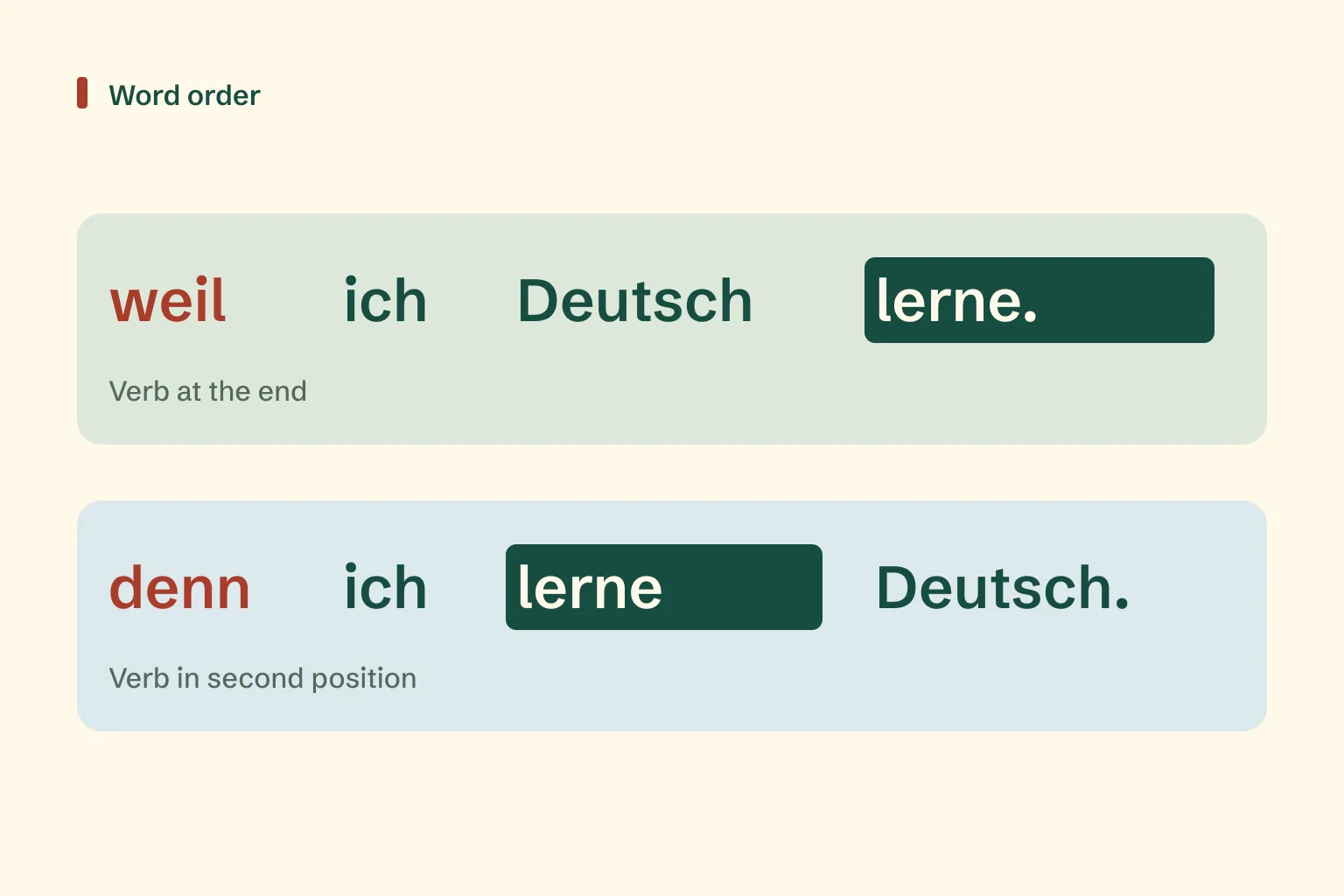
Weil and denn can both introduce a reason, but they produce different sentence structures. In standard written German, weil sends the finite verb to the end of its subordinate clause. After denn, the following main clause keeps normal word order. Learn the reason as a complete clause, then connect it.
Keep the meaning, change the structure
Start with two statements: Ich bleibe zu Hause. Ich bin krank. I am staying at home. I am ill.
With weil: Ich bleibe zu Hause, weil ich krank bin.
With denn: Ich bleibe zu Hause, denn ich bin krank.
The reason is the same. What changes is the position of bin. In the weil clause, it comes last. In the clause after denn, it stays in second position after the subject.
Find the finite verb before moving anything
The finite verb is the one carrying the tense and agreeing with the subject. In ich bin krank, it is bin. In ich muss arbeiten, it is muss.
That gives you Ich komme später, weil ich arbeiten muss: I am coming later because I have to work. Do not send the subject to the end or randomly reverse every word. Identify the verb first.
With denn, say Ich komme später, denn ich muss arbeiten. The modal and infinitive follow the normal main-clause pattern.
A reason can come first with weil
You can also write Weil ich krank bin, bleibe ich zu Hause. The whole subordinate clause occupies the first position of the overall sentence. The main clause then begins with bleibe, followed by ich.
This can feel surprising if you count individual words rather than sentence elements. Treat Weil ich krank bin as one fronted unit. A useful notebook practice is to draw a box around it, then mark the finite verb in the main clause.
For your first exercises, keep the main statement first. Once that is comfortable, practise moving the weil clause to the front. Add one structural challenge at a time.
Why spoken examples may sound different
In conversation you may hear weil followed by main-clause word order. That spoken usage does not make the standard written pattern irrelevant. For classroom writing and the exercises here, use the finite verb at the end after weil.
If you notice a different form in a podcast, record the complete context and ask your teacher about it. Do not change all your written sentences based on one fragment heard at speed.
Mini practice
Combine each pair twice: once with weil, once with denn. Keep the first sentence at the beginning.
- Ich bleibe zu Hause. Ich bin krank.
- Wir lernen Deutsch. Wir brauchen die Sprache im Alltag.
- Sie kommt später. Sie arbeitet heute.
Read each result aloud and identify the finite verb in the reason clause. This is more informative than checking only whether you remembered the conjunction.
Answers
- Ich bleibe zu Hause, weil ich krank bin. / Ich bleibe zu Hause, denn ich bin krank. The finite verb is bin.
- Wir lernen Deutsch, weil wir die Sprache im Alltag brauchen. / Wir lernen Deutsch, denn wir brauchen die Sprache im Alltag. The finite verb is brauchen.
- Sie kommt später, weil sie heute arbeitet. / Sie kommt später, denn sie arbeitet heute. The finite verb is arbeitet.
Try a reason from your own week
Write one true sentence about why you are learning German or why you missed a lesson. Keep the vocabulary familiar. Then switch between weil and denn while preserving the meaning.
For more sentence work, practise separable verbs. The important habit is the same: store a word together with the structure it needs.
Sources and further reading
See Grimm Grammar: subordinating conjunctions for the subordinate-clause pattern. The exercises above are original and use standard written word order.