
Classroom companion
Sein or werden in the passive? State and process in German
Distinguish German process passive from a resulting state, check ist, war and worden, and avoid treating every sein-participle sentence as passive.
Read as Markdown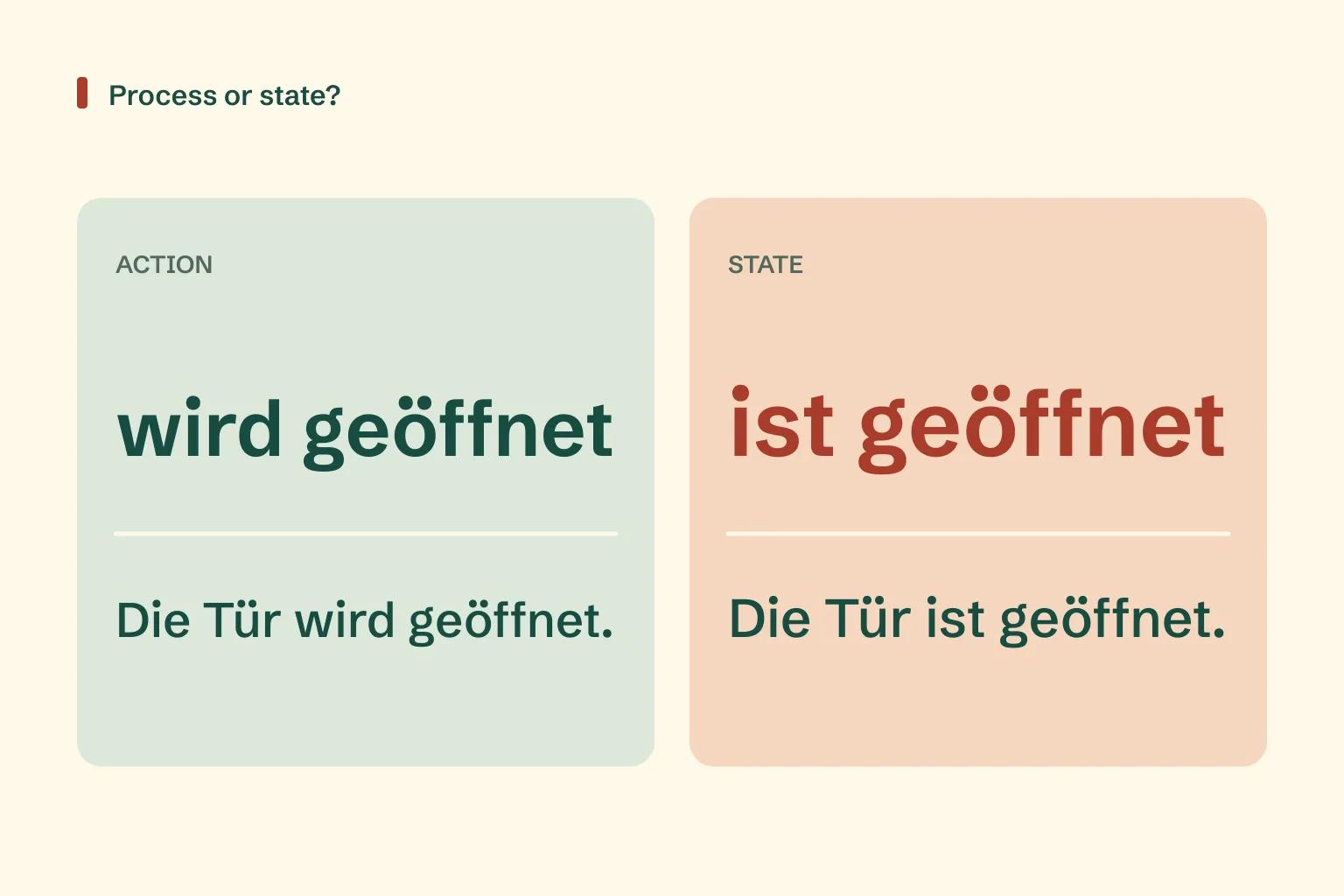
You arrive at the course room. Die Tür wird geschlossen says someone is closing the door. Die Tür ist geschlossen says the door is closed. The first focuses on a process; the second presents a state. The traditional term Zustandspassiv is useful for many sein + participle descriptions, but not every sentence containing sein and a participle belongs to that category.
Takeaway: Ask whether the sentence describes the action, its resulting state or an active Perfekt event. The complete verb group and meaning decide the reading, not the first auxiliary alone.
Compare the same door
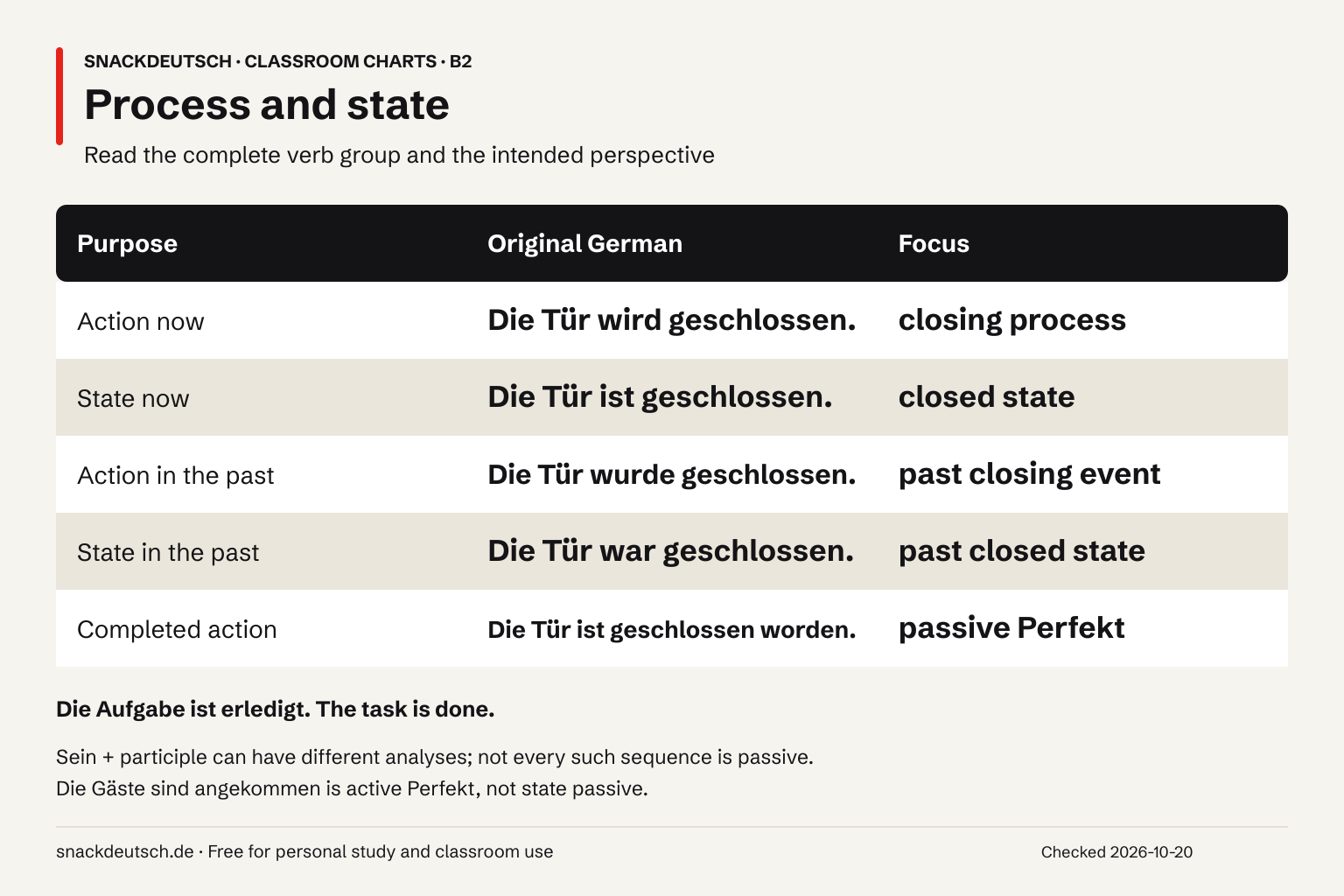
Process and state
Read the complete verb group and the intended perspective. Suggested level: B2.
| Purpose | Original German | Focus |
|---|---|---|
| Action now | Die Tür wird geschlossen. | closing process |
| State now | Die Tür ist geschlossen. | closed state |
| Action in the past | Die Tür wurde geschlossen. | past closing event |
| State in the past | Die Tür war geschlossen. | past closed state |
| Completed action | Die Tür ist geschlossen worden. | passive Perfekt |
Die Aufgabe ist erledigt. The task is done.
- Sein + participle can have different analyses; not every such sequence is passive.
- Die Gäste sind angekommen is active Perfekt, not state passive.
The examples separate voice from time. Both wird geschlossen and wurde geschlossen are process-passive forms, in different tenses. Ist geschlossen and war geschlossen describe states at different reference times. Ist geschlossen worden is passive Perfekt despite starting with ist.
Choose the question you are answering
Imagine these original classroom exchanges:
A: Warum können wir nicht in den Raum? Why can we not enter the room?
B: Die Tür ist abgeschlossen. The door is locked.
The answer presents the state relevant to entry. It does not tell you exactly when the locking happened or who did it.
Now compare:
A: Was passiert gerade am Eingang? What is happening at the entrance right now?
B: Die Tür wird abgeschlossen. The door is being locked.
The second answer names an ongoing process. The physical situation may be related, but the speaker selects a different perspective. A state description is not merely a shorter version of every process statement.
Build a useful state description
Start with a verb whose result can be understood as a state in the intended context: öffnen → geöffnet, schließen → geschlossen, erledigen → erledigt, vorbereiten → vorbereitet.
- Die Unterlagen sind vorbereitet. The documents are prepared.
- Die Aufgabe ist erledigt. The task is done.
- Der Raum war gestern schon reserviert. The room was already reserved yesterday.
Sein agrees with the subject: singular ist, plural sind; past singular war, plural waren. The participle used predicatively does not take an adjective ending: Die Unterlagen sind vorbereiteten is not correct. Before a noun, an adjectival participle does need the ending: die vorbereiteten Unterlagen.
Why grammar references use different analyses
Some descriptions call these sein-passive, some treat the participle as adjectival and sein as a copula, and some distinguish several subtypes. For this learner task, the practical questions remain useful: what is described, what time is meant and what verb group is present? You do not need to settle every theoretical boundary to choose Der Raum ist reserviert in an everyday exchange.
The analysis matters when it prevents a false universal. Do not assume any active verb can mechanically form a natural state passive. A result state must make sense for that verb and context. Die Gäste sind angekommen is active Perfekt of ankommen. It reports that the guests arrived; sind is the active Perfekt auxiliary, not a passive marker.
Do not lose an event when changing the wording
Die Unterlagen sind gestern verschickt worden reports yesterday’s sending. Die Unterlagen sind verschickt presents the sent/done state in context. If the date of the event matters to a colleague, use wording that retains it. A shorter sentence is not automatically equivalent in every communication task.
Similarly, Der Kurs ist beendet can describe the course as over. Der Kurs wird beendet focuses on ending it. Do not infer a specific cancellation policy or an official decision-maker from either phrase. The grammar describes perspective, not the administrative facts behind it.
Practice
- Choose the state: Die Fenster sind geöffnet / werden geöffnet. You want to describe how the room is now.
- Choose the process: someone is currently preparing the room. Use vorbereiten.
- Put the state into the past: Die Aufgabe ist erledigt.
- Correct: Die Unterlagen sind vorbereiteten.
- Is Die Gäste sind angekommen a state passive? Explain.
- What does worden contribute in Der Raum ist gereinigt worden?
- A partner asks whether the room is ready to use. Give a state answer and then a separate sentence naming a completed preparation action.
Explained answers and model
- Die Fenster sind geöffnet. This presents the open state. Werden geöffnet would focus on the opening action.
- Der Raum wird vorbereitet. Finite wird plus vorbereitet presents the process now.
- Die Aufgabe war erledigt. Past war changes the time of the state; it does not turn it into a process.
- Die Unterlagen sind vorbereitet. A predicative participle has no case ending here.
- No. It is active Perfekt of ankommen, which uses sein.
- It makes ist gereinigt worden the passive Perfekt of the cleaning event. Without worden, ist gereinigt can describe the resulting state.
- Der Raum ist vorbereitet. Die Tische sind heute Morgen aufgestellt worden. Other actions work if the first sentence describes readiness and the second clearly reports a completed event.
Sources and next practice
The IDS passive reference presents process/state terminology and notes different analyses. The IDS participle-II reference explains the boundary between adjectival use and a verbal construction. All examples here are original. Review adjective endings when a participle stands before a noun, then continue in the B2 path.