
Classroom companion
German nominalisation: move between verbs and noun phrases
Move between German verbs and noun phrases while preserving meaning, checking articles, complements and agreement, with original B2 exercises.
Read as Markdown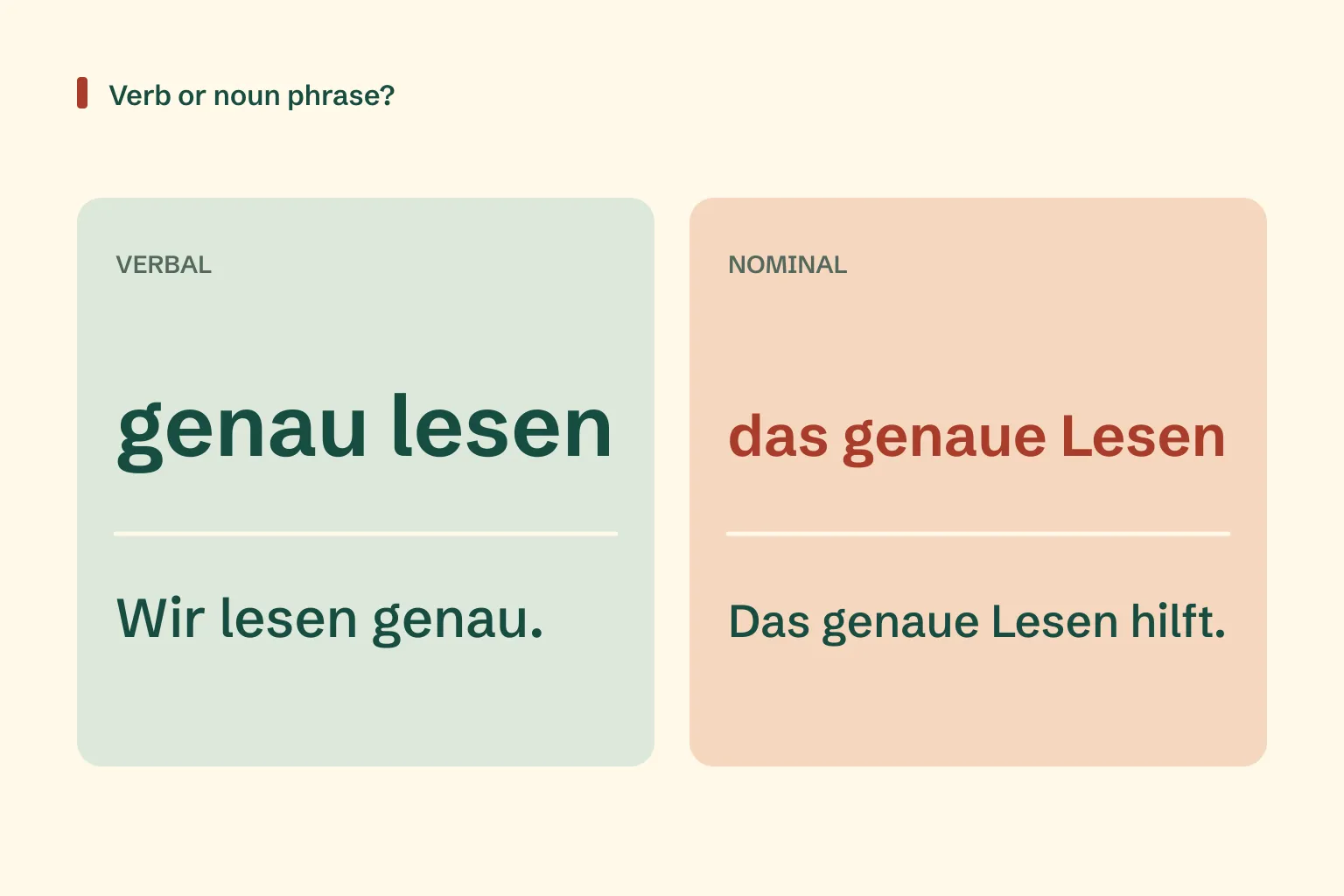
Your notes say Wir besprechen den Plan. A heading may instead read Besprechung des Plans (discussion of the plan). Nominalisation packages an action or quality as a noun phrase. Verbalisation unpacks it into a verb construction. The useful skill is choosing a clear form for your purpose while preserving who does what, not replacing every verb with a longer noun.
Takeaway: A nominal phrase needs its own article, endings and complements. When you unpack it, recover the action and participants instead of translating the noun in isolation.
Four starting transformations
Verbs and noun phrases
Keep the meaning, participants and agreement. Suggested level: B2.
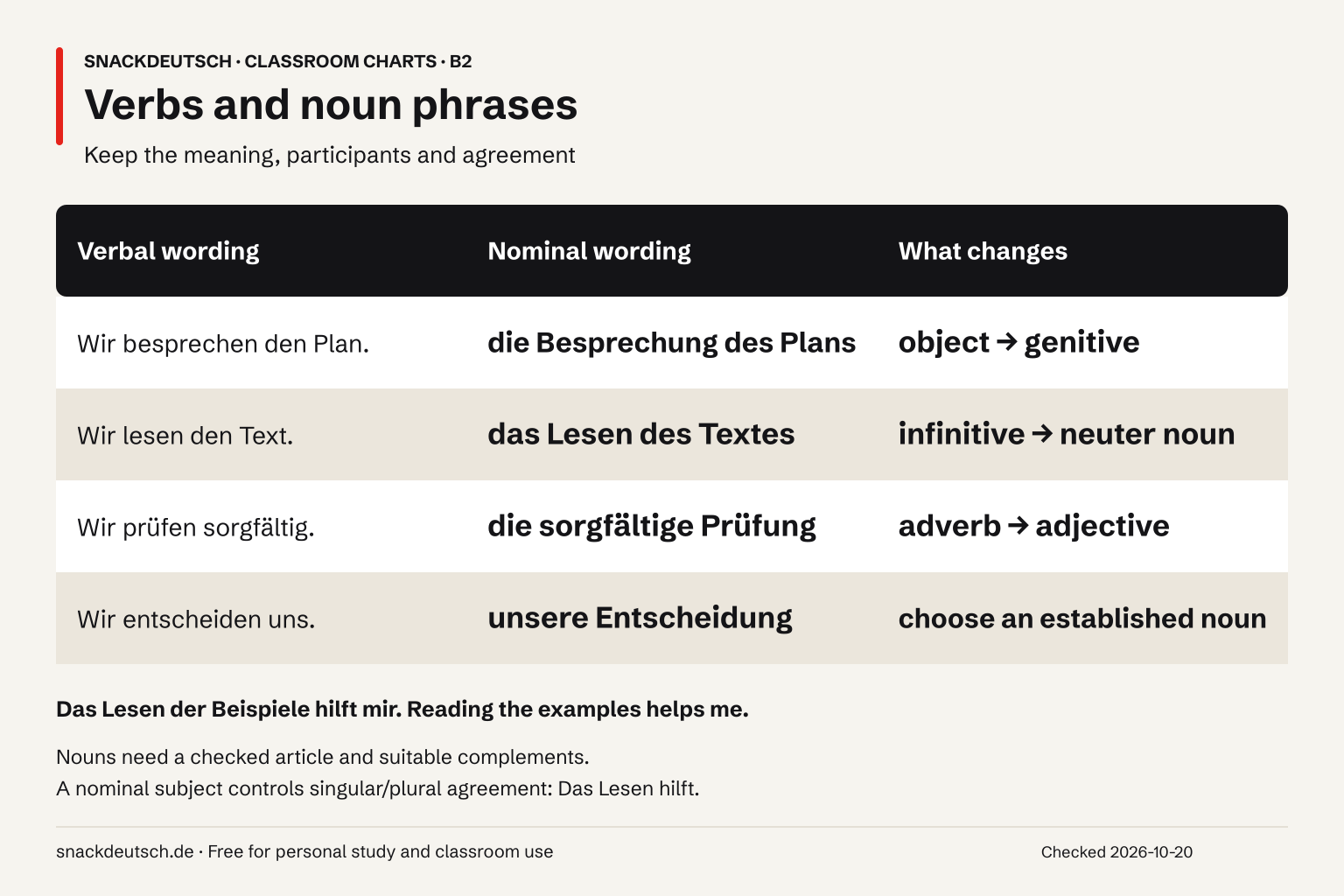
| Verbal wording | Nominal wording | What changes |
|---|---|---|
| Wir besprechen den Plan. | die Besprechung des Plans | object → genitive |
| Wir lesen den Text. | das Lesen des Textes | infinitive → neuter noun |
| Wir prüfen sorgfältig. | die sorgfältige Prüfung | adverb → adjective |
| Wir entscheiden uns. | unsere Entscheidung | choose an established noun |
Das Lesen der Beispiele hilft mir. Reading the examples helps me.
- Nouns need a checked article and suitable complements.
- A nominal subject controls singular/plural agreement: Das Lesen hilft.
The examples are teaching pairs, not a rule that every noun phrase preserves every nuance of the sentence beside it. Besprechung may refer to an event or discussion; Lesen presents the activity. A noun formed with -ung and a nominalised infinitive are different word-formation choices.
A nominalised infinitive is a noun
Wir lesen die Beispiele becomes das Lesen der Beispiele. In this clearly nominal use, Lesen is capitalized and neuter: das Lesen. An adjective receives an ending: das genaue Lesen. Compare verbal genau lesen, where genau has no adjective ending.
If the phrase is the subject, its head controls agreement: Das Lesen der Beispiele hilft mir. Beispiele is plural inside a genitive phrase, but the head Lesen is singular. Do not write Das Lesen der Beispiele helfen mir just because the nearest noun is plural.
Some bare infinitives permit more than one spelling analysis in particular constructions. This guide uses clearly nominal phrases with an article or preposition so the capital is not ambiguous. It does not invent a rule that every written infinitive must begin with a capital.
Use established derived nouns
Entscheiden → die Entscheidung, prüfen → die Prüfung and besprechen → die Besprechung are useful families. You cannot produce a natural noun for every verb by appending -ung. Check a dictionary when the noun is unfamiliar, including its article and whether it means the action, its result or something else.
Compare Wir entscheiden uns für den frühen Kurs with unsere Entscheidung für den frühen Kurs. The für phrase survives because it names the option selected. In die Prüfung des Textes, the genitive can name what is checked. Other verbs preserve a preposition: die Teilnahme am Kurs corresponds to am Kurs teilnehmen. Do not turn every complement into a genitive automatically.
Recover who acted
Die Prüfung der Unterlagen durch das Team dauerte eine Stunde identifies the activity, its object and the actor. A verbal version is Das Team prüfte die Unterlagen eine Stunde lang. The genitive der Unterlagen names what was checked, and durch das Team names who did it in this context.
A phrase such as die Unterstützung der Lehrerin can be ambiguous without context: support given by the teacher or support for the teacher. Unpacking it forces you to choose a meaning. If the source does not resolve the ambiguity, ask or preserve it explicitly rather than pretending grammar has supplied missing facts.
Choose a form for the reader
Nominal wording is useful in headings, compact summaries and some formal texts: Vorbereitung der Sitzung. A verbal sentence often makes an instruction clearer: Bitte bereiten Sie die Sitzung vor. Neither is inherently more advanced or more respectful. Use a finite verb when the reader needs to know who should act and by when.
Consider the original pair Nach der Besprechung des Plans verteilen wir die Aufgaben and Nachdem wir den Plan besprochen haben, verteilen wir die Aufgaben. Both express sequence, but the second explicitly names wir as the discussion participants. Check time and subject relationships when changing a phrase into a clause.
Practice
- Nominalise with an infinitive: Wir lesen den Text genau. Use das.
- Complete the agreement: Das Lernen neuer Wörter hilft / helfen mir.
- Verbalise: die sorgfältige Prüfung der Datei durch das Team. Write a past-tense sentence.
- Correct: das genau Lesen.
- Nominalise while preserving the preposition: Wir nehmen am Kurs teil.
- Why can die Unterstützung der Lehrerin need more context?
- Rewrite a heading as a clear instruction: Vorbereitung der Unterlagen bis Freitag. Address one person formally.
Explained answers and alternatives
- das genaue Lesen des Textes. The infinitive becomes a capitalized noun; genau becomes an attributive adjective with an ending and the object becomes genitive here.
- hilft. The head Lernen is singular. Wörter is embedded in the phrase and does not control the verb.
- Das Team prüfte die Datei sorgfältig. Perfekt Das Team hat die Datei sorgfältig geprüft is also possible. The actor and object must stay the same.
- das genaue Lesen. The adjective before a noun needs an ending in this construction.
- unsere Teilnahme am Kurs or die Teilnahme am Kurs. The an + dative relationship remains in am Kurs.
- The genitive can be interpreted as the source or recipient of support, depending on context. A verbal paraphrase must make that relationship clear.
- Bitte bereiten Sie die Unterlagen bis Freitag vor. The reader now knows the action and deadline; vorbereiten is separable in this main clause.
Sources and next practice
Duden’s nominalised-infinitive guidance supports capitalization and clear noun markers. Heidelberg University’s nominalisation rules support changes from adverb to adjective and from verbal complements to nominal attributes. All transformations and tasks here are original. Continue in the B2 learning path, or use the compound-noun guide to distinguish a different noun-building process.