
Classroom companion
German passive with werden: describe an action and its tense
Build German process-passive sentences with werden, keep tense and case clear, and distinguish worden from geworden with explained practice.
Read as Markdown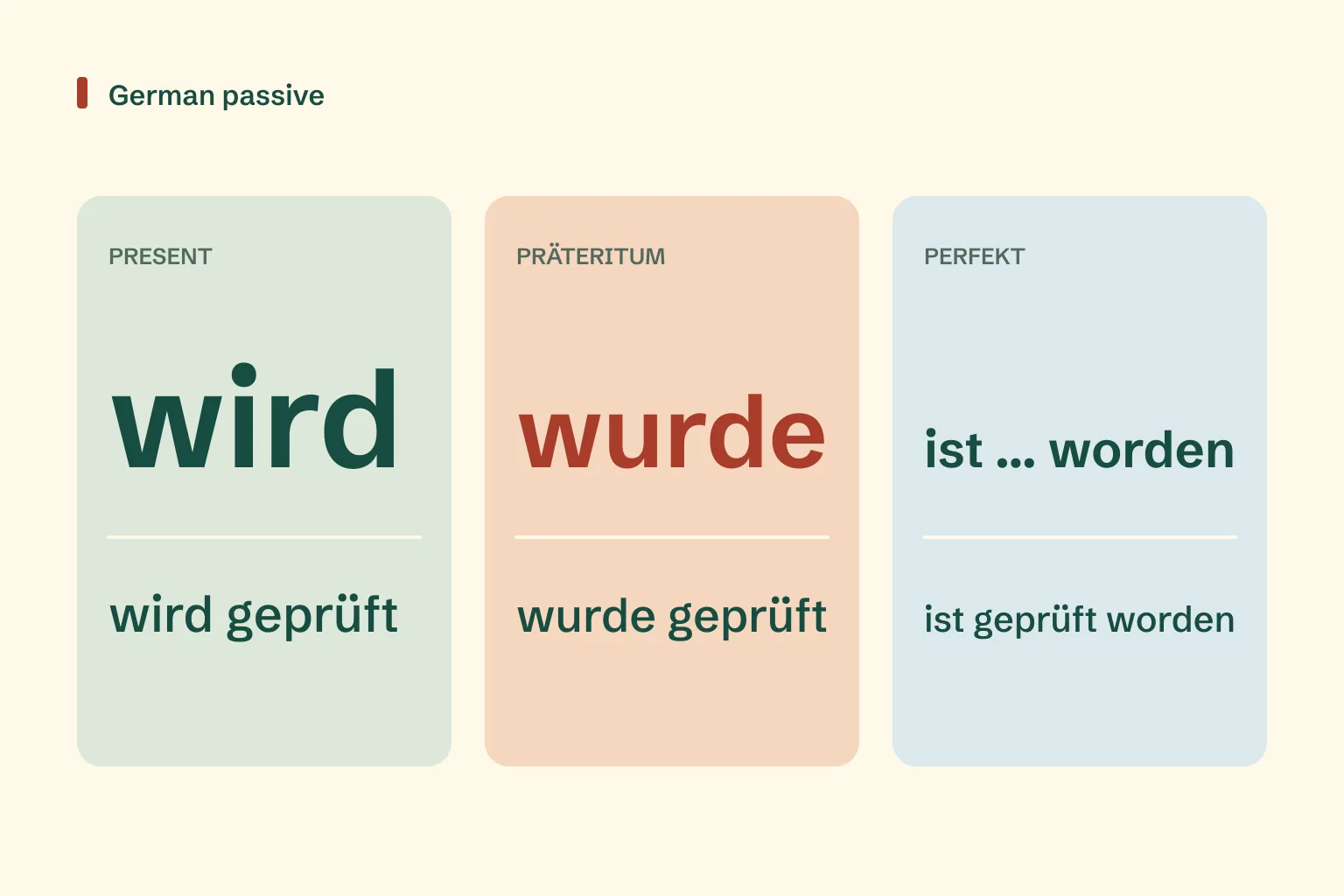
In your course project, Mara prüft den Text names who checks the text. Der Text wird geprüft focuses on the checking of the text instead. German process passive, often called Vorgangspassiv, uses a form of werden with a past participle. It is useful when the action or affected item matters more than naming the person doing it.
Takeaway: Passive voice changes perspective; it does not supply a tense by itself. Find the finite auxiliary and the complete verb group before deciding when the event happens.
One action across five tenses
German process passive
Werden + Partizip II · one action across tenses. Suggested level: B2.
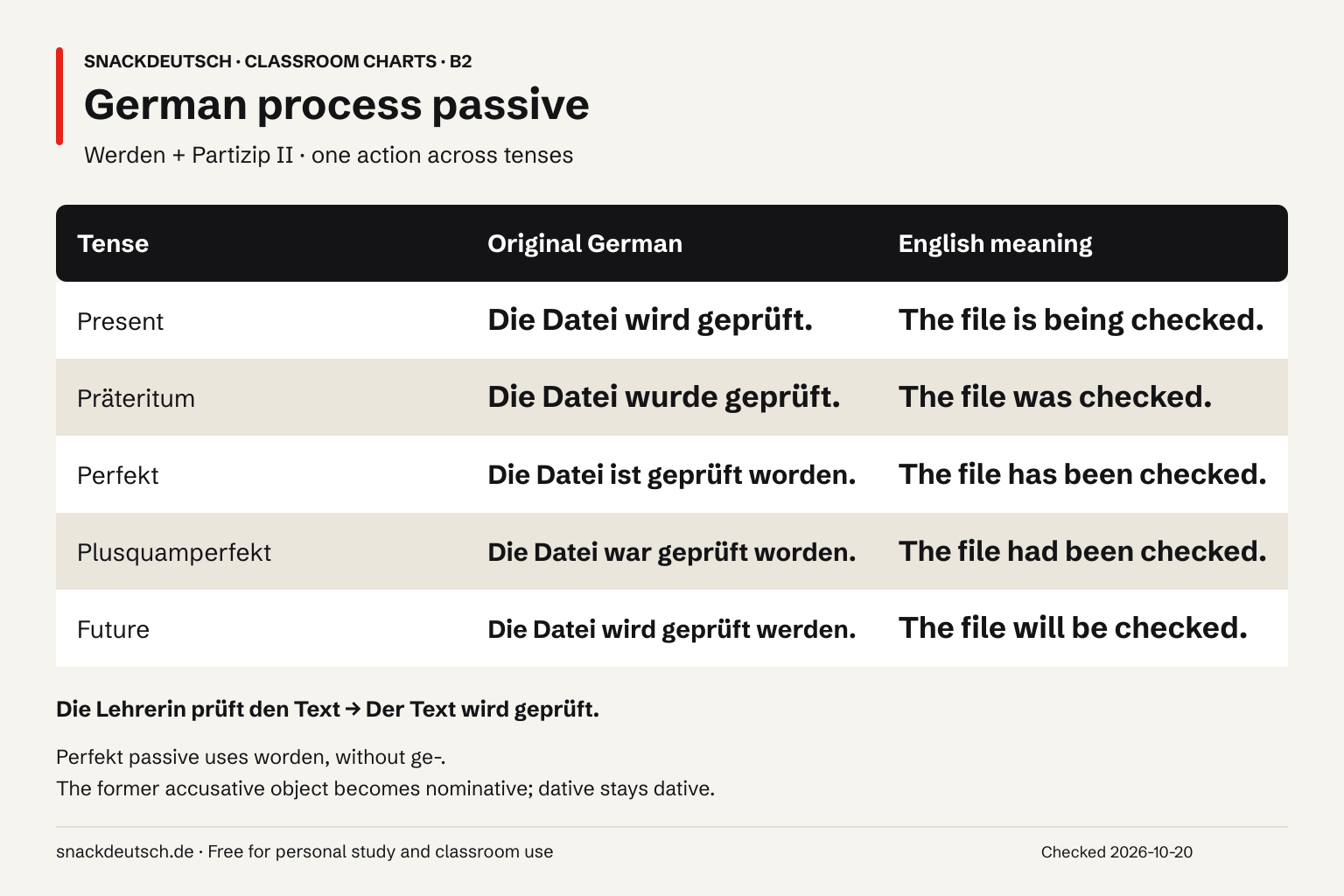
| Tense | Original German | English meaning |
|---|---|---|
| Present | Die Datei wird geprüft. | The file is being checked. |
| Präteritum | Die Datei wurde geprüft. | The file was checked. |
| Perfekt | Die Datei ist geprüft worden. | The file has been checked. |
| Plusquamperfekt | Die Datei war geprüft worden. | The file had been checked. |
| Future | Die Datei wird geprüft werden. | The file will be checked. |
Die Lehrerin prüft den Text → Der Text wird geprüft.
- Perfekt passive uses worden, without ge-.
- The former accusative object becomes nominative; dative stays dative.
These English meanings are natural starting translations rather than a claim that German and English tense choices always match word for word. The present passive can describe a process happening now or a repeated process: Die Aufgaben werden jeden Montag geprüft (The tasks are checked every Monday).
Transform a simple active sentence carefully
Start with Die Lehrerin korrigiert den Text (The teacher corrects the text).
- Identify the accusative object: den Text.
- Make it the passive subject: der Text.
- Choose the passive auxiliary for the tense: wird.
- Add the participle: korrigiert.
- If the agent matters, add von der Lehrerin.
The result is Der Text wird von der Lehrerin korrigiert. The subject der Text is singular, so wird is singular. With two texts, use Die Texte werden korrigiert. Do not let the plural noun inside an optional phrase control the verb: Der Text wird von zwei Lehrerinnen korrigiert is still singular.
What happens to a dative person?
In Die Lehrerin erklärt dem Schüler die Regel, die Regel is accusative and dem Schüler is dative. The passive becomes Die Regel wird dem Schüler erklärt. The dative remains dative; it does not turn into der Schüler merely because you changed voice.
Some verbs allow a passive without a nominative subject: Hier wird gearbeitet (Work is being done here). Dem Schüler wird geholfen keeps the dative person. These are useful warnings against “the first noun always becomes the passive subject.” This guide focuses its transformations on ordinary accusative-object examples before extending to those subjectless patterns.
Worden and geworden do different work
Die Datei ist geprüft worden contains worden, the special passive participle of werden. It forms the passive Perfekt with ist. In Der Raum ist ruhiger geworden (The room has become quieter), geworden belongs to werden meaning “become.” There is no checking action or passive participle there.
Do not write ist geprüft geworden for the passive construction taught here. Likewise, Die Datei hat geprüft worden uses the wrong auxiliary. Learn the full pair ist … worden, and change ist to sind for a plural subject.
Process is different from a resulting state
Die Tür wird geschlossen focuses on closing. Die Tür ist geschlossen describes the closed state. A past event can also be expressed as process passive: Die Tür wurde geschlossen or Die Tür ist geschlossen worden. The presence of ist somewhere in the group does not by itself prove that a sentence is a state passive.
For a real instruction, consider which voice tells the reader what to do most clearly. Bitte laden Sie die Datei hoch (Please upload the file) gives a direct action to an addressed person. Die Datei wird hochgeladen reports a process. Passive is not automatically more polite, more academic or more accurate.
Mention the agent only when useful
Von + dative is a useful agent phrase: von der Lehrerin, von unserem Team. Durch often presents a cause, means or intermediary, but the boundary depends on the construction. Do not teach a universal “von for people, durch for things” rule. In this practice, use von for the named checking person and omit it when nobody needs to know who performed the action.
Use the case reference if changing den Text to der Text is unfamiliar. The case change marks the new sentence role, not a change in the noun’s gender.
Practice
- Put into present passive: Das Team prüft die Datei.
- Change the subject to plural: Der Text wird korrigiert.
- Put into passive without changing the tense: Mara druckte den Plan.
- Complete the passive Perfekt: Die Nachricht ___ verschickt ___.
- Choose: Das Wetter ist besser worden / geworden.
- Transform: Die Lehrerin erklärt dem Schüler die Aufgabe. Keep the dative person.
- Explain why Der Brief ist geschrieben worden is not the same construction as Der Brief ist geschrieben.
Explained answers
- Die Datei wird geprüft. The former accusative object becomes a nominative singular subject. Vom Team is optional.
- Die Texte werden korrigiert. The new subject is plural and needs werden.
- Der Plan wurde gedruckt. The original was Präteritum, so keep past wurde rather than present wird.
- ist … worden. The singular passive Perfekt is Die Nachricht ist verschickt worden.
- geworden. The weather has become better; this is lexical werden, not passive worden.
- Die Aufgabe wird dem Schüler erklärt. The task becomes subject and the dative dem Schüler remains dative.
- Ist geschrieben worden presents the writing event in passive Perfekt. Ist geschrieben describes a state in a suitable context; worden is a crucial part of the first verb group.
Sources and next practice
The IDS passive reference supports voice perspective and the distinction between process and state. The University of Texas past-passive guide supports the tense patterns and worden. All examples and tasks are original. Continue in the B2 learning path.