
Classroom companion
German question words: asking for the information you need
Choose German question words by the answer you need, distinguish wo from wer, and practise questions about people, places, time and quantities.
Read as Markdown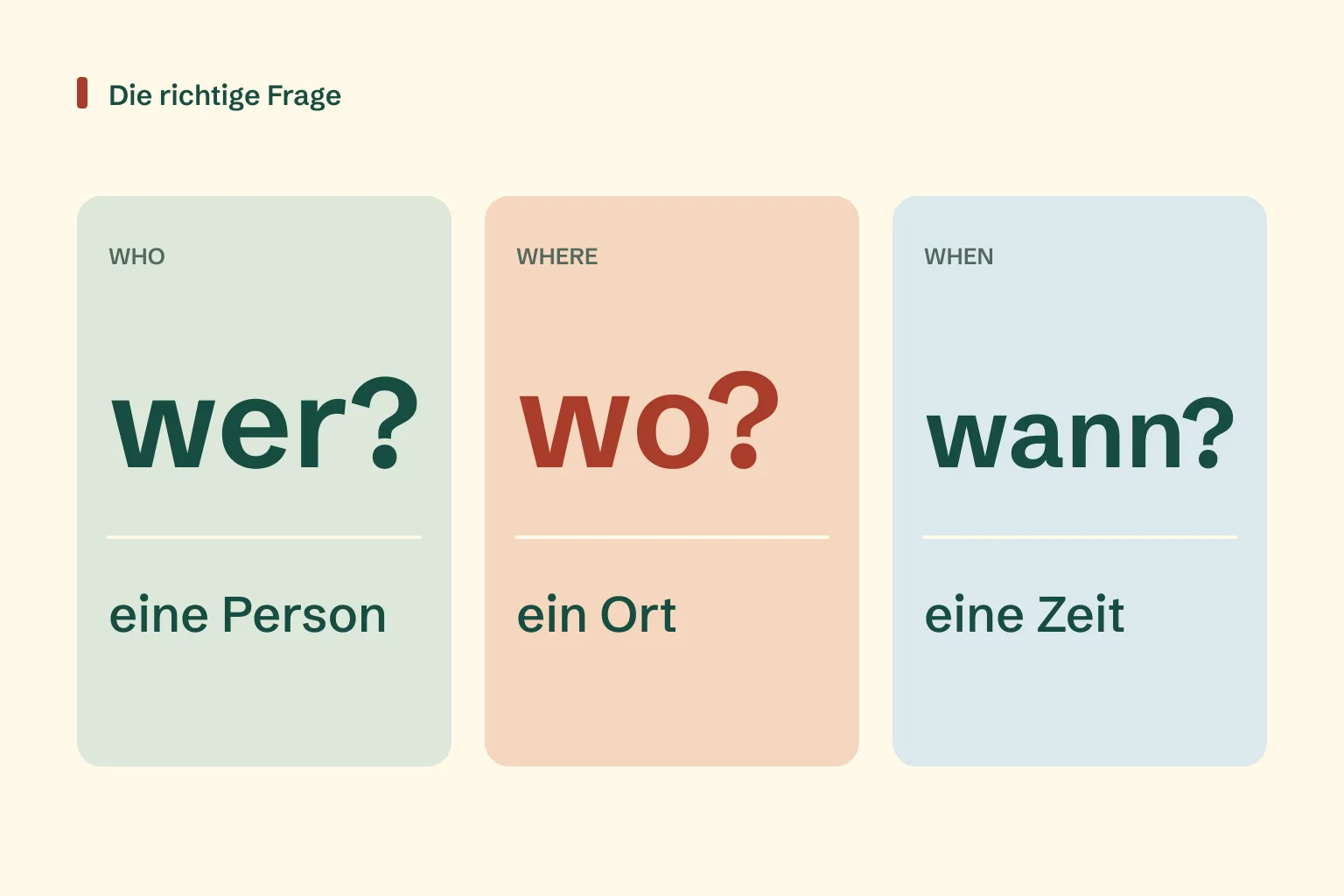
You miss one detail in the teacher’s instructions. Instead of repeating the whole sentence, choose a question word that identifies the missing information: wer for a person, wo for a location, wann for a time. Wie viele asks for the number of countable things. Thinking about the answer you need is more reliable than translating an English question word by sound.
Takeaway: Predict the type of answer before choosing the word. German wer means “who,” and wo means “where.”
German question words in useful classroom questions
German question words
Choose the information you need. Suggested level: A1.
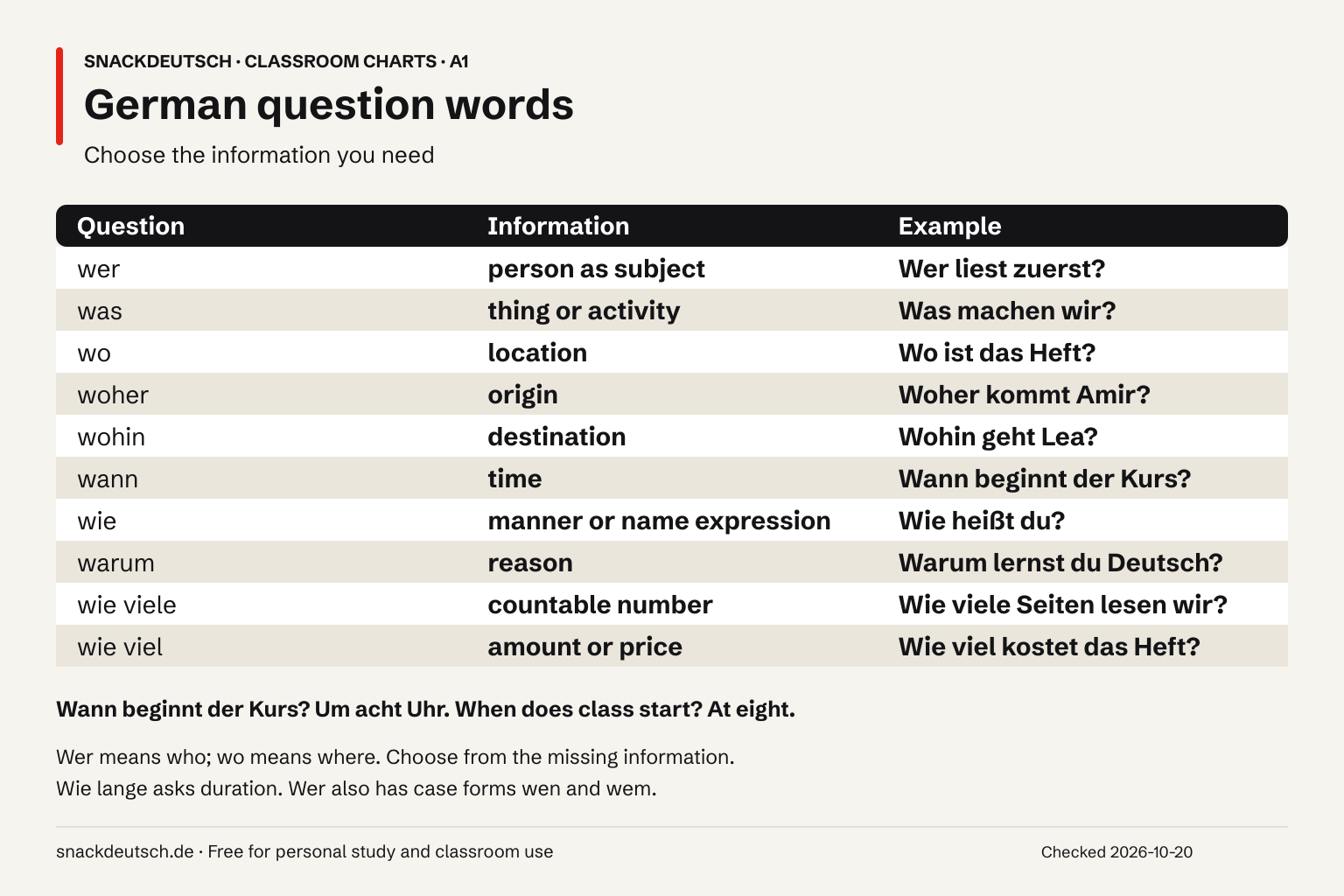
| Question | Information | Example |
|---|---|---|
| wer | person as subject | Wer liest zuerst? |
| was | thing or activity | Was machen wir? |
| wo | location | Wo ist das Heft? |
| woher | origin | Woher kommt Amir? |
| wohin | destination | Wohin geht Lea? |
| wann | time | Wann beginnt der Kurs? |
| wie | manner or name expression | Wie heißt du? |
| warum | reason | Warum lernst du Deutsch? |
| wie viele | countable number | Wie viele Seiten lesen wir? |
| wie viel | amount or price | Wie viel kostet das Heft? |
Wann beginnt der Kurs? Um acht Uhr. When does class start? At eight.
- Wer means who; wo means where. Choose from the missing information.
- Wie lange asks duration. Wer also has case forms wen and wem.
These are starting questions, not an exhaustive map of German question grammar. Wie does several jobs, which is why Wie heißt du? is best learned as a whole expression rather than translated word by word. Wie lange? asks duration: Wie lange dauert die Pause? (How long is the break?). Wann? asks when it takes place.
Location, origin and destination are different
Compare three facts about one person: Lea ist im Kursraum (Lea is in the classroom), Lea kommt aus Wien (Lea comes from Vienna), and Lea geht in die Bibliothek (Lea is going to the library). Ask wo, woher and wohin respectively. The verb kommen does not automatically require woher in every context: you can also ask Wann kommt Lea? when you want her arrival time.
The question word is chosen by the missing information, not by a fixed word-matching game. If someone answers Am Montag, they give time information. If they answer Im Raum zwei, they give a location. Hearing those answer shapes helps you notice whether your question was understood.
Keep the verb in its question position
In a simple information question, put the question phrase first and the finite verb next: Wie viele Wörter schreiben wir? (How many words are we writing?). Wie viele Wörter is one question phrase. Do not split it around the verb.
With a subject question such as Wer hilft? (Who helps?), wer already fills the subject role. You do not add another subject pronoun by default. Wer also has other case forms: Wen fragst du? (Whom are you asking?) and Wem hilfst du? (Whom are you helping?). Recognize these as a later extension rather than using wer for every reference to a person.
Turn missing notes into questions
Make a small class-information card with four gaps: teacher’s name, room, start time and number of pages. Your partner holds the completed version. Ask only for what you lack, and write each answer before asking the next question. This creates a reason to communicate and reveals whether wann and wie viele are doing different jobs in your speech.
Practise it
- Ask about the teacher in this answer: Frau Roth unterrichtet heute. Start with wer.
- Choose wo, woher or wohin for the answer Im Raum zwei.
- Ask for the start time: Der Kurs beginnt um 18 Uhr.
- Ask how many pages the class reads. Use wie viele and wir.
- Ask for the duration of a break using wie lange and die Pause.
- A learner asks Wo kommt Amir her? Is the information requested a location or an origin? Give a simpler equivalent question with woher.
Answers and reasons
- Wer unterrichtet heute? Wer is itself the subject, so there is no extra sie.
- Wo? Im Raum zwei tells us a location. Wo ist der Kurs? is a complete matching question.
- Wann beginnt der Kurs? Wann asks for the time; um 18 Uhr supplies it.
- Wie viele Seiten lesen wir? The plural Seiten identifies things being counted.
- Wie lange dauert die Pause? A duration is different from a starting time. An answer is Zehn Minuten.
- Origin. Woher kommt Amir? The separated wo … her question can also ask origin. The meaning, rather than the surface occurrence of wo alone, matters.
Use it in your next lesson
Choose two genuine gaps in your class notes and ask precise questions. Model: Wie viele Sätze schreiben wir? and Wann ist die Pause? Record the answers. For more practice distinguishing location and destination, use wo and wohin.
Sources and further reading
- UT: interrogatives: Question meanings, subject questions and the forms wer, wen and wem.
- IDS: question modes: Reference for the distinction between a yes/no question and a question asking for missing information.