
Classroom companion
Haben or sein? Build useful German Perfekt sentences
Choose haben or sein in common German Perfekt sentences. Practise classroom and everyday examples, participle placement, and a checked answer key.
Read as Markdown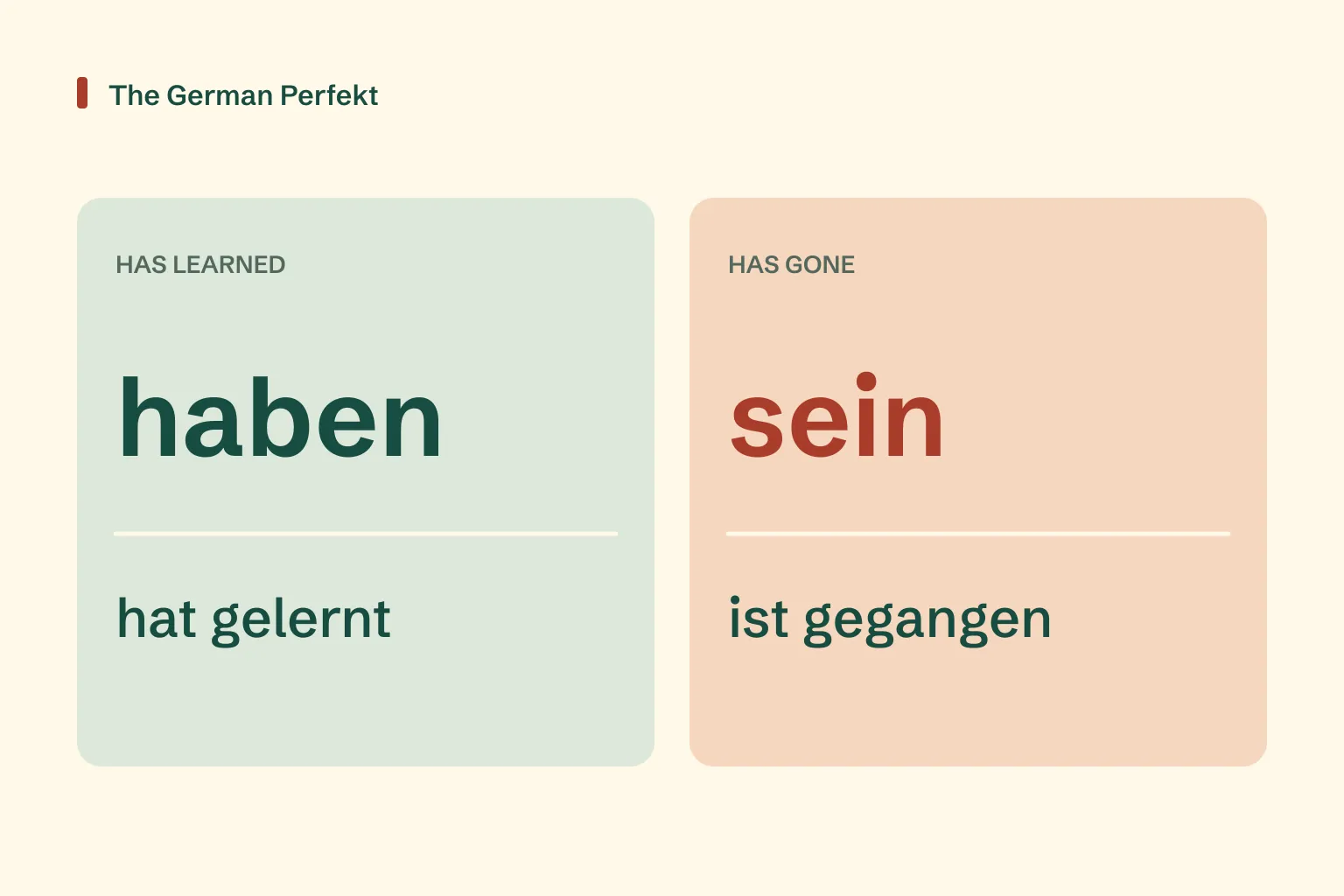
The German Perfekt combines a present-tense form of haben or sein with a past participle: Ich habe gelernt (I studied) or Ich bin gegangen: I went. Most verbs use haben. Many verbs describing a change of location or state use sein. Learn the auxiliary with the particular verb and meaning.
Save a complete past-tense phrase
Instead of recording only gehen = go, add ist gegangen and one sentence: Ich bin nach Hause gegangen: I went home. This preserves both the auxiliary and the participle.
For lernen, save hat gelernt: Ich habe gestern Deutsch gelernt: I studied German yesterday. The hat in the vocabulary entry is a conventional third-person example. You still conjugate the auxiliary for the subject in your own sentence.
| Verb | Useful stored form | Original example |
|---|---|---|
| lernen | hat gelernt | Ich habe die Wörter gelernt. |
| ausfüllen | hat ausgefüllt | Wir haben das Formular ausgefüllt. |
| gehen | ist gegangen | Sie ist nach Hause gegangen. |
| kommen | ist gekommen | Er ist zu spät gekommen. |
| bleiben | ist geblieben | Ich bin im Büro geblieben. |
| vergessen | hat vergessen | Du hast den Termin vergessen. |
Why “movement means sein” is incomplete
Gehen in the example describes a change of location, so sein is the appropriate auxiliary. But a vague idea of physical activity does not identify every verb’s auxiliary. Ich habe getanzt (I danced) uses haben. A simple slogan cannot replace learning the construction.
Bleiben uses sein even though it means to stay. Some verbs have different constructions or regional preferences, and the presence of an object can matter. For the words in your current course, check the exact meaning and sentence rather than forcing every verb into one shortcut.
At A1–A2, a small set of complete phrases is a manageable foundation. Add a new pattern when your teacher introduces it. You do not need to master every exceptional use to describe yesterday’s lesson.
Put the participle at the end
In a normal main clause, the finite auxiliary takes the verb position and the participle goes at the end: Ich habe gestern im Kurs Deutsch gesprochen. The sentence can contain several details between those two parts.
If a time phrase comes first, the finite verb still comes second: Gestern habe ich Deutsch gelernt. Count sentence elements, not individual words. Gestern Abend can occupy the first position as one time phrase.
Keep this pattern visible on your flashcard. A card that gives only gelernt may test the participle but does not help you remember the whole sentence frame.
Not every participle starts with ge-
Ausfüllen becomes ausgefüllt, with ge between the separable prefix and stem. Vergessen becomes vergessen, without an extra ge. Verbs in -ieren, such as studieren, also form their participles without ge: studiert.
These are useful patterns to notice, but irregular participles still need learning. Do not turn a single example into an automatic spelling rule for every verb you meet.
Mini practice
Choose the auxiliary and conjugate it for the subject.
- Ich ___ Deutsch gelernt.
- Wir ___ nach Hause gegangen.
- Sie (she) ___ ein Formular ausgefüllt.
- Du ___ zu spät gekommen.
- Er ___ im Büro geblieben.
- Ihr ___ den Termin vergessen.
Answers
- habe: lernen uses haben.
- sind: gehen here describes a change of location.
- hat: ausfüllen uses haben.
- bist: kommen uses sein here.
- ist: learn ist geblieben as a complete form.
- habt: vergessen uses haben.
Sources and further reading
See Grimm Grammar: introduction to the Perfekt. For the present-tense contrast, practise separable verbs. Then write three true sentences about your last German lesson.