
Free resources
Polite German requests with könnte and würde
Make clear German requests with könnte, würde and hätte gern, choose du or Sie, and practise responses without overcomplicated grammar.
Read as Markdown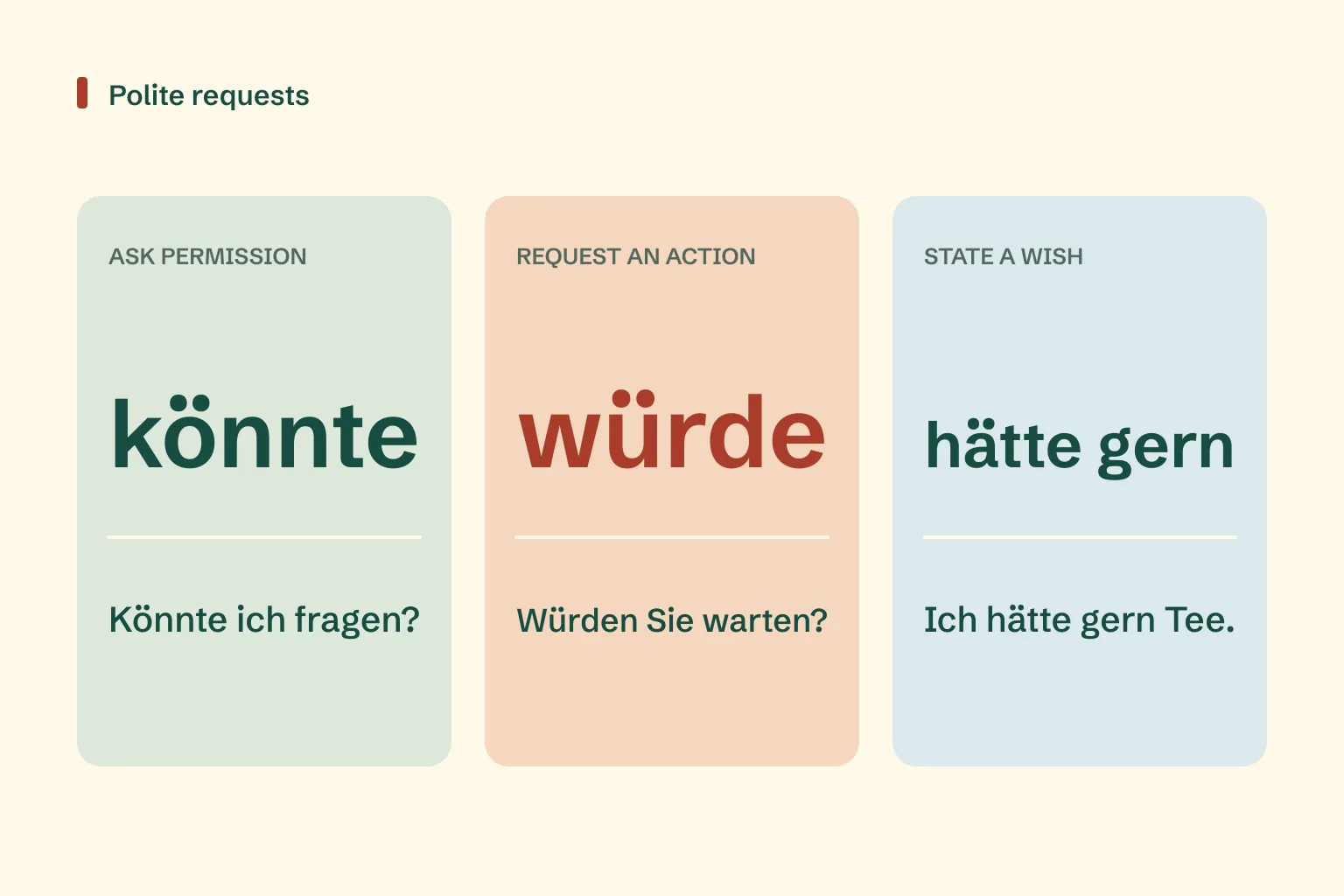
You missed the teacher’s last sentence. Könnten Sie das bitte wiederholen? makes a clear, courteous request: “Could you repeat that, please?” You do not need the entire Konjunktiv II system to start using this sentence. Learn a few accurate frames, then replace only the action or object you need.
Takeaway: Könnte ich …? asks about something you want to do. Könnten Sie …? asks the other person to do something. Keep the roles clear.
Six useful patterns
Polite classroom requests
Könnte, würde and hätte gern · selected useful frames. Suggested level: A2.
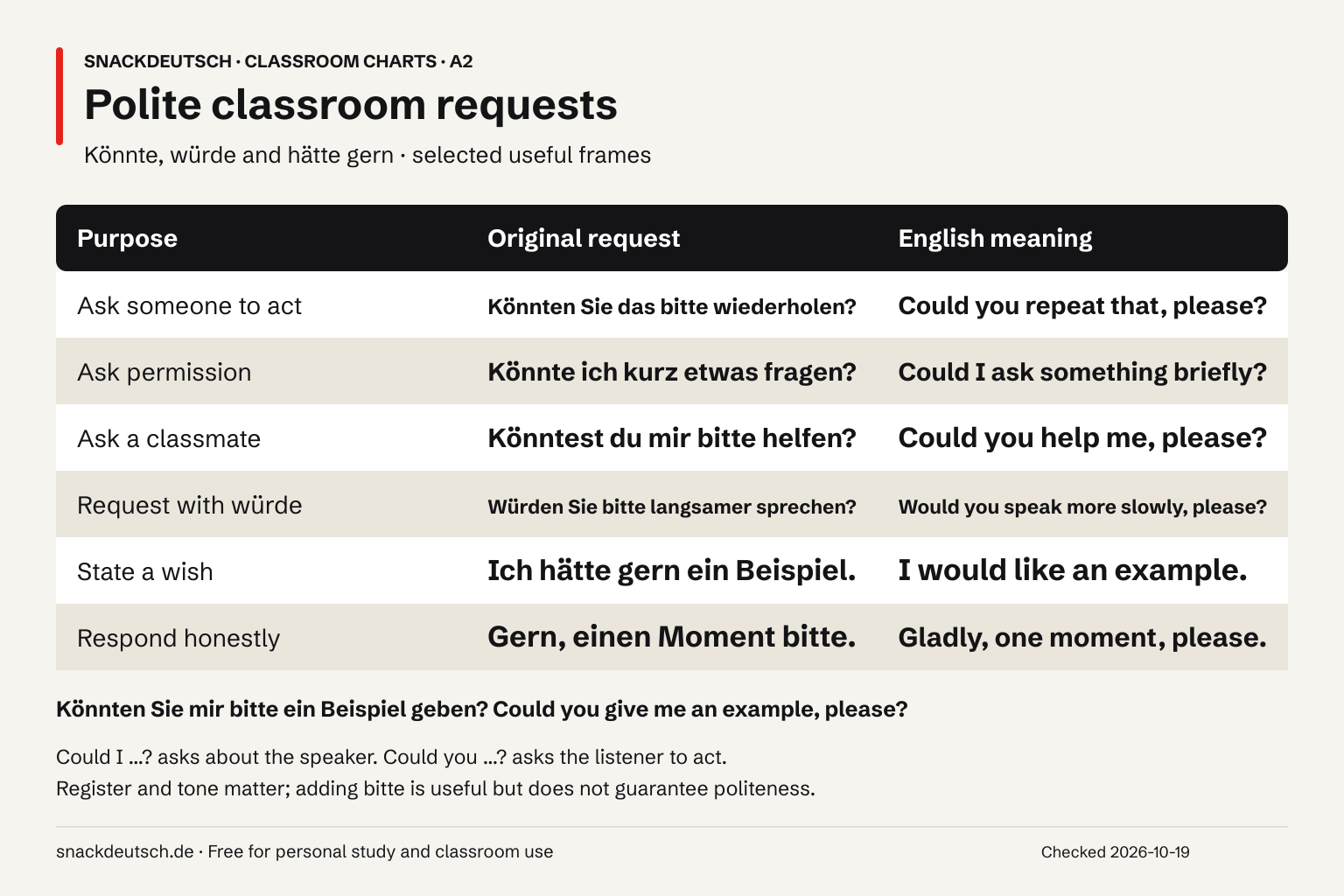
| Purpose | Original request | English meaning |
|---|---|---|
| Ask someone to act | Könnten Sie das bitte wiederholen? | Could you repeat that, please? |
| Ask permission | Könnte ich kurz etwas fragen? | Could I ask something briefly? |
| Ask a classmate | Könntest du mir bitte helfen? | Could you help me, please? |
| Request with würde | Würden Sie bitte langsamer sprechen? | Would you speak more slowly, please? |
| State a wish | Ich hätte gern ein Beispiel. | I would like an example. |
| Respond honestly | Gern, einen Moment bitte. | Gladly, one moment, please. |
Könnten Sie mir bitte ein Beispiel geben? Could you give me an example, please?
- Could I …? asks about the speaker. Could you …? asks the listener to act.
- Register and tone matter; adding bitte is useful but does not guarantee politeness.
These forms belong to Konjunktiv II. In these examples they soften a present request; they do not describe a past event. A textbook may introduce them before hypothetical situations because their everyday function is immediately useful.
Choose the person and the relationship
With a classmate you already address as du, ask Könntest du mir bitte den Satz zeigen? (Could you show me the sentence, please?). With a person you address formally, use Könnten Sie mir bitte den Satz zeigen? The verb and pronoun change together.
For a group of friends: Könntet ihr bitte kurz warten? For a formal group, Sie still uses könnten. Do not infer the correct address from age alone. Follow the relationship and the address agreed in your course or workplace.
| Person | können, request form | würde form |
|---|---|---|
| ich | könnte | würde |
| du | könntest | würdest |
| er/sie/es | könnte | würde |
| wir | könnten | würden |
| ihr | könntet | würdet |
| sie/Sie | könnten | würden |
Keep the infinitive at the end
Könnten Sie bitte langsamer sprechen? has finite könnten at the beginning and sprechen at the end. Würden Sie bitte langsamer sprechen? uses the same broad frame with würden. Neither needs zu before that final infinitive.
For a concrete classroom request, one of these is enough. Do not pile forms together as Würden Sie könnten …. You are not making the request more polite by adding two competing finite frames.
Ich hätte gern ein Beispiel works differently. It has a noun phrase, ein Beispiel, rather than a final infinitive. Hätte gern is useful for “would like to have”; ich möchte ein Beispiel sehen says “I would like to see an example” and includes the action sehen.
Respond without promising what you cannot do
A request opens a conversation. You can answer Ja, gern (Yes, gladly), Einen Moment bitte (One moment, please), or Tut mir leid, ich kann gerade nicht (Sorry, I cannot right now). A polite request does not oblige the listener to say yes.
If your partner is busy, offer another time: Könnten wir nach der Stunde darüber sprechen? (Could we talk about it after the lesson?). That is more useful than repeating the same request louder. Tone, timing and the size of the request matter alongside grammar.
Practise with a real class note
Pick a sentence you genuinely did not understand. Ask your partner to repeat it, then ask for one example. Your partner should sometimes accept and sometimes delay the request so you practise listening to the response. Use the personal-pronoun chart to check mir in mir helfen and Ihnen in a formal reply.
Practice
- Ask your teacher formally to repeat the word, using könnte.
- Ask permission for yourself to ask a question.
- Change to du: Würden Sie bitte kurz warten?
- Correct: Könnten Sie bitte zu helfen? Make a complete request for help for yourself.
- Ask for an example using hätte gern.
- A classmate asks for help while you are busy. Write a courteous delay with a specific later time.
- Does könnten make these requests past-tense questions? Explain.
Model answers and reasons
- Könnten Sie das Wort bitte wiederholen? Formal Sie takes könnten, and wiederholen closes the question.
- Könnte ich bitte eine Frage stellen? The speaker is asking to act, so ich/könnte fits. Könnte ich kurz etwas fragen? is another natural version.
- Würdest du bitte kurz warten? Both the verb and address change; warten stays infinitive.
- Könnten Sie mir bitte helfen? The modal takes a bare infinitive and helfen takes dative mir.
- Ich hätte gern ein Beispiel. The noun phrase follows hätte gern. Ich möchte ein Beispiel sehen is a different valid frame.
- Tut mir leid, gerade kann ich nicht. Können wir um vier zusammen üben? Other real, clear times are possible. The reply acknowledges the request and proposes an alternative.
- No. These Konjunktiv II forms express a softened present request in this context.
Source and next step
The Leibniz Institute for the German Language reference describes Konjunktiv II politeness. The examples here are original practice, not a guarantee about how every listener will judge a request. Choose the next lesson in the A2 path.
The IDS Konjunktiv II terminology reference clarifies the relationship of the synthetic forms to würde constructions; this lesson teaches only their request use.