
Free resources
German irregular verbs: a small reference for class and stories
Check twenty German irregular verb families in the present, Präteritum and Perfekt, then practise a small active set with explained answers.
Read as Markdown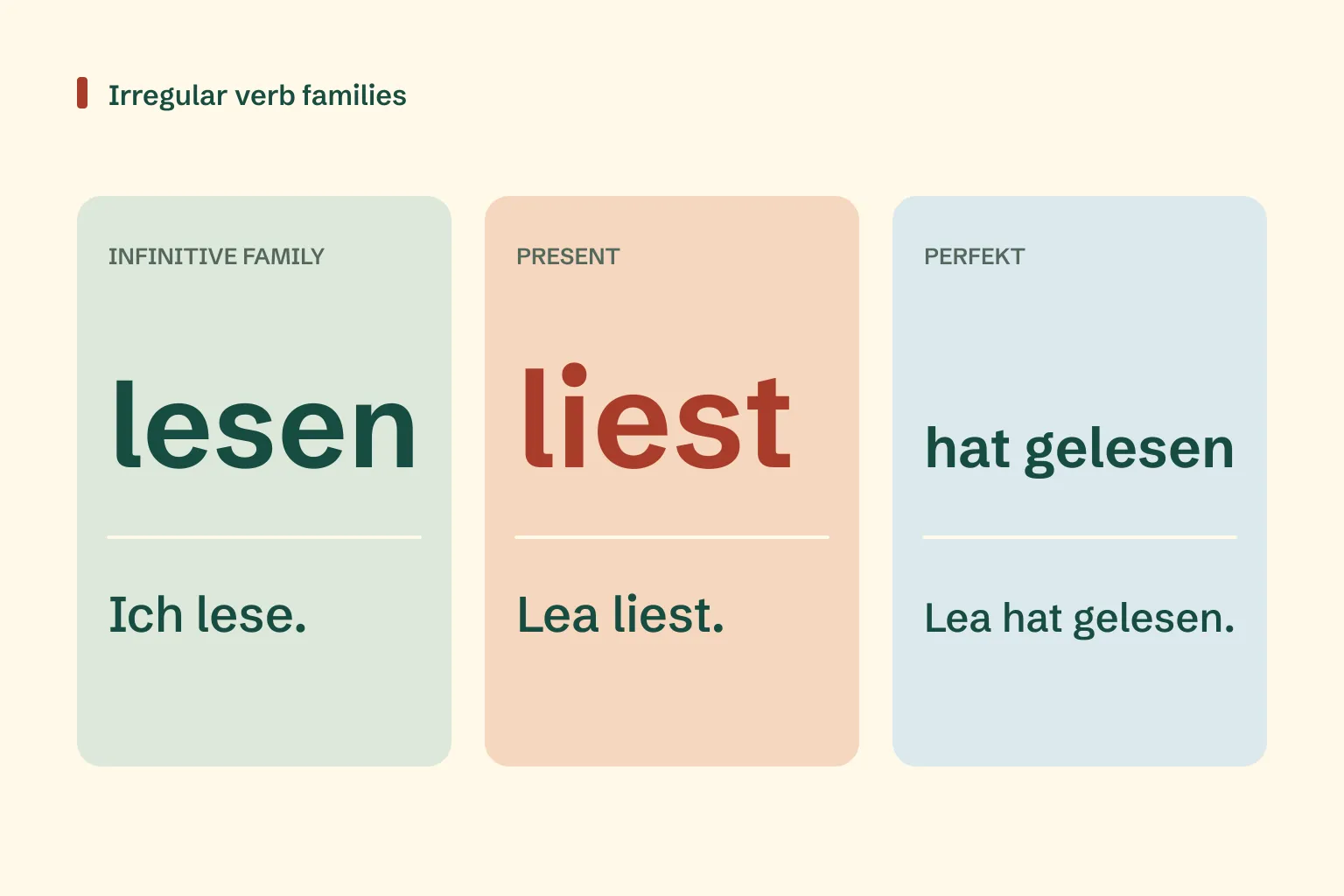
In class you say Ich lese, but your partner says Sie liest. Later you describe yesterday: Ich habe gelesen. Those three forms belong together. A useful irregular-verb card records the infinitive, a revealing present form and the Perfekt with its auxiliary. This selected reference gives you twenty useful verb families, including strong and mixed verbs; it does not cover every irregular German verb.
Takeaway: Learn lesen, sie liest, hat gelesen as a family. A changed vowel in one tense does not tell you every other form automatically.
Twenty families in two manageable reference tables
Both present and Präteritum columns show er/sie/es forms. The Perfekt column includes its auxiliary.
Irregular verb families 1
er/sie/es forms · present, Präteritum and Perfekt. Suggested level: A2.
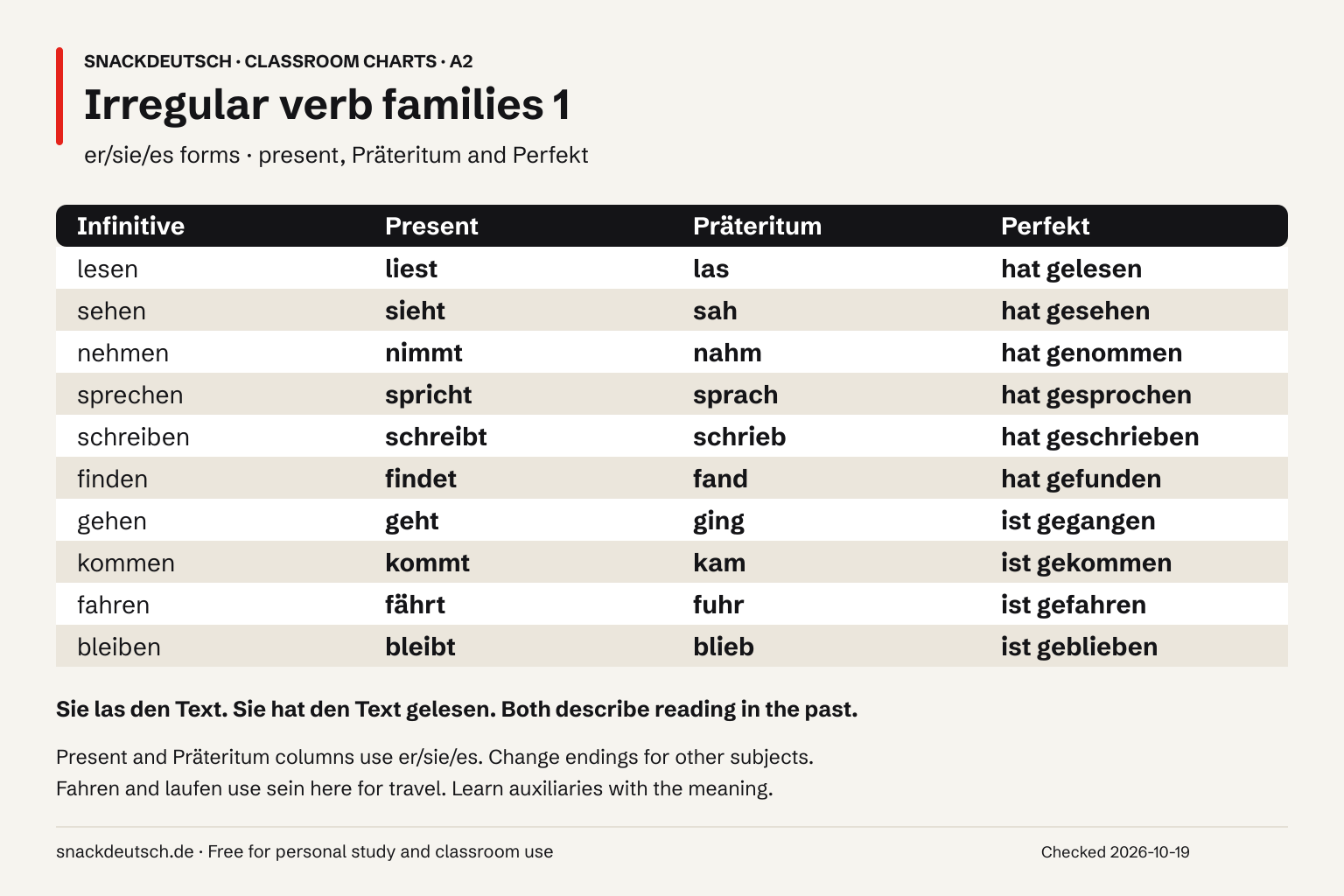
| Infinitive | Present | Präteritum | Perfekt |
|---|---|---|---|
| lesen | liest | las | hat gelesen |
| sehen | sieht | sah | hat gesehen |
| nehmen | nimmt | nahm | hat genommen |
| sprechen | spricht | sprach | hat gesprochen |
| schreiben | schreibt | schrieb | hat geschrieben |
| finden | findet | fand | hat gefunden |
| gehen | geht | ging | ist gegangen |
| kommen | kommt | kam | ist gekommen |
| fahren | fährt | fuhr | ist gefahren |
| bleiben | bleibt | blieb | ist geblieben |
Sie las den Text. Sie hat den Text gelesen. Both describe reading in the past.
- Present and Präteritum columns use er/sie/es. Change endings for other subjects.
- Fahren and laufen use sein here for travel. Learn auxiliaries with the meaning.
Irregular verb families 2
er/sie/es forms · present, Präteritum and Perfekt. Suggested level: A2.
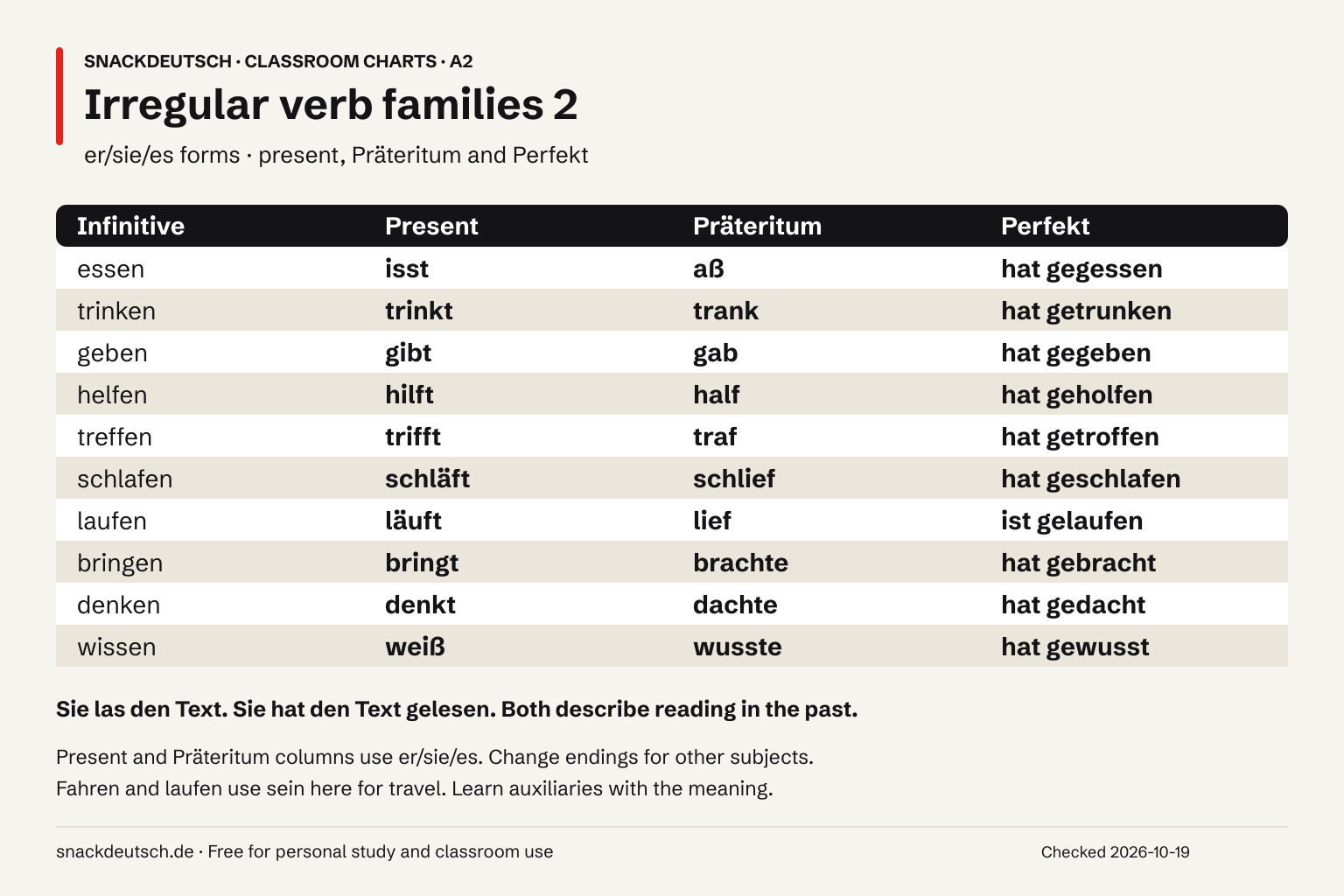
| Infinitive | Present | Präteritum | Perfekt |
|---|---|---|---|
| essen | isst | aß | hat gegessen |
| trinken | trinkt | trank | hat getrunken |
| geben | gibt | gab | hat gegeben |
| helfen | hilft | half | hat geholfen |
| treffen | trifft | traf | hat getroffen |
| schlafen | schläft | schlief | hat geschlafen |
| laufen | läuft | lief | ist gelaufen |
| bringen | bringt | brachte | hat gebracht |
| denken | denkt | dachte | hat gedacht |
| wissen | weiß | wusste | hat gewusst |
Sie las den Text. Sie hat den Text gelesen. Both describe reading in the past.
- Present and Präteritum columns use er/sie/es. Change endings for other subjects.
- Fahren and laufen use sein here for travel. Learn auxiliaries with the meaning.
The present column uses er/sie/es. It is not an infinitive and not a form for every subject. Write du liest but wir lesen; write er nimmt but ihr nehmt. The forms du fährst and er fährt have the umlaut, while wir fahren does not.
Build a complete Perfekt sentence
The reference’s hat gelesen contains a third-person auxiliary. Change the auxiliary to match your subject:
- Ich habe den Text gelesen. I read the text.
- Wir haben die Aufgabe gefunden. We found the task.
- Lea ist nach Hause gegangen. Lea went home.
- Wir sind im Kurs geblieben. We stayed in the class.
The auxiliary is finite and agrees with the subject. The participle normally closes these simple main clauses. With a time phrase first: Gestern habe ich den Text gelesen. Gestern occupies one sentence position; it does not push habe to third position.
Do not combine an auxiliary with a second present-tense verb: Ich habe lese is not the Perfekt of lesen. Use the participle gelesen. Similarly, ich bin gehe must become ich bin gegangen.
Why you should record haben or sein
The selected haben verbs describe actions with their ordinary objects here, such as reading a text or finding a key. Gehen, kommen and fahren use sein in the travel senses shown. Bleiben also uses sein, although it does not describe changing location. “All movement takes sein” is therefore too rough as a complete rule.
The meaning and construction matter. Ich bin nach Hause gefahren describes travelling home. In Ich habe den Wagen in die Garage gefahren (I drove the car into the garage), fahren is transitive and haben is possible. The chart is scoped to the travel pattern so that its short row does not pretend to settle every use.
Spot spelling that does not follow one formula
Compare geschrieben, gefunden and genommen. You cannot predict them by adding ge- and -t to the infinitive. Write the complete participle and practise it in a short event, such as Ich habe meine Notizen gefunden (I found my notes).
You will also meet the Präteritum forms las, sah and ging in stories. They are not extra Perfekt auxiliaries. Sie las den Text and Sie hat den Text gelesen both describe past reading, using different tense constructions. This reference gives the third-person singular simple past, not its full paradigm: compare er ging with wir gingen.
The final three rows are mixed verbs: bringen → brachte → gebracht, denken → dachte → gedacht, wissen → wusste → gewusst. They change the stem but use -te in the simple past and -t in the participle. Keep the twenty families as a reference while choosing only five for active speaking practice. Do not try to memorize every column in one sitting.
A five-minute retrieval task
Cover the Perfekt column and use five cues: read the text, take the bus, find the key, come home, stay at home. Say a whole sentence about yesterday, then uncover the row. Check both parts: the correct auxiliary and the correct participle. A correct participle beside the wrong auxiliary still needs attention.
Practice
- Complete the present: Lea ___ den Text (lesen).
- Complete the present: Wir ___ den Bus (nehmen).
- Build the Perfekt: ich / den Schlüssel / finden.
- Build the Perfekt: wir / nach Hause / kommen.
- Correct: Gestern ich habe geschrieben.
- Choose for this travel meaning: Sie hat / ist nach Berlin gefahren.
- Explain why bleiben is a useful counterexample to “only movement uses sein.”
Explained answers
- liest. Third-person singular lesen changes its stem vowel.
- nehmen. The wir form retains the infinitive-like stem; nimmt belongs to er/sie/es.
- Ich habe den Schlüssel gefunden. The subject requires habe, and the participle is gefunden.
- Wir sind nach Hause gekommen. Wir takes sind and this use of kommen uses sein.
- Gestern habe ich geschrieben. The time phrase is first and the finite auxiliary takes second position.
- ist. The sentence describes travelling to Berlin. This answer does not cover every transitive use of fahren.
- Bleiben uses sein in Perfekt even when someone stays in one place: Ich bin hier geblieben.
Sources and next practice
The University of Texas irregular Perfekt with haben and with sein support these selected families and auxiliary patterns. Continue in the A2 path, using only five verbs until you can retrieve both parts reliably.
The UT irregular Präteritum reference, mixed Präteritum reference and mixed Perfekt reference support the added simple-past column and final mixed-verb families.