
Classroom companion
Mein, dein and ihr: choosing German possessive articles
Choose a German possessive article from the owner, then add the noun’s ending. Practise mein, dein, sein, ihr and formal Ihr in clear classroom examples.
Read as Markdown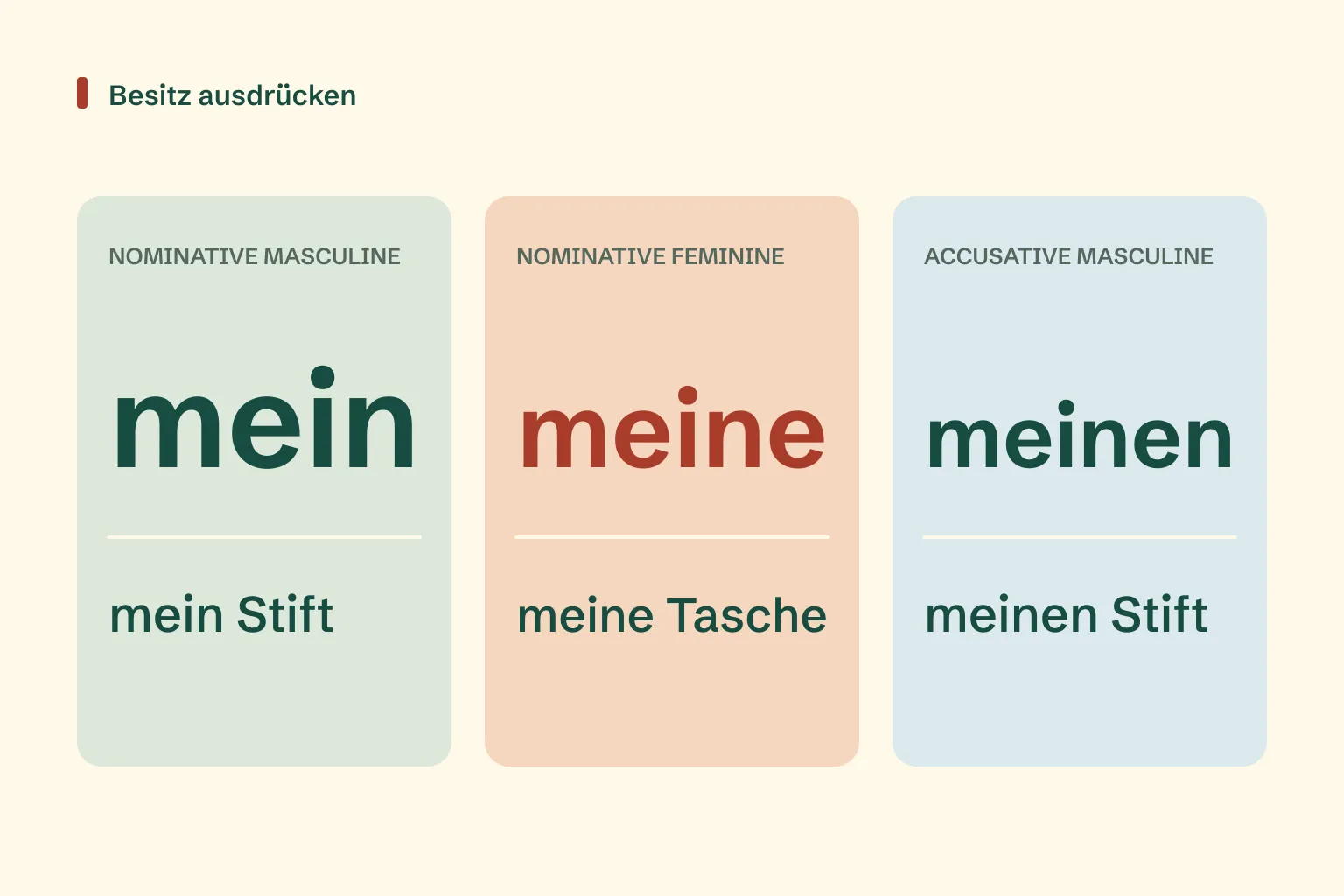
Your teacher holds up a notebook and asks who owns it. To say mein Heft (my notebook) or ihre Tasche (her bag), make two decisions: identify the owner, then choose the ending for the noun’s gender, number and case. The owner chooses mein-, dein-, sein-, ihr- and similar stems. The thing owned determines how that stem is inflected.
Takeaway: In ihre Tasche, ihr- can identify a female owner, while -e fits feminine Tasche in this nominative example. The bag’s gender does not tell you the owner’s gender.
Choose the owner first
German possessive stems
Step 1 · identify the owner. Suggested level: A1.
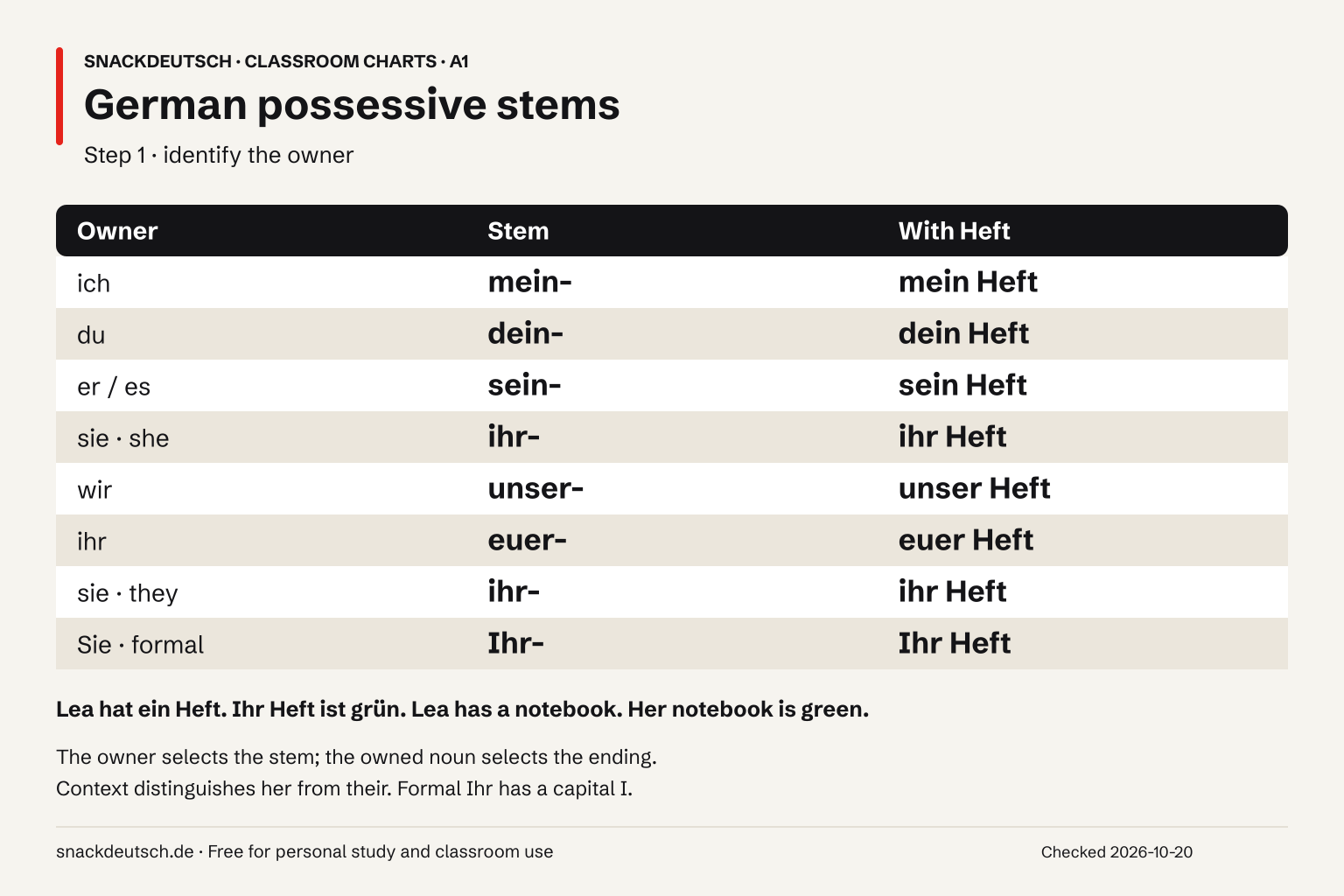
| Owner | Stem | With Heft |
|---|---|---|
| ich | mein- | mein Heft |
| du | dein- | dein Heft |
| er / es | sein- | sein Heft |
| sie · she | ihr- | ihr Heft |
| wir | unser- | unser Heft |
| ihr | euer- | euer Heft |
| sie · they | ihr- | ihr Heft |
| Sie · formal | Ihr- | Ihr Heft |
Lea hat ein Heft. Ihr Heft ist grün. Lea has a notebook. Her notebook is green.
- The owner selects the stem; the owned noun selects the ending.
- Context distinguishes her from their. Formal Ihr has a capital I.
Possessive article endings
Step 2 · noun gender, number and case. Suggested level: A1.
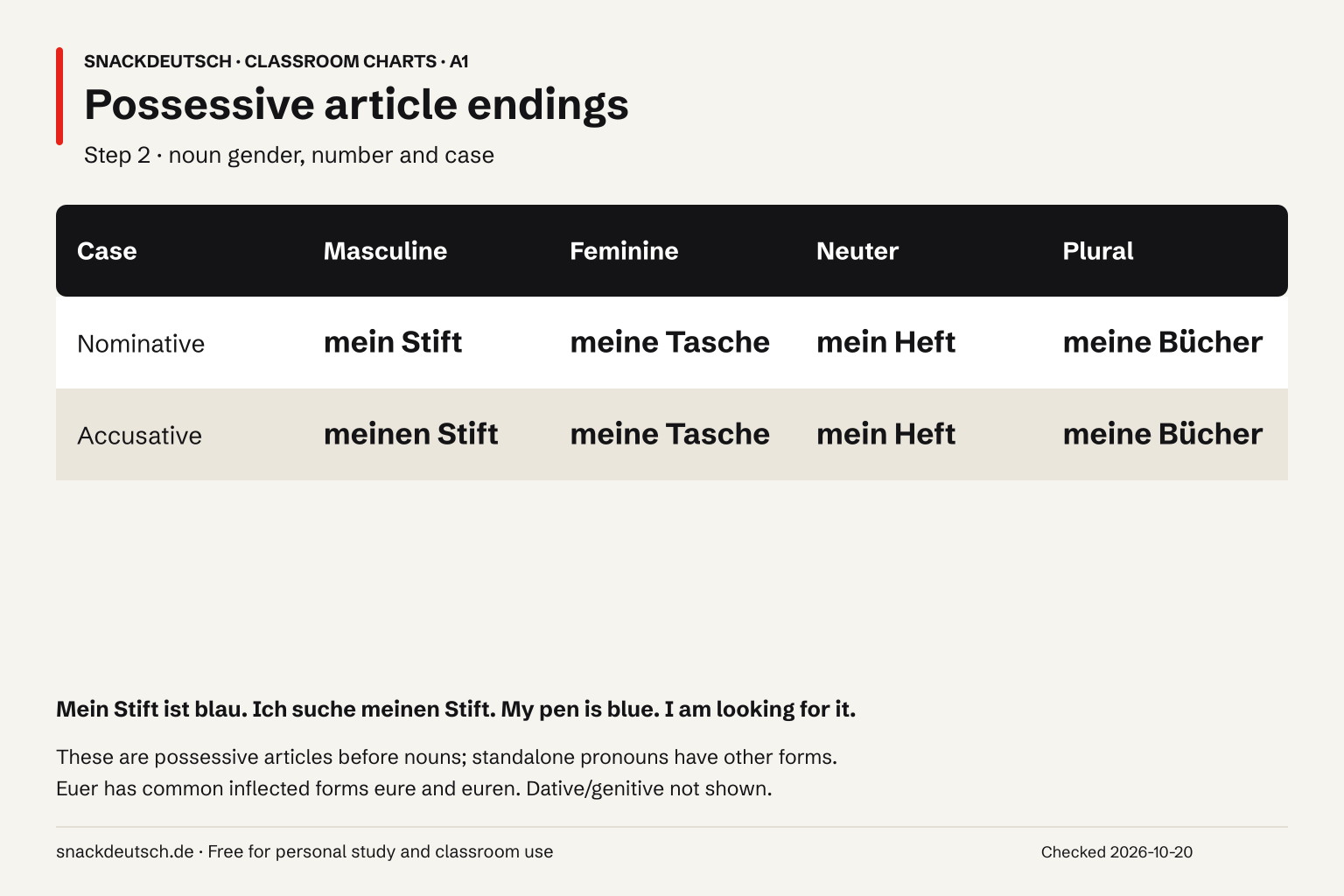
| Case | Masculine | Feminine | Neuter | Plural |
|---|---|---|---|---|
| Nominative | mein Stift | meine Tasche | mein Heft | meine Bücher |
| Accusative | meinen Stift | meine Tasche | mein Heft | meine Bücher |
Mein Stift ist blau. Ich suche meinen Stift. My pen is blue. I am looking for it.
- These are possessive articles before nouns; standalone pronouns have other forms.
- Euer has common inflected forms eure and euren. Dative/genitive not shown.
Context distinguishes her from their because the stem ihr- is shared. Formal Ihr- starts with a capital letter. Do not confuse possessive ihr Heft with personal-pronoun ihr in a sentence such as Ich helfe ihr (I help her). This lesson covers possessives placed before a noun, not possessive pronouns standing alone.
How the noun changes the ending
Mein Stift ist blau means “My pen is blue.” Mein Stift is the subject. Ich suche meinen Stift means “I am looking for my pen.” The masculine object takes meinen. The pen still belongs to the same person and is still masculine. Case changes the ending, not the owner or the noun’s gender.
Use the same pattern with other stems: deine Tasche, seinen Stift, unsere Bücher. With euer-, the internal e is commonly dropped when an ending is attached: eure Tasche, euren Stift. Do not create euer-e Tasche as a two-word expression. This compact chart covers nominative and accusative only. Dative and genitive forms need their own case check.
Follow the owner through a classroom example
Lea hat ein Heft. Ihr Heft ist grün. Lea has a notebook. Her notebook is green. Now change only the owner: Omar hat ein Heft. Sein Heft ist grün. Omar has a notebook. His notebook is green. Heft stays neuter in both sentences; ihr- changes to sein- because the owner changes.
Then change the item, keeping Lea as owner: Ihre Tasche ist grün (Her bag is green). The stem remains ihr-, but Tasche requires -e in this subject phrase. Separating these changes is more useful than guessing from a final letter.
A notebook method for possession
Draw two boxes labelled owner and noun role. For Ich suche Leas Stift, write Lea → ihr- in the first and masculine accusative → -en in the second. The result is Ich suche ihren Stift (I am looking for her pen). Practise with classroom objects before expanding to an entire family description.
Practise it
- Replace Leas Heft with a possessive: ___ Heft ist grün.
- Replace Omars Stift: Ich suche ___ Stift.
- Complete for wir: ___ Bücher sind hier.
- Use euer- before feminine Tasche in a subject phrase: ___ Tasche ist blau.
- Politely ask a teacher: “Is this your notebook?” Use formal Ihr and Heft.
- Explain what changes between mein Stift and meinen Stift. Give one complete sentence for each.
Answers and reasons
- Ihr Heft ist grün. Lea supplies ihr-; Heft needs no ending in this nominative form. Ihr is capitalized here because it starts the sentence.
- Ich suche seinen Stift. Omar supplies sein-. The masculine accusative object takes -en.
- Unsere Bücher sind hier. Wir gives unser-, and the plural subject takes -e.
- Eure Tasche ist blau. The form practised here is eure. Euere also occurs; the shorter form is common, rather than obligatory in every use.
- Ist das Ihr Heft? Formal Ihr remains capitalized inside the sentence.
- Mein Stift ist blau. Ich suche meinen Stift. The grammatical role changes from subject to accusative object; ownership and masculine gender remain the same.
Use it in your next lesson
Use two possessions in your class notes. Label the owner and grammatical role separately before writing. Model: Das ist meine Tasche. Ich suche meinen Schlüssel (That is my bag. I am looking for my key). Check noun gender with the noun article guide, rather than assigning an ending from the owner alone.
Sources and further reading
- UT: possessives in nominative: Possessive stems and agreement before a noun.
- UT: possessives in accusative: Accusative endings and owner versus owned item.