
Classroom companion
Describe a room in German: an A2 vocabulary and writing lesson
Describe a room in German using es gibt, useful furniture nouns and clear location phrases, then write and check your own A2 description.
Read as Markdown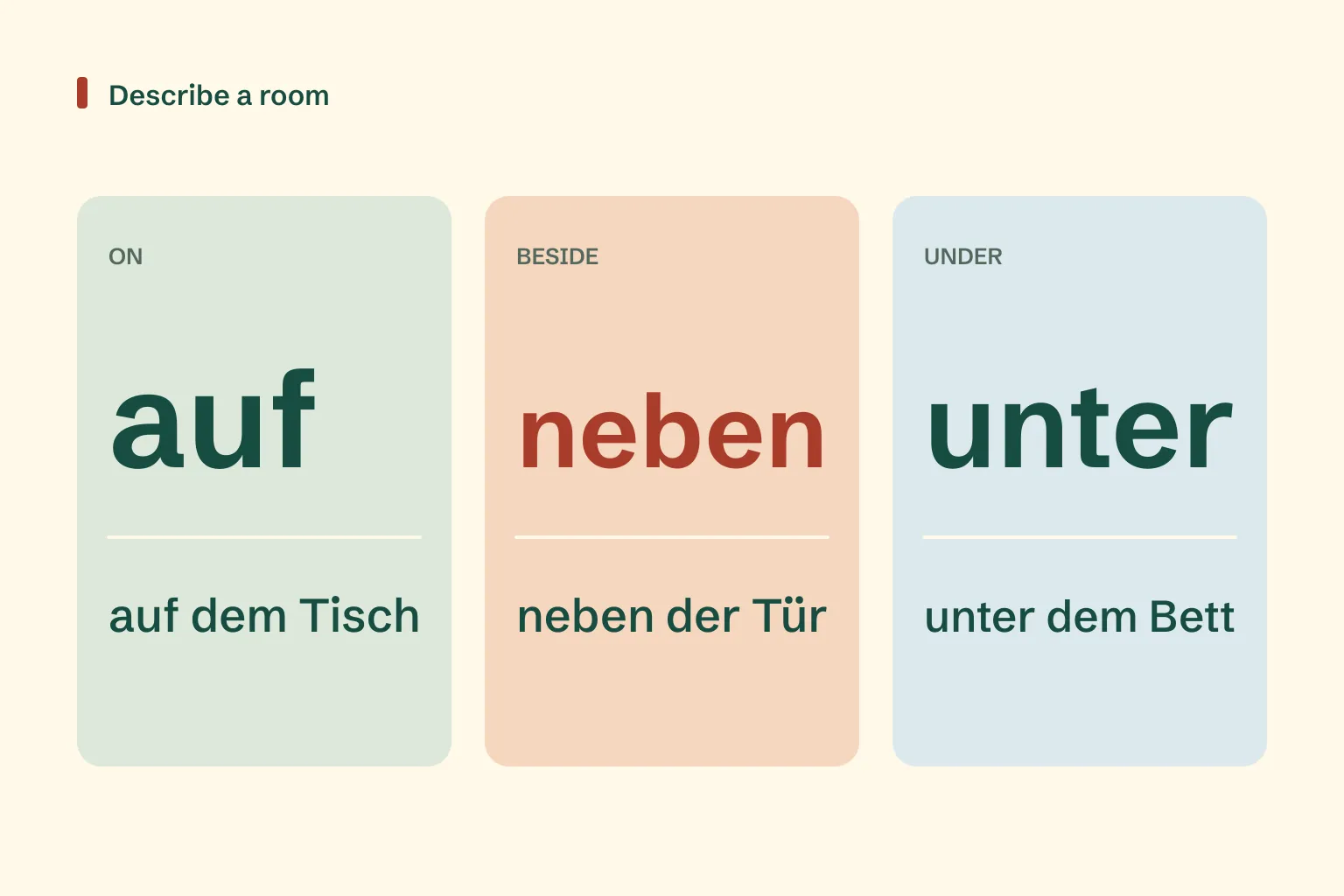
Your partner has to draw your study room from your description. Start with the room, name the main furniture, then locate each object with one clear reference point. In meinem Zimmer gibt es einen Schreibtisch. Er steht am Fenster means “There is a desk in my room. It stands by the window.” You are describing a position, not moving the desk.
Takeaway: Use es gibt + accusative to introduce something, then stehen, liegen or hängen with a location phrase to say where it is.
Furniture worth learning with its article
| Noun | Plural | A useful original phrase | English |
|---|---|---|---|
| der Schreibtisch | die Schreibtische | am Schreibtisch lernen | study at the desk |
| der Stuhl | die Stühle | neben dem Tisch stehen | stand beside the table |
| das Regal | die Regale | im Regal liegen | lie on/in the shelving unit |
| das Bett | die Betten | unter dem Bett liegen | lie under the bed |
| die Lampe | die Lampen | über dem Tisch hängen | hang above the table |
| das Fenster | die Fenster | am Fenster stehen | stand by the window |
| die Wand | die Wände | an der Wand hängen | hang on the wall |
| der Teppich | die Teppiche | auf dem Teppich liegen | lie on the rug |
These are chosen phrases, not rules assigning each noun a permanent position. A lamp may stand on a desk or hang above it. Choose the verb and preposition that match your actual room.
Read an original room description
Mein Lernzimmer ist klein, aber hell. Links neben der Tür steht ein Regal. Im Regal liegen meine Hefte und zwei Wörterbücher. Mein Schreibtisch steht am Fenster. Auf dem Schreibtisch stehen eine Lampe und ein Glas Wasser. Unter dem Tisch steht ein Papierkorb. An der Wand hängt ein Kalender. Das Bett steht rechts neben dem Regal. Auf dem Bett liegt heute meine Tasche. In der Mitte des Zimmers gibt es einen kleinen Teppich. Abends lerne ich am Schreibtisch. Dort ist genug Platz für mein Buch und meinen Laptop.
This model describes a small, bright study room: the shelves are beside the door, the desk by the window, and a bag is on the bed today. Heute matters because the bag’s position can change. The description does not make every detail a permanent feature.
Introduce, then locate
Es gibt takes accusative: Es gibt einen Tisch (There is a table). The table becomes the subject in Der Tisch steht am Fenster. When you replace it with a pronoun, use masculine er: Er ist groß.
Location phrases with the two-way prepositions in this description use dative: auf dem Tisch, unter dem Bett, neben der Tür. The sentence Ich stelle die Lampe auf den Tisch instead describes placing the lamp onto the table. Keep that change-of-location construction separate. The wo/wohin guide explains the contrast.
Choose details your partner can use
Avoid a chain of hier and dort when the listener cannot see you pointing. Say rechts neben der Tür (to the right of the door), then keep the viewpoint clear: imagine entering through that door. Rechts and links can become confusing if the partner pictures looking from the window instead.
Use adjectives after sein when you want a simpler sentence: Das Zimmer ist ruhig. Before a noun, endings add another choice: ein ruhiges Zimmer. Both are useful, but you can communicate a precise layout without inserting an adjective into every noun phrase.
Draw-and-check routine
Describe five objects while your partner draws. Do not show your drawing first. Then compare the two pictures and identify one misunderstood relationship: Der Stuhl steht neben dem Tisch, nicht hinter dem Tisch. Change roles with a different fictional room. This checks whether your location phrases actually distinguish the objects.
Practice
- Complete: In meinem Zimmer gibt es ___ Stuhl (ein, der Stuhl).
- Complete for a position: Die Tasche liegt auf ___ Bett (das Bett).
- What lies on the bed in the model, and when?
- Choose: Der Kalender steht / hängt an der Wand.
- Correct: Es gibt ein Schreibtisch.
- Write three connected sentences introducing a desk, locating it by the window and locating a lamp on it.
- Your partner draws the shelf behind the door, but you intended beside it. Correct the relationship politely in German.
Explained answers and models
- einen. Es gibt takes accusative, so masculine ein Stuhl becomes einen Stuhl.
- dem. This is a location with auf, and neuter dative is dem Bett.
- Die Tasche liegt heute auf dem Bett. The time word makes this today’s position rather than a permanent arrangement.
- hängt. A calendar attached to the wall is naturally described with hängen here.
- Es gibt einen Schreibtisch. The masculine object needs accusative einen.
- In meinem Zimmer gibt es einen Schreibtisch. Er steht am Fenster. Auf dem Schreibtisch steht eine Lampe. Other layouts are possible if you change the locations coherently.
- Das Regal steht neben der Tür, nicht hinter der Tür. Könntest du das bitte ändern? The correction gives the intended relationship and a clear request.
Sources and next lesson
The University of Texas accusative reference supports es gibt, and its two-way-preposition reference supports the location/destination distinction. The model room and tasks are original. Continue in the A2 learning path with a description of your own study space.