
Classroom companion
Introduce yourself in German: an A1 speaking practice lesson
Build a short German introduction with name, origin, home and languages, then ask a classmate matching questions and repair common beginner mistakes.
Read as Markdown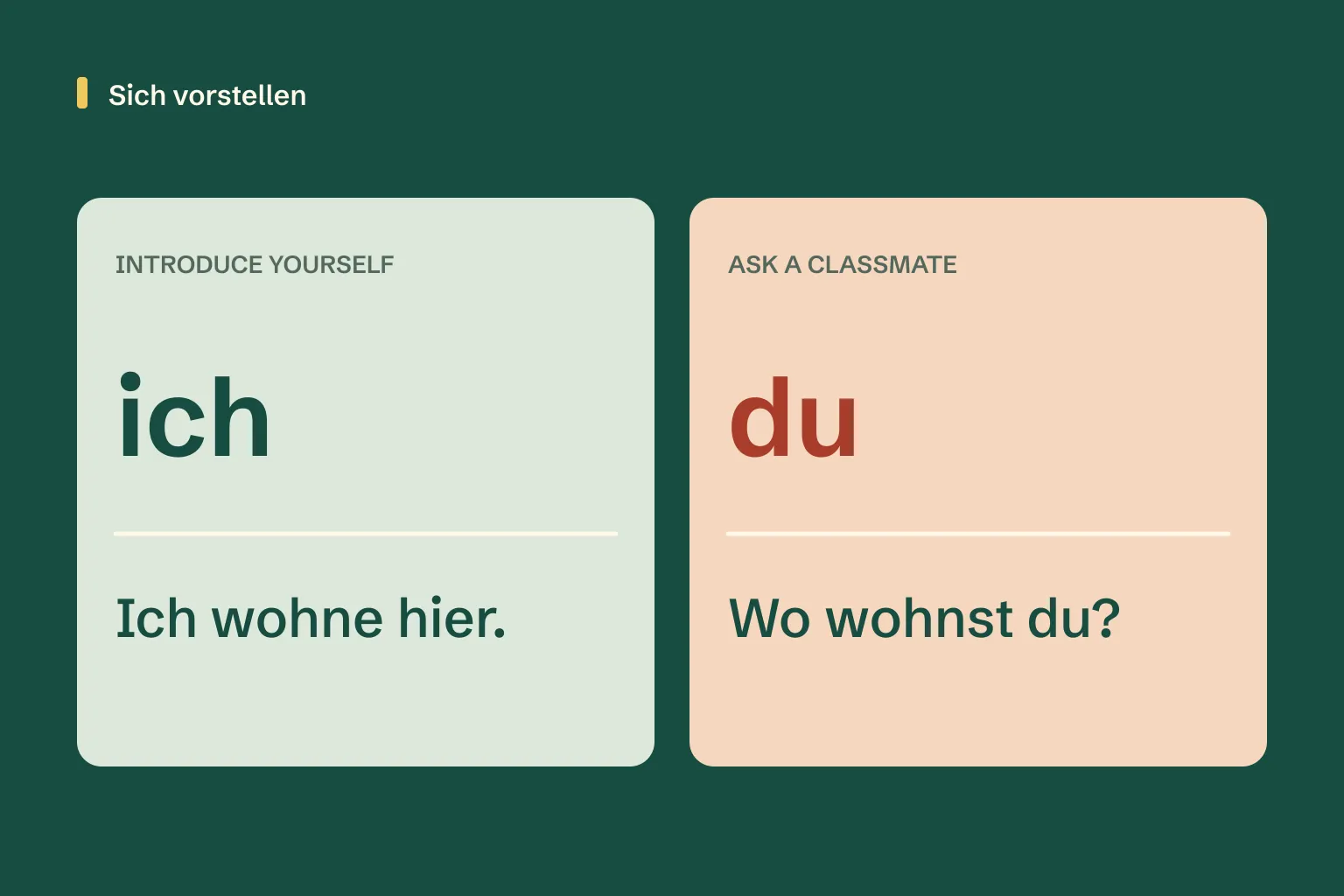
In your first pair exercise, a useful German introduction needs only a few true details: your name, where you are from, where you live and a language you speak. Use Ich heiße …, Ich komme aus …, Ich wohne in … and Ich spreche …. Then ask your classmate one matching question. A short exchange is easier to reuse than a memorized speech you cannot change.
Takeaway: Introduce one fact at a time, then turn the same topic into a question. Share only information you are comfortable sharing.
Four sentences with a clear job
| Purpose | Original model | English meaning |
|---|---|---|
| Name | Ich heiße Samira. | My name is Samira. |
| Origin | Ich komme aus Marokko. | I come from Morocco. |
| Current home | Ich wohne in Bremen. | I live in Bremen. |
| Languages | Ich spreche Arabisch und ein bisschen Deutsch. | I speak Arabic and a little German. |
Heißen means “be called.” Ich bin Samira is also a natural way to give your name, but do not combine the two patterns as Ich bin heiße Samira. Choose one conjugated verb for that simple message. The German present tense can express a current situation without an English-style “am living” form: Ich wohne in Bremen already means “I live in Bremen.”
Keep country expressions as complete chunks. Aus Marokko and aus Spanien work without an article, while some country names use one, for example aus der Schweiz and aus der Türkei. This is a practical set for introductions, not a claim that all places follow one article rule. Use in Bremen for the city where the person lives. Origin and current home can be different places.
Ask and answer with the same level of formality
For a classmate who uses du, ask Wie heißt du? (What is your name?), Woher kommst du? (Where are you from?), Wo wohnst du? (Where do you live?) and Welche Sprachen sprichst du? (Which languages do you speak?). Notice sprichst in the last question, compared with spreche in your answer.
With formal Sie, use Wie heißen Sie?, Woher kommen Sie?, Wo wohnen Sie? and Welche Sprachen sprechen Sie? Capitalize Sie in this use. A teacher may invite learners to use du; follow the agreed classroom convention rather than changing halfway through an exchange.
Mika: Hallo, ich heiße Mika. Und du? Hello, my name is Mika. And you?
Elif: Ich heiße Elif. Ich wohne in Essen. My name is Elif. I live in Essen.
Mika: Kommst du aus Essen? Are you from Essen?
Elif: Nein, ich komme aus der Türkei. Und woher kommst du? No, I am from Turkey. And where are you from?
Mika: Aus Japan. Ich lerne hier Deutsch. From Japan. I am learning German here.
The short answer Aus Japan is appropriate because the previous question supplies the context. Practise the full sentence first, then allow natural short answers.
Make the introduction usable tomorrow
Write four cue words rather than every sentence: Name, Herkunft, Wohnort, Sprachen. Cover the model and speak from those cues. Ask a partner to tell you one detail they understood. If the detail is wrong, repeat that sentence clearly. This gives you feedback on communication as well as grammar.
A1 is the suggested practice level here, not a guarantee of an exam result. You do not need to disclose age, address, immigration status or family details to complete the activity. Fictional profiles work equally well for language practice.
Practise it
- Complete Samira’s sentence: Ich ___ in Bremen. Use wohnen.
- Correct Ich bin heiße Samira using heißen.
- Ask a classmate where they are from, using du.
- Complete with the appropriate chunk: Ich komme ___ Schweiz.
- Change Wo wohnst du? into a formal question.
- Use Samira’s facts in the first table to write a four-sentence introduction. Then add one question for a partner.
Answers and reasons
- Ich wohne in Bremen. The ich form ends in -e.
- Ich heiße Samira. Remove bin. Ich bin Samira is another valid construction, but it does not use heißen as requested.
- Woher kommst du? Woher asks about origin; wo asks about location.
- Ich komme aus der Schweiz. Learn this country expression with its article.
- Wo wohnen Sie? Formal Sie takes wohnen and a capital S.
- Ich heiße Samira. Ich komme aus Marokko. Ich wohne in Bremen. Ich spreche Arabisch und ein bisschen Deutsch. Und wo wohnst du? A different matching question is acceptable; retain the supplied facts and correct verb forms.
Use it in your next lesson
Introduce yourself or a fictional person without reading a script. Then change just the current city. Model: Ich wohne jetzt in Leipzig. Jetzt means “now” and lets you update the message without rewriting your whole introduction. Keep the phrases in your vocabulary notebook.
Sources and further reading
- Goethe-Institut A1 vocabulary: Reference for beginner topics and core introductory vocabulary, not a script for this original dialogue.
- UT: present-tense verbs: Reference for matching present forms to the subject and using the present for current situations.