
Free resources
German reflexive pronouns: choosing mich, mir and the rest
Choose German reflexive mich, mir, dich, dir and sich from useful sentence patterns, with body-part examples and a complete practice worksheet.
Read as Markdown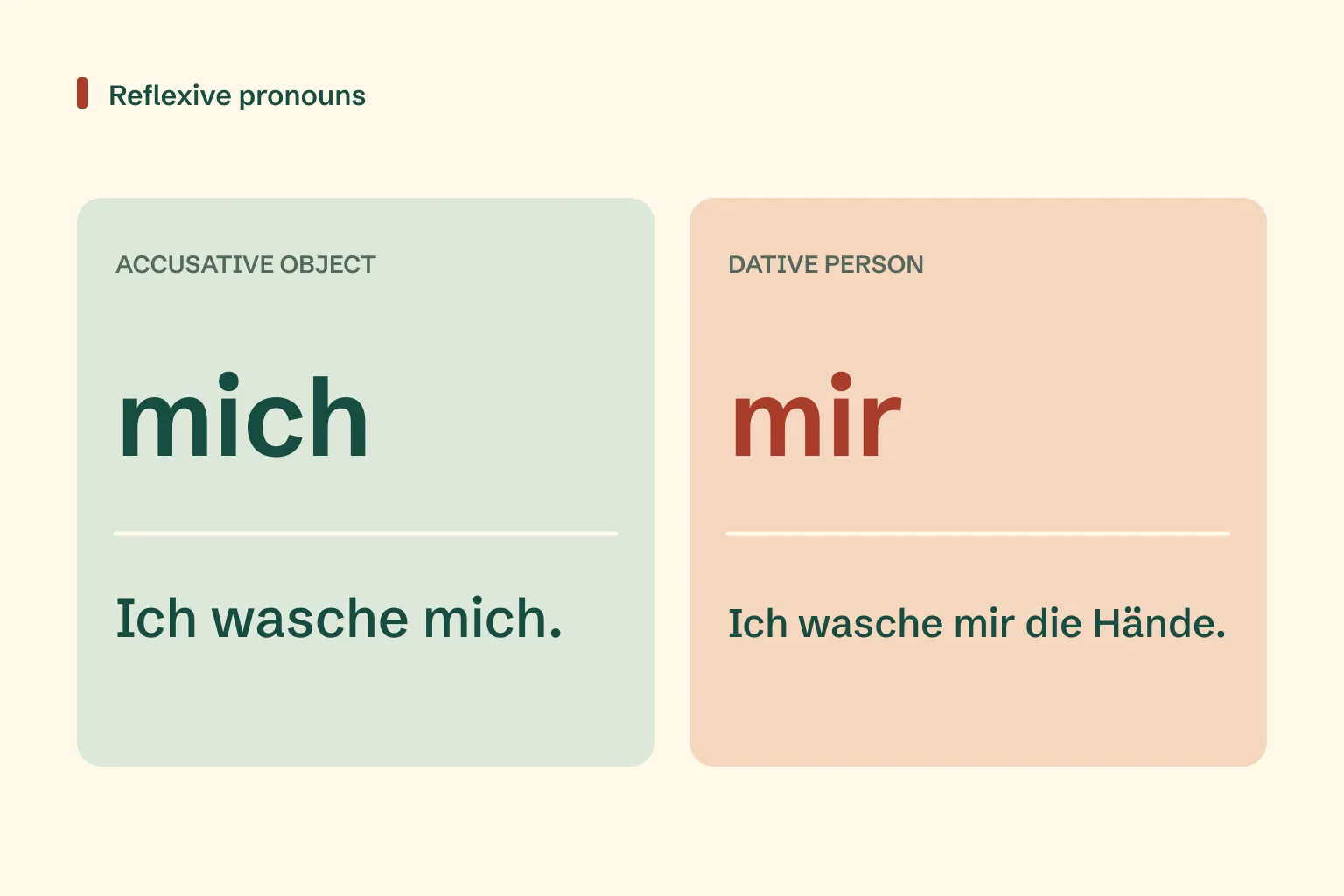
Your notes contain Ich wasche mich and Ich wasche mir die Hände. Both are correct. In the first, mich is what you wash: yourself. In the second, die Hände is the accusative object and mir identifies whose hands are involved. Learn the complete construction instead of choosing mich whenever you see ich.
Takeaway: Only ich and du have visibly different accusative and dative reflexive forms. The correct case still matters when the forms look identical.
The reference table
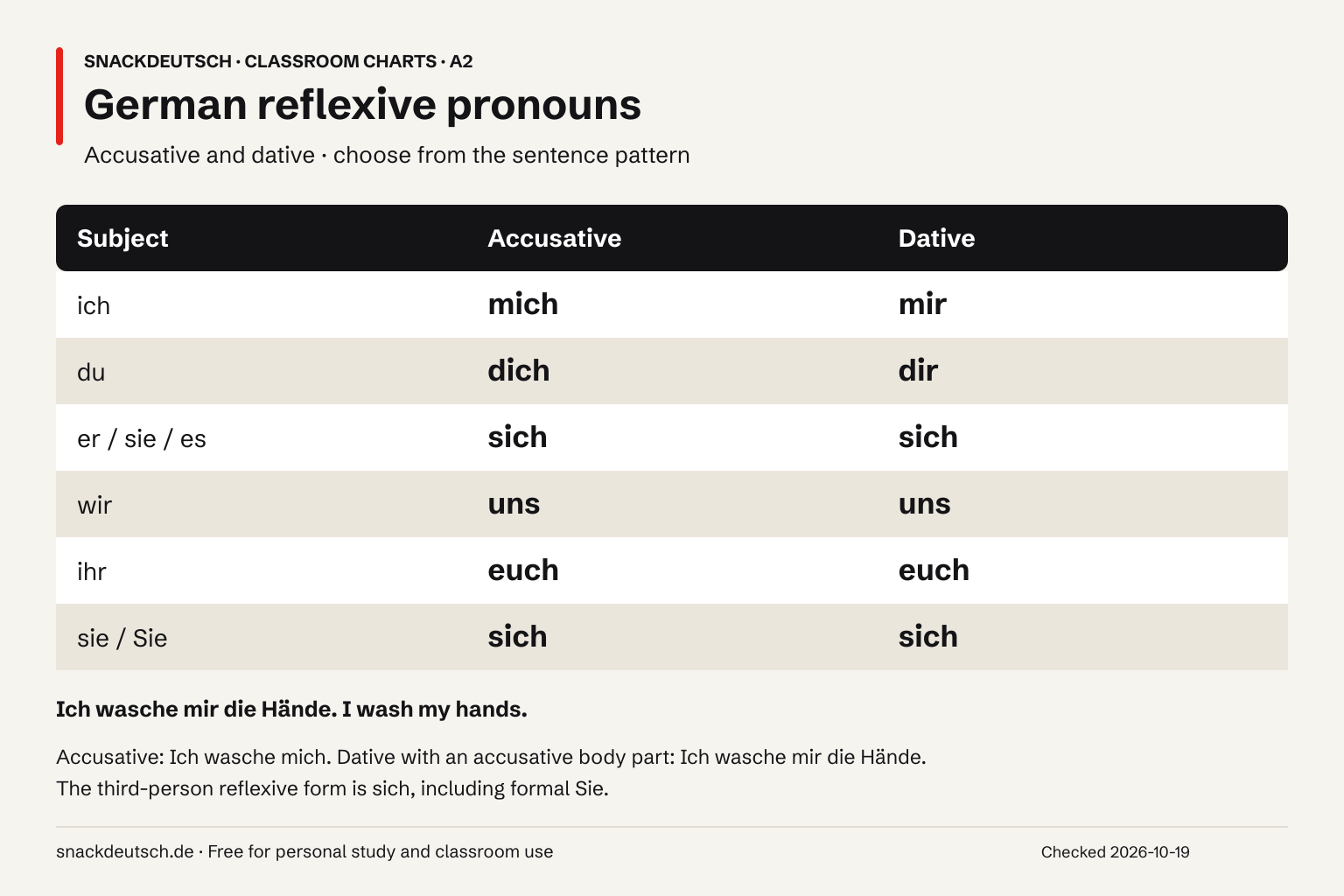
German reflexive pronouns
Accusative and dative · choose from the sentence pattern. Suggested level: A2.
| Subject | Accusative | Dative |
|---|---|---|
| ich | mich | mir |
| du | dich | dir |
| er / sie / es | sich | sich |
| wir | uns | uns |
| ihr | euch | euch |
| sie / Sie | sich | sich |
Ich wasche mir die Hände. I wash my hands.
- Accusative: Ich wasche mich. Dative with an accusative body part: Ich wasche mir die Hände.
- The third-person reflexive form is sich, including formal Sie.
Sich refers back to a third-person subject: Lea beeilt sich (Lea is hurrying). Formal Sie also uses sich: Beeilen Sie sich bitte (Please hurry). The reflexive pronoun remains lowercase. Compare ordinary dative Ihnen, which is capitalized in formal address.
Three constructions to keep separate
| Construction | Original example | What to remember |
|---|---|---|
| reflexive action | Ich wasche mich. | The speaker washes themself. |
| body part as object | Ich wasche mir die Hände. | Hands are the accusative object; the reflexive person is dative. |
| lexical reflexive verb | Ich interessiere mich für Musik. | Learn sich interessieren für + accusative as a pattern. |
English does not need “myself” in “I am interested in music.” German still uses mich. A reflexive verb is not always a literal action on your own body. Sich beeilen (hurry) and sich erinnern an (remember) also need a pattern learned from German examples.
Conversely, a verb can have a non-reflexive object: Ich wasche das Hemd (I wash the shirt). The subject and object differ, so do not add mich simply because waschen appeared in a reflexive table.
Put the pronoun into a sentence
In a straightforward subject-first main clause, the pronoun commonly follows the finite verb: Wir treffen uns nach dem Kurs (We meet after the course). With a time phrase first: Nach dem Kurs treffen wir uns. The finite verb remains second; the subject is wir.
With a modal, keep the infinitive at the end: Ich muss mich beeilen (I have to hurry). The reflexive pronoun is not attached to the final infinitive as one written word. Use the modal-verb guide for that sentence frame.
Check the meaning of uns
Wir treffen uns normally expresses meeting one another in a suitable context. Uns can therefore have a reciprocal meaning, not only “ourselves.” Context matters: Wir waschen uns generally means each person washes themself. If you need to be explicit about “one another,” einander can help in suitable constructions. You do not need to label every occurrence before you can use the everyday sentence correctly.
Turn a routine into class practice
Write a three-line morning routine using sich waschen, sich die Zähne putzen and sich beeilen. Then change ich to du. The useful contrast is Ich putze mir die Zähne → Du putzt dir die Zähne, not a long list without a situation. Underline die Zähne so you can explain why the person is dative.
Practice
- Complete: Ich beeile ___.
- Complete: Du wäschst ___ die Hände.
- Replace ich with wir: Ich interessiere mich für Kunst.
- Correct: Lea muss sich beeilt.
- Complete formal address: Interessieren Sie ___ für Musik?
- Translate: “I wash the shirt.” Should the sentence contain a reflexive pronoun?
- Explain the difference between Ich wasche mich and Ich wasche mir die Hände.
Explained answers
- mich. The pattern is sich beeilen with an accusative reflexive pronoun.
- dir. Die Hände is the accusative object; the person is dative dir.
- Wir interessieren uns für Kunst. Both the finite verb and pronoun match plural wir. Für Kunst remains unchanged.
- Lea muss sich beeilen. A modal takes the infinitive beeilen, not the finite form beeilt, at the end.
- sich. Formal Sie uses third-person reflexive sich, written lowercase.
- Ich wasche das Hemd. No reflexive pronoun is needed because the shirt is the object and differs from the speaker.
- In the first, mich is the accusative object. In the second, die Hände is the accusative object and mir is the dative person affected.
Source and next step
The University of Texas reflexive-verb reference supports the forms and contrast in case. All examples here are original. Return to the A2 path and practise one verb in a sentence about your own routine.
The IDS reflexive-pronoun reference also explains the subject reference and the possible reciprocal reading with plural participants.