
Classroom companion
German participles as adjectives: build and unpack noun phrases
Build and unpack German participial adjectives, choose Partizip I or II from the meaning, and check endings with original explained B2 practice.
Read as Markdown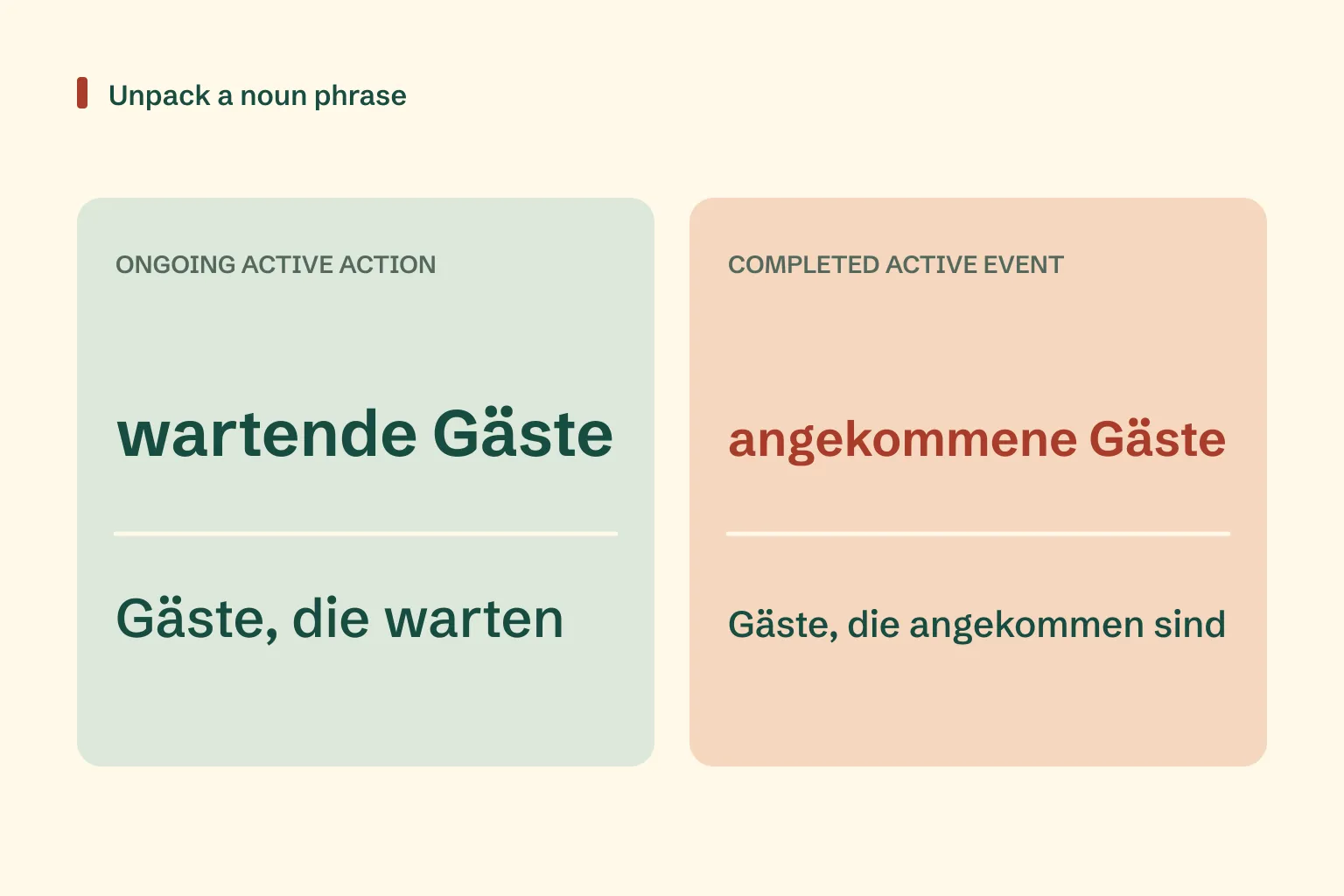
You read die vor dem Raum wartenden Gäste in a message. Unpack it as die Gäste, die vor dem Raum warten (the guests who are waiting outside the room). A participial adjective compresses information before a noun. To understand or create one accurately, identify the action and the noun’s relationship to it before choosing the participle and its ending.
Takeaway: Partizip I often presents an ongoing active relationship, but Partizip II is not automatically passive. Die angekommenen Gäste are people who have arrived, not people who were “arrived” by somebody.
Four phrase-to-clause checks
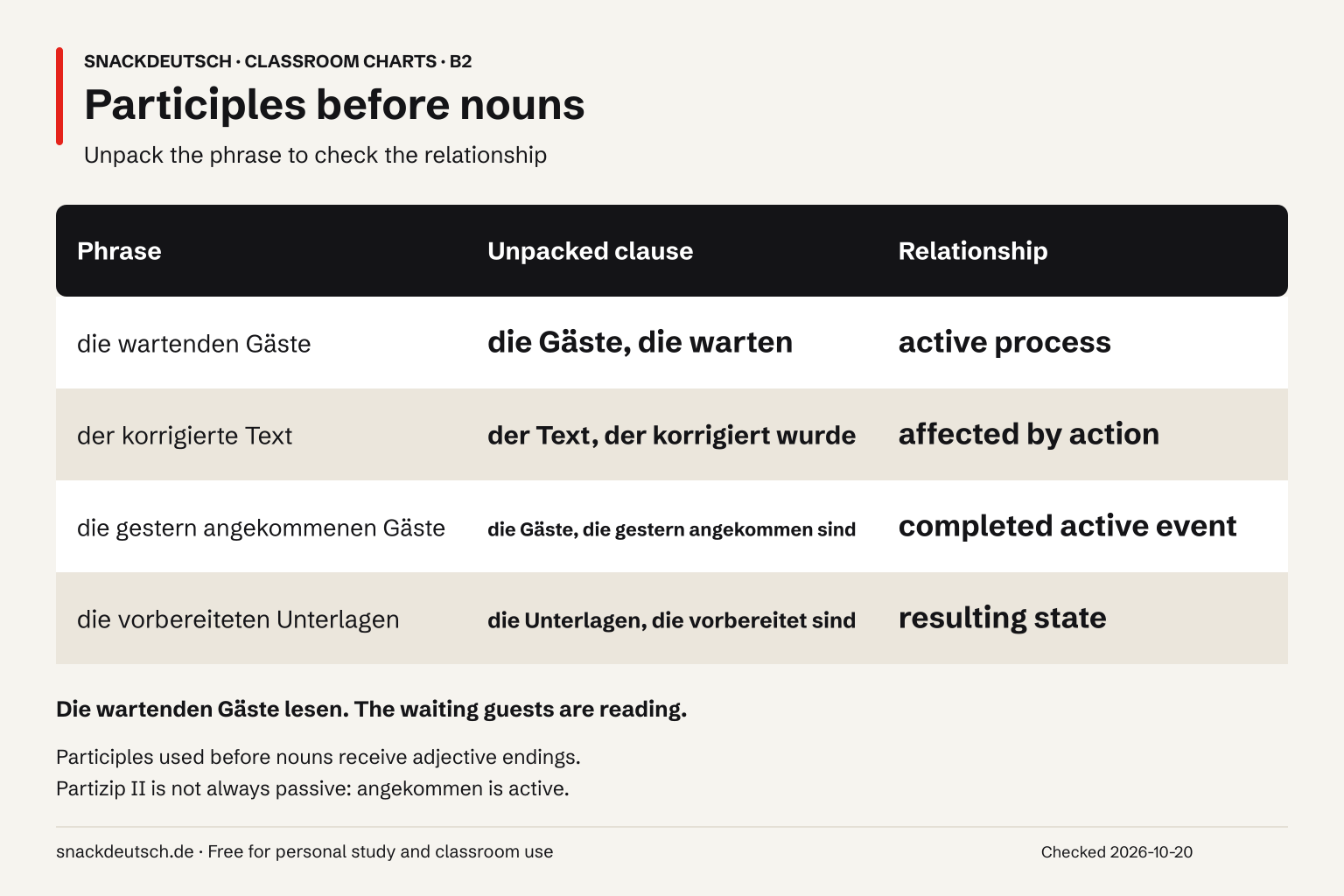
Participles before nouns
Unpack the phrase to check the relationship. Suggested level: B2.
| Phrase | Unpacked clause | Relationship |
|---|---|---|
| die wartenden Gäste | die Gäste, die warten | active process |
| der korrigierte Text | der Text, der korrigiert wurde | affected by action |
| die gestern angekommenen Gäste | die Gäste, die gestern angekommen sind | completed active event |
| die vorbereiteten Unterlagen | die Unterlagen, die vorbereitet sind | resulting state |
Die wartenden Gäste lesen. The waiting guests are reading.
- Participles used before nouns receive adjective endings.
- Partizip II is not always passive: angekommen is active.
The paraphrases show the intended meaning in these examples. A participial phrase can permit more than one tense or aspect interpretation in a larger text, so do not treat each expanded clause as its only possible translation.
Form Partizip I, then add the ending
A useful formation pattern is infinitive + d: warten → wartend, lernen → lernend, lachen → lachend. Before a noun, add the adjective ending: die wartenden Gäste, ein wartender Gast, mit einem wartenden Gast. The participle stem wartend and the adjective ending do different jobs.
Irregular infinitives such as sein and tun need their established forms, seiend and tuend. You do not need these less frequent descriptive uses for the initial practice. This lesson begins with common, transparent verbs so that you can focus on the phrase’s meaning and case.
German does not generally copy English continuous tense by combining sein with Partizip I: Die Gäste sind wartend is not the ordinary way to say “The guests are waiting.” Use Die Gäste warten. Die wartenden Gäste is a noun phrase, not a substitute for every English -ing sentence.
Partizip II needs a meaning check
Der korrigierte Text names a text affected by correction. A relative-clause paraphrase can be der Text, der korrigiert wurde. Die angekommenen Gäste names people who have completed their arrival, and the underlying clause is active: die Gäste sind angekommen.
This distinction prevents the false rule “Partizip I active, Partizip II passive” from becoming your only test. Ask what the verb normally means and whether its subject performs, undergoes or completes the relevant event. A dictionary or a complete source sentence is useful when the participle is unfamiliar.
Keep an extended phrase in order
In die gestern im Kurs besprochenen Beispiele, begin with the head noun Beispiele. The participle besprochenen describes them. Gestern and im Kurs add the time and location of the discussion. The expansion is die Beispiele, die gestern im Kurs besprochen wurden.
When you build the phrase, keep the extensions before the participle and the noun after it. Avoid inserting a finite verb inside the noun phrase: die gestern wurden besprochenen Beispiele mixes two constructions. Choose either the compressed phrase or a complete relative clause.
Long participial phrases can become difficult to process. Die von unserer am Montag neu gebildeten Arbeitsgruppe überprüften … asks the reader to hold too many relationships at once. A relative clause or two sentences can be clearer. B2 practice is about controlling the relationship, not maximizing the number of words before a noun.
Check endings with the noun’s case
Compare ein korrigierter Text, ich lese einen korrigierten Text and mit einem korrigierten Text. The underlying participle korrigiert stays recognizable while the ending changes. Use the adjective-ending charts after you have chosen the correct participle.
A phrase can have flawless endings and still the wrong meaning. Die korrigierenden Texte would make the texts the ones doing the correcting. For ordinary texts corrected by someone, choose die korrigierten Texte. Do the meaning check before the ending check.
Practice
- Form a phrase: die Gäste, die warten.
- Form a phrase: der Text, der gestern korrigiert wurde.
- Unpack: die heute angekommenen Teilnehmer.
- Complete: Ich lese einen gestern korrigiert___ Text.
- Correct ordinary ongoing action: Die Teilnehmer sind lernend.
- Why does die korrigierenden Texte differ from die korrigierten Texte?
- Unpack an overloaded phrase into a clearer relative clause: die gestern von unserer Gruppe besprochenen Vorschläge.
Explained answers
- die wartenden Gäste. Wartend describes the people performing the ongoing action and receives plural adjective -en after die.
- der gestern korrigierte Text. The text underwent correction; korrigiert receives nominative masculine -e after der.
- die Teilnehmer, die heute angekommen sind. This is an active completed arrival, not passive.
- -en: einen gestern korrigierten Text. Masculine accusative after einen needs -en.
- Die Teilnehmer lernen. A German present verb expresses the action here without a copied English continuous construction.
- Korrigierend would describe the texts as doing the correction. Korrigiert describes texts affected by correction in the intended context.
- die Vorschläge, die gestern von unserer Gruppe besprochen wurden. The relative clause keeps the same proposals, discussion, group and time while making the structure easier to follow.
Sources and next practice
The IDS references on Partizip I as an adjective and Partizip II as adjective or verb form support the form/meaning distinctions. All phrases and tasks above are original. Continue in the B2 path by unpacking one phrase from your own permitted class notes.