
Classroom companion
German past Konjunktiv II: explain what could have happened
Explain unreal past alternatives in German with hätte and wäre, distinguish them from past facts, and practise modal double infinitives with explained answers.
Read as Markdown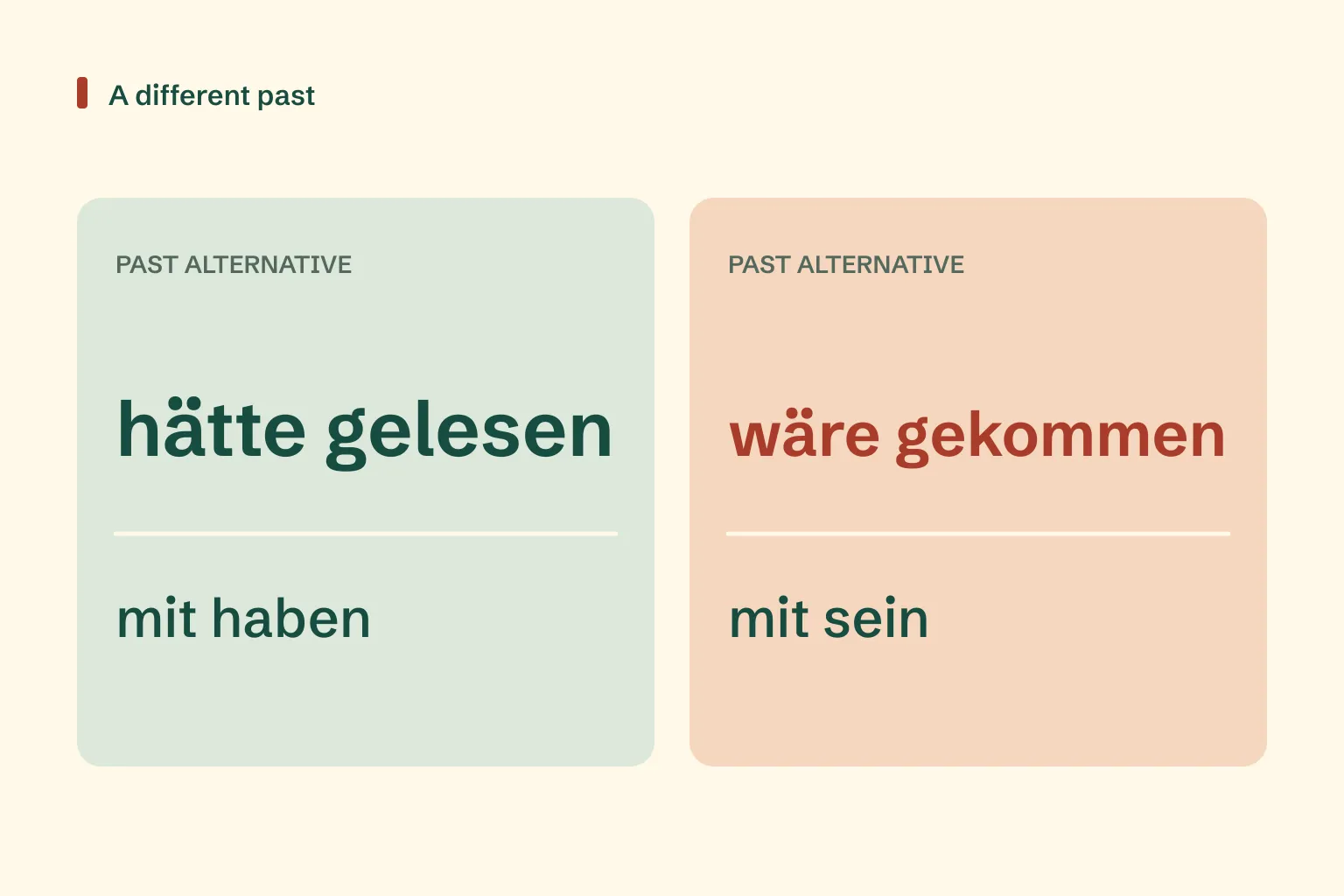
Your group missed the chance to rehearse. Wenn wir früher angefangen hätten, hätten wir die Präsentation noch üben können means “If we had started earlier, we could still have practised the presentation.” You are imagining a different past, not stating what happened. Past Konjunktiv II lets you discuss a missed opportunity, a possible alternative or a regret with a clear time reference.
Takeaway: Use hätte/wäre + past participle for the core past pattern. When a modal governs another verb, the usual pattern is hätte + double infinitive, as in hätte helfen können.
Keep the patterns distinct
Past hypothetical situations
Hätte/wäre + participle · modal uses a double infinitive. Suggested level: B2.
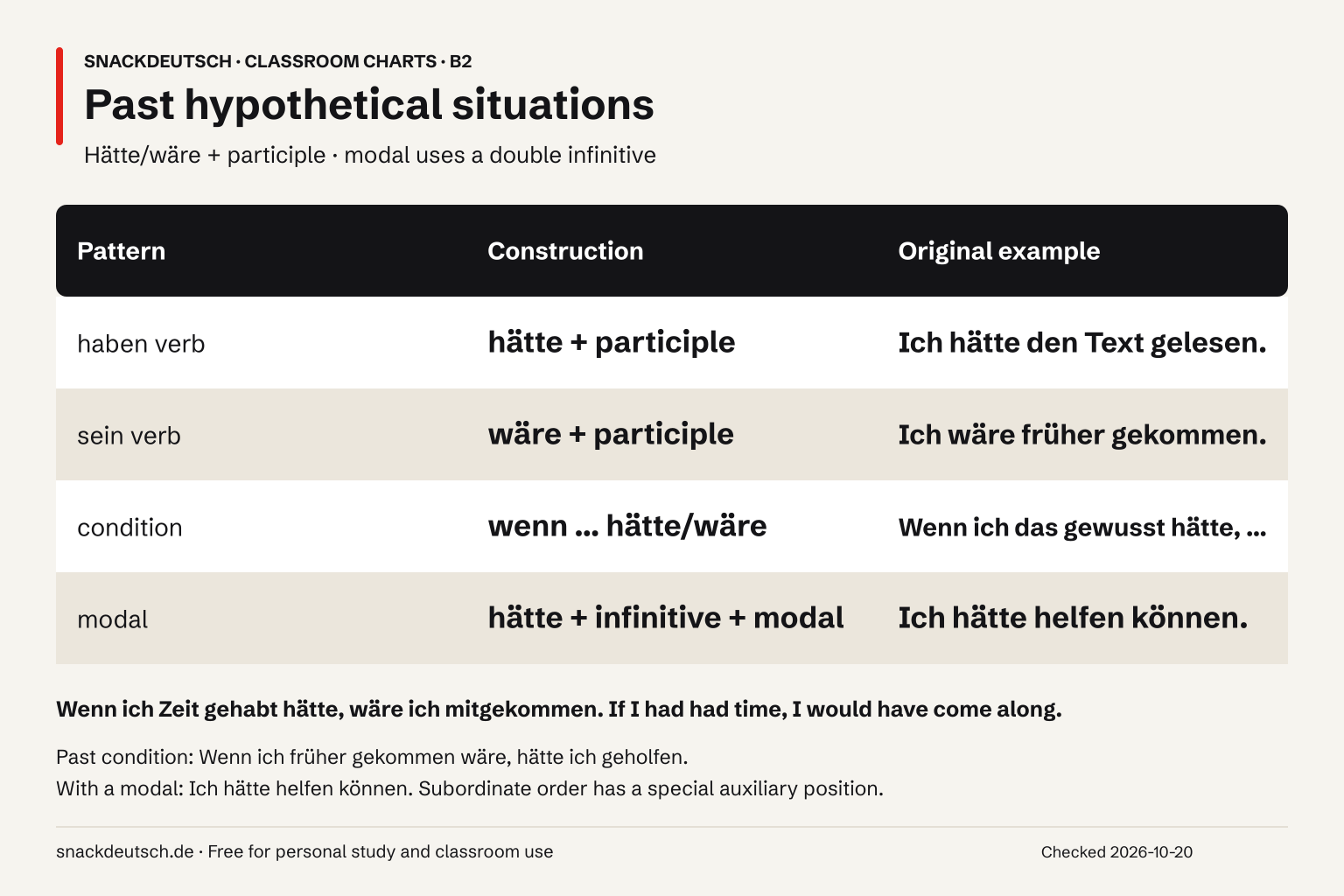
| Pattern | Construction | Original example |
|---|---|---|
| haben verb | hätte + participle | Ich hätte den Text gelesen. |
| sein verb | wäre + participle | Ich wäre früher gekommen. |
| condition | wenn … hätte/wäre | Wenn ich das gewusst hätte, … |
| modal | hätte + infinitive + modal | Ich hätte helfen können. |
Wenn ich Zeit gehabt hätte, wäre ich mitgekommen. If I had had time, I would have come along.
- Past condition: Wenn ich früher gekommen wäre, hätte ich geholfen.
- With a modal: Ich hätte helfen können. Subordinate order has a special auxiliary position.
Choose hätte or wäre from the ordinary Perfekt construction of the main verb in that meaning: hat gelesen → hätte gelesen; ist gekommen → wäre gekommen. The participle does not change merely because the sentence is hypothetical. It remains gelesen or gekommen.
From fact to imagined alternative
In a fictional class situation, Lea arrived late and missed the first example:
- Fact: Lea ist spät gekommen. Sie hat das erste Beispiel nicht gehört.
- Alternative: Wenn Lea früher gekommen wäre, hätte sie das erste Beispiel gehört.
The fact uses indicative Perfekt. The alternative uses wäre gekommen and hätte gehört. The condition ends in its auxiliary, and the main clause begins with hätte after the comma. You can reverse the clauses: Lea hätte das erste Beispiel gehört, wenn sie früher gekommen wäre.
Negation changes the claim: Wenn Lea nicht so spät gekommen wäre … imagines the absence of the lateness. Check that your condition actually fixes the problem in your stated facts. A sentence can have correct endings and still express an illogical alternative.
Distinguish present and past regret
Ich wäre gern dabei means “I would like to be there/involved” in a present or future context. Ich wäre gern dabei gewesen imagines having been there in the past. The extra gewesen changes the temporal construction.
Similarly, Ich hätte mehr Zeit describes imagined possession of more time, while Ich hätte mehr Zeit gehabt describes a past alternative. Do not add a past participle just to make the sentence sound more advanced; first decide whether the missing opportunity is now, tomorrow or already over.
When a modal changes the verb group
Compare Ich hätte geholfen (I would have helped) with Ich hätte helfen können (I could have helped). In the second, können replaces the expected participle gekonnt because it governs another infinitive. The pair helfen können is a double infinitive. The lesson focuses on this common standard pattern, not every regional or exceptional modal construction.
The subordinate version has a special order: …, weil ich hätte helfen können (because I could have helped). The auxiliary hätte comes before the double infinitive. Do not generalize the simple “finite verb always last” rule to this special verb group. For an initial practice sentence, a main clause such as Ich hätte früher anrufen können is easier to monitor.
Express regret without inventing blame
Ich hätte früher nachfragen sollen means “I should have asked earlier.” It evaluates a past action. In a real conversation, it can sound like self-criticism; Du hättest … sollen can sound like criticism of the listener. Grammar alone does not determine a courteous tone.
A reflective classroom task can use a fictional plan: Beim nächsten Mal frage ich früher nach (Next time I will ask earlier). This turns a counterfactual into a concrete future action without claiming the past can be changed or diagnosing why a learner struggled.
A three-step check
First write the factual past. Next choose a condition that differs from it. Finally write a plausible result and check both auxiliaries. If you use a modal, check whether you need the double infinitive and its special subordinate order. Use the Perfekt guide to verify the underlying auxiliary before changing mood.
Practice
- Complete: Wenn ich den Text gelesen ___, hätte ich die Frage verstanden.
- Complete: Wenn wir früher ___ ___, hätten wir einen Sitzplatz bekommen (kommen).
- Correct: Ich wäre den Brief geschrieben.
- Add the modal können to “I would have helped.”
- Complete the subordinate order: …, weil ich ___ helfen können.
- Distinguish Ich hätte Zeit from Ich hätte Zeit gehabt in English.
- Fictional facts: you forgot the notebook, so you could not show your example. Write one past alternative, then one future action.
Explained answers and model
- hätte. Lesen forms Perfekt with haben, so the hypothetical auxiliary is hätte.
- gekommen wären. Plural wir uses wären; the condition closes with the auxiliary.
- Ich hätte den Brief geschrieben. This use of schreiben takes haben, not sein.
- Ich hätte helfen können. Helfen können is the double infinitive; hätte geholfen gekonnt is not the target construction.
- hätte. The special order is weil ich hätte helfen können, with the finite auxiliary before the two infinitives.
- “I would have time” concerns an imagined present/future state; “I would have had time” concerns an imagined past state.
- Wenn ich mein Heft mitgebracht hätte, hätte ich mein Beispiel zeigen können. Beim nächsten Mal packe ich das Heft am Abend ein. Other future habits work if they address the stated problem without changing the fictional facts.
Sources and next practice
The University of Texas past-subjunctive reference supports the core pattern and modal double infinitive. The IDS Konjunktiv II reference distinguishes the past analytic form and mood functions. The tasks and scenarios are original; this lesson does not teach a complete reported-speech system. Continue in the B2 path.