
Classroom companion
German Konjunktiv II: discuss hypothetical situations in context
Discuss imagined German situations with hätte, wäre, könnte and würde, keep the condition and result clear, and practise with explained answers.
Read as Markdown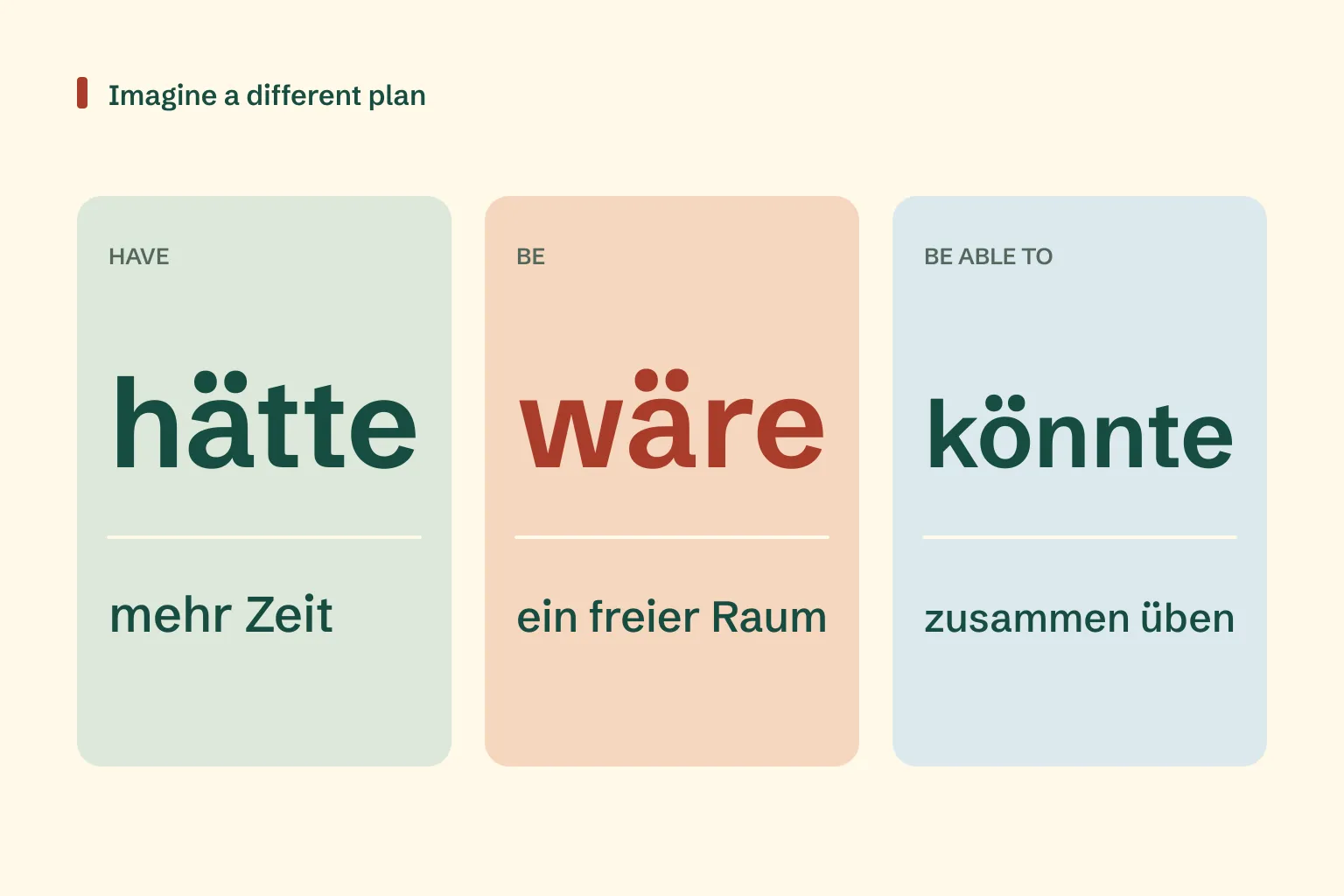
Your study group has one free room but imagines a quieter option: Wenn wir einen größeren Raum hätten, könnten wir zwei Gruppen bilden (If we had a larger room, we could form two groups). Hätten presents an imagined condition; könnten gives a possible result. Konjunktiv II helps you discuss alternatives without claiming they are already true.
Takeaway: Decide what is imagined and what follows from it. Use hätte/wäre/könnte or a suitable würde + infinitive form, then check the clause order.
A compact form reference
Present hypothetical situations
Forms for imagining a different situation. Suggested level: B2.
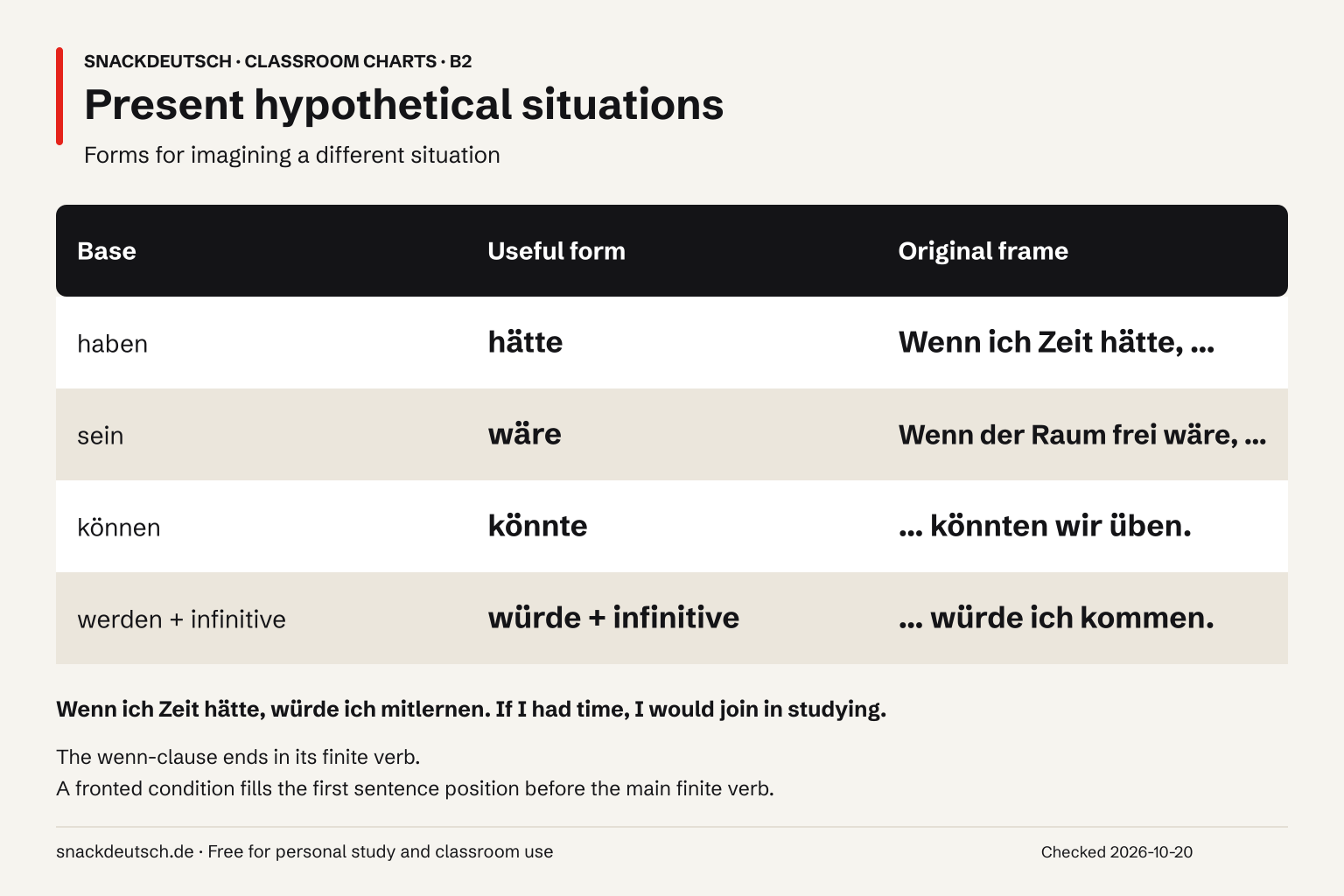
| Base | Useful form | Original frame |
|---|---|---|
| haben | hätte | Wenn ich Zeit hätte, … |
| sein | wäre | Wenn der Raum frei wäre, … |
| können | könnte | … könnten wir üben. |
| werden + infinitive | würde + infinitive | … würde ich kommen. |
Wenn ich Zeit hätte, würde ich mitlernen. If I had time, I would join in studying.
- The wenn-clause ends in its finite verb.
- A fronted condition fills the first sentence position before the main finite verb.
The table shows selected first/third-person singular forms, not a complete conjugation. Compare ich hätte, du hättest, wir hätten and ihr hättet. For sein, use ich wäre, du wärst, wir wären, ihr wärt. Könnten Sie …? also uses Konjunktiv II, but as a courteous request rather than a hypothetical plan.
The traditional label “Konjunktiv Präteritum” concerns how forms are built. It does not mean that Wenn ich jetzt Zeit hätte describes the past. Here jetzt makes the imagined situation present. A past counterfactual needs a different construction.
Build a condition and a result
Start with two facts in an original classroom scenario:
- Wir haben nur einen kleinen Raum. We have only a small room.
- Wir können keine zwei Gruppen bilden. We cannot form two groups.
Now imagine a change: Wenn wir einen größeren Raum hätten, könnten wir zwei Gruppen bilden. The finite hätten closes the wenn clause. After the comma, könnten comes before wir, because the whole fronted condition fills the first main-clause position.
You can reverse the order: Wir könnten zwei Gruppen bilden, wenn wir einen größeren Raum hätten. The condition stays verb-final; the main clause now begins with wir. Do not write Wenn wir … hätten, wir könnten … for this ordinary integrated pattern.
Choose between a direct form and würde
Hätte, wäre and könnte are common useful forms. Wenn ich Zeit hätte, würde ich mitkommen (If I had time, I would come along) combines a direct form and a würde construction naturally. In würde mitkommen, würde is finite and mitkommen is an infinitive.
A strong verb can also have a synthetic form: kommen → käme. Wenn ich früher käme, könnte ich helfen is grammatical. Whether käme or kommen würde sounds most natural depends on the verb, context and register. Do not teach “würde is always wrong in a wenn-clause” as a universal rule. Equally, avoid replacing every clear hätte with the longer haben würde in a short beginner-friendly exchange.
Keep the meaning modest
Könnten wir die Aufgabe anders lösen? asks about a possibility. It does not promise that the alternative will work. Add the condition that matters: Mit einem zweiten Beispiel könnten wir die Regel besser vergleichen (With a second example we could compare the rule better). This expresses a proposal, not evidence that learning will necessarily improve.
For a real open possibility, German can use indicative wenn: Wenn der Raum morgen frei ist, lernen wir dort (If the room is free tomorrow, we will study there). The Konjunktiv II version Wenn der Raum frei wäre … presents it more tentatively or as imagined. Context can change the nuance, so do not reduce the contrast to a numerical probability.
Do not confuse imagination with reporting speech
Lea sagt, sie habe Zeit uses Konjunktiv I to report a statement. Wenn Lea Zeit hätte, würde sie kommen imagines a condition. Konjunktiv II can also appear in reported speech in some contexts, but that is not what makes a wenn sentence hypothetical. Identify the speaker’s purpose before labelling a form.
Practice: rebuild the plan
- Complete: Wenn ich mehr Zeit ___, würde ich den Text noch einmal lesen (haben).
- Complete: Wenn der Raum größer wäre, ___ wir zu sechst üben (können).
- Correct: Wenn ich frei wäre, ich würde kommen.
- Give an equivalent order beginning with Ich würde: Wenn ich morgen frei wäre, würde ich mitlernen.
- Is Wenn ich jetzt Zeit hätte a past counterfactual? Explain.
- Imagine your group had a second dictionary. Write a condition and one possible result.
- Change the imagined condition to an open plan: the room may actually be free tomorrow. Use indicative wenn.
Explained answers and models
- hätte. Singular ich uses hätte; the finite form closes the condition.
- könnten. Plural wir requires könnten, and the main verb precedes its subject after the fronted condition.
- Wenn ich frei wäre, würde ich kommen. The whole condition occupies first position before the finite main verb.
- Ich würde mitlernen, wenn ich morgen frei wäre. Reordering does not change the condition’s verb-final pattern.
- No. Jetzt makes the imagined situation present; the form’s historical label does not set its time reference.
- Wenn wir ein zweites Wörterbuch hätten, könnten wir die Wörter schneller nachschlagen. Another possible result works if it is expressed as a proposal rather than a guaranteed outcome.
- Wenn der Raum morgen frei ist, lernen wir dort. The indicative presents the condition as an open possibility in this example.
Sources and next practice
The IDS Konjunktiv II reference supports the distinction between form and function and the availability of würde constructions. The University of Texas present-subjunctive guide supports the selected imagined-condition patterns. All classroom situations and questions are original. Continue in the B2 learning path.