
Classroom companion
Describe people in German: useful A2 phrases with practice
Describe a person in German with neutral visible details, habits and examples, using A2 vocabulary, an original model and explained practice.
Read as Markdown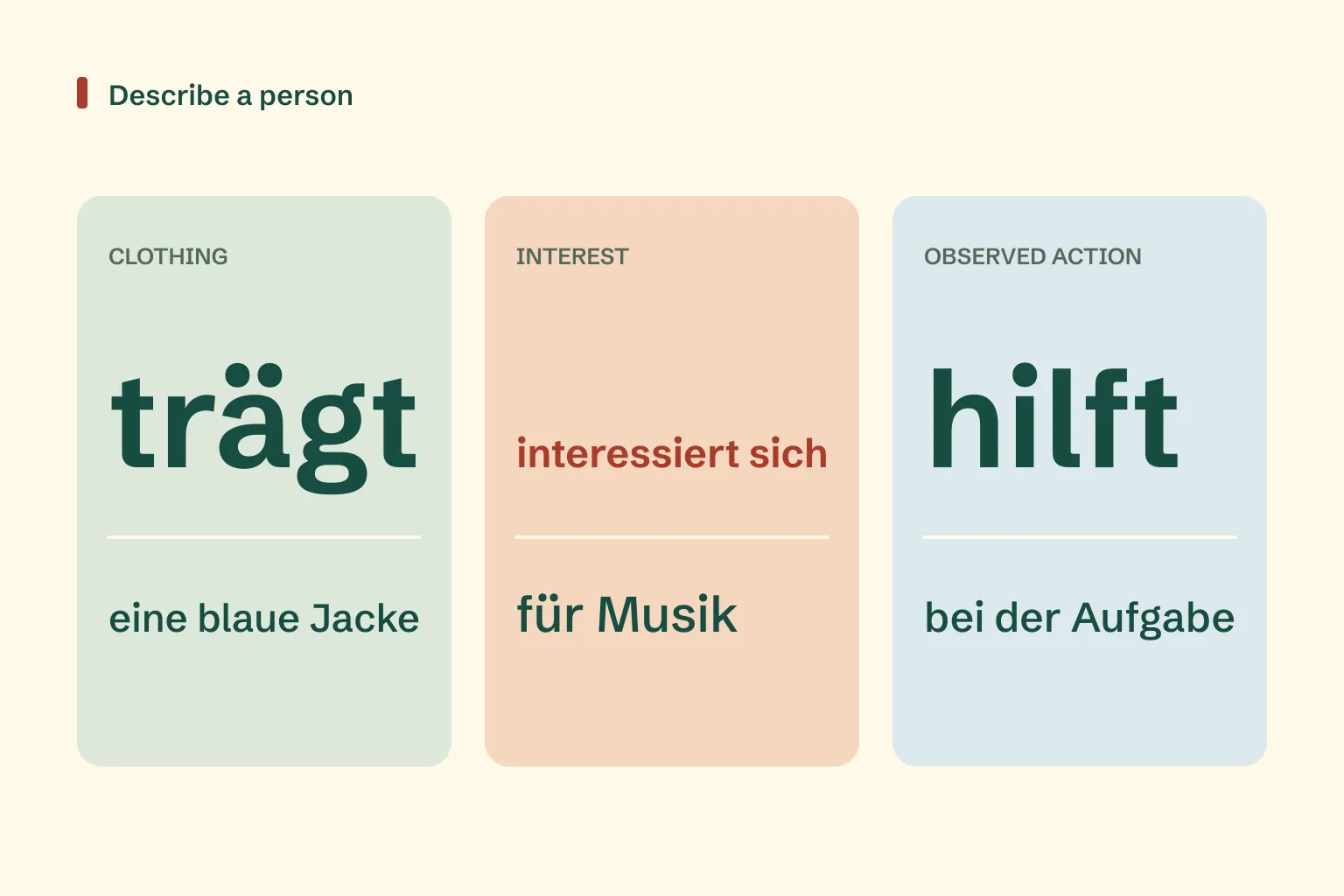
Your classmate needs to find your study partner in a busy course room. Give a few observable details: Sie trägt einen grünen Pullover und sitzt am Fenster (She is wearing a green jumper and is sitting by the window). For a fuller introduction, add interests and a concrete example of behaviour. Appearance alone does not tell you a person’s character or background.
Takeaway: Separate what someone looks like, what they are wearing and how they behave. Choose respectful details relevant to your description.
Useful patterns, not labels to guess from
| Purpose | German example | English meaning |
|---|---|---|
| hair | Er hat kurze braune Haare. | He has short brown hair. |
| glasses | Sie trägt eine Brille. | She wears glasses. |
| clothing now | Er trägt heute eine blaue Jacke. | He is wearing a blue jacket today. |
| height comparison | Sie ist ungefähr so groß wie ich. | She is about as tall as I am. |
| interest | Er interessiert sich für Musik. | He is interested in music. |
| behaviour | Sie erklärt neue Wörter geduldig. | She explains new words patiently. |
| a limited impression | Er wirkt heute müde. | He seems tired today. |
| a helpful action | Sie hat mir bei der Aufgabe geholfen. | She helped me with the task. |
Tragen can describe clothing, glasses or carrying something, depending on the object and context. Aussehen concerns appearance: Er sieht müde aus. Wirken marks an impression. Neither sentence establishes a diagnosis or a permanent character trait.
An original person description
Meine Lernpartnerin heißt Lara. Sie ist ungefähr so groß wie ich und hat kurze braune Haare. Im Kurs trägt sie oft eine Brille. Heute trägt sie einen grünen Pullover und eine schwarze Hose. Lara interessiert sich für Musik und fährt gern Fahrrad. Sie ist geduldig: Wenn ich ein Wort nicht verstehe, gibt sie mir ein anderes Beispiel. Manchmal spricht sie am Anfang einer Gruppenarbeit wenig. Später stellt sie gute Fragen. Wir lernen gern zusammen, weil wir beide klare Notizen mögen.
This model uses an observed action to explain geduldig. It does not treat being quiet at the start as proof that Lara is unfriendly or unable to speak. The description also distinguishes a frequent habit, oft, from today’s clothes, heute.
Keep adjective forms manageable
After sein, an adjective has no case ending: Lara ist geduldig. Before a noun it needs the ending that fits the phrase: ein grüner Pullover, einen grünen Pullover, eine schwarze Hose. In the model, tragen takes an accusative object, so masculine ein grüner Pullover becomes einen grünen Pullover.
For hair, the common plural phrase is kurze braune Haare. You can also use das Haar in some descriptions, but learn one natural pattern first rather than changing number in the middle of your sentence. The adjective-ending charts help with these noun phrases.
Choose what your listener needs
For finding someone in a room, location and clothing may be enough: Die Person am Fenster mit der grünen Jacke. For introducing a study partner, interests and how you work together are more informative. Do not infer nationality, language, beliefs or ability from appearance. If a detail is unknown and relevant, ask rather than invent it.
You can practise with a fictional person instead of describing a real classmate. This gives you room to use vocabulary without judging someone else’s body or personality. A useful classroom check is whether the description is clear and respectful, not whether it includes every word from the vocabulary list.
Practice
- Complete: Sie trägt ___ grünen Pullover (ein, der Pullover).
- Choose: Er ist geduldige / geduldig.
- Which detail in the model supports the description geduldig?
- Does the model say Lara always wears a green jumper?
- Correct the separable verb: Er aussieht heute müde.
- Write a two-sentence fictional description that helps someone locate a person in class.
- Add one interest and one behaviour with evidence to your description.
Explained answers and models
- einen. Tragen takes an accusative object here; masculine einen grünen Pullover needs both matching endings.
- geduldig. After sein, the adjective is predicative and has no case ending.
- She gives another example when her partner does not understand a word. This is a concrete action supporting the adjective.
- No. Heute identifies today’s clothing. Oft appears with the glasses, not the jumper.
- Er sieht heute müde aus. The finite part is sieht and the separable prefix aus closes the clause.
- Mika sitzt neben der Tür. Mika trägt heute eine blaue Jacke und eine Brille. Many details work if they distinguish the fictional person without contradicting each other.
- Mika interessiert sich für Filme. Mika ist hilfsbereit und hat mir gestern die Aufgabe erklärt. The helpful action supports the adjective. A different observed action can support another suitable description.
Sources and next practice
Duden’s aussehen conjugation supports sieht … aus; the University of Texas adjective overview explains predicative and attributive use, and its ein-word table supports einen grünen Pullover. All descriptions are original. Continue in the A2 path.