
Free resources
German weak nouns: when the noun takes an extra n
Understand German n-declension with der Student, der Kollege and der Herr. Check case endings, important limits and six original tasks with explained answers.
Read as Markdown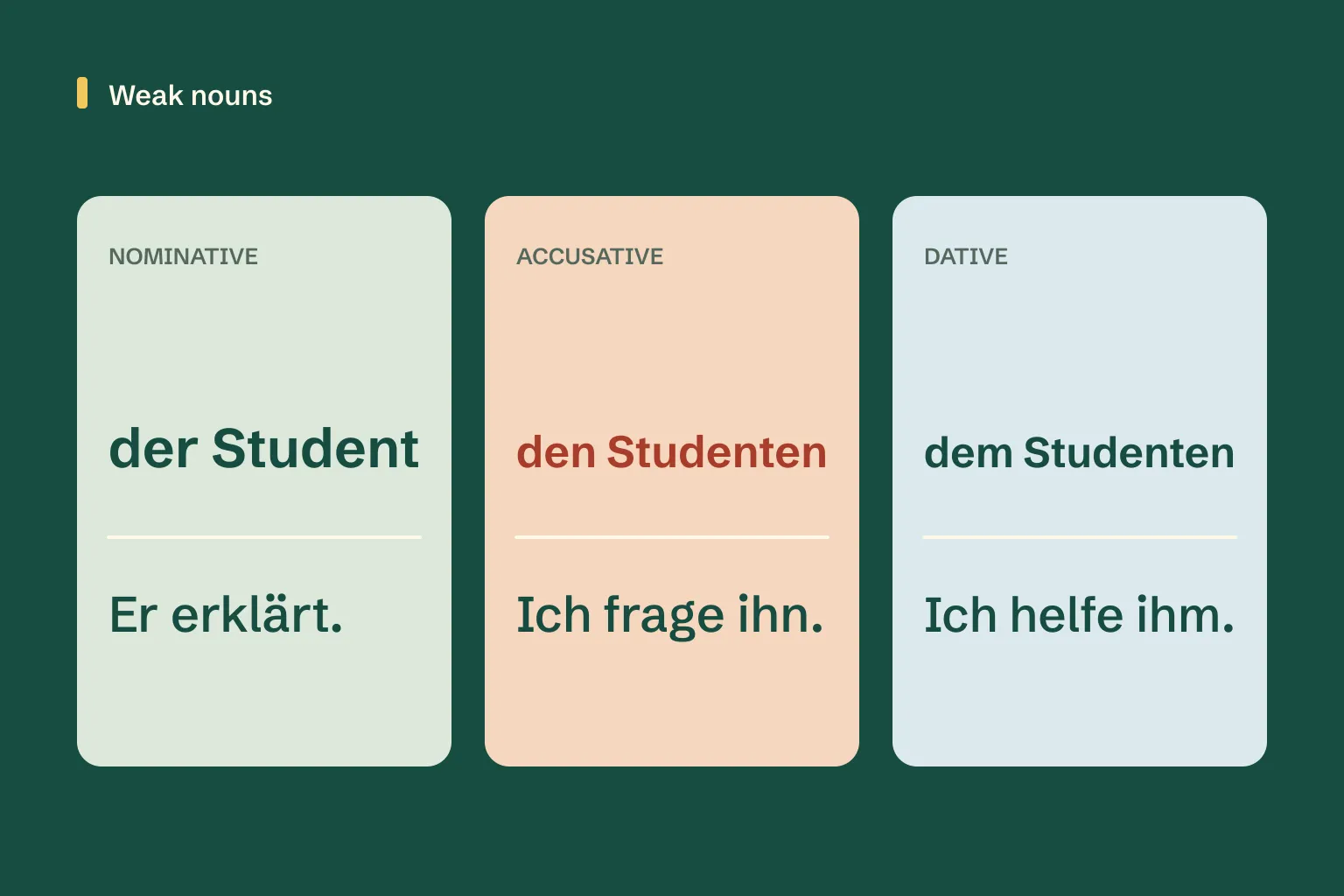
In class, you write Ich frage den Student. Your article den is correct, but the noun also needs an ending: Ich frage den Studenten. Student belongs to a group often called weak masculine nouns or n-Deklination. In the singular, they normally add -(e)n outside the nominative. Learn the noun pattern as well as the article.
Takeaway: For a typical weak masculine noun, nominative singular is the short dictionary form; accusative, dative and genitive singular take -n or -en. Do not apply this pattern to every masculine noun.
A small weak-noun chart
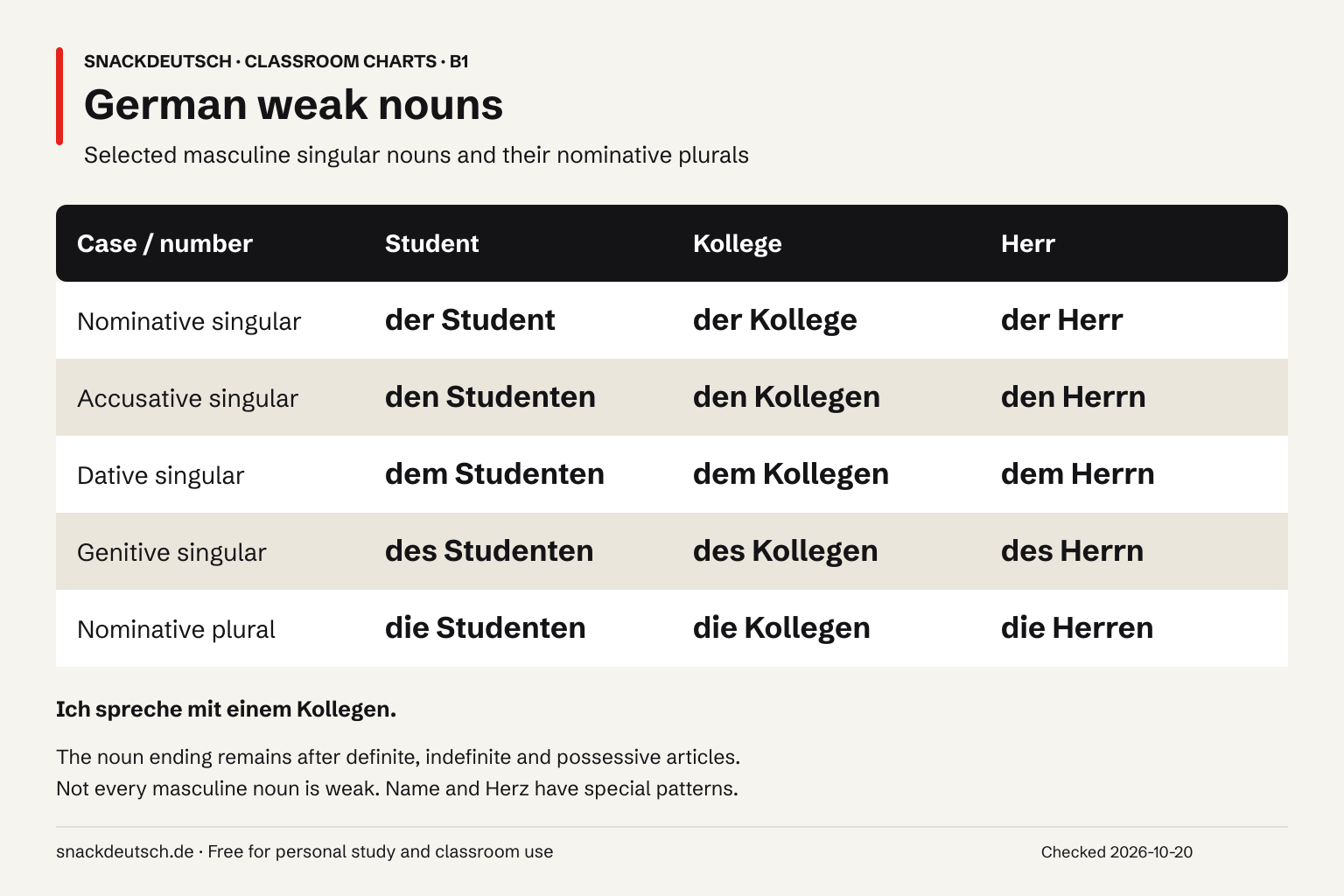
German weak nouns
Selected masculine singular nouns and their nominative plurals. Suggested level: B1.
| Case / number | Student | Kollege | Herr |
|---|---|---|---|
| Nominative singular | der Student | der Kollege | der Herr |
| Accusative singular | den Studenten | den Kollegen | den Herrn |
| Dative singular | dem Studenten | dem Kollegen | dem Herrn |
| Genitive singular | des Studenten | des Kollegen | des Herrn |
| Nominative plural | die Studenten | die Kollegen | die Herren |
Ich spreche mit einem Kollegen.
- The noun ending remains after definite, indefinite and possessive articles.
- Not every masculine noun is weak. Name and Herz have special patterns.
The article changes for case, and the noun takes its own ending. With Herr, singular Herrn and plural Herren are different. Keep that pair visible instead of inventing dem Herren for the ordinary singular title in this chart.
Read the sentence before adding the ending
Start with one person in a classroom setting:
- Der Student erklärt die Aufgabe. The student explains the task. Der Student is the nominative subject.
- Ich frage den Studenten. I ask the student. The verb fragen takes this accusative object.
- Ich helfe dem Studenten. I help the student. Helfen takes dative.
- Das ist die Frage des Studenten. That is the student’s question. The genitive phrase names whose question it is.
The noun stays masculine throughout. Studenten does not automatically mean plural. In Ich helfe dem Studenten, dem shows singular. In Ich helfe den Studenten, den and context show plural. To identify number, read the whole noun phrase.
Common groups are clues, not an automatic rule
Many masculine person nouns ending in -e follow the pattern: der Kollege, den Kollegen; der Junge, den Jungen. Several borrowed person labels ending in -ant, -ent or -ist also do: der Praktikant, den Praktikanten; der Student, den Studenten; der Journalist, den Journalisten.
But ordinary masculine nouns such as der Lehrer and der Kursleiter are not weak in this sense: Ich frage den Lehrer, not den Lehreren. Nor is every masculine -e noun a safe candidate: der Käse has genitive des Käses. Use the clues to remind you to check a dictionary, not to overrule it.
Nouns derived from adjectives, such as der Deutsche or ein Deutscher, have adjective-like declension. They can look similar in some forms, but they need their own pattern. This lesson does not combine them into one list of identical endings.
Keep mixed patterns separate
Der Name has den Namen, dem Namen, but des Namens. The extra -s in the genitive means it does not fit the simple Student column exactly. Likewise das Herz is neuter and has special forms, such as dem Herzen and des Herzens.
Recognizing these exceptions is useful, but start with a reliable small set before collecting every irregularity. Your main goal is to stop dropping -en from a noun such as Student after an accusative or dative article. Do not add an extra -s to produce des Studentens.
Make the correction useful in your notebook
Instead of saving only der Kollege = colleague, record:
der Kollege, die Kollegen; ich frage den Kollegen; ich spreche mit dem Kollegen.
The two examples practise different case triggers. Then change the article: Ich spreche mit einem Kollegen. The noun still has -n. A common mistake is to learn the pattern only with dem and lose it after einem or meinem.
For a class task, invent a fictional partner and write three short descriptions: who they are, whom you ask and whom you thank. Use Student or Kollege, and check both article and noun. No real classmate’s personal details are needed.
Six tasks
- Complete with Student or Studenten: Der ___ wartet vor dem Raum.
- Use der Kollege: Ich frage den ___ nach dem Termin.
- Use ein Journalist: Lea spricht mit einem ___.
- Correct the noun form: Das ist die E-Mail des Studentens.
- Choose Herrn or Herren: Ich spreche mit ___ Becker. Then name the plural of der Herr.
- Which nouns need a weak ending here? Ich sehe den Lehrer und den Praktikant. Write the corrected sentence and explain the difference.
Answers and reasons
- Der Student wartet vor dem Raum. It is the nominative singular subject, so the short form remains.
- Den Kollegen. Fragen has an accusative object; weak Kollege takes -n outside nominative singular.
- Einem Journalisten. Mit requires dative; Journalist adds -en, even after an indefinite article.
- … des Studenten. A typical weak noun uses -en in genitive singular, without another -s.
- Mit Herrn Becker; plural die Herren. Singular Herrn and plural Herren are different forms.
- Ich sehe den Lehrer und den Praktikanten. Lehrer is not weak; Praktikant is. Both objects are accusative, but the nouns follow different declension patterns.
Sources and next practice
Checked on 19 October 2026: University of Texas, weak nouns, and Duden entries for Student, Kollege, Herr and Käse. Original examples; B1 is an editorial teaching estimate.
Revisit the accusative and dative guide if the article choice is uncertain. Continue in the B1 learning path with three noun phrases from your own permitted class notes.