
Free resources
Obwohl and trotzdem: connect a contrast in German
Use obwohl and trotzdem for an unexpected contrast. Compare clause order, avoid a common verb-position mistake and practise with explained B1 answers.
Read as Markdown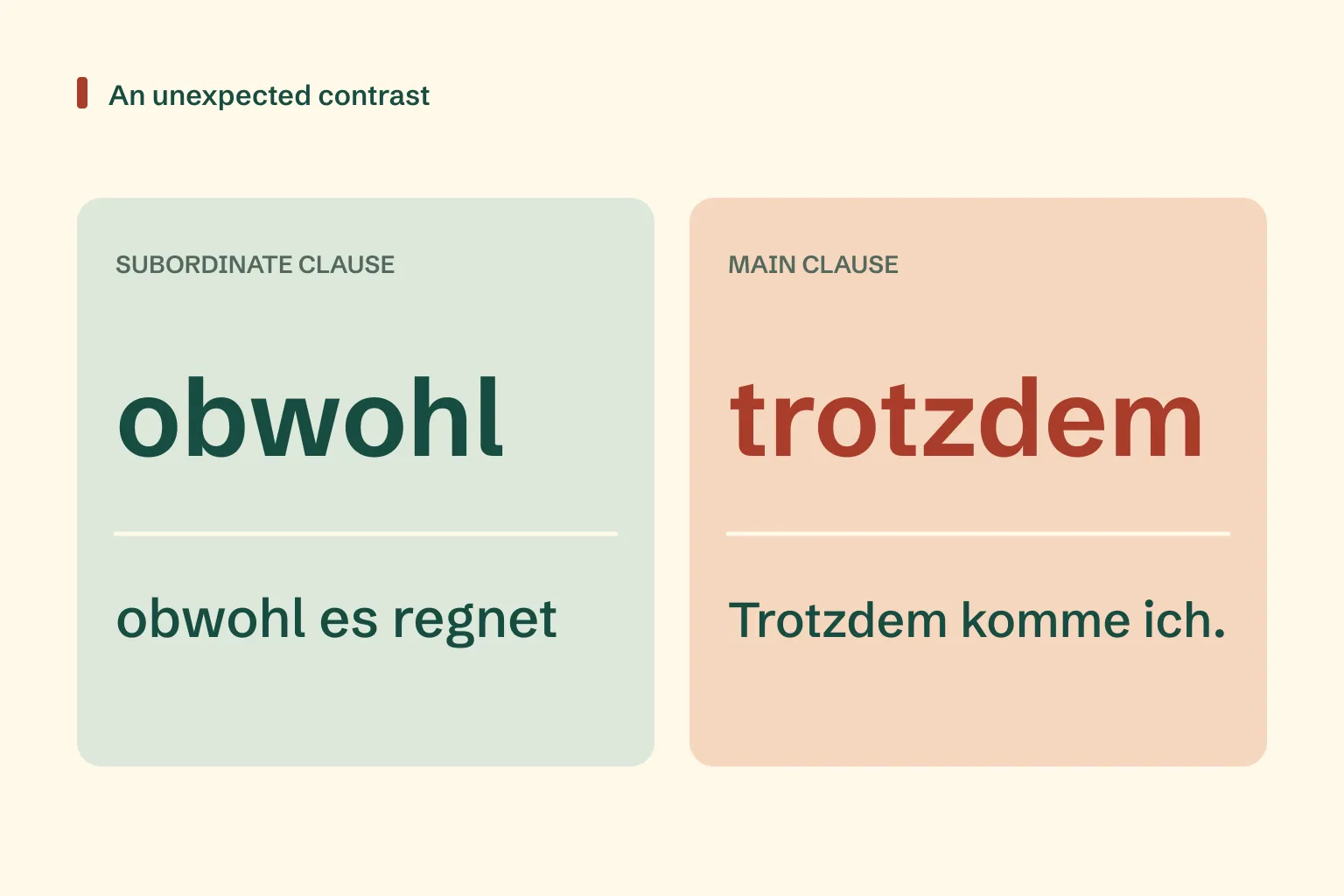
A classmate is tired, but she still attends the lesson. You can say Sie kommt zum Kurs, obwohl sie müde ist, or Sie ist müde. Trotzdem kommt sie zum Kurs. Both highlight a result that may be surprising. The important difference for your writing is the clause pattern, not an English translation of “although” or “nevertheless” alone.
Takeaway: In the standard written pattern taught here, obwohl introduces a subordinate clause with the finite verb at the end. Trotzdem can occupy the first position of a main clause, followed immediately by its finite verb.
Start with the expectation
For a contrast to make sense, the reader needs an expectation. If somebody is tired, we may expect them to stay home. Attending anyway goes against that expectation:
Sara ist müde. Trotzdem kommt sie zum Kurs. Sara is tired. Nevertheless, she comes to class.
Compare a result that follows naturally: Sara ist müde. Deshalb geht sie früh nach Hause. Here deshalb means “for that reason.” Substituting trotzdem changes the relationship. Neither connector is a decoration that can be added without thinking about the facts.
Compare the three useful frames
| Focus | Original sentence | What to check |
|---|---|---|
| Main action first | Wir üben draußen, obwohl es kühl ist. | Ist ends the obwohl clause. |
| Difficulty first | Obwohl es kühl ist, üben wir draußen. | After the whole first clause, üben comes before wir. |
| Two main clauses | Es ist kühl. Trotzdem üben wir draußen. | Trotzdem fills the first position of its main clause. |
All three say that the cool weather does not stop the practice. The first makes wir üben draußen the starting message. The second foregrounds the difficulty. The third creates a stronger sentence break.
In the second example, do not write Obwohl es kühl ist, wir üben draußen. The complete subordinate clause occupies the first position, so üben comes next. “Verb second” means second sentence element, not second written word.
Keep the surprising action after trotzdem
Take these facts: Die Übung ist schwer. Ich mache weiter. The action that happens despite the difficulty is ich mache weiter. Therefore:
Die Übung ist schwer. Trotzdem mache ich weiter.
If you write Ich mache weiter. Trotzdem ist die Übung schwer, you claim that the difficulty persists despite your continuing. That can make sense in another context, but it reverses what you emphasize. When editing, draw an arrow from the obstacle to the unexpected continuation before choosing your order.
A longer example is Ich habe den Text schon zweimal gelesen. Trotzdem verstehe ich die letzte Frage noch nicht. We might expect two readings to bring understanding. The second sentence says that expectation has not been fulfilled.
Trotzdem does not always stand first
Ich komme trotzdem zum Kurs is also a normal main clause. Ich fills position one; komme is second; trotzdem appears later. This guide uses Trotzdem komme ich … as an easy comparison with Obwohl …. Do not turn the practice frame into a rule that the adverb must always begin its clause.
You may also hear trotzdem used like a subordinator in regional or colloquial speech. For the standard written exercise here, keep obwohl + verb-final clause and trotzdem + main-clause word order separate. This gives you a consistent pattern for a classroom email or short opinion text.
Edit a specific class message
A learner writes: Ich habe am Freitag wenig Zeit. Ich möchte bei der Probe helfen. Ich kann erst um sieben kommen. A connected revision is:
Obwohl ich am Freitag wenig Zeit habe, möchte ich bei der Probe helfen. Ich kann erst um sieben kommen. Trotzdem kann ich noch die Einleitung üben.
The first contrast is between limited time and willingness to help. The second is between late arrival and a useful remaining action. The middle sentence stays simple because a connector would not improve every line. In your own notes, keep one obstacle and one achievable action: wenig Zeit haben / die Einleitung üben.
Six practice tasks
- Join with obwohl, main action first: Ben kommt zu Fuß. Es regnet.
- Start the same message with Obwohl.
- Complete with deshalb or trotzdem: Der Raum ist sehr laut. ___ können wir einander gut hören, if hearing each other is surprising.
- Correct: Ich bin nervös. Trotzdem ich halte die Präsentation.
- Rewrite with trotzdem later in the clause: Trotzdem mache ich bei der Übung mit. Start with Ich.
- Write two versions of this situation: Lea has little time, but she helps with your text. Use obwohl once and trotzdem once.
Answers and reasons
- Ben kommt zu Fuß, obwohl es regnet. Regnet is the finite verb at the end of the subordinate clause.
- Obwohl es regnet, kommt Ben zu Fuß. Kommt follows the whole opening clause; Ben comes after it.
- Trotzdem können wir einander gut hören. The noise would normally make hearing difficult. Können follows the connector; hören closes the modal frame.
- Trotzdem halte ich die Präsentation. Halte is second, after trotzdem. Nervousness does not prevent the action.
- Ich mache trotzdem bei der Übung mit. Mache remains second; separable mit stays at the end.
- Models: Lea hilft mir mit dem Text, obwohl sie wenig Zeit hat. Lea hat wenig Zeit. Trotzdem hilft sie mir mit dem Text. Different useful wording is acceptable if Lea remains the helper and the contrast is preserved.
Sources and next practice
Checked on 19 October 2026: IDS grammis, concessive clauses, IDS, connective particles, and University of Texas, subordinate conjunctions. The level label B1 is an editorial estimate, and all examples are original.
Return to the B1 learning path. For a related comparison, revisit weil and denn and decide whether a sentence expresses a reason or a contrast.