
Classroom companion
German small talk at work: an A2 conversation lesson
Start and end a brief German workplace conversation with A2 phrases, relevant follow-up questions and a complete original dialogue with explained answers.
Read as Markdown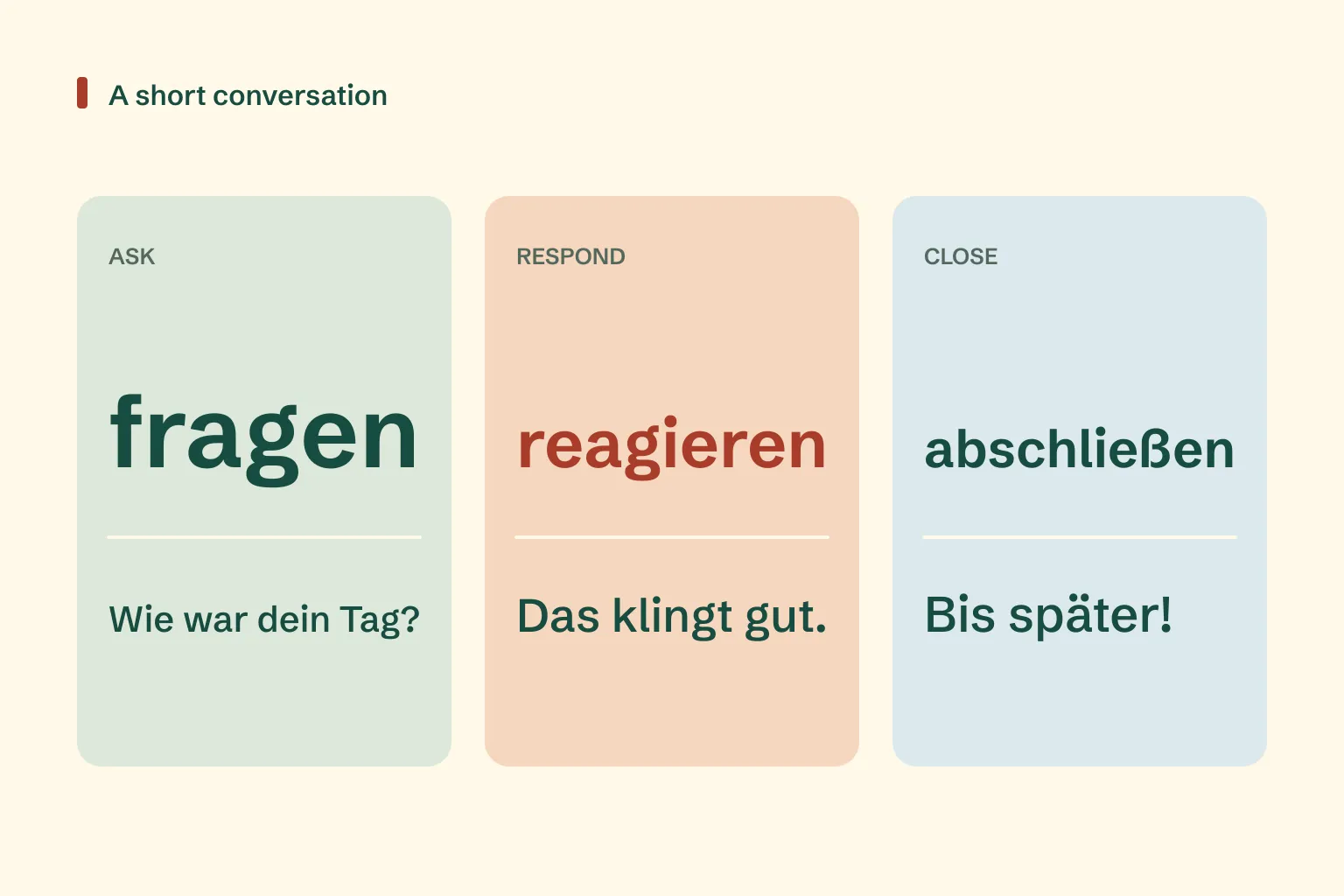
A colleague is making tea before work. Guten Morgen. Wie war dein Wochenende? can open a short conversation if you already use du with each other. Listen to the answer and ask one relevant follow-up. Small talk works as an exchange, not a test in which you deliver every prepared sentence regardless of the other person’s response.
Takeaway: Open simply, react to one detail and close clearly when either person needs to work. The aim is a manageable exchange, not access to someone’s private life.
Four moves for a short conversation
| Move | Original phrase | English meaning |
|---|---|---|
| Open | Guten Morgen. Wie geht’s? | Good morning. How are things? |
| Follow a detail | Was hast du gekocht? | What did you cook? |
| React | Das klingt gut. | That sounds good. |
| Close | Ich muss jetzt weiterarbeiten. Bis später! | I need to get back to work. See you later! |
A reply such as Ganz gut, danke. Und dir? (Quite well, thanks. And you?) returns the question. If someone gives a brief answer and looks busy, you can leave it there. Do not assume they are rude or that your German caused a problem.
Original dialogue: a short tea break
Nina: Guten Morgen, Amir. Wie war dein Wochenende?
Amir: Ruhig. Ich habe mit meinem Bruder gekocht. Und deins?
Nina: Auch schön. Ich bin am Sonntag spazieren gegangen. Was habt ihr gekocht?
Amir: Eine Suppe mit viel Gemüse. Mein Bruder kocht gern, ich schneide lieber das Gemüse.
Nina: Das klingt gut. Kocht ihr oft zusammen?
Amir: Nicht jede Woche, aber manchmal am Samstag. Möchtest du auch einen Tee?
Nina: Ja, gern. Danke. Ich muss gleich zu einer Besprechung.
Amir: Dann bis später. Viel Erfolg!
Nina: Danke, bis später!
Nina first answers Amir’s return question, then asks about his cooking. She does not jump to a new topic without acknowledging him. When she mentions a meeting, Amir closes the exchange rather than introducing another long story.
Match the address you actually use
With someone addressed formally, say Wie war Ihr Wochenende? or Und Ihnen? rather than dein/dir. A formal closing might be Ich muss jetzt weiterarbeiten. Wir sprechen später weiter. There is no universal rule that every German workplace uses one address. Follow the relationship and the local agreement.
The personal-pronoun guide helps distinguish formal Sie/Ihnen and informal du/dir. If you are unsure how to address a person, ask or follow the way they introduce themselves instead of deciding from appearance.
Prepare a boundary as well as an opening
You can give a neutral short answer: Ich war zu Hause und habe mich ausgeruht (I stayed at home and rested). You do not have to share family, health or financial details to practise German. If a question feels too personal, Darüber möchte ich gerade nicht sprechen means “I do not want to talk about that right now.” Then choose a neutral topic if you want to continue.
For language practice, a fictional weekend is enough. Your partner should respond to the invented detail, not investigate whether it is true. This keeps the exercise focused on communication rather than personal disclosure.
A partner session with a purpose
Prepare two opening questions and two closings. Speak for ninety seconds. The listener must reuse one detail from the first answer in a follow-up. Then replay the conversation with one person saying Ich muss gleich los (I need to leave in a moment). Practise shortening the exchange without an abrupt silence.
Practice
- Which detail does Nina follow up in Amir’s answer?
- What signals that the conversation should finish soon?
- Change to formal address: Wie war dein Wochenende? Und dir?
- Your colleague says Ich habe einen Film gesehen. Ask a relevant follow-up.
- Write a friendly closing when you need to return to work.
- Give a short weekend answer without sharing private information.
- Is Das klingt gut an agreement to participate in an activity? Explain in this dialogue.
Explained answers and models
- Cooking with his brother. She asks what they cooked and later whether they often cook together.
- Nina says she has a meeting soon. Amir responds with a brief closing instead of extending the topic.
- Wie war Ihr Wochenende? Und Ihnen? The formal possessive and pronoun are capitalized.
- Welchen Film hast du gesehen? Hat dir der Film gefallen? also develops the same detail.
- Danke für den Tee. Ich muss jetzt weiterarbeiten. Bis später! A shorter Bis später! works when the context already makes the reason clear.
- Es war ruhig. Ich war zu Hause und habe gelesen. Other neutral activities work, including an explicitly fictional answer during practice.
- No. Nina reacts positively to the description of the soup. She is not promising to cook or attend a future event.
Sources and further practice
The Goethe-Institut A2 materials provide separate official everyday speaking tasks; this conversation and teaching routine are original. The University of Texas Perfekt references support the selected past-event forms. Continue in the A2 path.