
Classroom companion
Express likes and preferences in German: A2 practice
Express German likes and preferences with mögen, gern, lieber and am liebsten, then practise choosing a class activity with explained answers.
Read as Markdown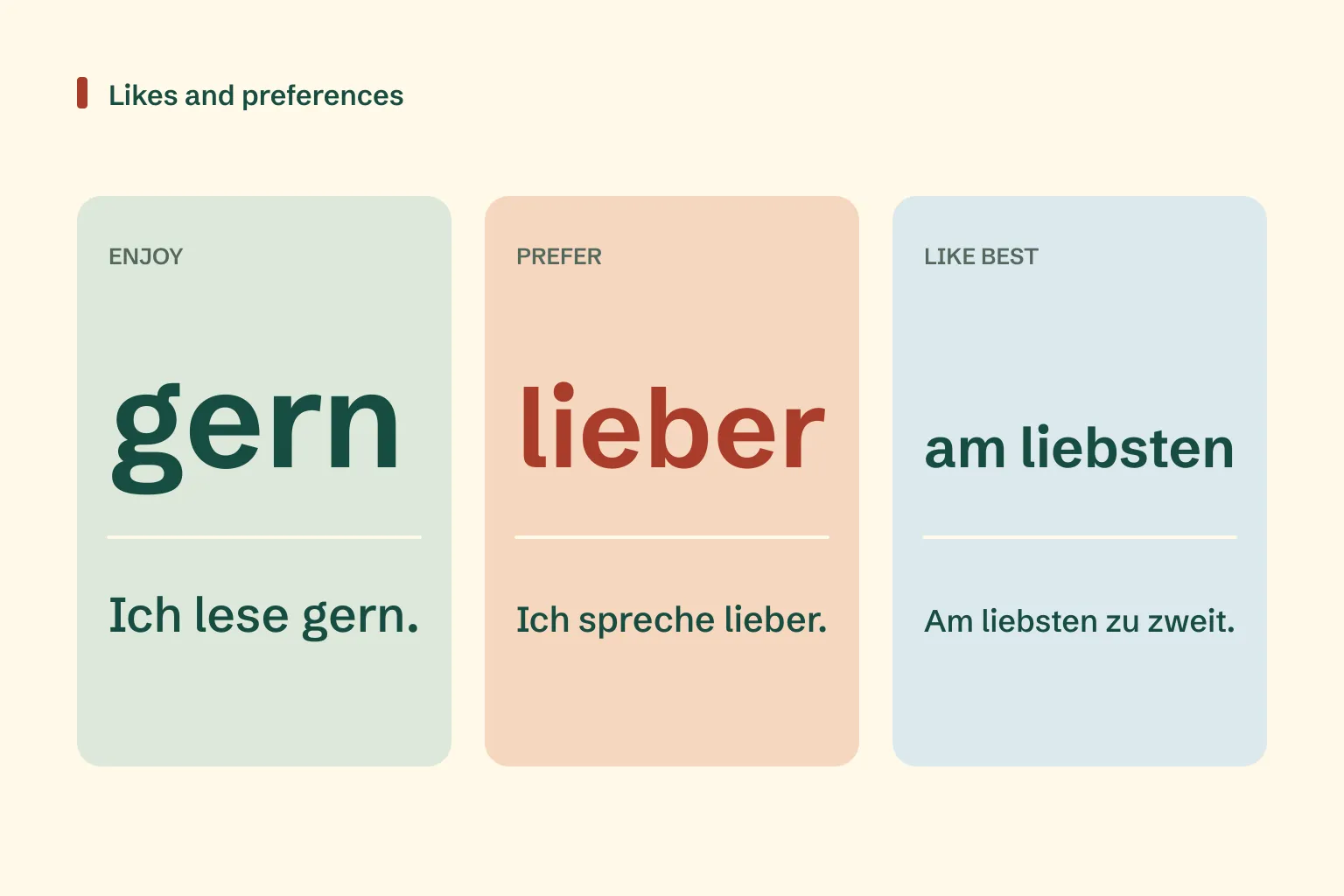
Your group must choose between reading a story and practising a dialogue. Ich lese gern Geschichten, aber heute möchte ich lieber einen Dialog üben means “I like reading stories, but today I would rather practise a dialogue.” German separates liking an object, enjoying an activity and preferring one option. Learn the sentence frames so you can state a choice and respond to someone else’s.
Takeaway: Use mögen + noun for a useful basic liking pattern, gern + activity, and lieber when you prefer an alternative. A preference is not a fact that everyone must share.
Four useful frames
| Frame | Original example | English meaning |
|---|---|---|
| mögen + noun | Ich mag kurze Geschichten. | I like short stories. |
| verb + gern | Ich lese gern. | I like reading. |
| verb + lieber | Ich höre lieber Dialoge. | I prefer listening to dialogues. |
| verb + am liebsten | Am liebsten spreche ich mit einer Partnerin. | I like speaking with a partner best. |
Gern and gerne are both used; this lesson uses gern consistently. The comparison family is gern, lieber, am liebsten. Do not build gerner for this standard preference pattern. Mögen has present forms such as ich mag, du magst, wir mögen; review the modal-verb reference for the full family and the separate möchte forms.
An original group decision
Elif: Möchtest du heute die Geschichte lesen oder den Dialog üben?
Jonas: Ich lese gern, aber heute möchte ich lieber sprechen. Morgen haben wir eine mündliche Aufgabe.
Elif: Für mich ist die Geschichte interessant. Dort gibt es viele Wörter aus unserem Kurs.
Jonas: Wir können zuerst zehn Minuten lesen und danach den Dialog üben.
Elif: Das finde ich gut. Dann benutzen wir die neuen Wörter im Gespräch.
The learners give different reasons without declaring the other person’s choice wrong. Their final plan uses both activities. A compromise is one possible outcome, not something you must invent in every conversation.
Give one reason without overloading the sentence
Start simply: Ich übe lieber am Nachmittag. Dann bin ich nicht so müde (I prefer practising in the afternoon. Then I am not so tired). You can connect the reason with weil when you know its word order: Ich übe lieber am Nachmittag, weil ich dann nicht so müde bin.
Do not copy English word order into weil ich bin …. Either keep two correct main clauses or put the finite verb at the end of the weil clause. The weil/denn guide covers that choice in more detail.
Distinguish a general liking from today’s request
Ich mag Tee describes liking tea. Ich möchte einen Tee expresses wanting a tea now or in a relevant situation. Ich trinke lieber Tee als Kaffee compares the drinks. The noun and the setting may be the same, but the speaker’s action differs.
Similarly, Ich lerne am liebsten allein describes a preference. It does not establish that studying alone is best for every learner. In group work, add a practical request: Können wir zuerst fünf Minuten allein lesen? (Can we first read alone for five minutes?). This turns your preference into something the group can consider.
Make a preference map
Choose three class activities: reading, writing and speaking. For each, write a liking sentence and one condition that changes your preference. For example, you may enjoy speaking with a partner but prefer reading alone first when a text is unfamiliar. This gives you more precise language than ranking every activity once for all situations.
Practice
- Complete: Ich ___ kurze Texte (mögen, ich).
- Correct: Ich gern lese am Abend.
- Complete the preference family: gern, ___, am ___.
- Which activity does Jonas prefer today, and why?
- Translate: “I like tea, but today I would like coffee.”
- Give a preference for practising German and one reason in two clear sentences.
- Your partner prefers reading first; you want speaking practice. Propose a plan that includes both.
Explained answers and models
- mag. Mögen changes its stem in the singular: ich mag.
- Ich lese gern am Abend. The finite verb belongs second. Am Abend lese ich gern also works with the time phrase first.
- lieber, liebsten. The complete pattern is gern, lieber, am liebsten.
- Speaking, because the next day they have an oral task. The reason is specific to today’s choice, not a general dislike of reading.
- Ich mag Tee, aber heute möchte ich Kaffee. Mag gives a general liking; möchte states the present wish.
- Ich lerne lieber am Morgen. Dann ist es bei mir ruhig. Other preferences are valid when the reason fits the choice.
- Können wir zuerst zehn Minuten lesen und danach zusammen sprechen? The durations may differ; the key is an explicit sequence giving both activities a place.
Source and next practice
The University of Texas comparative reference supports gern, lieber, am liebsten. The dialogue and decision task are original. Continue in the A2 learning path with one preference you can discuss in your next class.
The University of Texas modal-verb reference supports the contrast between present mögen forms and the useful möchte request forms.