
Classroom companion
German for a doctor appointment: an A2 language role-play
Practise booking and checking a doctor appointment in German, spelling your name and asking for repetition, with a fictional A2 role-play and answer key.
Read as Markdown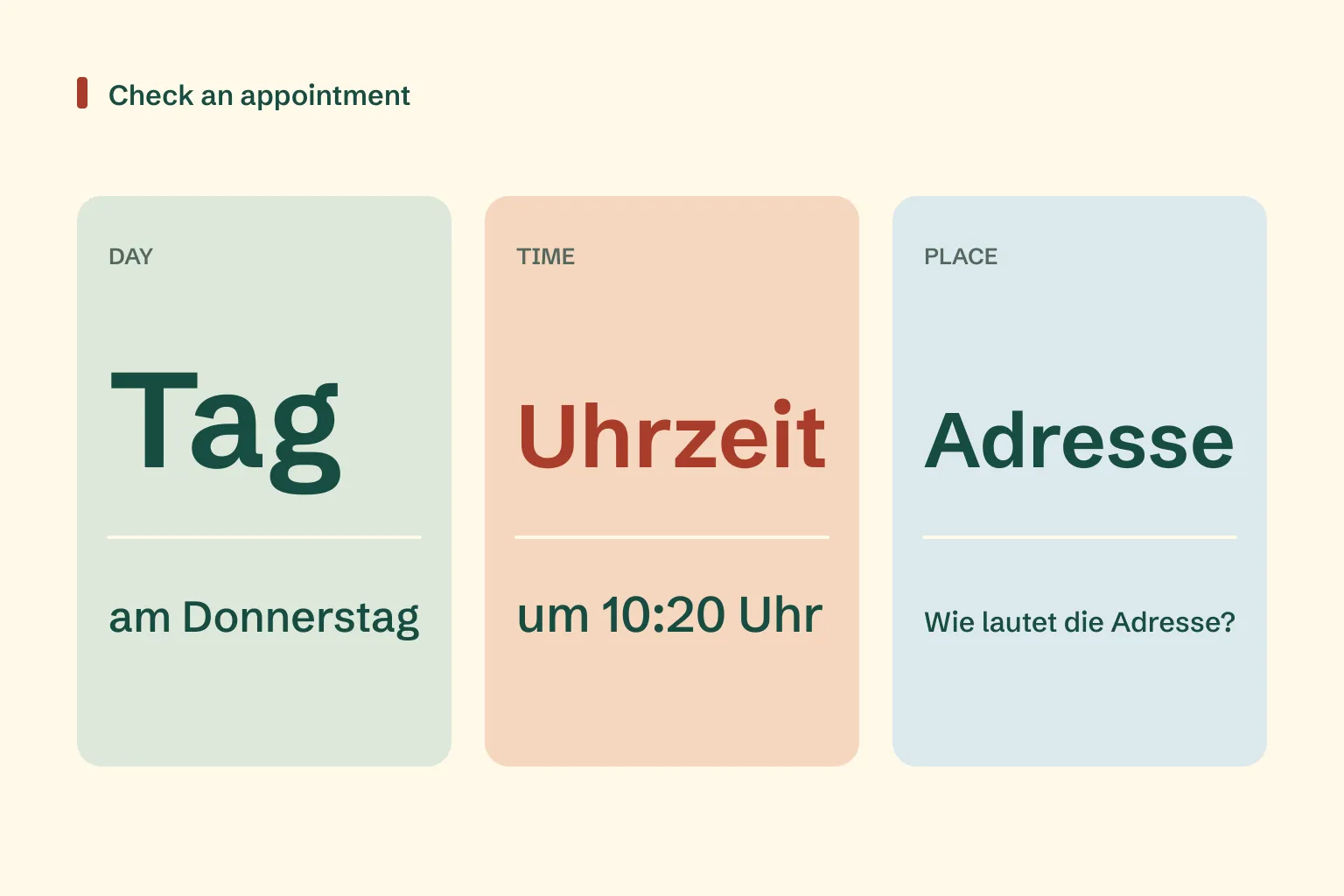
You call a practice and need to understand the appointment details. Start with Guten Tag, ich möchte einen Termin vereinbaren (Hello, I would like to arrange an appointment). Then give your name and check the day, time and place. This lesson practises the language of that exchange. Its fictional dialogue does not assess symptoms or decide when someone needs medical care.
Takeaway: Confirm day + time + place aloud. When you have not understood, ask for repetition instead of agreeing to a detail you are unsure about.
Useful phrases for the call
| German | English meaning |
|---|---|
| Ich möchte einen Termin vereinbaren. | I would like to arrange an appointment. |
| Ich war noch nicht bei Ihnen. | I have not been to your practice before. |
| Mein Name ist … | My name is … |
| Könnten Sie bitte langsamer sprechen? | Could you speak more slowly, please? |
| Könnten Sie das bitte wiederholen? | Could you repeat that, please? |
| Wie lautet die Adresse? | What is the address? |
| Muss ich etwas mitbringen? | Do I need to bring anything? |
| Ich habe Sie leider nicht verstanden. | Unfortunately I did not understand you. |
The question about bringing something leaves the actual requirement to the practice. Do not assume that every practice has the same registration, insurance or document process. This exercise intentionally avoids teaching an administrative rule as if it were universal.
Original role-play: checking the details
All names, addresses and appointment times below are invented for practice.
Praxis: Guten Tag, Praxis Berger, mein Name ist Stein.
Mina: Guten Tag, mein Name ist Mina Lopes. Ich möchte einen Termin vereinbaren.
Praxis: Waren Sie schon einmal bei uns?
Mina: Nein, ich war noch nicht bei Ihnen.
Praxis: Einen Moment bitte. Wir können Ihnen am Donnerstag um 10:20 Uhr einen Termin anbieten.
Mina: Entschuldigung, könnten Sie die Uhrzeit bitte wiederholen?
Praxis: Um zehn Uhr zwanzig.
Mina: Also am Donnerstag um 10:20 Uhr. Habe ich das richtig verstanden?
Praxis: Ja. Wie schreibt man Ihren Nachnamen?
Mina: Lopes, L-O-P-E-S. Wie lautet die Adresse?
Praxis: Lernstraße 8, im ersten Stock.
Mina: Danke. Muss ich etwas mitbringen?
Praxis: Ich erkläre Ihnen kurz, was wir für den Termin brauchen.
The final line deliberately leaves the practice’s real answer open. In a classroom role-play, your partner can ask you to note an information sheet or call-back detail. Do not invent a clinical instruction or a real practice policy.
Repair the conversation
A telephone line can be unclear. Use a specific repair request: War das zehn Uhr zwanzig oder zehn Uhr dreißig? (Was that 10:20 or 10:30?). This gives the listener two concrete options. If you are unsure of the day as well, check it separately instead of putting several uncertainties into one rushed question.
Write digits while listening, then read them back. The spoken form zehn Uhr zwanzig corresponds to 10:20. Avoid relying on informal regional expressions for a time if they are unfamiliar to you. Asking for an explicit clock time is a useful communication strategy.
When you arrive
You can say Guten Tag, ich habe einen Termin um 10:20 Uhr. Mein Name ist Mina Lopes. If someone asks a question you do not understand, use Könnten Sie das bitte einfacher sagen? (Could you say that more simply, please?). You do not need to pretend you understood.
The personal-pronoun guide explains formal Sie/Ihnen. The language here uses formal address because the speakers have not agreed to use du.
Practice
- What appointment does Mina confirm?
- Why does she ask for the time again?
- Ask in German for the address.
- You heard either 14:10 or 14:30. Write a specific checking question.
- Replace “I want a date” with an appropriate German opening for arranging an appointment.
- Write a two-sentence arrival statement for the fictional appointment.
- Does this dialogue establish what documents every German practice requires?
Explained answers and alternatives
- Am Donnerstag um 10:20 Uhr. Both day and time are explicitly repeated and confirmed.
- She wants to check a detail she did not understand clearly. The text gives no medical reason for asking.
- Wie lautet die Adresse? Könnten Sie mir bitte die Adresse sagen? is another clear version.
- War das vierzehn Uhr zehn oder vierzehn Uhr dreißig? Naming the alternatives makes the uncertainty specific.
- Guten Tag, ich möchte einen Termin vereinbaren. Termin is the appointment; Datum is a calendar date.
- Guten Tag, ich habe einen Termin um 10:20 Uhr. Mein Name ist Mina Lopes. A different fictional name is valid if the booking details stay consistent.
- No. Mina asks what to bring; the exercise does not assert a universal process or medical requirement.
Sources and further practice
Duden’s entry for vereinbaren supports the appointment phrase. The Goethe-Institut A2 practice materials provide separate official examples of everyday communication tasks; this role-play is original and is not an exam item. Use the A2 path for more language practice.